
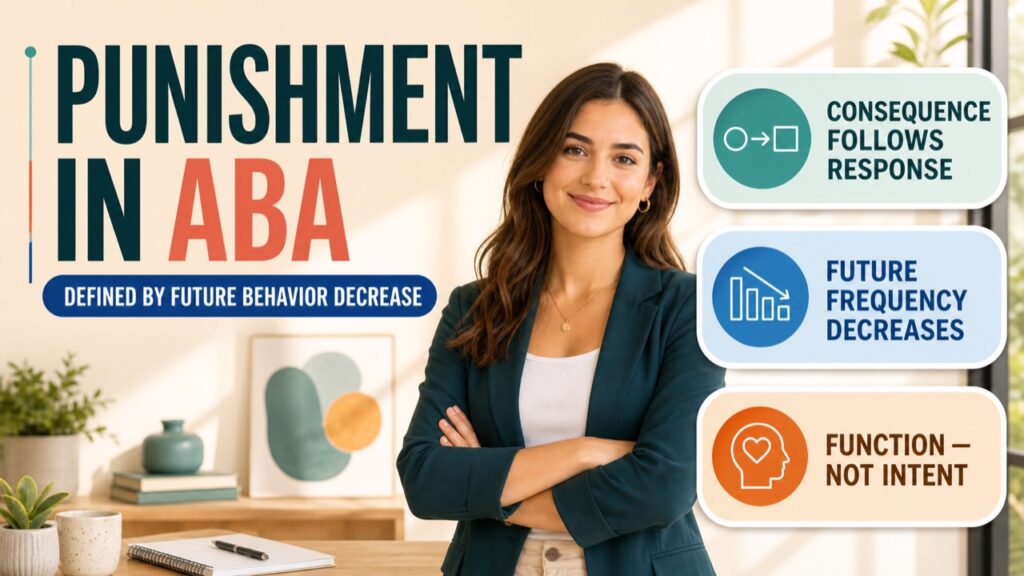
What the Definition of Punishment Requires
In behavior analysis, the search phrase punishment has occurred when the behavior it followed is completed by a functional result: the future frequency or probability of that behavior, or the relevant response class, decreases under comparable conditions. A consequence can be intended to reduce behavior, look severe, or stop behavior briefly without meeting that definition. The effect on future behavior is the deciding evidence.
Table of Contents
- What the Definition of Punishment Requires
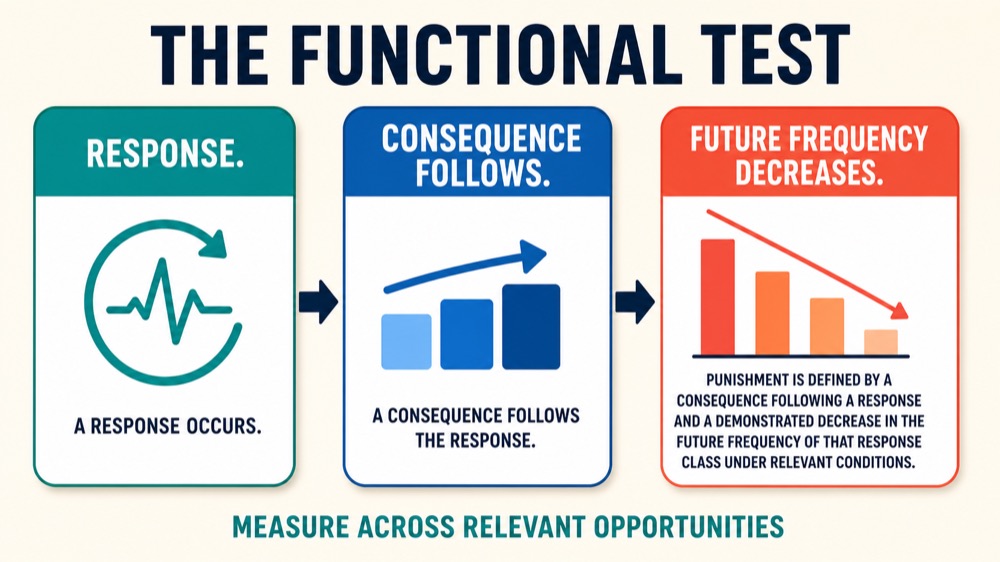
- The Functional Test
- Immediate Suppression Is Not the Definition
- Positive Punishment, Negative Punishment, and Contrasts
- Original Examples and Nonexamples
- Response Class, Context, and Generalization
- What Research Says About Possible Fallout
- Ethical Selection, Risk, and Continual Evaluation
- An Original Study Scenario
- Common Classification Errors
- Frequently Asked Questions
- Practice Complete Contingency Analysis
- References
Punishment is a contingency and process, not a moral label. A consequence follows a response, and repeated measurement shows less of that response in the future. The label “punisher” is warranted when data demonstrate that function in the specified relation. The same event can have a different effect for another person, response, setting, or time.
The current BCBA Test Content Outline (6th ed.) requires candidates to distinguish responses and response classes, positive and negative punishment contingencies, types of punishers, extinction, and the possible emotional and elicited effects of procedures. Those tasks call for complete contingency analysis, not identification by appearance alone.
The Functional Test
A precise classification includes the response, the stimulus change that follows it, the future measure, and the conditions under which comparison occurs. “The behavior decreased” is not enough if the behavior was never operationally defined or if opportunities, effort, instructions, motivating operations, or consequence delivery changed at the same time.
- Response: Define the measurable behavior or response class before interpreting change.
- Consequence: Identify what was presented, removed, or changed contingent on the response.
- Temporal relation: Confirm that the consequence followed the response in the arrangement being evaluated.
- Future effect: Compare repeated opportunities and determine whether the relevant behavior became less likely.
- Context: State where, when, and under which stimulus and motivational conditions the effect was demonstrated.
Suppose a game records premature moves during repeated rounds. Each premature move is followed by the loss of one game point, and premature moves decrease from a mean of six to two per round while the number and difficulty of opportunities stay stable. That result is consistent with punishment in that arrangement. One lost point followed by a pause would not establish the future effect.
Immediate Suppression Is Not the Definition
A sudden sound, interruption, instruction, or other event can produce an immediate change for several reasons. It may elicit a response, interrupt an ongoing response, shift attention, signal a different contingency, or alter the opportunity to respond. Unless later responding decreases under relevant conditions, immediate suppression does not demonstrate punishment.
This distinction also protects against circular reasoning. Calling an event a punisher because it looked unpleasant, and then explaining the pause by saying punishment occurred, adds no independent evidence. The analytic question is whether behavior changed over subsequent opportunities and whether the design supports the consequence relation rather than another variable.
Positive Punishment, Negative Punishment, and Contrasts
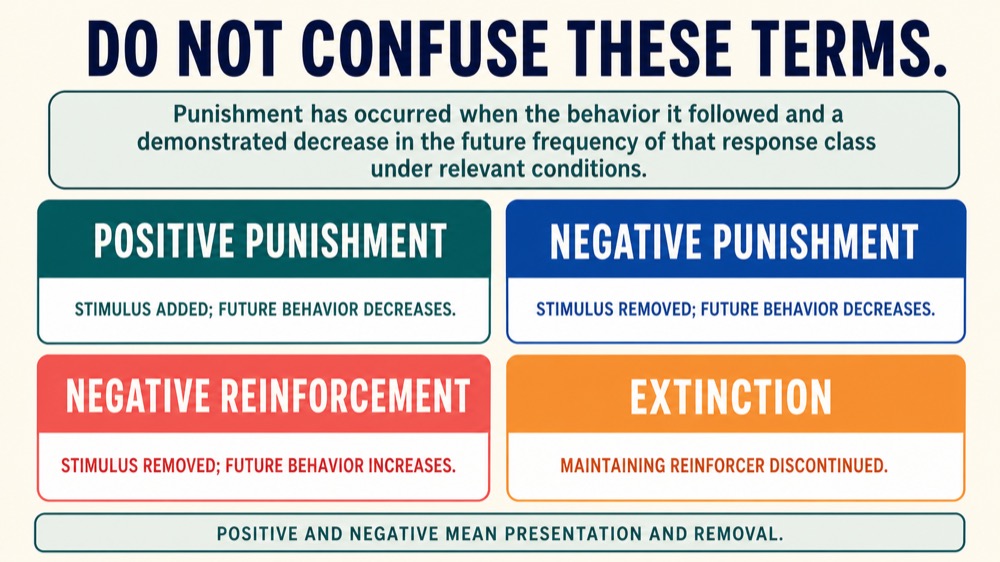
Positive and negative describe the direction of the stimulus change, not whether an action is good, bad, preferred, or ethical. Each punishment contingency still requires a future decrease. Negative reinforcement and extinction can also involve removal or nondelivery, so both the contingency and the behavioral effect must be identified.
- Positive punishment: A stimulus is presented after a response, and the future frequency of that response decreases.
- Negative punishment: A stimulus is removed after a response, and the future frequency of that response decreases.
- Negative reinforcement: A response removes, reduces, postpones, or prevents a stimulus, and the future frequency of that response increases.
- Extinction: A response no longer produces the reinforcer that previously maintained it; the reinforcement contingency is discontinued and responding may decrease across time.
Removal alone therefore does not identify negative punishment. If fastening a seat belt terminates an alarm and seat-belt fastening increases, the relation is negative reinforcement. If a game point is removed following an early move and early moves decrease, the relation is negative punishment. If a previously effective button press no longer produces the game event, the arrangement is extinction rather than response cost.
Original Examples and Nonexamples
These hypothetical examples illustrate classification; they are not recommendations for clinical procedures or recalled BACB questions. Each conclusion is limited to the measured response, consequence, and context.
- Natural positive-punishment example: Contact with an overly hot mug is followed by pain, and unprotected contact with that mug decreases on later opportunities. The added stimulation functioned as a punisher for that response under those conditions.
- Negative-punishment example: In a voluntary computer game, an early click removes one point and early clicks decrease across comparable rounds. Point removal functioned as a punisher for early clicking.
- Intent nonexample: A correction follows calling out, but calling out increases across later lessons. Whatever the intent, the measured relation does not show punishment; attention or another variable may be relevant.
- Immediate-change nonexample: A response stops for several seconds after an unexpected sound, then returns at its prior rate. The interruption alone does not demonstrate a decrease in future frequency.
- Extinction contrast: A vending response previously produced an item, delivery is discontinued, and the response later declines. The maintaining reinforcer was withheld; no separate consequence was arranged as punishment.
Examples involving tickets, reprimands, time-out, or response cost are often classified from their names. That shortcut is unreliable. A ticket that does not reduce later speeding is not demonstrated to be a punisher for that driver, and attention during a reprimand can increase the response it was meant to reduce. Function must be measured.
Response Class, Context, and Generalization
A response class is a group of responses that share a relevant functional relation, although their forms may differ. If one topography decreases, analysts should not assume that every member of a broader class decreased. A person might stop one response while shifting to another response that produces the same outcome. Measures should match the level of the claim.
Punishment effects can also come under stimulus control. A response may decrease where the punishing consequence has occurred yet persist elsewhere. That observation does not make an SD or S-delta part of the punishment definition, and the usual reinforcement-based SD/S-delta labels should not be substituted for a complete punishment contingency. Describe the discriminative context and measured generalization directly.
What Research Says About Possible Fallout
Claims about punishment side effects require the same care as claims about effectiveness. Fontes and Shahan reviewed concerns such as temporary suppression, conditioned punishment, escape and avoidance, aggression, and countercontrol. They concluded that the concerns are reasonable, while strong evidence does not show that such problems are necessarily universal, long-lasting, or unique to punishment.
The review does not show that punishment is harmless or remove the obligation to minimize risk. It highlights gaps in the evidence and the need for better theory and research. A professional decision should therefore avoid two absolutes: side effects should not be treated as inevitable in every case, and their absence should not be assumed. Client-specific benefits, risks, preferences, rights, collateral behavior, and data remain essential.
Ethical Selection, Risk, and Continual Evaluation
The BACB Ethics Code provides more than a warning to “be cautious.” Standard 2.14 requires interventions to be conceptually consistent, evidence based, based on assessment results, and designed with positive-reinforcement procedures prioritized. It also requires attention to needs, context, resources, risks, benefits, side effects, preferences, efficiency, cost, and likely maintenance.
Standard 2.15 focuses specifically on minimizing risk. Restrictive or punishment-based procedures are recommended and implemented only after less intrusive means have not produced the desired results, or when an existing intervention team determines that the behavior’s risk outweighs the intervention risk. Required review processes must be followed, effectiveness must be continually evaluated and documented, and ineffective procedures must be modified or discontinued promptly.
Standards 2.17 and 2.18 add data-based decision making and continual evaluation. Standard 2.11 addresses informed consent, and 2.16 requires a written description before implementation. These requirements are not a procedure recipe. They establish professional gates that depend on assessment, competence, applicable laws and policies, client rights, meaningful alternatives, oversight, and ongoing evidence.
- Prioritize positive reinforcement and socially valid alternative behavior.
- Base selection on assessment results and scientific evidence.
- Evaluate benefits, risks, side effects, preferences, and contextual fit.
- Use required informed-consent and review processes.
- Measure procedural integrity, target behavior, alternatives, and collateral effects.
- Modify or discontinue ineffective intervention components in a timely manner.
An Original Study Scenario
A teacher says, “I used punishment because I told the student to stop and the student became quiet.” No later data are provided. Which conclusion is most defensible? The instruction was followed by immediate quiet, but the information does not establish a decreased future probability of the defined response class. The event could be an interruption, discriminative cue, rule, or consequence with another function.
A complete answer requests repeated data across relevant opportunities, defines the response class, identifies the consequence, and considers other changing variables. If later responding decreases and the consequence relation is demonstrated, punishment may be supported. If responding increases, the consequence may have reinforced the response. Intent alone settles neither result.
Common Classification Errors
- Classifying from an event’s unpleasant appearance instead of its measured effect.
- Using one pause or one observation as evidence of a future behavior change.
- Treating positive and negative as moral judgments rather than presentation and removal.
- Calling every removal contingency negative punishment without checking whether behavior increased.
- Calling extinction punishment without identifying the discontinued maintaining reinforcer.
- Generalizing a decrease in one response to an unmeasured response class or setting.
- Describing a named procedure as effective without data on target, alternative, and collateral behavior.
Frequently Asked Questions
Can something intended as punishment function as reinforcement?: Yes. If the consequence follows a response and the future frequency of that response increases, the relation meets a reinforcement definition, regardless of the provider’s intent or the event’s everyday label.
Does punishment require an aversive stimulus?: The functional definition requires a consequence and a future decrease, not a judgment that the stimulus is inherently aversive. Presentation and removal describe the contingency; measured behavior establishes the function.
Is punishment the same as extinction?: No. In extinction, the reinforcer that previously maintained a response is discontinued. In punishment, a response produces a stimulus change and later responding decreases. Both can be followed by lower behavior, but the operations differ.
Practice Complete Contingency Analysis
When reviewing a scenario, write the response, consequence, direction of stimulus change, future behavior effect, and comparison condition before naming the process. Use our Free BCBA Mock Exam for original practice and feedback on broader behavior-analytic reasoning. The practice experience does not replace current BACB documents or individualized professional assessment.
References
- Behavior Analyst Certification Board. BCBA Test Content Outline (6th ed.).
- Behavior Analyst Certification Board. Ethics Code for Behavior Analysts.
- Fontes, R. M., & Shahan, T. A. Punishment and Its Putative Fallout: A Reappraisal.



