

What Satiation Means in ABA
Satiation in ABA describes a context-dependent reduction in the effectiveness of a particular consequence after relevant exposure or consumption. The search phrase satiated ABA often points to the same idea, but “satiated” should not be treated as a permanent characteristic of a learner or an item. The relation can change across people, stimuli, settings, schedules, and time.
Table of Contents
- What Satiation Means in ABA
- When Satiation Can Function as an Abolishing Operation
- Preference Is Not the Same as Reinforcement
- Satiation Compared With Deprivation, Extinction, and Habituation
- How to Evaluate a Satiation Interpretation
- Three Data-Based Teaching Examples
- Common Interpretation Errors
- An Original Study Scenario
- Frequently Asked Questions
- Practice Motivating-Operation Reasoning
- References
A behavior analyst therefore does not identify satiation simply because someone says “no,” stops responding once, or has had access to an item for a certain number of minutes. Those observations may be important, but they can also reflect competing reinforcers, response effort, weak stimulus control, schedule changes, illness, fatigue, extinction, or measurement error. A functional interpretation requires evidence about the consequence and the behavior that has produced it.
The BCBA Test Content Outline (6th ed.) places motivating operations within broader behavior-analytic knowledge. Studying satiation is useful because it requires precise discrimination among an operation, its value-altering effect, its behavior-altering effect, and other variables that can produce a similar response pattern. It is not necessary to convert an everyday description of feeling “full” or “done” into an unmeasured inner cause.
When Satiation Can Function as an Abolishing Operation
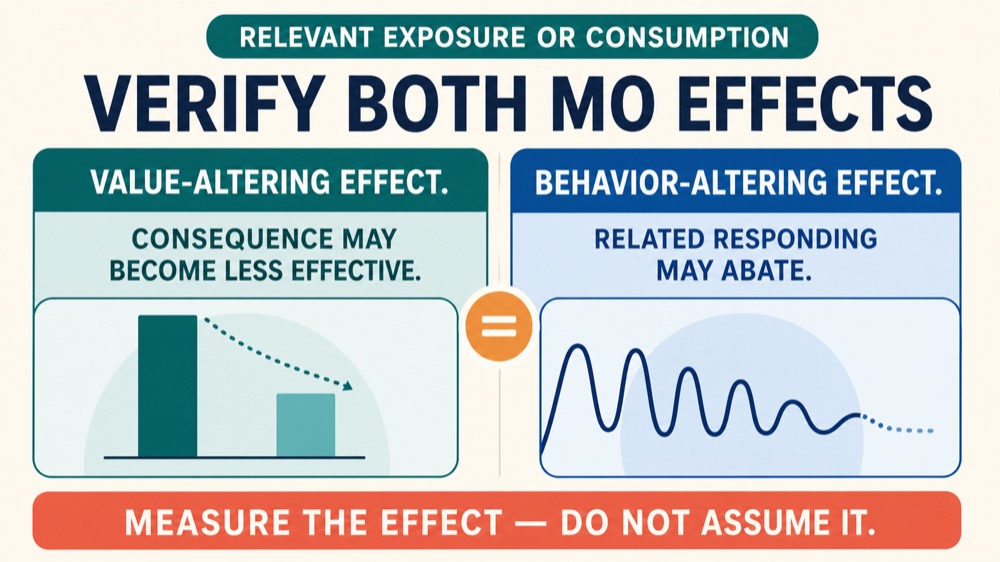
Extended exposure or consumption may function as an abolishing operation when two related effects are demonstrated. A value-altering effect is a temporary decrease in the effectiveness of a consequence as a reinforcer. An abative effect is a decrease in the current frequency of behavior that has produced that consequence. The operation, value change, and behavior change are related terms, but they are not interchangeable labels.
- Value evidence: Under the relevant condition, the consequence produces less reinforcement than it did under a comparison condition. Measures might include responding on a reinforcer-assessment arrangement rather than preference alone.
- Behavior evidence: The behavior previously reinforced by that consequence decreases in the same relevant context, while measurement and the programmed contingency are kept interpretable.
- Alternative explanations: Data should be reviewed for changes in effort, instructions, discriminative stimuli, consequence delivery, competing events, health, and implementation integrity.
Suppose a hypothetical learner completes an average of eight brief tasks per five-minute period when each completion produces music access. After extended music access, task completion averages three per period, and a structured reinforcer assessment also shows lower responding for music than in the comparison condition. That pattern is consistent with both an abative effect and a value-altering effect. The observation is still conditional on the arrangement; it does not establish that music has lost value everywhere or indefinitely.
Preference Is Not the Same as Reinforcement
A preference assessment measures relative selection, approach, engagement, or another defined response among available options under specified conditions. A reinforcer assessment evaluates whether a consequence increases or maintains behavior. Preference data can help identify candidates for testing, but selecting an item does not give that item a fixed behavioral function.
This distinction matters when evaluating satiation. Reduced selection may suggest that current value has changed, yet the strongest conclusion depends on what was measured and how. Conversely, a person may continue selecting an activity while responding that earns it changes because the earning response became more effortful. The behavior analyst should match the claim to the design rather than using “preferred,” “reinforcing,” and “valuable” as synonyms.
- Preference question: Which option is selected or approached under this assessment arrangement?
- Reinforcement question: Does contingent delivery strengthen or maintain the target response under these conditions?
- Motivating-operation question: Does a current environmental event change both consequence effectiveness and relevant behavior?
Satiation Compared With Deprivation, Extinction, and Habituation
Several processes can produce declining behavior, but the functional relations differ. The comparison below should be used as a reasoning guide, not as a shortcut based on surface appearance. In every case, the conclusion must follow the measured operation, contingency, and effect.
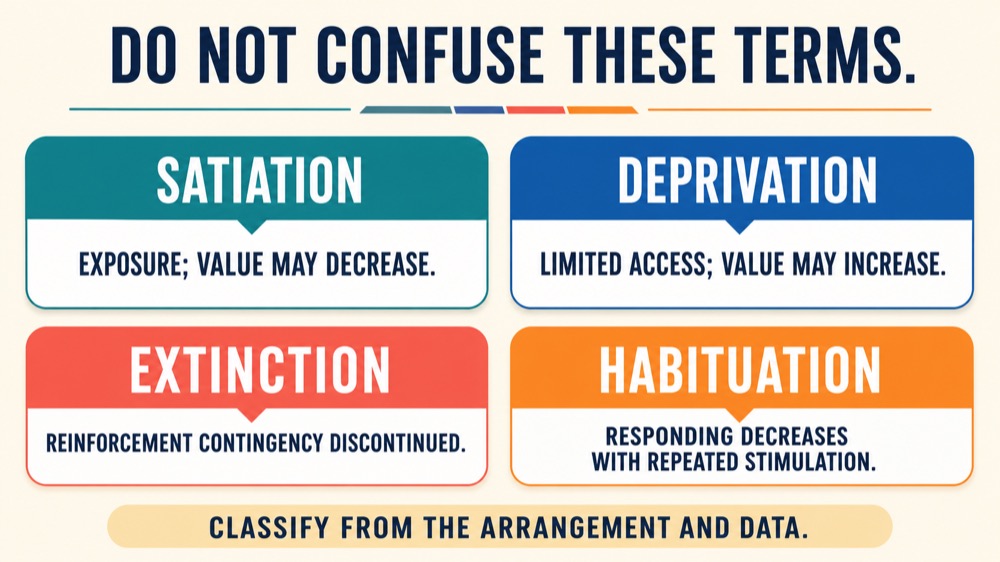
- Satiation: Relevant exposure or consumption is followed by reduced consequence effectiveness and reduced current behavior that has produced that consequence. The consequence may remain available.
- Deprivation: Restricted recent access may have an establishing effect by increasing consequence effectiveness and evoking relevant behavior. The effects are not guaranteed, and deprivation is not a perfectly symmetrical opposite for every stimulus or person.
- Extinction: The maintaining consequence is withheld or no longer follows the response. Behavior changes because the contingency changed, not because continued delivery necessarily became less effective.
- Habituation: Responding decreases with repeated stimulation. Murphy, McSweeney, Smith, and McComas argued that habituation can be a more precise account of some within-session decreases, particularly with noningestive stimuli.
The terms satiation and habituation are sometimes used together, but they should not automatically be treated as identical. The Murphy and colleagues review examines how repeated presentation can reduce reinforcer effectiveness and why habituation theory may improve prediction. Its analysis is a reminder to describe the actual procedure and data instead of attaching one familiar label to every within-session decline.
How to Evaluate a Satiation Interpretation
A careful evaluation begins with observable definitions. Define the exposure or consumption event, the response that produces the consequence, the programmed contingency, the relevant comparison, and the time window. Then select measures capable of distinguishing lower consequence effectiveness from unrelated performance changes. Ethical and practical safeguards, assent, health needs, and individual context remain part of the decision.
- Specify the operation: Record what contact occurred, for how long or how much, and under which conditions.
- Define the behavior: Use a measurable response rather than a broad label such as “unmotivated.”
- Measure consequence effectiveness: Include evidence beyond informal preference when making a reinforcer-function claim.
- Check the contingency: Confirm that the consequence was still delivered as programmed when distinguishing an abolishing operation from extinction.
- Compare conditions: Use repeated observations and an interpretable comparison rather than treating one low data point as proof.
- Review competing variables: Consider response effort, available alternatives, instructions, schedule parameters, health, and implementation integrity.
- Limit the conclusion: Describe the person, stimulus, behavior, setting, and period supported by the data rather than generalizing globally.
Presession access illustrates why this caution matters. In an applied analysis, Langthorne, McGill, and O’Reilly evaluated access to attention before sessions and found condition-specific effects. A broader systematic examination of presession exposure also shows that results vary across arrangements. Access before a session is an operation to evaluate; it is not proof of a particular effect.
Three Data-Based Teaching Examples
The following scenarios are original teaching examples, not treatment recommendations or recalled BACB exam items. Their purpose is to show how the same visible decrease can support different interpretations once the operation and contingency are specified.
- Example A—consistent with an AO: In alternating, repeated conditions, extended access to a song is followed by lower responding that earns the song and lower responding on a reinforcer assessment for that song. Delivery remains intact. The combined pattern is consistent with value-altering and abative effects for that consequence under those conditions.
- Example B—more consistent with extinction: A request drops after the programmed consequence stops following it. No relevant exposure operation occurred, and implementation data confirm nondelivery. The decrease alone should not be labeled satiation because the maintaining contingency changed.
- Example C—insufficient evidence: A learner chooses a toy during a morning preference assessment, declines it once in the afternoon, and completes fewer tasks. Without repeated measures, a reinforcer assessment, and checks on effort, alternatives, health, and consequence delivery, neither reinforcer function nor satiation has been demonstrated.
Notice that Example A does not prove a permanent property of the song or the learner. If responding recovers later, changes with another response requirement, or differs in another setting, those data refine the functional description. Behavior analysis gains precision by stating what the comparison shows and what it cannot show.
Common Interpretation Errors
Most errors occur when a familiar label is assigned before the functional relation is measured. Use these checks to keep everyday language from replacing analysis.
- Do not infer satiation solely from elapsed access time or a presumed internal state.
- Do not treat a preference result as proof that an item strengthened behavior.
- Do not call every decline after repeated stimulation an abolishing operation without evidence for both effects.
- Do not call a decline “extinction” when the programmed reinforcer continues to follow the response.
- Do not assume deprivation will raise value equally for every person, consequence, and context.
- Do not use access restriction involving food, health, comfort, or other necessities as a casual motivational tactic.
An Original Study Scenario
A student earns two minutes with a drawing app after completing a worksheet segment. Across several comparison sessions, completion and app-earning responses are stable. After an extended period of freely available app use, completion declines, but the analyst does not measure whether the app still reinforces another response and discovers that worksheet difficulty also increased. Which conclusion is best supported?
The defensible answer is that the data are insufficient to identify satiation as an abolishing operation. The decline could reflect the access condition, increased effort, or both, and no direct value measure was included. A strong answer names the missing evidence instead of treating temporal order as causation. This reasoning also distinguishes a motivating-operation analysis from a simple story about what the student wanted.
Frequently Asked Questions
Does the label “satiation” demonstrate an abolishing operation?: No. Relevant exposure or consumption can function as an abolishing operation when the data show the required value-altering and abative effects. The everyday label, the amount of access, or one response decrease does not establish those effects by itself.
Can a highly preferred item lose effectiveness?: Yes, consequence effectiveness can change with context. A high preference ranking predicts neither fixed reinforcement nor a specific motivating-operation effect. Measure the relevant behavior and consequence relation under current conditions.
Does presession access necessarily reduce problem behavior?: No single outcome should be assumed. Effects depend on the maintaining consequence, access arrangement, schedule, person, competing variables, and behavior measured. Any application requires individualized assessment, competence, safeguards, consent, and ongoing data.
Practice Motivating-Operation Reasoning
To study efficiently, practice identifying the environmental operation, the consequence whose effectiveness may have changed, the relevant behavior, the contingency, and plausible alternatives. Our Free BCBA Mock Exam provides original practice and feedback for broader behavior-analytic reasoning. Use the results to identify concepts that need review rather than assuming that a familiar label is functionally correct.
References
- Behavior Analyst Certification Board. BCBA Test Content Outline (6th ed.).
- Murphy, E. S., McSweeney, F. K., Smith, R. G., & McComas, J. J. Dynamic Changes in Reinforcer Effectiveness: Theoretical, Methodological, and Practical Implications for Applied Research.
- Langthorne, P., McGill, P., & O’Reilly, M. F. An Evaluation of the Effects of Presession Attention on Problem Behavior Maintained by Different Reinforcers.
- O’Reilly and colleagues. A Systematic Examination of the Influence of Presession Access to Attention on Behavior.



