
Is ABA controversial? Yes—especially when ABA is discussed as autism intervention. The controversy is not one simple disagreement about whether learning principles exist. It includes the history of behavior modification, autistic people’s lived experiences, the goals selected for intervention, questions about consent and assent, evidence quality, and the ethics of changing behavior that may be harmless or self-advocating.
Table of Contents
- Is ABA Controversial? The Short Answer
- Why Is ABA Controversial?
- What Do Autistic and Neurodiversity Perspectives Add?
- How Can Readers Separate History From Current Practice?
- What Does the Evidence Question Actually Ask?
- What Ethical Checkpoints Matter Today?
- How Can You Evaluate a Provider or Claim?
- How Is This Tested on the BCBA Exam?
- ABA Controversy Checklist
- Quick Review Checklist
- Take the Free BCBA Mock Exam
A fair answer also needs a second sentence: ABA is a broad field, and services differ substantially in goals, procedures, providers, settings, and safeguards. That variation does not erase criticism, and it does not make every current practice identical to every historical practice. It does mean that a responsible reader should evaluate the specific goals and procedures rather than rely on a slogan.
This article is an educational overview for families, students, and BCBA candidates. It is not a diagnosis, treatment recommendation, or legal or ethics opinion. The current BACB ethics-code page describes standards for certificants, while autistic self-advocacy and peer-reviewed ethical critiques add perspectives that a searcher should not skip. Table of Contents
Is ABA Controversial? The Short Answer
Yes. The controversy is strongest around ABA used with autistic people, particularly when intervention is intensive, adult-directed, focused on outward conformity, or implemented without meaningful choice and a way to refuse. Many autistic people and advocates describe harmful or traumatic experiences, and ethical scholarship has argued that autonomy, dignity, and rights have not always been protected.
At the same time, behavior analysts and some families describe contemporary ABA-based services as individualized teaching intended to improve communication, safety, daily living, participation, or access to preferred activities. Some professional literature argues that current practice should be judged by its goals, methods, outcomes, and safeguards rather than only by its history.
Those statements can coexist because “ABA” is not one uniform intervention. A meaningful evaluation asks: What behavior is being targeted? Who chose the goal? Is the goal socially important to the person? Can the person say no or ask for a break? What procedures are used? What data show benefit or harm? What happens when the person’s experience conflicts with the provider’s interpretation?
Why Is ABA Controversial?
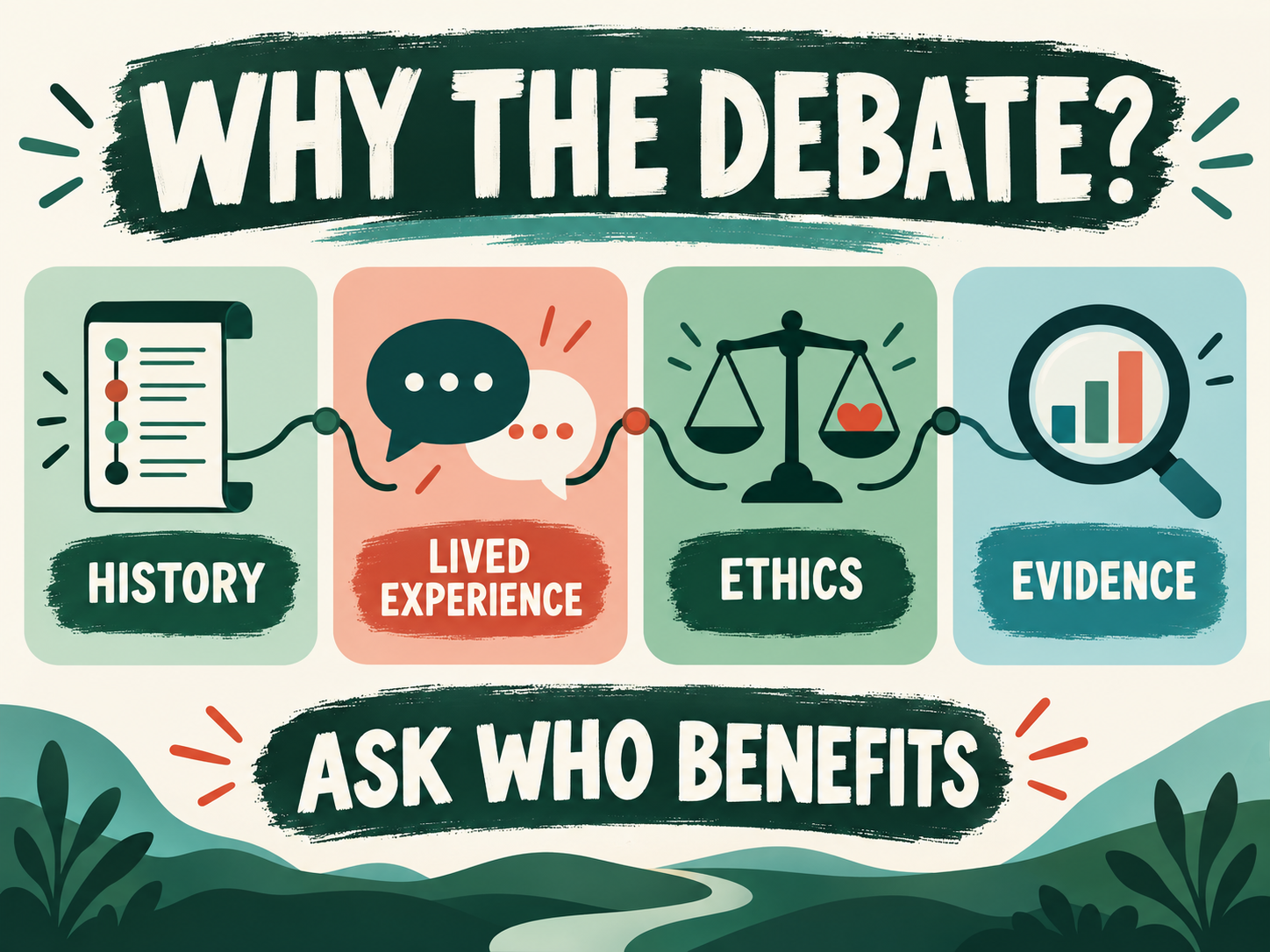
Most explanations fall into several overlapping layers. Treating them as one argument creates a false choice between “the science is fine” and “all services are identical.”
| Layer of the debate | The question people raise | What a careful reader should inspect |
|---|---|---|
| History | What practices, goals, and assumptions were used in earlier behavior-modification programs? | Whether a source acknowledges harmful history instead of presenting a sanitized origin story. |
| Autonomy | Can a person refuse, pause, communicate discomfort, or choose a different way to participate? | Assent, functional communication, dignity, and whether withdrawal is actually honored. |
| Goals | Is the goal meaningful to the person, or is it mainly about looking less autistic to others? | Quality of life, communication, safety, access, self-advocacy, and the person’s own priorities. |
| Evidence | What outcomes improve, for whom, under which procedures, and with what risks or limitations? | Study design, meaningful outcomes, harms, follow-up, representation, and conflicts of interest. |
What Do Autistic and Neurodiversity Perspectives Add?
They add direct information about acceptability, identity, autonomy, and long-term effects that may not appear in a short-term skill score. A person may learn to perform an outward behavior while becoming less able to signal distress, protect a boundary, or communicate a need. Conversely, a behavior that adults find unusual may be harmless, regulating, or meaningful to the person. A goal should not be selected simply because it makes observers more comfortable.
The Autistic Self Advocacy Network’s intervention-ethics brief frames autism intervention around rights and quality-of-life questions, while neurodiversity-affirming behavior-analytic writing argues that the field should address these concerns rather than dismiss them. Peer-reviewed critiques likewise raise questions about autonomy, coercion, and whether the person receiving services has a meaningful voice.
Including these perspectives does not require treating every personal account as a controlled trial, just as a controlled trial cannot replace listening to a person describing what an intervention felt like. They answer different questions. Evidence asks what patterns appeared under specified conditions; lived experience asks whether the intervention was acceptable, respectful, and worth its cost to the person. Ethical practice needs both kinds of information.
How Can Readers Separate History From Current Practice?
Use a three-column reading method:
- Historical practice: identify the procedures and goals a source is discussing. Do not let a provider use “that was long ago” to avoid naming what was harmful, and do not let a critic assume every current program uses the same procedures without checking.
- Current service: ask what happens in the actual program: goals, prompts, consequences, data, breaks, communication methods, supervision, caregiver involvement, and response to refusal.
- Ethical standard: compare the current plan with client welfare, dignity, informed choice, assent, competence, cultural responsiveness, and the person’s meaningful outcomes.
The current BACB Code, effective for applicants and certificants from January 1, 2022 and updated on the official site, includes principles about benefiting others, dignity and respect, integrity, competence, informed consent, and assent. A code is a standard for professional conduct; it is not proof that every provider or program meets it. That is why families and clients still need transparent questions and accountability.
What Does the Evidence Question Actually Ask?
“Does ABA work?” is too broad to be a useful evidence question. A better question names the population, procedure, goal, comparison, outcome, time horizon, and possible harms. Research on ABA-based interventions may measure communication, adaptive behavior, problem behavior, participation, or standardized scores; those outcomes are not interchangeable.
Evidence can support a statement such as “this procedure improved a defined skill for some participants under these study conditions.” It cannot automatically support “ABA is good for everyone,” “all autistic behaviors should be reduced,” or “a particular service will improve quality of life for this person.” Evidence quality also depends on representation, follow-up, independent assessment, adverse-event reporting, and whether the outcome reflects the person’s priorities.
Ethical critiques and professional responses should both be read carefully. The peer-reviewed bioethical critique, the analysis of neurodiversity critiques, and the behavior-analytic discussion of concerns do not answer identical questions. Comparing their claims, methods, assumptions, and limitations is more informative than choosing whichever headline confirms a prior opinion.
What Ethical Checkpoints Matter Today?
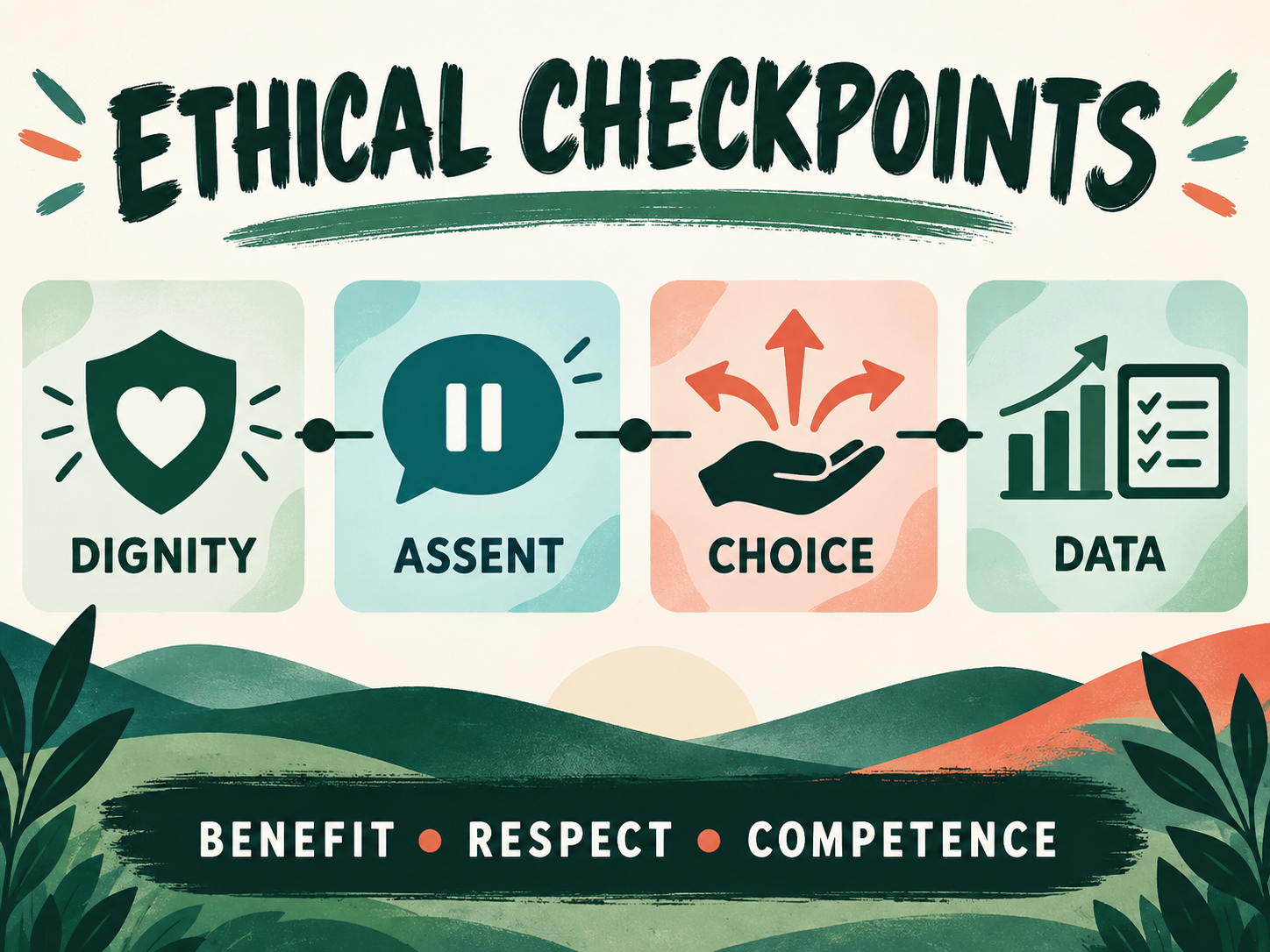
A current ethical review should be concrete. “We use positive reinforcement” is not enough, because a technically positive consequence can still be embedded in a coercive or meaningless goal. Ask how the person’s welfare and voice shape the whole service.
- Meaningful goals: targets should support communication, safety, autonomy, access, relationships, daily living, or another outcome the person and stakeholders value.
- Assent and refusal: the person needs a practical way to communicate willingness, discomfort, “no,” or “break,” and the team must explain what it will do with that information.
- Least harmful effective approach: the team should evaluate risks, unwanted effects, emotional responses, and alternatives instead of treating compliance as the default success metric.
- Cultural and neurodiversity responsiveness: the provider should examine bias, avoid equating difference with deficit, and include perspectives from the person and community.
- Data plus lived experience: graphs matter, but so do the person’s comfort, priorities, relationships, and ability to self-advocate.
- Competence and accountability: the BCBA should work within competence, supervise appropriately, explain the plan, protect privacy, and correct problems when data or feedback identify them.
The BACB Code is a useful professional reference, but families should not confuse a credential with a guarantee. A provider who welcomes questions, shares data, explains uncertainty, and changes a plan when the person is distressed gives you more information than a provider who offers only a success slogan.
How Can You Evaluate a Provider or Claim?
Use this short claim audit before accepting either a positive or negative statement about ABA:
| Claim type | Ask | Red flag |
|---|---|---|
| “ABA always works.” | Which procedure, goal, participant, outcome, and follow-up? | No population, method, limitation, or harm discussion. |
| “ABA is always abusive.” | Which practices and historical period are being described, and what current plan is under review? | Treating all providers, goals, and procedures as identical. |
| “The data improved.” | Did the person experience meaningful benefit, and was the measure valid and socially important? | Only adult-observer convenience or compliance is measured. |
How Is This Tested on the BCBA Exam?
BCBA questions may not ask “is ABA controversial?” directly. They may present an ethics scenario involving a goal, a procedure, a stakeholder disagreement, assent, cultural responsiveness, or an unwanted effect. Read the scenario for the principle underneath the controversy:
- Benefit and do no harm: identify who benefits, what risks exist, and whether the plan is being adjusted to reduce harm.
- Dignity and respect: ask whether the target is meaningful and whether the person’s communication and refusal are respected.
- Informed choice and assent: check whether relevant information is explained and whether the client’s willingness matters.
- Competence and evidence: determine whether the provider has training, consultation, supervision, and a data-based rationale.
- Cultural responsiveness: look for bias, stakeholder input, and goals that fit the person’s context rather than a generic norm.
The best answer is usually not “ABA is controversial, so do nothing” or “ABA is evidence-based, so ignore the concern.” It is the action that protects the client, gathers relevant information, consults when needed, and uses data and feedback to revise the plan. For additional scenario practice, use the free BCBA mock exam. It is a study aid, not official BACB guidance and not a substitute for supervised experience or professional consultation.
ABA Controversy Checklist
When you read a claim about is ABA controversial, check whether it answers these questions:
- Does the source name the population, goals, procedures, and time period?
- Does it acknowledge historical practices and current variation?
- Does it include autistic people’s perspectives on autonomy, identity, and quality of life?
- Does it distinguish a measured skill change from a meaningful benefit?
- Can the person refuse, pause, communicate discomfort, and choose support?
- Are data, adverse effects, alternatives, and limitations discussed?
- Does the provider work within competence and welcome accountability?
The most accurate short answer remains: yes, ABA is controversial, and the reasons are serious. A useful next step is not to hide the controversy or reduce it to a verdict; it is to examine the specific goals, procedures, evidence, safeguards, and the person’s own experience.
Quick Review Checklist
Use this final checklist to turn is aba controversial into exam-ready reasoning. The goal is not to memorize a label in isolation; it is to identify the relevant evidence and explain why the best answer fits the scenario. Key ideas to review:
- State the central definition or decision point for is aba controversial in your own words.
- Identify the detail that makes is aba controversial different from its closest related ABA term.
- Separate the observable facts in a scenario from assumptions that are not supported by the facts.
- Write one example and one nonexample so you can recognize the concept in a new setting.
Exam application checks:
- Ask what the question is actually requesting before comparing the answer choices.
- Mark the antecedent, response, consequence, or other evidence that supports the selected answer.
- Look for a distractor that describes a related process but does not answer the specific question.
Final self-check:
- Explain how you would verify the interpretation with clear observations or data.
- Change one detail in the scenario and decide whether your answer should change.
- Give a one-sentence rationale that a supervisor or study partner could evaluate.
Take the Free BCBA Mock Exam
If you want a low-pressure way to check your recall, use the free practice resource below. Take the Free BCBA Mock Exam



