
What is one concern with standard functional analysis? The clearest exam answer is the safety risk: a standard functional analysis deliberately arranges test contingencies that can evoke and reinforce problem behavior. If the target behavior is severe—such as aggression, self-injury, or dangerous destruction—the assessment can temporarily increase risk unless it is designed, monitored, and stopped under appropriate safeguards.
Table of Contents
- What Is One Concern With Standard Functional Analysis?
- Why Can a Standard FA Create Risk?
- What Does a Standard Functional Analysis Test?
- How Should Safety Change the Design?
- What Other Limitations Should You Remember?
- Standard FA Versus Descriptive Assessment
- Exam Answer Checklist
- Practice the Behavior-Assessment Domain
- Quick Review Checklist
- Take the Free BCBA Mock Exam
- References
That answer does not mean a standard functional analysis is automatically unsafe or unethical. It means the procedure has an important trade-off. Its strength is experimental control: the analyst changes relevant environmental events and measures behavior across conditions. The concern is that those changes may occasion the very behavior being assessed. A competent analyst must therefore balance the need for a clear functional relation with client dignity, safety, clinical judgment, and the least risky assessment arrangement that can answer the question. This article explains the exam-ready answer, how standard conditions create the concern, and why a safety concern is different from saying that every standard functional analysis produces invalid data. Table of Contents
What Is One Concern With Standard Functional Analysis?
The main concern is that the test conditions may evoke severe problem behavior and arrange reinforcement for it. In a standard functional analysis, the analyst is not merely observing what happens naturally. The analyst systematically manipulates events such as demands, attention, or access to a preferred item. If the target behavior produces the programmed consequence, the behavior may occur more often during the session.
For example, if the question is whether aggression is maintained by escape from demands, the analyst may present a task and deliver a brief break following aggression in the escape condition. That contingency can provide useful experimental information, but it also creates an immediate safety and ethical concern. The procedure must be individualized, brief when possible, carefully monitored, and conducted by people who can respond to risk.
For a multiple-choice question, look for an answer that recognizes potentially dangerous evocation or reinforcement of problem behavior. Be cautious with options that say a standard FA is always unethical, never provides experimental control, or cannot be used with severe behavior. Those statements are too absolute. The concern is real, but the method can be adapted, shortened, or replaced when the risk is not acceptable.
Why Can a Standard FA Create Risk?
A standard FA typically compares one or more test conditions with a control or play condition. In a test condition, an event suspected of maintaining behavior is arranged, and the consequence that would support that hypothesis is delivered after the target response. Repeated differences in responding across conditions can demonstrate a functional relation.
The same experimental feature that improves causal inference can create risk. The analyst may need to make a motivating operation more likely, restrict access to a reinforcer briefly, present difficult demands, or deliver attention after problem behavior. When the target response includes self-injury or aggression, even a short session may be clinically significant. The risk is not limited to physical injury: repeated contact with the programmed consequence can also strengthen a response pattern that the treatment will later need to reduce.
| Concern | Why it can happen | Design response |
|---|---|---|
| Evoking severe behavior | The test condition arranges antecedents or motivating operations that may increase responding. | Use risk screening, trained staff, protective procedures, brief sessions, and clear stopping rules. |
| Strengthening the target response | The programmed consequence may follow problem behavior during testing. | Use the minimum exposure needed to answer the question and move toward a function-based replacement response. |
| Insufficient experimental control | Behavior may be too low, too variable, or too risky to differentiate across conditions. | Interpret cautiously, collect procedural-integrity data, and consider a different assessment arrangement. |
What Does a Standard Functional Analysis Test?
The exact arrangement depends on the referral question and the individual, but the classic standard FA commonly includes conditions that test socially mediated or automatic reinforcement. A control or play condition provides a comparison in which the suspected reinforcer is freely available and problem behavior does not produce the test consequence.
- Attention: attention follows the target behavior to test whether social attention is reinforcing.
- Escape: a demand or task is presented, and a brief break follows the target behavior to test escape from demands.
- Tangible: access to a preferred item or activity is restricted and then delivered following the target behavior when that function is clinically plausible.
- Alone or no interaction: social interaction and materials are minimized to test for behavior that may persist through automatic reinforcement.
- Play or control: attention, leisure materials, and low task demands are available while problem behavior does not produce a programmed reinforcer.
These labels describe test arrangements, not fixed “types of people” or permanent causes. A result is meaningful only when the conditions are implemented consistently and the pattern of responding is interpreted with the rest of the assessment information.
How Should Safety Change the Design?
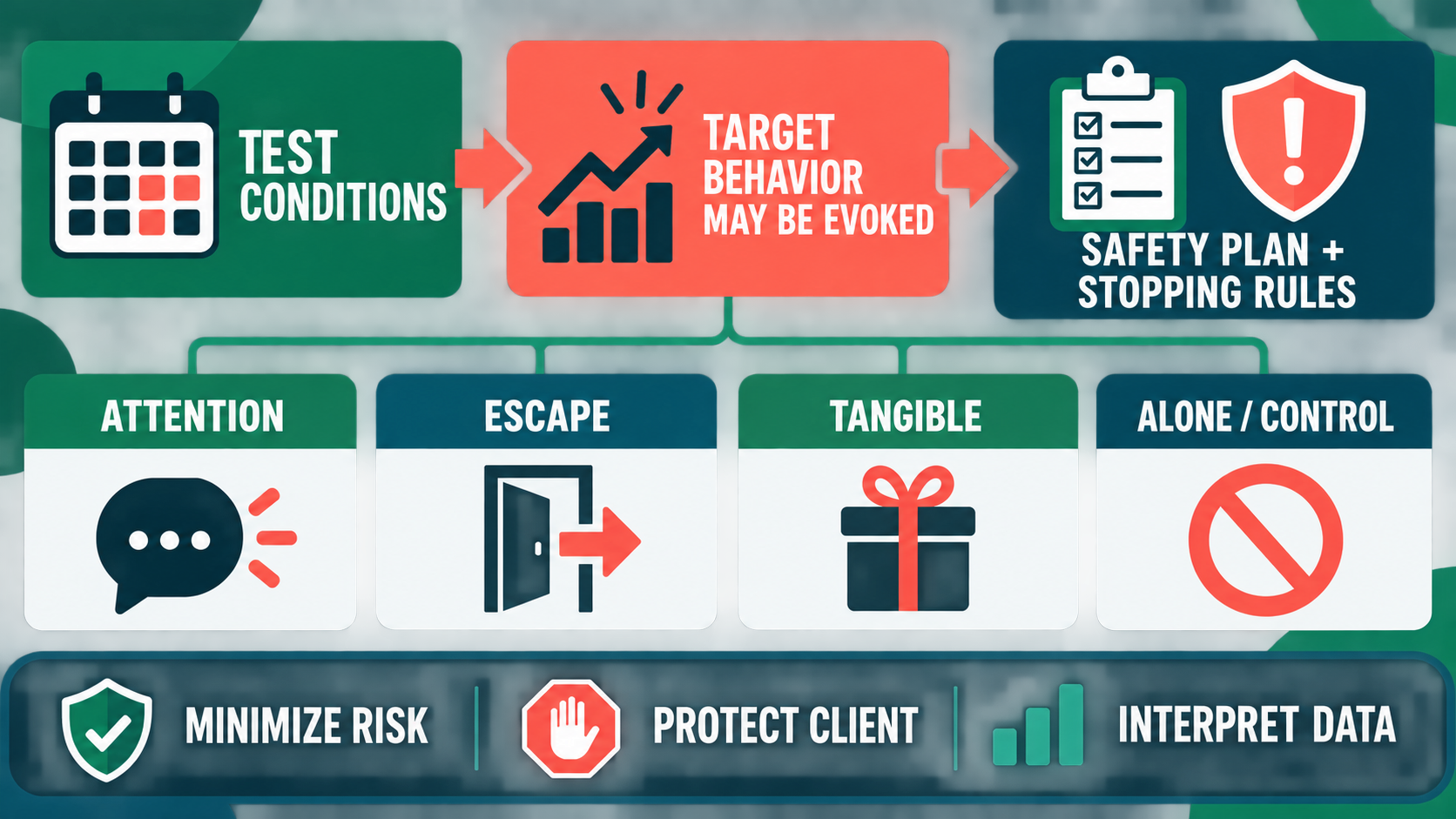
Safety should be part of the assessment design before the first session, not an improvised reaction after behavior escalates. The analyst should review records, interview relevant people, define the target response precisely, identify medical or environmental risks, and decide what level of behavior can be safely tested. The presence of a functional-analysis question does not remove the obligation to protect the client, staff, and others.
- Use an operational definition that distinguishes the target response from lower-risk behavior.
- Identify severity, injury history, precursors, and conditions that could make escalation more likely.
- Have trained personnel, required protective equipment, communication access, and emergency procedures ready.
- Set session limits and stopping rules before the assessment begins.
- Record procedural integrity so a risky or inconsistent implementation is not mistaken for a client characteristic.
- Consider brief, trial-based, latency-based, synthesized, or other clinically appropriate arrangements when they answer the question with less exposure.
- Stop and revise the plan when the potential benefit no longer justifies the risk.
“Use a different format” is not the same as “skip assessment.” The goal is to obtain useful information while reducing unnecessary exposure. In some cases, indirect and descriptive information can help select conditions or identify variables to test. In others, the analyst may need a more controlled analysis. The choice should fit the behavior, setting, available expertise, and safety profile.
What Other Limitations Should You Remember?
The safety concern is the best single answer to this keyword, but standard FAs have other possible limitations. First, a test may produce undifferentiated results, meaning the data do not show a clear separation between conditions. Second, a uniform set of attention, escape, tangible, alone, and play conditions may not represent the idiosyncratic variables operating in the person’s daily environment. Third, a condition can create a false-positive interpretation if the arranged contingency is not actually relevant outside the assessment.
These limitations are reasons to evaluate the design and data—not reasons to memorize that standard FAs are useless. The current BCBA Test Content Outline places “design and evaluate functional analyses” in Behavior Assessment. “Evaluate” means asking whether the conditions match the referral question, whether the data support a functional relation, whether procedural integrity is adequate, and whether the outcome is safe and useful for treatment planning.
Standard FA Versus Descriptive Assessment
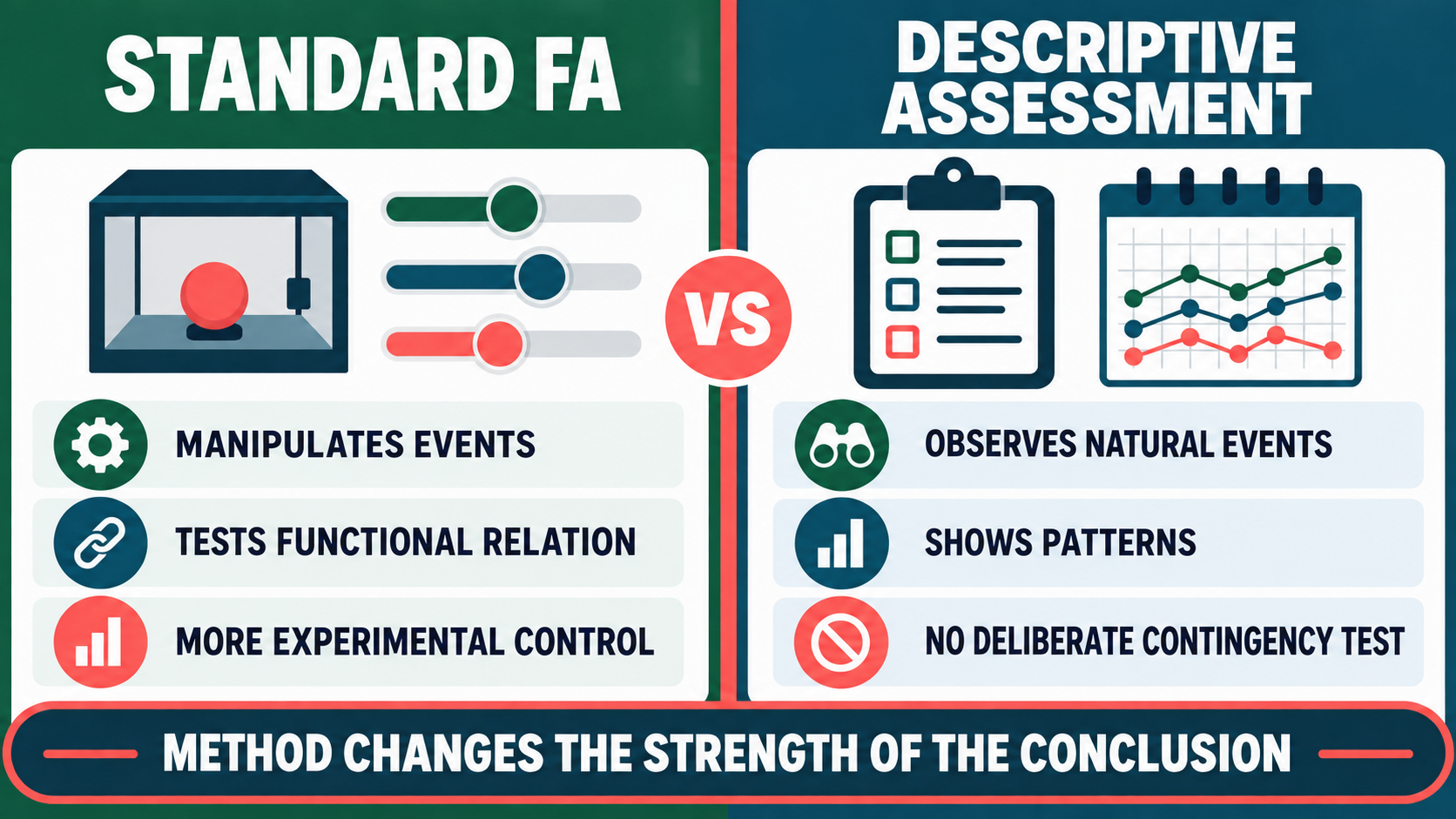
An exam may test the difference between a functional analysis and a descriptive assessment. A descriptive assessment observes naturally occurring antecedents, behavior, and consequences. It can show correlations or patterns, but it does not deliberately manipulate the consequence to demonstrate experimental control. A functional analysis systematically changes environmental events to test a functional relation.
Because a standard FA has stronger experimental control, it may provide more direct evidence about function. Because it manipulates contingencies, it may also produce more risk. A descriptive assessment may be safer or more practical in some settings, but its results should not automatically be called proof that a particular consequence maintains behavior. The assessment method changes the kind of conclusion the analyst can make.
Exam Answer Checklist
When you see the question what is one concern with standard functional analysis, use this sequence:
- Identify whether the option names a risk created by manipulating contingencies.
- Choose the option that recognizes possible evocation or reinforcement of severe problem behavior.
- Reject absolute statements that every standard FA is unethical, invalid, or impossible.
- Remember that safety, competence, procedural integrity, and stopping rules are part of responsible design.
- Separate the safety concern from secondary issues such as undifferentiated data or limited ecological validity.
A compact answer to memorize is: “A standard FA may evoke dangerous problem behavior because the test conditions arrange consequences for that behavior; therefore, the assessment requires careful safety planning and may need modification.”
Practice the Behavior-Assessment Domain
Functional-analysis questions often combine assessment design, experimental control, ethics, and interpretation. After reviewing this concept, use our free BCBA mock exam to practice identifying the best answer under time pressure. The mock exam is a study aid; it does not replace the current BACB outline, supervision, or professional judgment. Try the Free BCBA Mock Exam
Quick Review Checklist
Use this final checklist to turn what is one concern with standard into exam-ready reasoning. The goal is not to memorize a label in isolation; it is to identify the relevant evidence and explain why the best answer fits the scenario. Key ideas to review:
- State the central definition or decision point for what is one concern with standard in your own words.
- Identify the detail that makes what is one concern with standard different from its closest related ABA term.
- Separate the observable facts in a scenario from assumptions that are not supported by the facts.
- Write one example and one nonexample so you can recognize the concept in a new setting.
Exam application checks:
- Ask what the question is actually requesting before comparing the answer choices.
- Mark the antecedent, response, consequence, or other evidence that supports the selected answer.
- Look for a distractor that describes a related process but does not answer the specific question.
Final self-check:
- Explain how you would verify the interpretation with clear observations or data.
- Change one detail in the scenario and decide whether your answer should change.
- Give a one-sentence rationale that a supervisor or study partner could evaluate.
Take the Free BCBA Mock Exam
A useful next step is to apply this idea in a fresh set of BCBA-style practice questions and review the feedback. Take the Free BCBA Mock Exam
References
- BACB BCBA Test Content Outline (6th ed.)
- BACB Ethics Codes
- Melanson et al., Functional analysis of problem behavior: A 40-year review
- Hanley, Practical Functional Assessment and Skill-Based Treatment



