

If you are searching for professional boundaries ABA, the phrase points to the limits and safeguards that keep behavior-analytic relationships focused on client welfare, informed consent, competent service, and the role each person has agreed to hold. Boundaries are not about being cold or distant. They reduce conflicts of interest, protect confidentiality, and make it easier for clients, families, supervisees, and colleagues to give honest feedback.
Table of Contents
- Professional Boundaries ABA: What Do They Mean?
- Which BACB Standards Matter Most?
- Where Do Professional Boundary Issues Show Up?
- How Should You Handle a Professional-Boundary Grey Area?
- How Do Boundaries Apply to Supervision?
- What Are Common BCBA Exam Traps?
- Professional-Boundary Checklist
- Practice the Ethics Domain
- Take the Free BCBA Mock Exam
- References
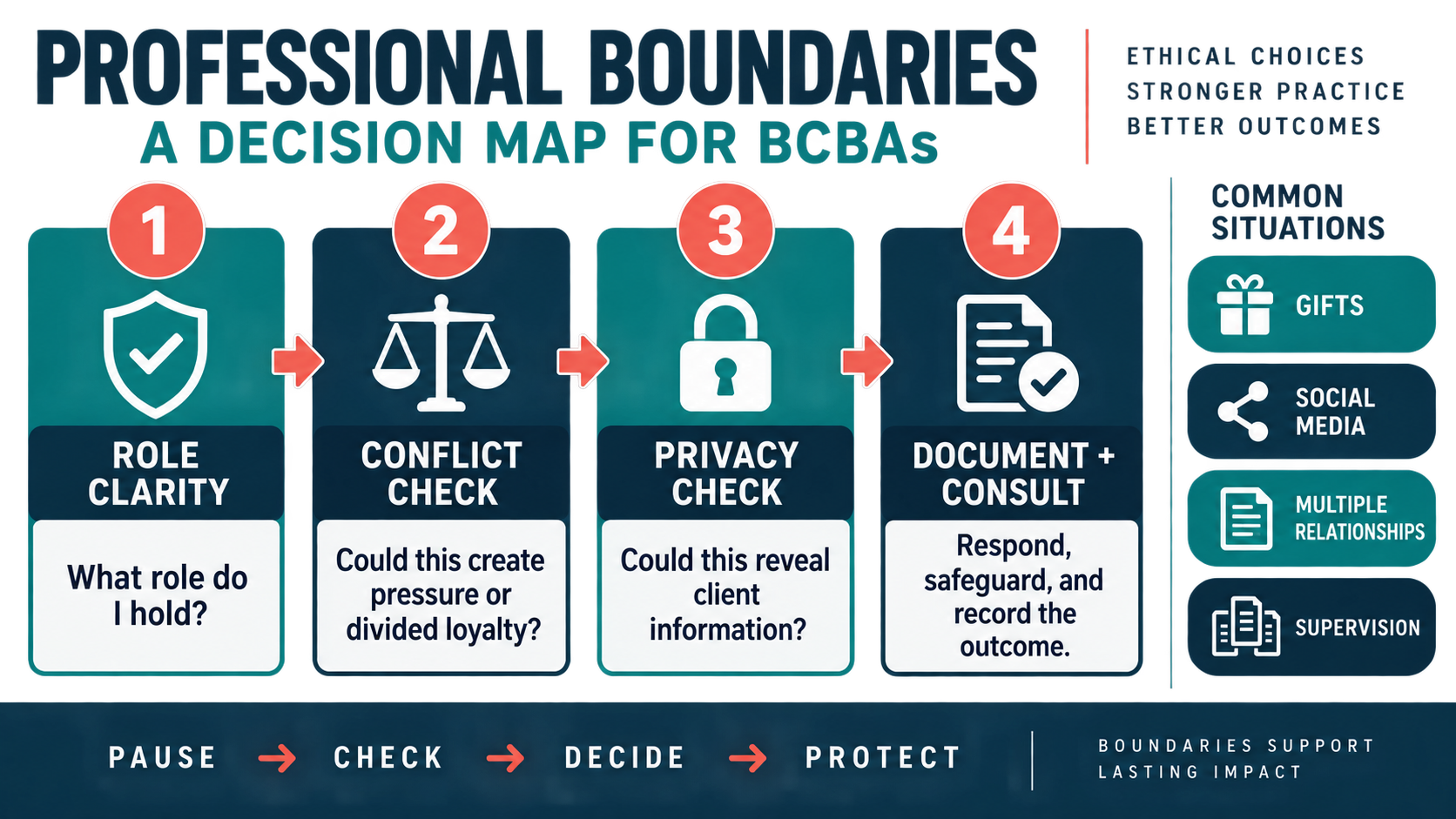
The current BACB Ethics Code is the starting point for a boundary decision. It addresses multiple relationships, gifts, coercion, competence, confidentiality, informed consent, social media, referrals, and documentation. A good boundary question is therefore not only “Is this allowed?” It is also “Could this blur roles, create pressure, disclose private information, or make someone’s services depend on a personal relationship?”
This guide gives BCBA students and ABA professionals a practical way to recognize a boundary concern, connect it to the current code, and choose a defensible next step. It is educational information, not legal advice or a substitute for consultation about a specific case. Table of Contents
Professional Boundaries ABA: What Do They Mean?
In ABA, a professional boundary separates the behavior analyst’s service role from personal, financial, familial, social, or other roles that could influence judgment. The boundary is not a single distance rule. It is a way to monitor whether a relationship creates unequal influence, divided loyalty, privacy risk, or an expectation that the professional will provide special treatment.
For example, a behavior analyst may be warm, culturally responsive, and collaborative without becoming a client’s friend, business partner, family member, or social-media contact. The analyst can explain procedures in understandable language, invite stakeholder input, and respect client preferences while still keeping the professional role clear. A boundary becomes a concern when the additional role could impair objectivity, exploit trust, interfere with consent, or make it harder to end or change services.
Which BACB Standards Matter Most?
The current Ethics Code should be read as a connected system. The standards below are especially useful when analyzing a professional-boundary scenario:
| Code area | Core idea | Boundary question |
|---|---|---|
| 1.11 Multiple Relationships | Avoid relationships that may create conflicts or harm; monitor, resolve, safeguard, and document. | Does this person now have two roles that could affect decisions or feedback? |
| 1.12 Gifts | Gifts over $10 from or to clients, stakeholders, supervisees, or trainees are not accepted or given; explain the rule at the start. | Could the gift become expected, financially meaningful, or a source of special access? |
| 2.03 and 5.10 | Protect confidential information in service delivery, websites, and social-media activity. | Could a post, photo, message, or connection identify a client or reveal the relationship? |
| 1.13 and 1.14 | Do not exploit authority or enter prohibited romantic or sexual relationships. | Is the person vulnerable because of the professional power relationship? |
Where Do Professional Boundary Issues Show Up?
Boundary questions are common because ABA services often occur in homes, schools, community settings, and online spaces. The setting can feel informal even when the relationship remains professional.
- Gifts and favors: a family offers a holiday gift, free service, personal favor, or special discount.
- Social media: a client’s parent sends a friend request, tags the analyst, or shares a service story online.
- Former clients: a former family asks to become friends, hire the analyst privately, or restart services later.
- Family and business roles: a relative, friend, landlord, employer, or business partner becomes part of the service arrangement.
- Referrals: the analyst recommends a provider with whom they have a financial or personal relationship.
- Communication: informal texting, personal phone use, or after-hours contact creates an unclear expectation of access.
Not every unusual situation is automatically a code violation. The analyst should examine role conflict, power, confidentiality, financial benefit, client welfare, and whether the situation can be resolved or safeguarded. A consistent written policy helps prevent a decision from changing based on which family asks or how persuasive the request feels.
How Should You Handle a Professional-Boundary Grey Area?
Start with the facts, not the preferred answer. Describe who is involved, the professional roles, the requested action, the possible benefit, and the possible harm. Then review the current BACB Code, applicable law, funder and employer policy, and the client’s service agreement. When the situation is outside your competence or involves a serious conflict, consult an appropriately qualified professional and document the consultation.
- Identify every relationship and role that exists now.
- Ask whether the additional role could impair judgment, create pressure, or harm a party.
- Protect confidentiality before responding to a text, post, request, or referral.
- Choose the least risky response that preserves client welfare and professional clarity.
- Communicate the boundary respectfully and in understandable language.
- Document the concern, consultation, action taken, and eventual outcome.
- If the conflict cannot be resolved, use appropriate transition or referral steps.
If a multiple relationship cannot be resolved immediately, the Ethics Code calls for safeguards to identify and avoid conflicts, a plan to eventually resolve the relationship, and documentation of actions and outcomes. “Everyone is comfortable with it” is not enough by itself. Comfort does not remove unequal power, privacy risk, or a future conflict of interest.
How Do Boundaries Apply to Supervision?
Supervision adds evaluative power to the relationship. A supervisor may influence training opportunities, feedback, fieldwork documentation, recommendations, or access to cases. That makes it especially important to keep personal, financial, and supervisory roles clear. A supervisor should not use a supervisee’s dependence to obtain favors, personal loyalty, unpaid work outside the agreement, or private access.
The same principle applies when an employer, parent, or organization asks one person to serve as both clinician and supervisor in a way that creates divided loyalty. Clarify responsibilities, use written agreements, invite appropriate feedback, and escalate unresolved conflicts through the organization’s process or consultation channel. Good boundaries support honest supervision; they do not prevent warmth, encouragement, or individualized teaching.
What Are Common BCBA Exam Traps?
- “A boundary means no rapport.” False. Rapport and cultural responsiveness can coexist with clear roles.
- “Any gift is automatically prohibited.” The current code uses a $10 threshold and also considers whether gifts become ongoing, expected, or financially beneficial; follow the exact current wording.
- “A former client is no longer relevant.” A former relationship can still create confidentiality, power, or future-service concerns.
- “Consent makes every dual relationship acceptable.” Consent is important but does not erase conflicts of interest or coercive power.
- “Delete the message and move on.” A boundary concern may require consultation, a clear response, and documentation.
Professional-Boundary Checklist
Before accepting a request that feels personal, unusual, or financially meaningful, ask:
- What professional role do I hold with this person?
- What new role is being requested?
- Could the roles create a conflict, pressure, or harm?
- Could the action reveal confidential information?
- Does the current BACB Code, law, funder, or employer policy limit the action?
- Should I consult, decline, safeguard, refer, or transition?
- What will I document, and who needs to know?
Practice the Ethics Domain
Professional-boundary questions reward precise reading. Look for the relationship, the power difference, the possible conflict, and the action that protects the client while following the current code. Our free BCBA mock exam can help you practice these scenario decisions under time pressure. It is a study aid, not legal or ethics advice for a specific case. Try the Free BCBA Mock Exam For targeted review, use our professional boundaries aba practice questions to apply the concept in exam-style scenarios.
Take the Free BCBA Mock Exam
A useful next step is to apply this idea in a fresh set of BCBA-style practice questions and review the feedback. Take the Free BCBA Mock Exam
References
- BACB Ethics Code for Behavior Analysts
- BACB Ethics Codes
- BACB Ethics Resources
- BACB Newsletter: July 2023



