

If you are asking what is manding in ABA, start with the function rather than the wording. A mand is a verbal operant in which a relevant motivating operation helps evoke a response and the response is followed by a reinforcer that is characteristic of what was requested. In plain language, the learner is not merely saying a word; the request is occurring in a context where a particular consequence matters.
Table of Contents
- What Is Manding in ABA?
- Follow the MO → Request → Reinforcer Chain
- Mand Versus Tact: Ask What Controls the Response
- Use Data, Not Form Alone
- Read Common Manding Examples
- Connect the Analysis to Teaching Decisions
- Troubleshoot a Weak or Misclassified Mand
- Turn the Distinction into BCBA Exam Practice
- FAQ
- Take the Free BCBA Mock Exam
That definition gives you a better study rule than “a mand is asking.” The form may be a spoken word, sign, picture exchange, device selection, gesture, or another response. To analyze the example, ask what value-altering condition was present, what response occurred, what consequence followed, and whether the consequence matched the request. This article keeps that chain separate from teaching prescriptions for any individual learner.
What Is Manding in ABA?
what is manding in aba is best answered by identifying a three-part relation: motivation, request, and characteristic reinforcement. A learner asks for a drink when thirsty, requests a break when the relevant condition makes a break valuable, or selects a particular item when access to that item is important. The exact response form does not decide the label by itself.
ABAI study material describes the mand as a verbal operant related to motivating operations and the consequence that is characteristic of the response. That is why an identical word can function differently in two situations. “Ball” may be a mand when the learner is requesting access to a ball and receives the ball. The same vocal form may be a tact when the learner labels a ball that is visible and no ball access is delivered as the defining consequence. For BCBA study, remember this compact formula:
| Part of the relation | Question to ask | What would support a mand interpretation? |
|---|---|---|
| Motivating operation | What changed the value of a consequence or evoked the response? | A relevant deprivation, loss, interruption, or other value-altering condition is documented. |
| Response | What did the learner do or say? | The response is observable and can be recorded without guessing the learner’s intent. |
| Consequence | What immediately followed? | The requested or characteristic reinforcer followed, subject to the applicable plan and context. |
Follow the MO → Request → Reinforcer Chain
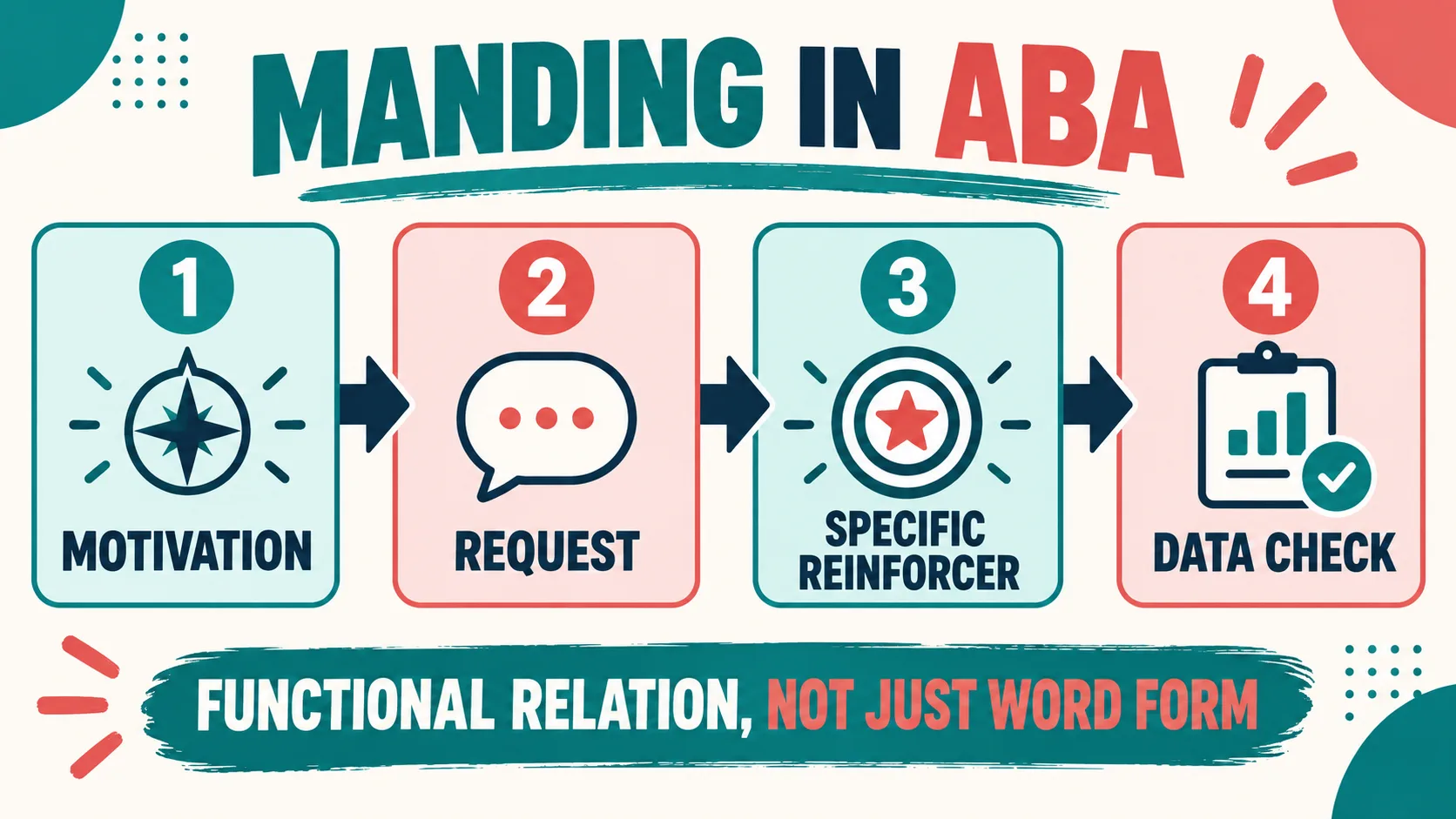
In a study scenario, track the sequence from left to right. A motivating operation can alter the value of a consequence and evoke behavior that has produced that consequence before. The response is the proposed mand. The consequence then gives you evidence: did the learner receive the specific outcome that makes sense for that request?
Do not turn the arrow into a rigid classroom script. A motivating operation is not simply “the learner wants something,” and an establishing operation is not a universal synonym for every antecedent. Use the terminology your course or current BACB study material uses, and separate the value-altering effect from the response-evoking effect when a question asks for that distinction.
| Step | Study prompt | Evidence to record |
|---|---|---|
| 1. Motivation | What consequence became more valuable, or what condition evoked the response? | Relevant condition, time, activity, and any interruption or access history. |
| 2. Request | What observable response occurred? | Exact topography, prompt level, latency, and whether the response was independent. |
| 3. Outcome | What consequence followed the response? | Whether the characteristic or requested reinforcer was delivered and for how long. |
| 4. Pattern | Does the relation repeat across relevant opportunities? | Opportunity count, independent responses, prompt dependence, and successful outcomes. |
A single successful request can illustrate the concept, but a pattern gives stronger evidence for a learning decision. For exam questions, the most informative option is usually the one that preserves the functional relation instead of inferring a mand from a word list alone.
Mand Versus Tact: Ask What Controls the Response
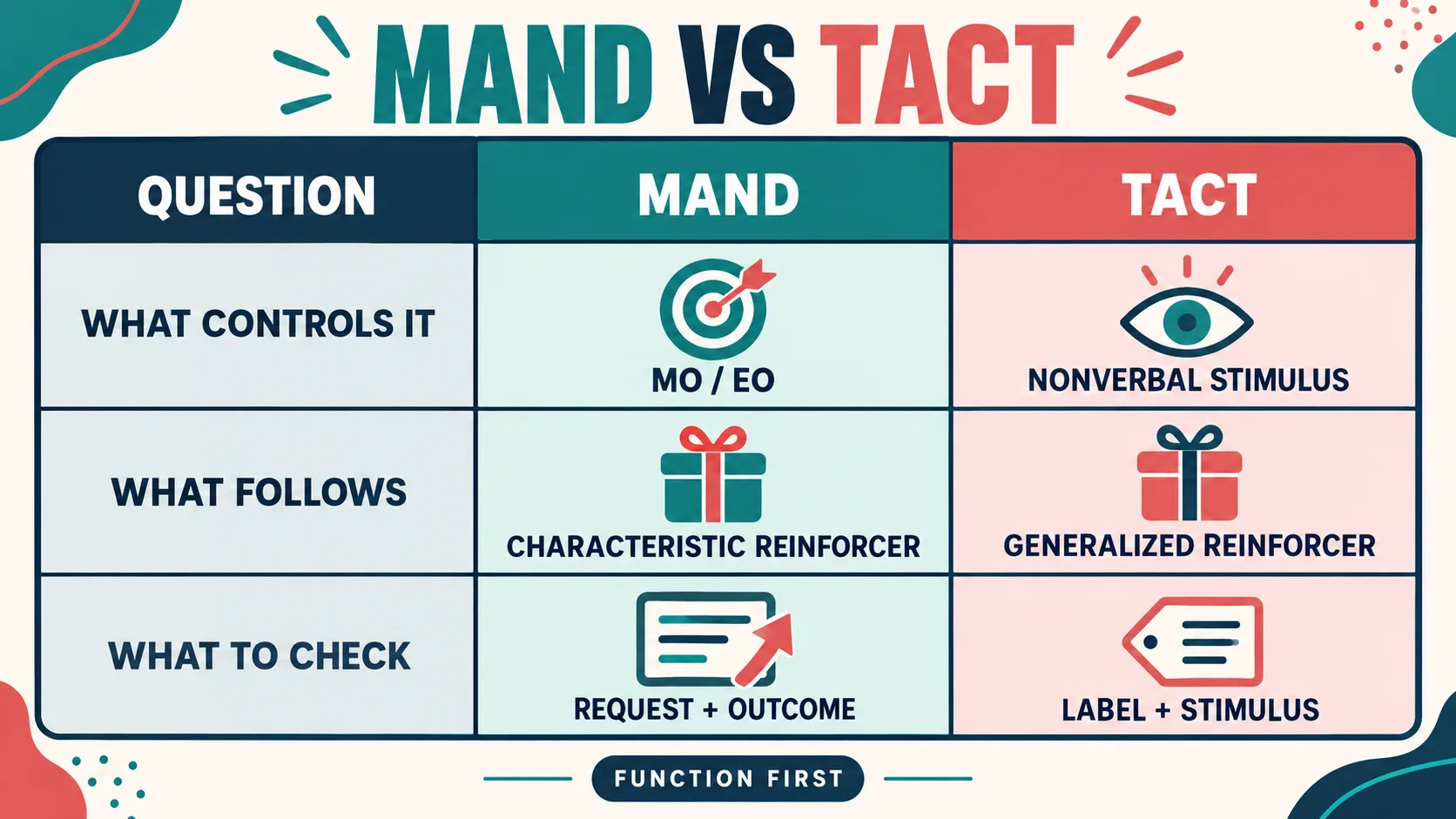
The quickest way to separate a mand from a tact is to ask what is controlling the response and what consequence is relevant. A mand is related to a motivating operation and produces a characteristic reinforcer. A tact is typically evoked by a nonverbal stimulus and contacts generalized conditioned reinforcement, such as attention or acknowledgment. The visible response can look identical while the controlling variables differ.
| Question | Mand | Tact |
|---|---|---|
| What primarily controls it? | A relevant motivating operation or value-altering condition. | A nonverbal stimulus, event, property, or relation being contacted. |
| What commonly follows? | The characteristic reinforcer related to what was requested. | Generalized reinforcement such as social acknowledgment or attention. |
| What should the analyst inspect? | Motivation, request form, consequence, and access history. | Stimulus present, labeling accuracy, and generalized consequence. |
Use the verbal operants BCBA exam guide for the larger comparison. This page focuses on the common trap: assuming that “saying the name of an item” is automatically a tact or that “using a request word” is automatically a mand. Function, not vocabulary, is the deciding factor.
Use Data, Not Form Alone
To study manding well, translate the example into observable fields. Avoid notes such as “the learner wanted a snack and manded appropriately” unless the note also shows what happened before and after the response. A compact data record can include:
- Opportunity: the relevant condition, activity, or access interruption that preceded the response.
- Topography: the exact vocal, sign, picture, device, gesture, or other response.
- Prompt: whether a verbal, model, gesture, visual, or physical prompt was used.
- Consequence: what was delivered, delayed, denied, or changed after the response.
- Pattern: whether independent responding and the characteristic outcome repeat across opportunities.
This record does not require you to assume that every request should contact reinforcement in the same way. It gives the learner, supervisor, or study reader enough information to ask the next question. In a real service setting, decisions belong to the responsible team and the applicable plan; in an exam scenario, select the option that identifies the controlling variables most precisely.
| If the data show… | Do not conclude too quickly | Next study question |
|---|---|---|
| The same word occurs in many settings | The word has one fixed verbal-operant function. | What antecedent and consequence changed across settings? |
| A response is prompted and followed by an item | The independent mand repertoire is already established. | What happens when the prompt is faded and the motivation is present? |
| The response occurs but the requested item is not delivered | The response cannot be a mand. | Was the outcome unavailable, delayed, replaced, or recorded under a different plan? |
| A label follows a visible item | The response is automatically a tact. | Was there also a relevant motivation and a characteristic reinforcer? |
Read Common Manding Examples
Examples are useful only when they expose the controlling variables. Compare the scenarios below as study cases, not as universal teaching instructions.
| Scenario | Likely analysis | Why the label needs evidence |
|---|---|---|
| After a long interval without water, a learner uses a picture for “drink” and receives water. | Candidate mand relation. | The relevant motivation, observable request, and characteristic outcome align. |
| A learner sees a dog, says “dog,” and receives social acknowledgment. | Candidate tact relation. | The visible stimulus and generalized consequence may be more important than access to the dog. |
| A learner says “break” after a prompt, but the response is followed by a new task. | Insufficient evidence for an effective mand. | The form looks like a request, but the relevant outcome and prompt dependence need review. |
The point is not to give the response a permanent label after one observation. The point is to identify what additional data would resolve the question. That habit is especially valuable when two answer choices differ only in whether they describe the antecedent, the response, or the consequence. When you review a short scenario, mark these four fields before choosing a label:
- Before: identify the condition that could make a consequence valuable or evoke the response.
- During: write the response exactly as observed, including modality and prompt level.
- After: name the consequence instead of assuming that access or attention occurred.
- Across: compare more than one opportunity whenever the question gives a pattern.
Connect the Analysis to Teaching Decisions
When a study question asks about mand training, look for an answer that preserves motivation and makes the response useful. A teaching plan may consider response modality, prompt arrangement, prompt fading, reinforcement quality, generalization, and safety. The correct sequence depends on the learner, skill, environment, and approved plan; an article cannot select those variables for a real person.
- Start with a response that can be observed and recorded consistently.
- Arrange or identify motivation ethically and according to the learner’s plan; do not manufacture distress to create a request.
- Deliver the relevant consequence according to the plan when the target response occurs.
- Measure independence, prompt level, latency, and successful access rather than counting every form as equivalent.
- Check whether the response generalizes across people, materials, settings, and relevant motivating conditions.
For exam reasoning, “teach more words” is usually less precise than “arrange an appropriate motivating condition, prompt a functional response when needed, reinforce the request with the characteristic outcome, and fade prompts while collecting data.” The longer option is not automatically correct, but the functional sequence tells you what the answer is trying to preserve.
Troubleshoot a Weak or Misclassified Mand
When a proposed mand is not producing a stable pattern, return to the chain instead of changing the word form first. The problem may be motivation, an unclear response definition, an outcome mismatch, prompt dependence, or a measurement gap.
| Observed problem | Functional check | Study-safe next move |
|---|---|---|
| The learner never initiates the response. | Was the relevant consequence valuable and available to request? | Review the motivating condition and opportunity before adding more prompts. |
| The learner responds only after a full verbal model. | Is the prompt becoming the controlling stimulus? | Track prompt level and ask how a prompt-fading plan would affect independence. |
| The response occurs but the outcome does not match. | Was the consequence characteristic of the request? | Separate response topography from function and review the approved consequence plan. |
| The same response is labeled mand in every context. | Did the controlling variables actually remain the same? | Compare antecedents and consequences across opportunities before naming the operant. |
This is a troubleshooting framework for learning the concept, not a replacement for supervision, assessment, or a learner-specific behavior plan. If the scenario involves safety, communication access, or clinical decisions, follow the responsible team and current requirements.
Turn the Distinction into BCBA Exam Practice
The current BACB task-list hub and BCBA Test Content Outline are the right places to confirm current exam scope. For a mand question, use this order:
- Underline the proposed response and describe it in observable terms.
- Circle the antecedent that could function as a motivating operation or other controlling variable.
- Identify the consequence and ask whether it is characteristic of the request.
- Compare the answer choices for a mand, tact, prompt, reinforcer, or measurement distinction.
- Choose the option that explains the functional relation without adding unsupported clinical assumptions.
Then write one sentence explaining why the strongest distractor fails. If the distractor labels a vocal form without naming the controlling variables, your explanation should say that form alone does not establish mand function. If it names motivation but ignores the consequence, your explanation should say that the full relation still needs to be checked.
After this review, use the free BCBA mock exam for original practice. It is not an official BACB assessment, does not determine certification eligibility, and cannot guarantee a passing result. Use missed questions to decide whether you need to revisit motivating operations, verbal operants, measurement, or application—not simply memorize the word “mand.”
FAQ
What is manding in ABA? Manding is the analysis of a verbal operant in which a relevant motivating operation helps evoke a request and the response is followed by a characteristic reinforcer. The response can be vocal, signed, pictured, gestural, device-based, or another observable form.
Is manding the same as asking? “Asking” is a useful everyday description, but it is not enough for a behavior-analytic analysis. Check what motivated the response and what consequence followed. A request-like form without the relevant functional relation should not be labeled from wording alone.
What is the difference between a mand and a tact? A mand is related to a motivating operation and a characteristic reinforcer. A tact is typically evoked by a nonverbal stimulus and contacts generalized reinforcement. The same word or sign can have different functions in different contexts.
Can a picture or device selection be a mand? Yes, the response form does not have to be vocal. The analysis still requires an observable response, a relevant context, and evidence about the consequence. Do not infer function only from the communication system used.
What should I record when studying a mand example? Record the relevant opportunity or motivation, exact response form, prompt level, consequence, and repeated pattern across opportunities. Those fields let you distinguish a functional relation from a label based only on the response topography.
Bottom line: To answer what is manding in ABA, follow the chain: motivation, observable request, characteristic reinforcer, and data. That sequence makes the mand-versus-tact distinction clearer and keeps your BCBA exam reasoning tied to function rather than vocabulary.
Take the Free BCBA Mock Exam
A useful next step is to apply this idea in a fresh set of BCBA-style practice questions and review the feedback. Take the Free BCBA Mock Exam



