
If you are reading BCBA coursework, ABA exam notes, or a behavior-analysis record, ABA usually means Applied Behavior Analysis. But the bare aba acronym does not have one universal meaning in every document. The reliable answer comes from context: look at the surrounding terms, the organization named on the page, and the action the document asks you to take.
Table of Contents
- The ABA Acronym: Look at the Surrounding Terms
- Use a Three-Question Context Check
- Separate Field, Credential, Board, and Role
- Apply the Rule to BCBA Study Notes
- Know When Not to Assume Applied Behavior Analysis
- Write the Full Term Once, Then Use the Acronym Consistently
- Avoid Common Acronym Errors
- Use Practice After the Terminology Check
- FAQ
- Take the Free BCBA Mock Exam
This guide is intentionally narrower than a general ABA definition. It helps a BCBA learner decide which meaning is intended, keep ABA separate from BCBA and BACB, and avoid carrying a behavior-analysis expansion into a legal or banking document. The official sources linked here are the final authority for credential and practice questions.
The ABA Acronym: Look at the Surrounding Terms
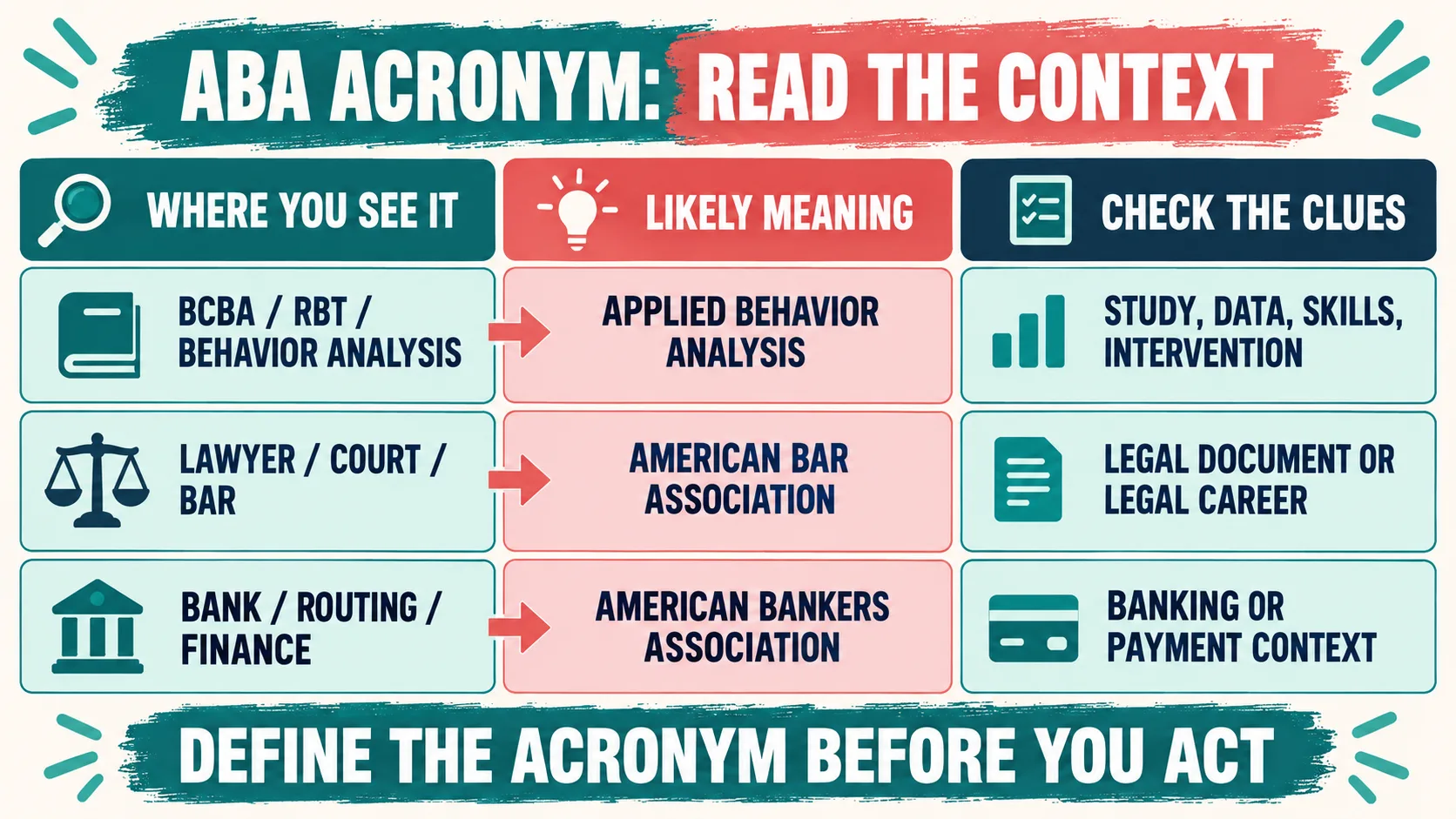
In behavior analysis, APBA describes the applied branch of the discipline as applied behavior analysis, abbreviated ABA. That makes Applied Behavior Analysis the likely expansion when the same page also mentions behavior, measurement, skills, intervention, supervision, reinforcement, assessment, BCBA, BCaBA, or RBT.
That is a context rule, not a license to guess. An acronym directory lists unrelated meanings such as American Bar Association and American Bankers Association. If the document discusses a lawyer, a court, a bank, routing information, or financial institutions, stop and verify the organization before interpreting ABA as Applied Behavior Analysis.
| Surrounding clues | Most likely meaning | Verify with |
|---|---|---|
| BCBA, RBT, behavior plan, data, skill acquisition | Applied Behavior Analysis | The course, handbook, or behavior-analysis organization named on the page |
| Attorney, court, bar admission, legal advocacy | American Bar Association | The legal organization or document header |
| Bank routing, payments, financial institution, banking policy | American Bankers Association | The bank, payment provider, or financial document |
| Only the three letters with no surrounding clues | Undetermined | Ask who published it and what decision the document supports |
For the broad behavior-analysis explanation, use the existing aba acronym reference. This article adds the missing context step instead of repeating the entire definition.
Use a Three-Question Context Check
When a note, flash card, or search result only says “ABA,” run these questions in order. The sequence is short enough to use during study and strong enough to prevent the most common category error.
- What field is the document discussing? Is it behavior analysis and learning, law, banking, sports, or something else?
- Which nearby terms repeat the topic? Look for credential names, data terms, service terms, or organization names rather than relying on the acronym alone.
- What action will I take with the information? Are you answering an exam question, reading a treatment record, checking a legal resource, or entering payment details?
The third question matters because a familiar expansion can still be unsafe in a high-stakes document. A BCBA candidate may correctly know that ABA often means Applied Behavior Analysis and still choose the wrong interpretation if the page is actually about a legal association or a banking code.
| Question | Behavior-analysis signal | If the signal is missing |
|---|---|---|
| What field is present? | Behavior, learning, observation, measurement, or intervention | Do not expand the acronym yet |
| What names appear nearby? | BCBA, BCaBA, RBT, BACB, supervisor, or task list | Identify the publisher or organization first |
| What action is requested? | Study, record data, plan an intervention, or review a credential | Use the document header and official link as the tie-breaker |
Separate Field, Credential, Board, and Role
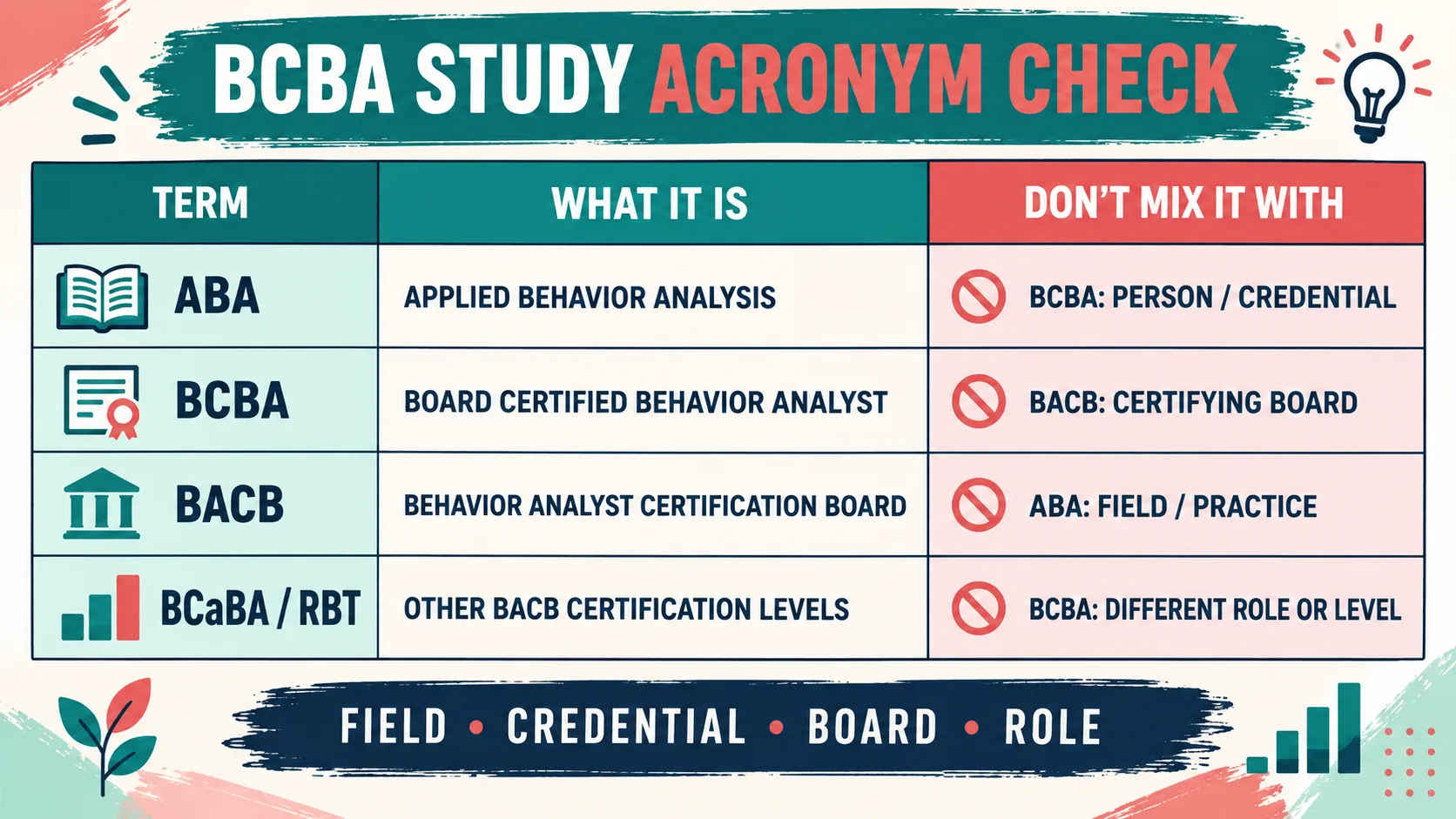
Many new learners mix the four terms because they appear on the same pages. They are connected, but they are not interchangeable. ABA is the field or applied approach. BCBA is a professional credential. BACB is the certification board. BCaBA and RBT are other BACB certification levels or roles with their own requirements and supervision relationships.
| Term | What it identifies | What it does not mean |
|---|---|---|
| ABA | Applied Behavior Analysis, an applied branch of behavior analysis | A person, license, or certification by itself |
| BCBA | Board Certified Behavior Analyst, a graduate-level BACB certification | The name of the whole field or a synonym for every ABA worker |
| BACB | Behavior Analyst Certification Board, the credentialing organization | Applied Behavior Analysis itself or a treatment plan |
| BCaBA / RBT | Other BACB certification levels with different scopes and supervision relationships | Another spelling of BCBA or proof that two roles are identical |
The BACB’s current overview and BCBA resources are useful for credential names and certification boundaries. APBA’s behavior-analysis overview is useful for the field context. When a source is about state practice, licensure, or employment, check the relevant regulator or employer as well; an acronym definition cannot answer those separate questions.
Apply the Rule to BCBA Study Notes
In a study guide, the same three letters can appear beside different kinds of information. The clue is usually the noun or verb that follows it. “ABA data,” “ABA intervention,” and “ABA dimensions” point toward Applied Behavior Analysis. “BCBA certification,” “BACB handbook,” and “RBT supervision” point toward credentials, a board, or a role.
- Definition clue: if the sentence explains principles, procedures, measurement, or socially significant behavior, ABA most likely means Applied Behavior Analysis.
- Credential clue: if the sentence names eligibility, examination, certification, or supervision, check whether it actually means BCBA, BCaBA, RBT, or BACB.
- Document clue: if an official handbook, task list, or BACB page is linked, follow the source’s own terminology instead of shortening every term to ABA.
- Scenario clue: if a practice question asks what a professional may do, the answer may depend on credential and supervision—not on the fact that the service is ABA.
This distinction helps you read questions more accurately. “Which ABA procedure fits?” is a field-and-procedure question. “Who may supervise this work?” is a credential-and-scope question. Treating both as an acronym-definition question can send you toward the wrong answer choice.
Know When Not to Assume Applied Behavior Analysis
Ambiguity is not a defect you can solve by repeating the most familiar definition. It is a signal to inspect the document. If the publisher is not a behavior-analysis organization and the surrounding content does not mention behavior, learning, data, or credentials, do not force an ABA study interpretation.
| Document setting | Risk of assuming the wrong meaning | Safer move |
|---|---|---|
| BCBA course, ABA textbook, or behavior record | You could confuse a field term with a credential | Read the definition and nearby credential names together |
| Legal website, court material, or bar resource | You could open or cite the wrong organization | Use the legal publisher’s full name and official domain |
| Banking, routing, or payment material | You could misunderstand an operational or financial instruction | Confirm the bank or payment organization before acting |
| Search snippet with no publisher context | The snippet may omit the sentence that disambiguates the term | Open the source and read the title, header, and first paragraph |
Write the Full Term Once, Then Use the Acronym Consistently
When you create study notes, define an acronym on first use. A clear note might say, “Applied Behavior Analysis (ABA) uses behavior-analytic principles and procedures to address socially significant behavior.” Later, you can use ABA, but keep BCBA, BACB, BCaBA, and RBT written as their own terms.
- Write the full term the first time it appears.
- Place the abbreviation in parentheses immediately after the full term.
- Use the same capitalization throughout the page.
- Define a related credential separately instead of treating it as a synonym.
- Keep the source link next to a date-sensitive certification claim.
This is more than a style preference. It lets a study partner see whether you understand the category of the term. If you write “ABA supervises RBTs,” for example, the sentence hides an important distinction: a credentialed professional may supervise work under applicable requirements, while ABA itself is not a person.
Avoid Common Acronym Errors
Use this final error check before saving a flash card or choosing an answer:
- Did I expand ABA from the surrounding topic instead of from memory alone?
- Did I accidentally use ABA when the question asked for a credential or board?
- Did I distinguish BCBA from BCaBA and RBT instead of treating all three as the same role?
- Did I confirm whether the source is a BACB, APBA, legal, banking, or unrelated publisher?
- Did I avoid turning a study definition into a promise about state licensure or clinical outcomes?
For a deeper list of behavior-analysis terms, continue to the site’s Applied Behavior Analysis terminology guide. For exam-focused dimensions, use the 7 dimensions of ABA exam guide. Those pages serve different jobs; this one is the acronym checkpoint that comes first.
Use Practice After the Terminology Check
Once you can separate field, credential, board, and role, practice questions become more useful. You can focus on the scenario instead of losing time to a three-letter label. Review whether a missed answer came from an acronym misunderstanding, a definition gap, or an application error.
- Underline the full term or credential named in the question.
- Circle the context clues that establish the field.
- Explain why the tempting alternative expansion does not fit.
- Review the official source when the question involves certification or supervision.
After the terminology check, use the free BCBA mock exam as original practice. It is not an official BACB exam, does not determine your credential, and cannot guarantee a passing result.
FAQ
What does ABA stand for in BCBA materials? In a behavior-analysis or BCBA study context, ABA usually means Applied Behavior Analysis. Confirm the surrounding terms and publisher before finalizing the expansion because the same letters have unrelated meanings elsewhere.
Is ABA the same as BCBA? No. ABA commonly names Applied Behavior Analysis, the applied branch of behavior analysis. BCBA stands for Board Certified Behavior Analyst, a graduate-level certification. One is a field term; the other identifies a credentialed professional. What does BACB stand for? BACB stands for Behavior Analyst Certification Board. It is the credentialing organization, not another name for Applied Behavior Analysis. Use the current BACB site and handbook for certification requirements. Can ABA mean American Bar Association? Yes, in a legal context. It can also mean American Bankers Association in a banking context. The document’s publisher and surrounding terms determine which expansion is appropriate.
Should I write out ABA in every sentence? Usually, define Applied Behavior Analysis in full on first use, put ABA in parentheses, and then use the acronym consistently. Define BCBA, BACB, BCaBA, and RBT separately when they first appear. Bottom line: the best answer to an ABA acronym question is contextual. Identify the field, inspect the neighboring terms, verify the publisher, and keep the field separate from the credential, board, and role.
Take the Free BCBA Mock Exam
A useful next step is to apply this idea in a fresh set of BCBA-style practice questions and review the feedback. Take the Free BCBA Mock Exam



