

If you are asking how many years to become a BCBA, the most accurate answer is: there is no single BACB-defined number. Your calendar depends on where you start, whether your degree and behavior-analytic coursework qualify, how quickly you can complete supervised fieldwork, how complete your application is, how much exam preparation you need, and whether your state adds a separate licensure step.
Table of Contents
- How Many Years to Become a BCBA?
- Start With Your Current Position
- Fixed Gates Versus Parallel Steps
- Fieldwork Pace Changes the Calendar
- Use the 2026-to-2027 Checkpoint
- Application Review and Exam Timing
- Build Your Personal BCBA Timeline
- Common Delay Points
- Turn the Timeline Into a BCBA Study Plan
- FAQ
- Take the Free BCBA Mock Exam
As a planning illustration, starting after high school may take about six to eight or more years; with a bachelor’s degree, about two to five or more; with a qualifying master’s degree, about one to three or more. These are not BACB rules. Use the calculator below, then verify current BACB requirements before choosing a program or fieldwork plan.
The existing how many years to become a bcba timeline page covers the broad pathway. This article adds a narrower planning task: identify the gates that must happen in sequence, the milestones that may overlap, and the dates or assumptions that can change your personal estimate.
How Many Years to Become a BCBA?
Think in layers rather than one universal duration: qualifying education, supervised fieldwork, application, examination, and any separate state-licensure process. Some layers can overlap only when your pathway and current BACB requirements permit it.
| Planning question | Why it changes the answer | What to verify |
|---|---|---|
| What degree do you already hold? | The education layer can be the largest part of the calendar if you are starting from high school or a nonqualifying degree. | Degree level, institution, transcript, and the pathway rules that apply when you apply. |
| Is the coursework pathway verified? | A job title or a few ABA classes does not automatically establish eligibility. | Current BACB handbook language and your program’s documented course sequence. |
| How many fieldwork hours can you complete compliantly? | Your monthly pace determines how long the fieldwork layer lasts, and not every work hour necessarily qualifies. | Supervisor availability, monthly limits, supervision, documentation, and unrestricted activities. |
| When can you submit a complete application? | Incomplete documents create calendar time that a simple “years” estimate hides. | Current application instructions, payment, transcripts, fieldwork forms, and any deadline that applies. |
Start With Your Current Position
Choose the row that best describes your situation today. The ranges below are deliberately labeled as planning illustrations. They are not an eligibility decision, and they do not account for every university schedule, supervisor arrangement, exam result, or state rule.
| Starting point | Typical layers still on your calendar | Illustrative planning range | Main uncertainty |
|---|---|---|---|
| No college degree yet | Undergraduate degree, qualifying graduate education/coursework, fieldwork, application, exam, and any state process. | About 6–8+ years as a planning illustration. | Program sequence, whether fieldwork can overlap, and the pathway available when you apply. |
| Bachelor’s degree completed | Qualifying master’s/coursework, fieldwork, application, exam, and any state process. | About 2–5+ years as a planning illustration. | Whether the bachelor’s and the selected graduate route satisfy the current pathway conditions. |
| Qualifying master’s completed | Any remaining coursework or verification, fieldwork, application review, exam preparation, and any state process. | About 1–3+ years as a planning illustration. | Fieldwork pace, documentation quality, examination timing, and whether the degree/coursework is accepted for your route. |
Fixed Gates Versus Parallel Steps
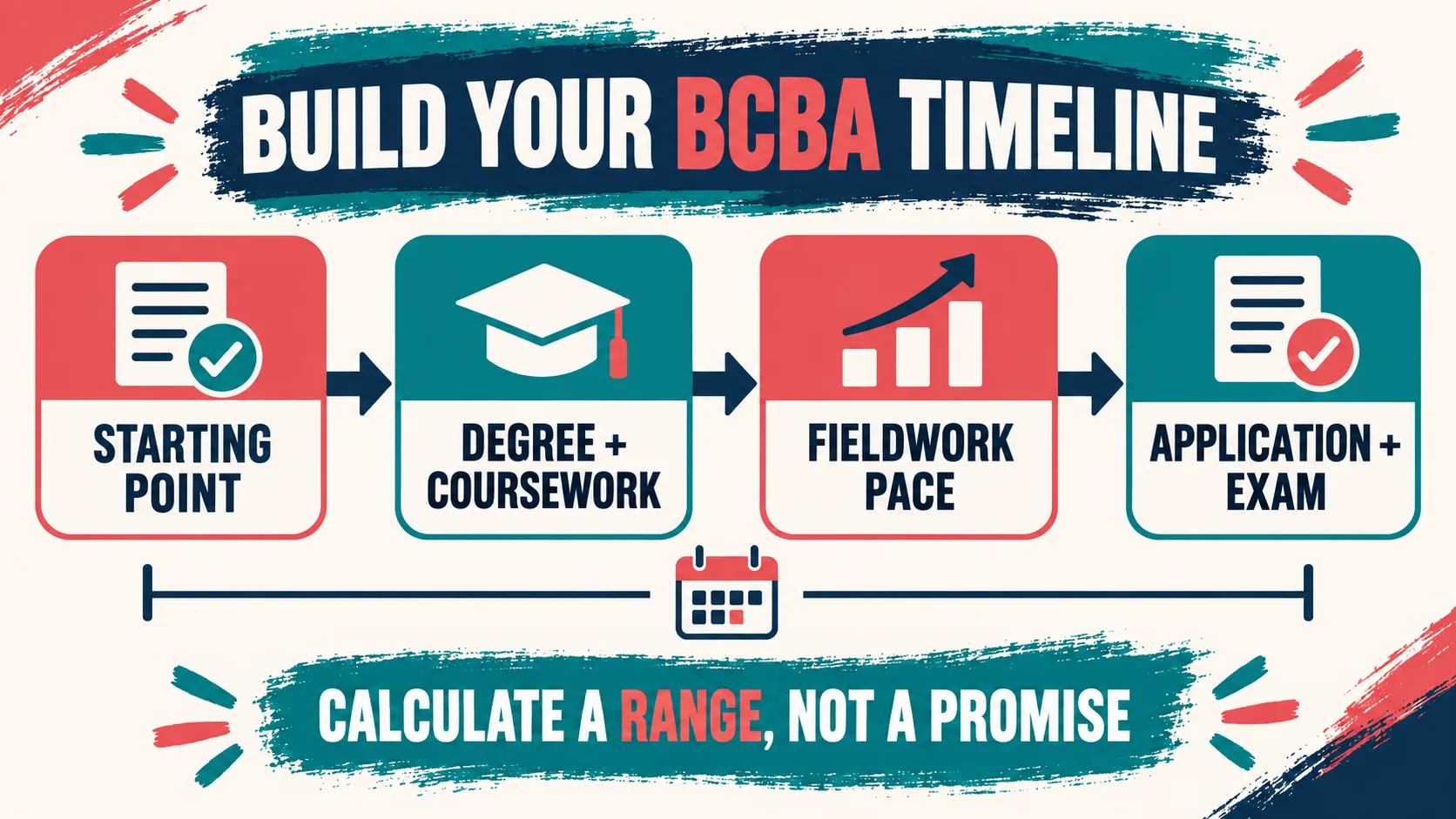
When people ask how long the BCBA path takes, they often add every step as if the steps were completely separate. Real calendars can be more efficient than that, but they cannot be compressed without limit. Education requirements must be satisfied, fieldwork must be documented under the applicable rules, and the application must be complete before the certification process can move forward.
| Milestone | Can it overlap another step? | Planning rule |
|---|---|---|
| Degree completion | Usually the degree itself is a fixed gate; other activities may occur while you are enrolled. | Do not assume enrollment equals conferral or eligibility. |
| Behavior-analytic coursework | It may be part of a degree or a defined coursework route, depending on the current rules. | Verify the actual pathway and course documentation before counting it. |
| Supervised fieldwork | It may overlap education in some pathways when the eligibility and supervision conditions are met. | Count only compliant, documented hours; work hours alone are not enough. |
| Exam preparation | Study can overlap final paperwork, but exam authorization and scheduling still have their own dependencies. | Set a study window after confirming what you are eligible and authorized to do. |
| State licensure | It may be checked or prepared in parallel, but it is separate from BACB certification. | Add a state-specific verification step; do not treat a BACB estimate as a license estimate. |
Fieldwork Pace Changes the Calendar
Fieldwork often determines whether a personal estimate is closer to one year or several years after the education layer. BACB materials describe supervised fieldwork pathways that include 2,000 hours of supervised fieldwork or 1,500 hours of concentrated supervised fieldwork, subject to the current handbook and documentation rules. The pace is not simply “hours worked”: supervision, qualifying activities, monthly limits, and records all matter.
| Illustrative monthly qualifying pace | 2,000-hour pathway math | 1,500-hour concentrated pathway math | What this table does not decide |
|---|---|---|---|
| 50 hours per month | About 40 months | About 30 months | Whether every hour is qualifying, supervised, documented, and accepted. |
| 80 hours per month | About 25 months | About 19 months | Whether your arrangement meets the current period limits and supervision requirements. |
| 100 hours per month | About 20 months | About 15 months | Whether the higher pace is realistic, available, and compliant for your setting. |
These are arithmetic examples, not permission to select a pathway by speed. Read the current BACB fieldwork guidance and confirm your plan with the responsible supervisor or program. A slower compliant pace is better than an unverifiable fast estimate.
- Write down the pathway you are considering before calculating months.
- Track qualifying and unrestricted activities separately from total work hours.
- Leave a buffer for supervisor availability, holidays, schedule changes, and documentation corrections.
- Recalculate whenever the handbook, your enrollment status, or your supervision arrangement changes.
Use the 2026-to-2027 Checkpoint
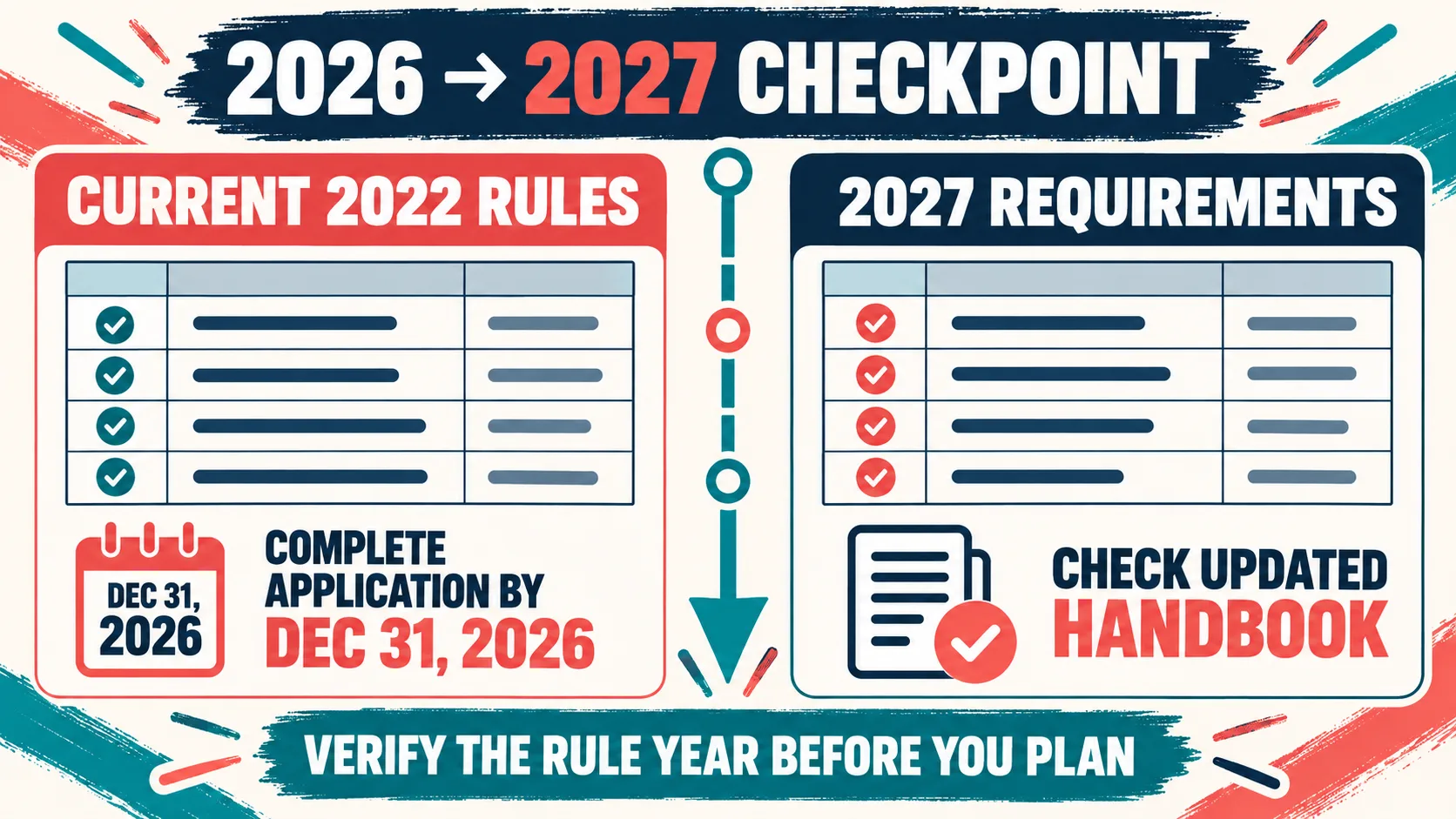
If your plan crosses the 2027 transition, do not rely on an old article or a search snippet. The BACB states that the 2027 BCBA and BCaBA requirements take effect January 1, 2027. The official transition notice says a complete application—including payment and required documentation—must be received by December 31, 2026 to be reviewed under the current 2022 requirements. “I started the process” is not the same as “a complete application was received.”
| Planning checkpoint | What the official information says | How to use it |
|---|---|---|
| Before January 1, 2027 | A complete application with payment and documentation must be received by December 31, 2026 for review under the current 2022 requirements. | Treat December 31 as a completeness checkpoint, not as a promise of approval or certification by that date. |
| On or after January 1, 2027 | The 2027 requirements apply; the BACB handbook and transition materials are the controlling references. | Recheck the pathway, degree, coursework, fieldwork, and application documentation before you finalize your estimate. |
| Any state-licensure step | State rules are separate from BACB certification and differ by jurisdiction. | Add a state-agency verification task and potential processing time to your personal range. |
For current details, read the BACB 2027 requirements notice and the current BCBA Handbook. The purpose of this article is to help you spot the date-sensitive decision; it is not a substitute for the official handbook.
Application Review and Exam Timing
Once education and fieldwork evidence are ready, the application stage needs its own calendar. The BACB application lifecycle says review can take up to 45 days once all required documentation is received. Missing or corrected documents add time, so count preparation and follow-up too.
| Late-stage block | Calendar assumption | Planning buffer |
|---|---|---|
| Document assembly | You need transcripts, forms, payment, and any pathway evidence in the format requested. | Set aside time to request, check, and correct documents before submission. |
| BACB review | The official lifecycle describes up to 45 days once all required documentation is received. | Do not count from the day you begin an online form; count from a complete submission. |
| Exam preparation | The study window depends on baseline knowledge, test date, practice performance, and schedule. | Use practice data to set a review window instead of promising a fixed number of days. |
| Retest or correction | A failed attempt, missing evidence, or corrected form adds time that a best-case estimate ignores. | Keep a contingency block in the range and avoid scheduling around an immovable personal deadline. |
Build Your Personal BCBA Timeline
Use this five-line worksheet to show which assumption creates your range; it is not meant to create false precision.
- Set the start date: record the date you will actually begin the next qualifying education, coursework, or fieldwork step.
- Count fixed education time: use the program’s documented schedule, not a generic internet estimate.
- Convert fieldwork hours to months: divide the qualifying-hour requirement by a realistic compliant monthly pace, then add a buffer.
- Add application and exam blocks: include document preparation, the official review window, scheduling, and your study plan.
- Add the state check: verify whether your intended work location requires a separate license or registration and what that agency requires.
| Your input | Write your answer | Why it matters |
|---|---|---|
| Current education position | No degree / bachelor’s complete / qualifying master’s or coursework complete | Selects the correct starting scenario. |
| Pathway and handbook version | Write the official source and the date you checked it. | Prevents an old requirement from silently driving a new estimate. |
| Fieldwork plan | Target hours per month, supervisor, start date, and buffer. | Turns a total-hour requirement into a calendar estimate. |
| Submission and exam window | Document-ready date, review block, study block, and contingency. | Separates official processing time from your personal preparation time. |
- Write a best-case range only after you have written a realistic range.
- Mark every assumption that depends on another person, such as a supervisor or registrar.
- Recheck the range at each semester, fieldwork period, and handbook update.
Common Delay Points
| Delay point | What to check early | How to protect the plan |
|---|---|---|
| Coursework does not map cleanly to the pathway | Ask for written program and transcript guidance before assuming eligibility. | Keep the official handbook and program documentation with your timeline. |
| Supervisor capacity changes | Confirm the supervision arrangement, meeting pattern, documentation, and backup plan. | Use a monthly buffer and do not count future hours before they are earned and documented. |
| Application is not complete | Check payment, transcripts, forms, signatures, and date-sensitive evidence. | Use a pre-submission checklist and keep proof of what was received. |
| Exam preparation is too optimistic | Review performance by content area rather than counting study hours alone. | Reserve time for targeted review and a possible schedule change. |
| State requirements are discovered late | Check the agency for the state where you intend to practice. | Keep certification and licensure as two linked but separate workstreams. |
Turn the Timeline Into a BCBA Study Plan
Once you have a range, connect each calendar block to a measurable next action: transcript check, fieldwork documentation audit, or practice-set review by task area. That is more useful than choosing one distant test date and hoping the earlier gates line up.
- Education checkpoint: confirm the current pathway, degree, and coursework evidence.
- Fieldwork checkpoint: review hours, supervision, unrestricted activities, and missing records.
- Application checkpoint: use the BACB application lifecycle and confirm what “complete” means for your submission.
- Exam checkpoint: use original practice questions to identify weak content areas and choose the next review block.
When you are ready for exam practice, try the free BCBA mock exam. It is original practice content, not an official BACB assessment. It cannot determine your eligibility, predict a score, or guarantee a passing result, but it can help you turn a broad study period into a focused review plan.
FAQ
What is the fastest way to become a BCBA? There is no universal fastest route. The practical goal is a compliant pathway with verified coursework, realistic fieldwork, a complete application, and adequate exam preparation. Can I complete BCBA fieldwork while earning a degree? It may be possible, but it depends on the current requirements, your program, supervisor, and documentation. Verify your route before counting overlap.
Does working as an RBT or behavior technician shorten the BCBA timeline? It provides experience, but it does not automatically replace a qualifying degree, coursework, or supervised fieldwork. Map your actual activities to current requirements. How long does BACB application review take? The BACB says review can take up to 45 days once all required documentation is received. Preparation, corrections, exam scheduling, and state requirements add separate time.
What changes for BCBA applicants in 2027? The 2027 requirements take effect January 1, 2027. A complete application, including payment and documentation, must be received by December 31, 2026 for review under the current 2022 requirements. Check the current notice and handbook.
Bottom line: To answer how many years to become a BCBA, start with your current education position, calculate a compliant fieldwork pace, separate fixed gates from parallel work, add application and exam buffers, and verify the rule year. A personal range with visible assumptions is more useful than one impressive but unsupported number.
Take the Free BCBA Mock Exam
A useful next step is to apply this idea in a fresh set of BCBA-style practice questions and review the feedback. Take the Free BCBA Mock Exam



