
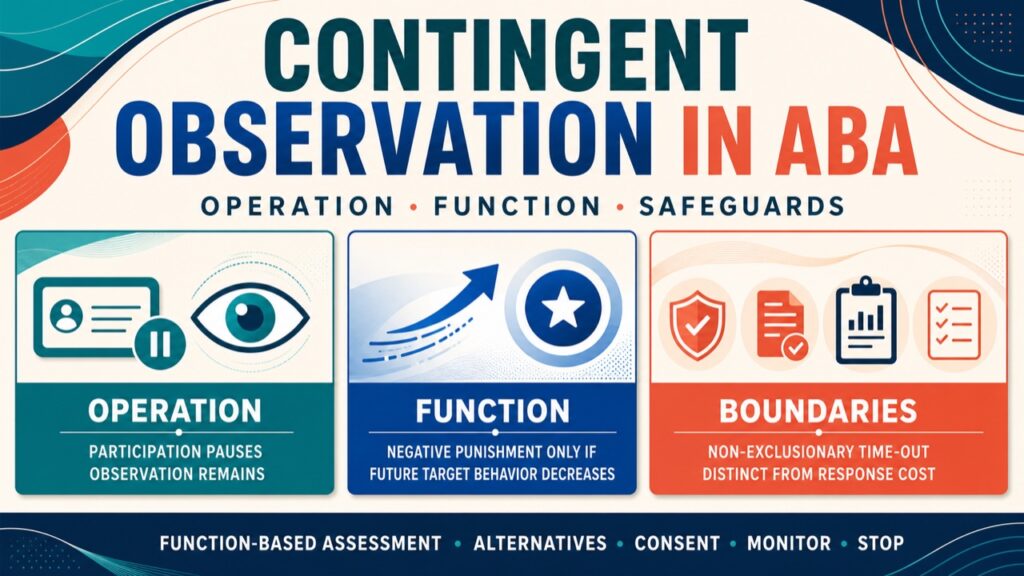
Contingent observation ABA is a form of non-exclusionary time-out discussed within behavior reduction. Following a defined target behavior, access to an ongoing reinforcing activity is paused while the person remains near enough to observe it. The label describes an arrangement, not a guaranteed behavioral effect. It functions as negative punishment only when the contingent reinforcement removal produces a measurable decrease in the future probability of the behavior. This article explains the concept, contrasts it with related procedures, and outlines the assessment and safeguards that qualified professionals consider. It is educational information, not an individualized treatment protocol.
Table of Contents
- What Is Contingent Observation in ABA?
- Contingent Observation, Exclusionary Time-Out, and Response Cost
- Examples and Nonexamples
- How Professionals Evaluate a Possible Plan
- Potential Benefits and Important Limitations
- Ethical Safeguards and Scope of Practice
- Concept Checks for BCBA Study
- Free BCBA Mock Exam Practice
- Reference
What Is Contingent Observation in ABA?
The two words in the name identify the defining features. Contingent means that the change in access follows a clearly defined behavior according to a stated plan. Observation means that the person stays in the general setting and can see the activity while participation in the relevant reinforcing context is temporarily unavailable. For example, a person may remain near a group activity without taking part in it. An observation area is therefore conceptually different from a separate time-out room.
Contingent observation is usually classified as non-exclusionary time-out: the person remains in the broader setting. The procedure still restricts access to something thought to be reinforcing, so calling it “non-exclusionary” does not make it neutral or automatically appropriate. A plan must specify the target behavior, the activity or reinforcement being changed, how observers will measure outcomes, and what would trigger reassessment or discontinuation.
The consequence is described as negative punishment when two conditions are supported by data: a stimulus or activity is removed following the response, and the future frequency of that response decreases. The first condition describes the programmed contingency; the second establishes its behavioral function. If the behavior does not decrease—or if it increases—the negative-punishment label has not been demonstrated merely because access was removed. Observation itself may also be reinforcing for some people, which is one reason function and outcome cannot be assumed.
Contingent Observation, Exclusionary Time-Out, and Response Cost
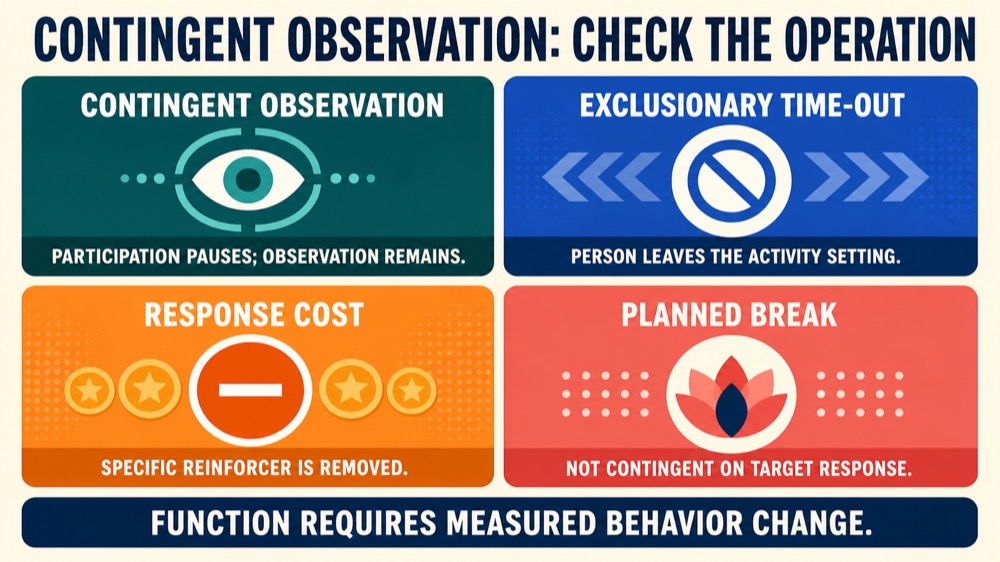
These terms all can involve a reduction in access to reinforcement, but they describe different operations. Precise identification depends on what changes after the response, not on the adult’s intention or the everyday phrase “take a break.”
- Contingent observation: participation in a particular reinforcing activity is paused while the person remains in the general setting and can observe.
- Exclusionary time-out: the person is removed from the activity setting to another location, so direct observation of the activity may no longer be available.
- Response cost: a specified amount of an earned or available reinforcer, such as a point or token, is removed following a response.
- Planned break: access changes independently of the target behavior, such as a scheduled regulation or rest break; this is not contingent observation.
- Extinction: the reinforcer that previously maintained a response is withheld; this is conceptually different from removing access to a broader reinforcing setting after a response.
One vignette can help separate the operations. Imagine that a written support plan addresses disruption during a preferred group activity. If participation pauses while the learner remains nearby and can observe, the programmed operation resembles contingent observation. If the learner is moved to a different room, it resembles exclusionary time-out. If one earned point is removed but participation continues, it resembles response cost. Whether any of these arrangements actually functions as punishment depends on measured behavior change over time.
Examples and Nonexamples
Consider a hypothetical, professionally designed plan in which a defined response occurs during an enjoyable collaborative activity. The plan temporarily changes access to participation while the person remains in the shared environment and can watch the activity. The team records the response, the programmed consequence, re-entry, and subsequent behavior. This illustrates the structure of contingent observation without implying that the procedure is suitable for that person or that observation is nonreinforcing.
Now change one feature at a time. Moving the person to a separate location changes the arrangement toward exclusionary time-out. Removing a token while leaving participation unchanged describes response cost. Offering a voluntary break that the person can request describes an antecedent or self-management support rather than punishment. Pausing an activity because of an unrelated schedule change is not contingent on the target behavior. These nonexamples show why the observable contingency matters more than informal labels.
A second conceptual example concerns outcome. Suppose participation is paused after the response, but the response remains stable across well-designed observations. The consequence was programmed, yet a punishing effect was not demonstrated. If the response decreases while distress, avoidance, or another harmful response rises, a narrow reduction in the original measure is not sufficient evidence of an acceptable intervention. Benefit, adverse effects, social validity, and quality of life all belong in the evaluation.
How Professionals Evaluate a Possible Plan
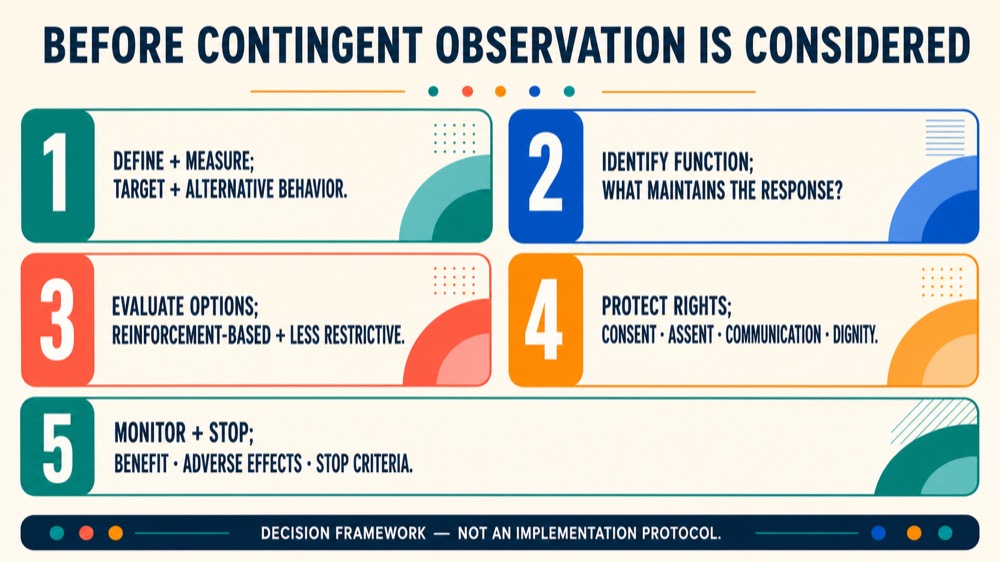
This section is a decision framework rather than a step-by-step implementation guide. Before considering contingent observation, a qualified professional should conduct an individualized, function-based assessment and examine whether the activity is actually reinforcing, what maintains the behavior, and whether observation might provide attention, escape, sensory stimulation, or another valued outcome. A procedure selected without that analysis can be ineffective, counterproductive, or unnecessarily restrictive.
Assessment should lead first to reinforcement-based and less restrictive options that teach useful alternatives. Depending on the identified function and context, those options may include changing difficult antecedents, improving predictability, teaching functional communication, strengthening tolerance or coping skills, arranging choice, and reinforcing an appropriate alternative response. Contingent observation should not substitute for teaching or for correcting environmental barriers.
If a credentialed provider and the relevant decision makers consider the procedure, the written plan needs operational clarity and individualized safeguards. Important review questions include:
- Is the target behavior observable, measurable, socially significant, and assessed in context?
- Does the evidence support the proposed function and identify the reinforcement removal being considered?
- Which reinforcement-based, preventive, and less restrictive strategies have been evaluated?
- How will informed consent, assent when applicable, communication access, dignity, and cultural context be protected?
- What measures will capture benefit, procedural integrity, emotional responding, avoidance, escalation, and other possible adverse effects?
- Who is qualified to supervise the plan, and what competency-based training and ongoing review are required?
- What objective criteria require modification, pause, or termination of the procedure?
Parameters such as setting, access change, re-entry, monitoring, and review cannot be copied from a generic article. They depend on the person, function, risk assessment, legal and organizational requirements, and the approved behavior plan. Health, safety, communication, toileting, hydration, and access to necessary support remain protected; a reduction procedure is not a reason to ignore needs or requests for help.
Potential Benefits and Important Limitations
Conceptually, contingent observation maintains proximity to the ongoing environment and may preserve some access to instruction or models of appropriate participation. It may also be less spatially restrictive than moving a person to a separate room. These possible advantages are comparative, not proof that the procedure is benign or indicated.
Several limitations are central. Watching the activity may itself be reinforcing. The response may be maintained by escape, attention, automatic reinforcement, or multiple variables that the arrangement does not address. The contingency may also evoke distress, avoidance, aggression, or attempts to leave. In busy settings, implementation can drift, data can be incomplete, and different adults may change access in inconsistent ways. These factors can obscure whether the procedure produced benefit or harm.
Social consequences matter as well. Being unable to participate near peers can feel stigmatizing or humiliating, even without physical separation. Lost instructional and social opportunities should be measured rather than treated as negligible. A decrease in one target behavior does not by itself establish social validity, generalization, durability, or improvement in meaningful daily outcomes.
Ethical Safeguards and Scope of Practice
Contingent observation is a behavior-reduction procedure involving restricted access to reinforcement, so conservative review is warranted. The BACB BCBA Test Content Outline includes competencies related to identifying behavioral function, selecting interventions, considering unwanted effects, monitoring effectiveness, and evaluating procedural integrity. The outline is a content map for BCBA examination preparation; it is not a substitute for the current Ethics Code, local law, organizational policy, supervision, or an individualized clinical record.
A sound review protects autonomy and dignity. Informed consent should describe material risks, alternatives, data review, and the right to raise concerns. Assent and withdrawal signals should be considered when applicable, and communication must remain available. The procedure must not become seclusion, restraint, public shaming, forced compliance, or deprivation of basic needs. Safety plans should address escalation without turning the observation arrangement into an enforcement exercise.
Ongoing data review should extend beyond the target response. Teams should examine skill acquisition, participation, emotional responding, attempts to escape, relationship effects, and stakeholder-reported acceptability. They should also verify treatment integrity: an apparent lack of effect may reflect an incorrect functional hypothesis, an ineffective consequence, inconsistent implementation, or an unsuitable measure. Any meaningful adverse effect or failure to meet predefined benefit criteria calls for prompt reassessment under qualified supervision.
Jurisdiction, setting, funder rules, school policy, and client protections can differ. Competence with behavioral concepts does not by itself grant legal authority to design or authorize every restrictive procedure. Professionals should work within their credential, training, supervision, and applicable requirements, and they should document why the selected approach is necessary relative to safer alternatives.
Concept Checks for BCBA Study
For exam preparation, focus on discriminating the operation from its function and from neighboring concepts. Avoid memorizing a chair, timer, script, or fixed location; those surface details do not define the principle.
- Can you state what is contingent on the target behavior?
- Can you identify whether participation, a specific reinforcer, or the entire setting changes?
- Can you explain why non-exclusionary time-out still requires ethical scrutiny?
- Can you distinguish a programmed consequence from a demonstrated negative punishment effect?
- Can you identify when observation may remain reinforcing?
- Can you name reinforcement-based and less restrictive alternatives that require evaluation?
- Can you specify what data would reveal benefit, treatment drift, or adverse effects?
A useful study exercise is to write several short vignettes and change one variable at a time: location, participation, token loss, schedule, behavioral contingency, or measured outcome. Then label the operation and state what additional data would be needed before assigning a behavioral function. This method builds conceptual precision without turning a study example into treatment advice.
Free BCBA Mock Exam Practice
Use the Free BCBA Mock Exam to practice distinguishing behavioral operations, functions, and ethical decision points. The practice resource can help you identify topics for further study; it does not reproduce or guarantee the content of any certification examination.



