

What Does ACT in ABA Mean?
ACT in ABA usually refers to the behavior-analytic discussion or use of acceptance and commitment therapy or acceptance and commitment training. The acronym is shared, but the label does not settle whether a service is psychotherapy, behavior-analytic training, consultation, or something outside a practitioner’s role. That determination depends on the goals, procedures, functional assessment, provider competence, setting, representations made to the client, and applicable legal requirements.
Table of Contents
- What Does ACT in ABA Mean?
- Training Versus Therapy Is Not a Labeling Shortcut
- The Conceptual Foundations: Functional Contextualism and RFT
- The Six ACT Processes at a Conceptual Level
- What the Evidence and Professional Debate Support
- A Professional Decision Checklist Before Use
- Why Direct Functional Assessment Remains Essential
- Three Applied Evaluation Cases
- ACT and the BCBA Exam
- Frequently Asked Questions
- Practice the Foundations With a Free BCBA Mock Exam
- References
Acceptance and commitment therapy was developed as a contextual behavioral approach to psychotherapy. Some authors use acceptance and commitment training, or ACTraining, for nonpsychotherapeutic applications. Renaming a procedure “training” does not place it automatically within ABA or a BCBA’s competence. A defensible service still requires a behavioral rationale, direct ongoing assessment, measurable outcomes, informed participation, and data-based evaluation.
The 6th Edition BCBA Test Content Outline does not name ACT. It does include radical behaviorism, assessment, intervention selection, data-based evaluation, ethics, and professional competence—the foundations needed to evaluate a proposed approach.
Training Versus Therapy Is Not a Labeling Shortcut
It is too simple to say that therapy always treats a diagnosis while training never does, or that the absence of a diagnosis makes a service nonpsychotherapeutic. Professional boundaries vary by jurisdiction and role. A BCBA credential does not replace another license, expand a state-defined scope, or override employer, contract, or funder requirements.
- Scope of practice asks whether the activity belongs within the profession and the practitioner’s legally and contractually defined role.
- Scope of competence asks whether the individual can perform the activity consistently and proficiently, supported by appropriate study, training, supervised experience, consultation, or co-treatment.
- Defined role asks what service the provider agreed to deliver, how it was described, and whether that role was documented before services began.
- Clinical purpose asks what outcome is being targeted and whether the service is being represented or delivered as mental-health diagnosis or treatment.
The BACB Ethics Code separates these questions. Standard 1.04 addresses a documented role; 1.05 addresses scope of competence; and 1.06 requires maintaining competence. Behavior analysts must also follow applicable requirements, identify services accurately, and explain their scope. Consultation or referral may be needed when an outcome or procedure extends beyond the available role or competence.
The Conceptual Foundations: Functional Contextualism and RFT
ACT is associated with functional contextualism and relational frame theory, or RFT. Functional contextualism analyzes acts in context, while RFT offers a behavior-analytic account of learned relational responding and transformed stimulus functions. Both are relevant when verbal behavior and private events participate in complex behavior-environment relations.
Radical behaviorism does not ignore thoughts, emotions, or sensations, but it does not treat them as autonomous inner causes. A report such as “I cannot do this” is relevant verbal behavior; its literal wording does not reveal its function. Review our radical versus methodological behaviorism guide for the broader distinction.
Function cannot be read from topography. Public and private behavior, context, consequences, learning history, and changing performance must be examined. Competent use may require knowledge of verbal behavior, RFT, contextual behavioral science, functional assessment, and the population—not merely familiarity with six process names.
The Six ACT Processes at a Conceptual Level
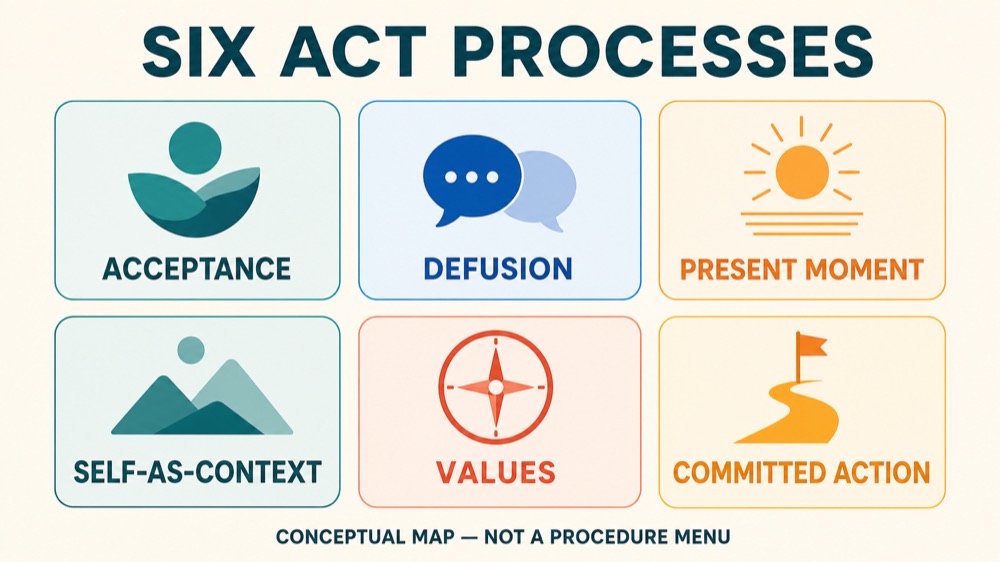
ACT literature commonly organizes psychological flexibility around six interrelated processes. The list below is a conceptual map, not a procedure menu or authorization to deliver an intervention.
- Acceptance: willingness to contact private events without making their immediate elimination a prerequisite for meaningful action.
- Cognitive defusion: changes in how verbal events function, so behavior is not rigidly governed by their literal content.
- Present-moment attention: flexible contact with relevant events occurring now rather than automatic dominance by verbal accounts of the past or future.
- Self-as-context: perspective-taking repertoires that distinguish ongoing observing from the changing content of experience.
- Values: verbally constructed, chosen qualities of action that can orient patterns of behavior; values are not treated as hidden causal entities.
- Committed action: persistent or changing patterns of overt behavior coordinated with selected directions and evaluated in context.
“Psychological flexibility” is a middle-level construct used to organize these processes. In ABA practice, it should not substitute for operationally defined targets or measured functional relations. A process label such as defusion or acceptance also does not demonstrate that a specific procedure produced change. The analyst still needs observable definitions, baseline information, implementation measures, outcome data, and plausible alternative explanations.
What the Evidence and Professional Debate Support
The literature does not support a blanket conclusion that every BCBA should use ACT. Tarbox and colleagues argued that carefully defined nonpsychotherapeutic applications can fit within ABA when they preserve behavior-analytic commitments. Kelly and Kelly described possible uses for analyzing complex verbal behavior. A Suarez review found growing single-case research but also gaps in the populations, components, and variables studied.
Sandoz, Gould, and DuFrene argued that ongoing, explicit, direct functional assessment is necessary and warned against inferring function from verbal topography. Cihon and colleagues questioned the precision, replicability, evidence, and alignment of some ACTraining work with ABA dimensions. A later special section described the disagreement as unresolved.
An ACT-related component may be considered only when the activity is lawful and within the documented role, competence is demonstrated, direct assessment supports selection, the procedure is precise and conceptually systematic, evidence fits the context, and outcomes are evaluated. Interest or a course certificate is insufficient.
A Professional Decision Checklist Before Use
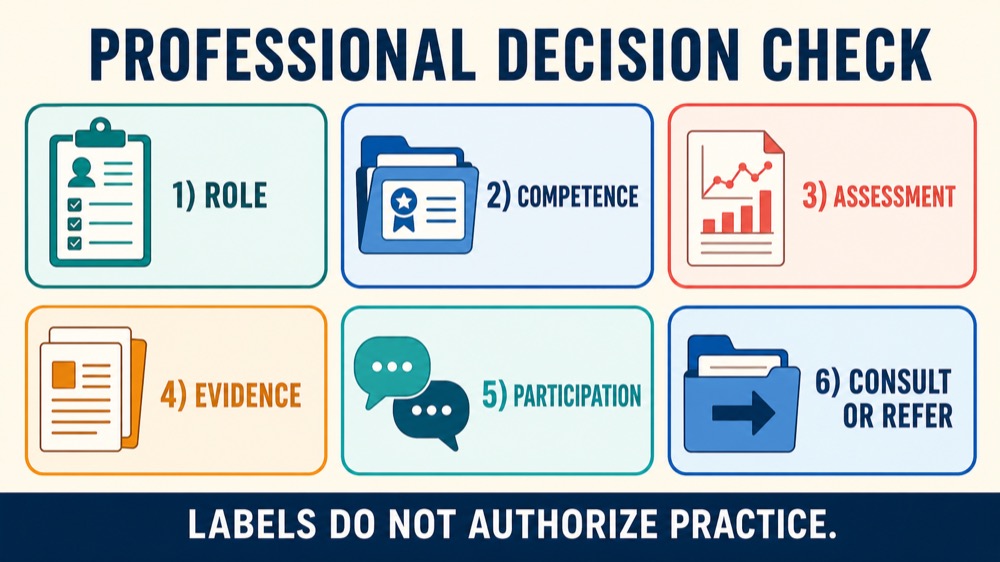
This checklist is for evaluating a proposed service, not for self-authorizing a new clinical procedure.
- Role: Is the requested outcome inside the practitioner’s documented behavioral-services role, contract, and applicable laws or licensure rules?
- Competence: Can the practitioner document relevant education, supervised performance, consultation, and proficiency with the population and procedure?
- Assessment: Do direct and ongoing data support the hypothesized functional relations and the need for this component?
- Evidence: Is the exact procedure supported for this target, population, and context rather than only by broad ACT outcome literature?
- Participation: Have the client and stakeholders received an understandable description of goals, alternatives, risks, benefits, and data plan, with informed consent and assent when applicable?
- Evaluation: Are target behavior, procedural integrity, social validity, side effects, and decision rules measured over time?
- Consult or refer: Is another qualified professional needed for mental-health diagnosis or treatment, medical needs, co-treatment, or any service outside the analyst’s competence?
BACB standard 2.13 requires behavior-analytic, evidence-based assessments suited to client needs and context. Standard 2.14 governs intervention selection: conceptual consistency, scientific evidence, assessment results, positive-reinforcement priority, context, resources, risk, benefit, side effects, and preferences. Standard 2.15 is specifically about minimizing risk; it is not the main evidence-selection standard. Standards 2.17 and 2.18 require data use and continual evaluation.
Why Direct Functional Assessment Remains Essential
ACT language can make an intervention sound individualized while still relying on topography. Two people may both say, “I am going to fail,” yet the statement and related behavior can participate in different contingencies. One person’s statement may precede escape that is reinforced by task removal; another may reliably recruit reassurance; another may occur during task engagement without disrupting performance. The sentence alone does not identify the function.
Direct assessment uses observable evidence relevant to the individual. Depending on risk and service, it may include repeated observation, experimental analysis when appropriate, measurement of verbal and overt responding, contextual variables, and single-case evaluation. Assessment continues because functions, contexts, and effects can change.
If performance improves after a multicomponent program, data may support the program’s effect without proving that a named private process caused the change. Reports should separate measured behavior from interpretive constructs and state what the design can demonstrate.
Three Applied Evaluation Cases
These cases illustrate decision points rather than providing treatment scripts.
- Staff performance: A supervisor proposes an ACT-branded workshop to improve implementation during stressful shifts. The team first defines observable staff performance, measures training integrity and outcomes, verifies that the activity fits the employment and supervisory role, evaluates evidence for the exact component, and avoids representing the workshop as mental-health treatment.
- Caregiver collaboration: A caregiver reports discomfort with a behavior plan. The analyst does not assume “experiential avoidance” or use values language to pressure adherence. The team checks treatment acceptability, feasibility, cultural and contextual fit, risks, preferences, consent, and whether the plan itself should change. Caregiver disagreement can be important information, not a symptom to overcome.
- Client verbal behavior: A learner’s statements about fear occur with school refusal. The analyst measures the relevant behavior and context, considers medical and mental-health needs, stays within the documented role, and collaborates or refers as indicated. ACT terminology is not used to bypass assessment or to treat trauma or an anxiety disorder without appropriate credentials and coordination.
ACT and the BCBA Exam
The current 6th Edition Test Content Outline does not list ACT, the hexaflex, or psychological flexibility as named tasks. Candidates should not memorize ACT exercises as if they were certain exam content. Instead, use the topic to test whether you can apply broader competencies:
- Explain private events without mentalistic causation.
- Distinguish professional scope from individual competence.
- Select assessments and interventions from evidence, function, preferences, risks, and context.
- Define behavior and evaluate change with direct, repeated measurement.
- Recognize when consultation, co-treatment, or referral is required.
Frequently Asked Questions
Does calling ACT “training” automatically make it ABA?: No. The name does not determine professional scope, competence, conceptual consistency, evidence, assessment quality, or legal requirements. Evaluate the actual service and the provider’s role.
Can a BCBA use ACT?: There is no responsible universal yes-or-no answer. A specific activity may be defensible for a particular behavior analyst in a particular role when competence, assessment, evidence, consent, data, and applicable requirements are satisfied. Other activities may require collaboration, another credential, or referral.
Is ACT a required BCBA exam topic?: ACT is not named in the current 6th Edition Test Content Outline. Related exam domains include radical behaviorism, verbal behavior, assessment, intervention selection, ethics, and professional competence.
Practice the Foundations With a Free BCBA Mock Exam
ACT should not be promoted as a guaranteed exam topic. You can, however, practice the foundational reasoning used to evaluate it: separate labels from demonstrated function, distinguish private events from mentalistic causes, select interventions from assessment and evidence, and identify ethical boundaries. Use our Free BCBA Mock Exam to practice related concepts and professional decision making with original questions and feedback.
References
- Behavior Analyst Certification Board. BCBA Test Content Outline (6th ed.).
- Behavior Analyst Certification Board. Ethics Code for Behavior Analysts.
- Tarbox, J., Szabo, T. G., & Aclan, M. Acceptance and Commitment Training Within the Scope of Practice of Applied Behavior Analysis.
- Sandoz, E. K., Gould, E. R., & DuFrene, T. Ongoing, Explicit, and Direct Functional Assessment Is a Necessary Component of ACT as Behavior Analysis.
- Kelly, A. D., & Kelly, M. E. Acceptance and Commitment Training in Applied Behavior Analysis: Where Have You Been All My Life?.
- Suarez, V. D., Moon, E. I., & Najdowski, A. C. Systematic Review of Acceptance and Commitment Training Components.
- Leaf, J. B., et al. Introduction to the Special Section: Spotlight on Acceptance and Commitment Training.



