

If you are studying the behavioral dimension of ABA, the shortest accurate answer is this: the behavior selected for analysis must be described as something observable and measurable, not as a vague trait, motive, or impression. A strong target lets another trained person identify what happened, when it happened, and how it will be counted.
Table of Contents
- What Is the Behavioral Dimension of ABA? Use an Observable Test
- What Makes a Target Behavior Behavioral?
- Behavioral vs Applied, Analytic, and Effective
- How to Rewrite a Vague Target in Three Moves
- How to Spot the Behavioral Dimension in a BCBA Question
- Common BCBA Exam Traps Around the Behavioral Dimension
- Practice the Definition Before the Distractor
- Quick Review Checklist
- Take the Free BCBA Mock Exam
That definition matters because the word behavioral can sound obvious while exam questions quietly test a different dimension. A target may be socially important, measured experimentally, effective, or generalizable as well. This guide isolates the behavioral test, shows how to rewrite weak targets, and gives you a quick way to separate similar answer choices.
What Is the Behavioral Dimension of ABA? Use an Observable Test
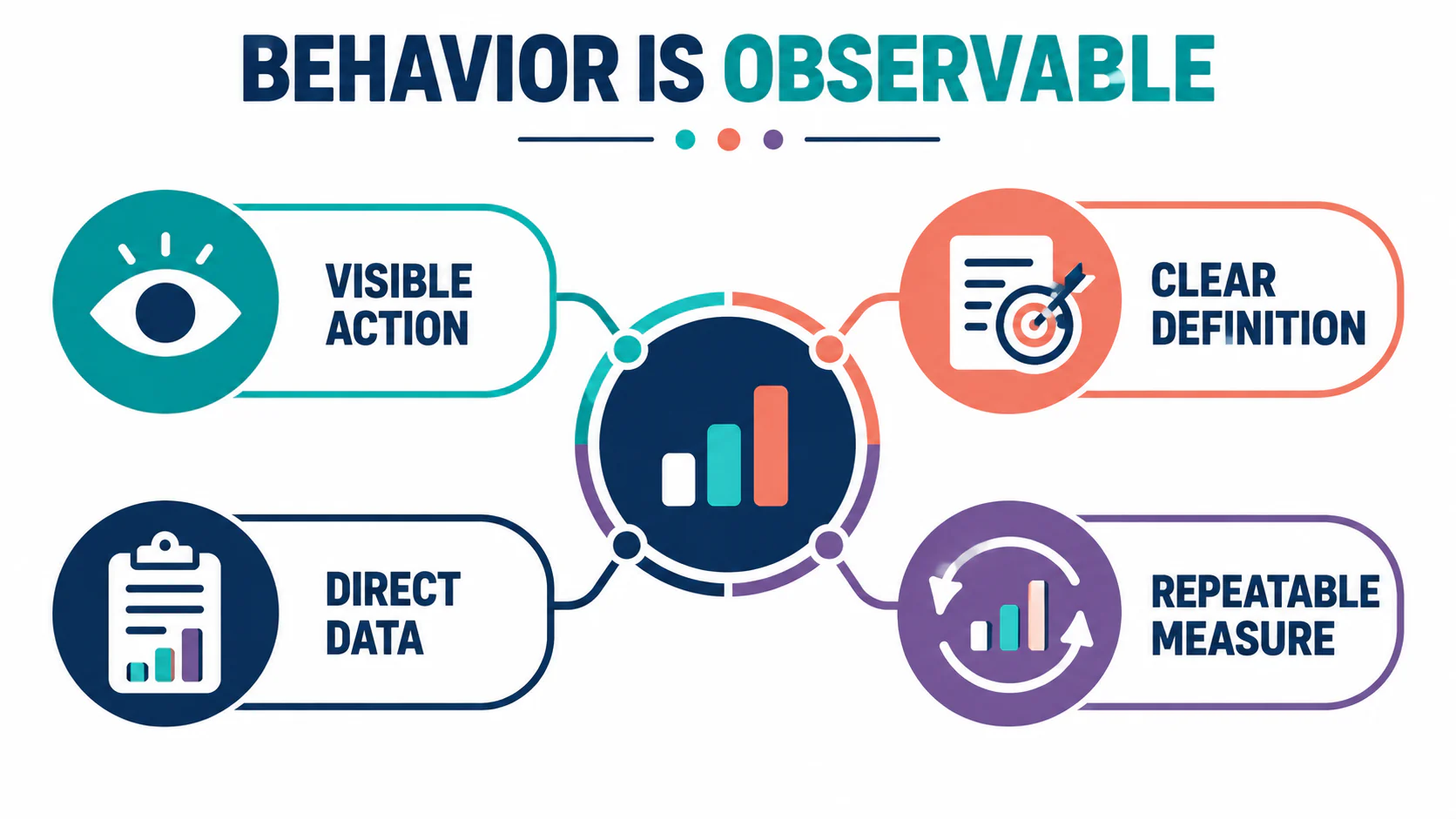
The behavioral dimension asks whether the target of analysis is behavior itself and whether that behavior can be described in terms that support direct observation and measurement. In practical BCBA work, that means moving from a label such as “noncompliance” or “poor attention” to a response definition that states what a person does or does not do.
Observable does not mean that every behavior must be dramatic or visible from across a room. It means the response can be identified using agreed-upon features rather than a private interpretation. A listener turning away, a student placing a pencil on the desk, or a learner beginning a task within a defined interval can each be described more precisely than “not motivated.”
Measurable means the definition allows data collection. Depending on the behavior, a BCBA may count frequency, record duration, measure latency, sample intervals, or record the percentage of opportunities with a correct response. The measurement system must fit the response and the decision the team needs to make.
The behavioral dimension is therefore a definition-and-data question. It is not a claim that a behavior has a particular cause, and it is not automatically a claim that an intervention worked. Those conclusions require other parts of the analysis, including assessment, experimental control, and outcome evaluation.
For current credential and examination boundaries, check the BACB BCBA certification resource and the current examination information before relying on a study summary. This article explains a concept for exam preparation; it does not replace the BACB handbook, content outline, supervision, or professional judgment.
What Makes a Target Behavior Behavioral?
A useful target has a clear response class, a context or opportunity when needed, and boundaries that reduce disagreement between observers. You do not need to write an unnecessarily long paragraph, but you do need enough detail that a second person could collect the same kind of data without guessing your meaning.
| Weak label | Why it is weak | More behavioral wording |
|---|---|---|
| Noncompliance | It does not say which instruction, response window, or action counts as failure to follow through. | After a teacher instruction, the student does not begin the named action within 30 seconds. |
| Poor attention | Attention may be inferred from posture, eye contact, or assumed engagement rather than a defined response. | During independent work, the student leaves the assigned materials and looks away for at least 5 seconds. |
| Aggression | The label can hide different topographies with different risks and measurement needs. | The open hand makes contact with another person’s arm, torso, or head. |
| Communication improved | Improvement is a judgment about change, not a description of the response being measured. | The learner independently hands over the break card within 10 seconds of the relevant opportunity. |
Notice that the stronger examples do not assume why the person responded. They specify an action, a boundary, and sometimes an opportunity or time window. That structure supports observer training and makes it easier to choose a defensible measurement system instead of collecting numbers that do not answer the question.
Behavioral vs Applied, Analytic, and Effective
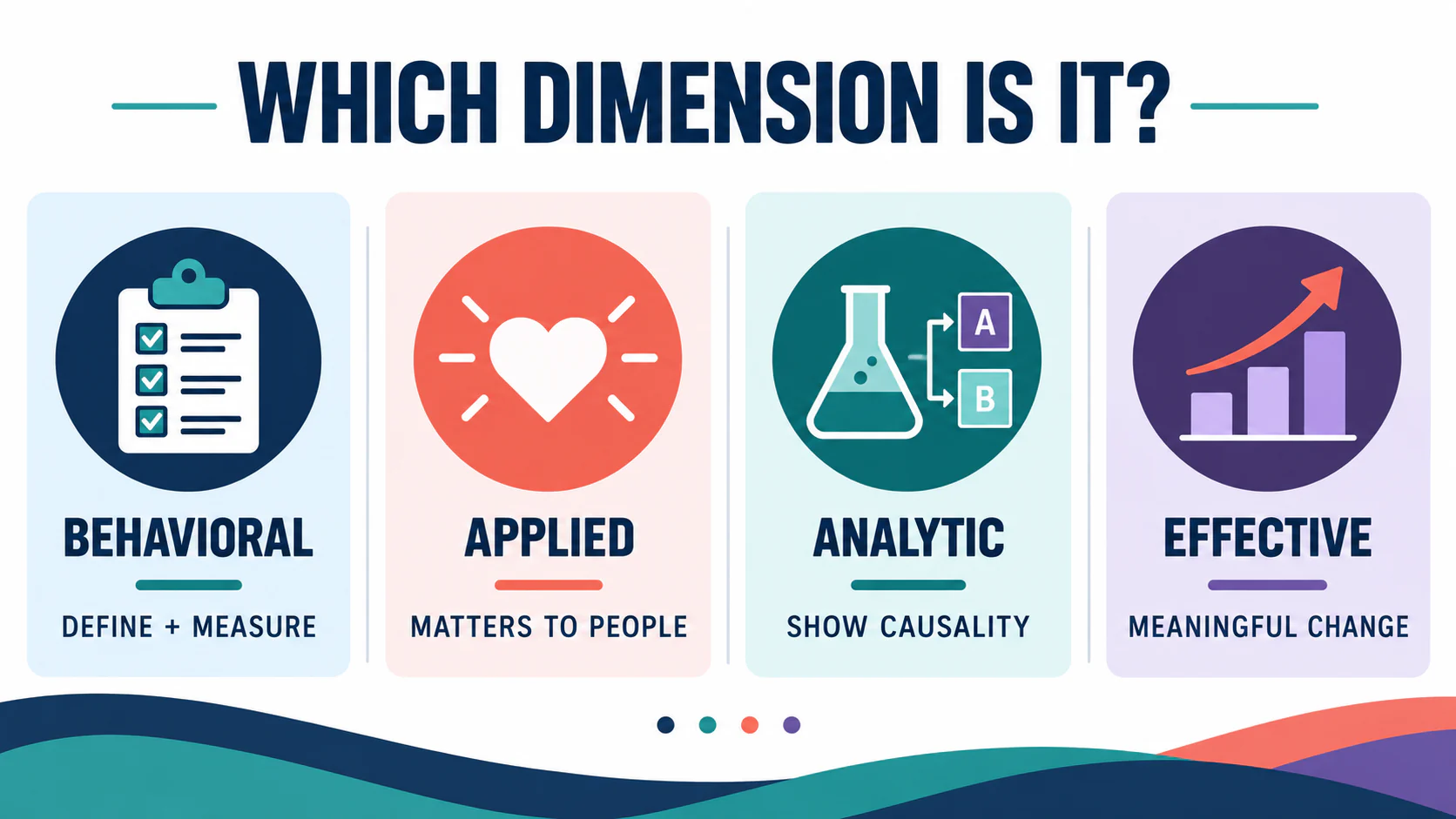
The seven dimensions of applied behavior analysis are related, but they answer different questions. In a multiple-choice item, two options may sound reasonable because a single example can involve several dimensions. Look for the wording that matches the question’s emphasis rather than selecting every true-sounding statement.
| Dimension | Primary question | Exam clue |
|---|---|---|
| Behavioral | Is the target a defined response that can be observed and measured? | The stem emphasizes operational definition, direct observation, or reliable measurement. |
| Applied | Does the target matter to the person or the people affected by the behavior? | The stem emphasizes social importance, meaningful goals, or quality of life. |
| Analytic | Is there convincing evidence that the intervention caused the behavior change? | The stem emphasizes experimental control, replication, or a functional relation. |
| Effective | Did the intervention produce a meaningful improvement, not merely a statistically visible change? | The stem emphasizes practical magnitude, meaningful outcomes, or whether change is enough. |
A target can be behavioral and applied at the same time: “independently requests a break using the student’s communication system” is observable and may also be socially important. If a question asks which dimension is demonstrated by the operational definition, behavioral is the better match. If it asks why the goal was selected, applied may be the intended answer.
How to Rewrite a Vague Target in Three Moves
When a scenario gives you a broad label, use a short rewrite process. First, identify the response topography: what would a camera or observer record? Second, add the boundary that separates an instance from a non-instance. Third, select a measurement dimension that captures change without distorting the response.
- Circle the label: mark words such as “defiant,” “anxious,” “disengaged,” “social,” or “improved” as prompts for clarification rather than finished targets.
- Ask what the person does: describe movement, vocal behavior, interaction, task response, communication, or another response that can be identified consistently.
- Add a measurement rule: decide whether count, duration, latency, interval agreement, or opportunity-based percentage best represents the response.
- Check the boundary: state what does not count when it matters, such as joking language, accidental contact, or a response outside the observation window.
For example, “increase participation” is not yet a complete target. You might define participation as placing the required materials on the desk and responding to the assigned item within 30 seconds of an instruction. That operational definition does not prove the plan will be effective, but it gives the team a behavior that can be measured and discussed.
How to Spot the Behavioral Dimension in a BCBA Question
On an exam-style question, start by identifying what the stem is asking you to judge. If the options differ mainly in how clearly they describe the response, the behavioral dimension is likely the target. If the options instead differ in social importance, causal evidence, or the size of the outcome, another dimension may be more central.
- Find the noun being evaluated: is it the target behavior, the goal, the design, the outcome, or the social value?
- Look for measurement language: phrases such as observable, operational definition, direct data, interobserver agreement, frequency, duration, or latency point toward the behavioral question.
- Separate description from explanation: “what happened” is different from “why it happened.” A functional hypothesis cannot replace a behavioral definition.
- Reject the strongest overclaim: an option that says a credential, diagnosis, intention, or single observation proves the cause of behavior is usually exceeding the evidence.
If the stem asks which statement best demonstrates the behavioral dimension, choose the answer that makes the response clear enough for direct data collection. Do not choose a merely positive goal, a preferred intervention, or a causal conclusion unless the question specifically asks about those features.
Common BCBA Exam Traps Around the Behavioral Dimension
Most mistakes come from confusing a useful clinical phrase with a complete operational definition. A team may casually say “attention,” “tantrum,” or “task refusal,” but exam questions ask whether the phrase is precise enough to guide observation and measurement. Precision is not cosmetic; it protects the interpretation of the data.
- Trait trap: “lazy” or “unmotivated” describes an interpretation, not a response. Ask what action is occurring and under which conditions.
- Outcome trap: “the plan worked” describes an outcome judgment. It does not define the behavior that changed or show how change was measured.
- Diagnosis trap: a diagnosis may provide context, but it is not an operational definition of an individual response.
- Function trap: escape, attention, and access to tangibles describe possible maintaining variables. They do not replace a topographical description of the target behavior.
- Vagueness trap: “appropriate communication” sounds desirable but needs a response form, opportunity, and boundary before it can be measured consistently.
Use the official BACB resources for current certification and examination information, and use your broader seven-dimensions study guide for the full framework. This focused page is a decision aid, not a substitute for the current handbook, exam materials, supervision, or professional judgment.
Practice the Definition Before the Distractor
A focused 10-minute review can make this keyword useful for exam preparation. Spend three minutes rewriting one vague target, three minutes choosing a measurement dimension, two minutes explaining why the target is behavioral, and two minutes comparing it with the applied or analytic dimension. Say the distinction aloud or write one sentence for each choice.
Then use the Free BCBA Mock Exam to test whether you can apply the definition under time pressure. Treat each missed item as a classification problem: did you miss the target definition, the measurement choice, the dimension being tested, or the evidence boundary? That review produces a more specific study action than simply rereading the word “behavioral.”
Is the behavioral dimension the same as an operational definition?: No. An operational definition is a tool for describing a response precisely, while the behavioral dimension is a broader feature of ABA practice and research. A strong operational definition often demonstrates the behavioral dimension, but the concepts should not be treated as interchangeable in every question.
Does behavioral mean that the behavior must be visible?: The practical exam question is whether the target can be defined and measured consistently. Do not rely on private impressions, assumed motives, or vague traits. State the response and its boundaries in a way that supports direct or otherwise defensible data collection.
What should I memorize for the BCBA exam?: Memorize the question each neighboring dimension answers, then practice applying it to scenarios. For the behavioral dimension, ask whether the target is a defined response that can be observed and measured; for applied, analytic, and effective, look for social importance, causal evidence, and meaningful change.
Quick Review Checklist
Use this final checklist to turn behavioral dimension of aba into exam-ready reasoning. The goal is not to memorize a label in isolation; it is to identify the relevant evidence and explain why the best answer fits the scenario. Key ideas to review:
- State the central definition or decision point for behavioral dimension of aba in your own words.
- Identify the detail that makes behavioral dimension of aba different from its closest related ABA term.
- Separate the observable facts in a scenario from assumptions that are not supported by the facts.
- Write one example and one nonexample so you can recognize the concept in a new setting.
Exam application checks:
- Ask what the question is actually requesting before comparing the answer choices.
- Mark the antecedent, response, consequence, or other evidence that supports the selected answer.
- Look for a distractor that describes a related process but does not answer the specific question.
Final self-check:
- Explain how you would verify the interpretation with clear observations or data.
- Change one detail in the scenario and decide whether your answer should change.
- Give a one-sentence rationale that a supervisor or study partner could evaluate.
Take the Free BCBA Mock Exam
When you are ready to apply the idea, use the free practice resource below for additional feedback. Take the Free BCBA Mock Exam



