
If you are asking, “What are the other two levels created by the BACB?” the short answer is BCaBA and RBT. The BACB operates three certification programs: BCBA, BCaBA, and RBT. BCBA is the graduate-level certification; BCaBA is the undergraduate-level certification; and RBT is the paraprofessional certification.
Table of Contents
- What Are the Other Two Levels Created by the BACB?
- The BACB Credential Ladder
- What a BCaBA Does
- What an RBT Does
- Why BCBA-D Is Not the Other Two Levels
- Which Path Fits Your Goal?
- What to Check for the 2027 Updates
- Common BACB Credential Mistakes
- Quick Recap
- Keep Building Your BCBA Knowledge
- Take the Free BCBA Mock Exam
- References
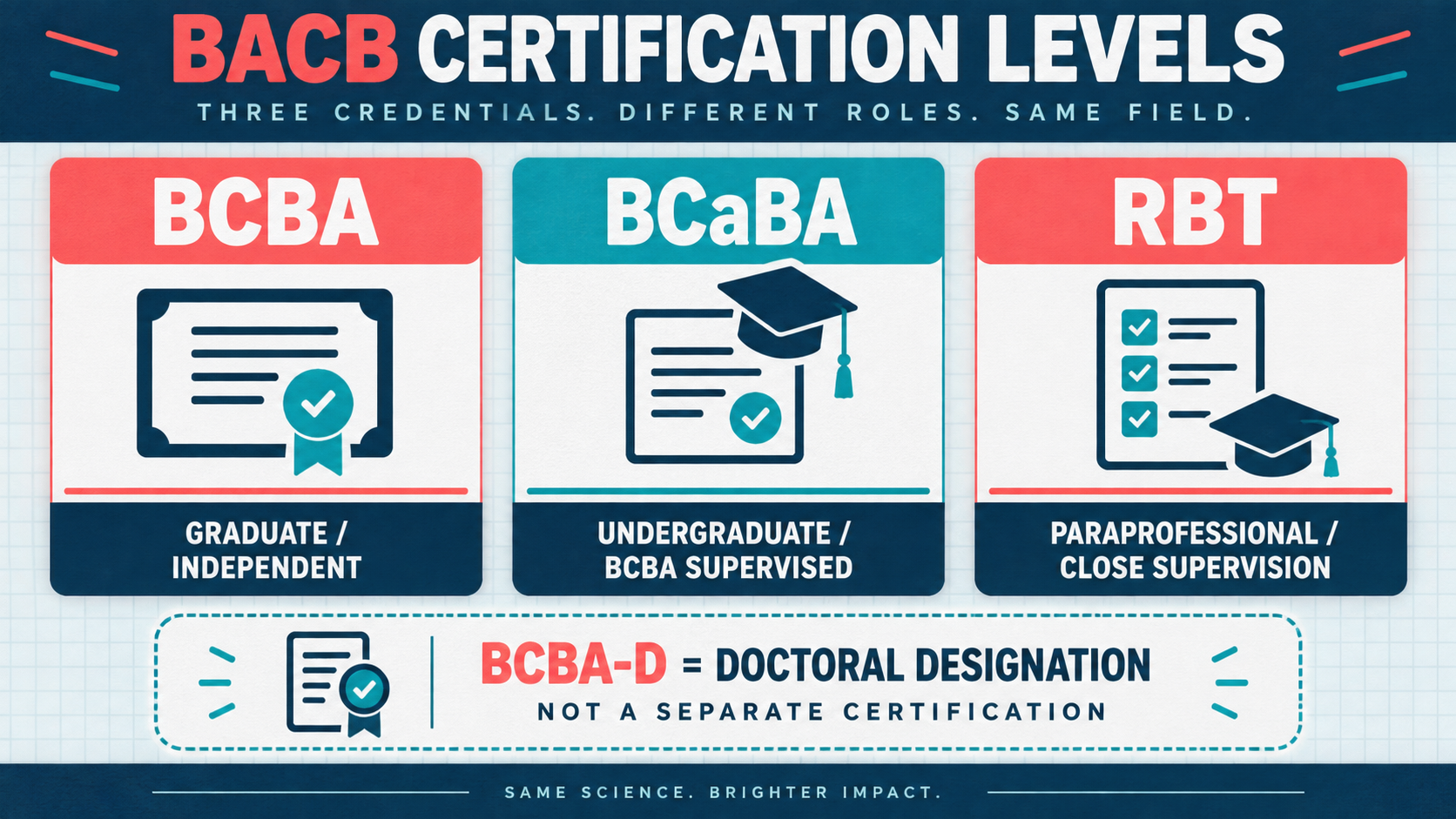
There is one important terminology trap. BCBA-D is a doctoral designation for a BCBA, not a fourth independent BACB certification. It does not grant privileges beyond BCBA certification. The practical differences between the three certification programs are education level, scope of practice, and supervision. This guide explains the two credentials that people usually mean by “the other two levels,” how they relate to BCBA work, and why the current handbook matters when you compare requirements. Table of Contents
What Are the Other Two Levels Created by the BACB?
When BCBA is the level already named in the question, the other two BACB certification programs are:
- BCaBA® — Board Certified Assistant Behavior Analyst®: an undergraduate-level certification. A BCaBA may provide behavior-analytic services under BCBA supervision and may supervise RBT work within the applicable requirements.
- RBT® — Registered Behavior Technician®: a paraprofessional certification. An RBT assists with behavior-analytic services under the direction and close supervision of an RBT Supervisor and/or RBT Requirements Coordinator.
The word “levels” can make the structure sound like three degrees. They are not degrees. They are BACB credentials with different eligibility requirements and professional responsibilities. The BCBA page describes BCBAs as independent practitioners who can supervise BCaBAs, RBTs, and other implementers; that is why BCBA sits at the independent-practice end of this basic ladder.
The BACB Credential Ladder
The fastest way to compare the three programs is to look at the training level and supervision relationship together. A credential’s title does not by itself tell you what a person is permitted to do in a particular state, payer system, or workplace, so local licensure and employer rules still matter.
| Credential | BACB describes it as | Supervision relationship | Core distinction |
|---|---|---|---|
| BCBA | Graduate-level certification | Can practice independently and supervise BCaBAs, RBTs, and implementers | The level most often associated with independent behavior-analytic practice |
| BCaBA | Undergraduate-level certification | Provides services under BCBA supervision; may supervise RBTs | Assistant-level credential between RBT and BCBA |
| RBT | Paraprofessional certification | Works under the direction and close supervision of an RBT Supervisor and/or Requirements Coordinator | Frontline implementation role within a behavior-analytic service team |
What a BCaBA Does
BCaBA stands for Board Certified Assistant Behavior Analyst. The BACB classifies it as an undergraduate-level certification. A BCaBA may provide behavior-analytic services, but the work is performed under the supervision of a BCBA. BCaBAs may also supervise RBT work when the relevant requirements are met.
That makes BCaBA different from both neighboring credentials. It is more advanced than the paraprofessional RBT role, but it does not carry the same independent-practice description as BCBA. A BCaBA candidate therefore needs to study the current BCaBA handbook, eligibility pathway, fieldwork rules, examination information, and maintenance requirements—not simply use a BCBA checklist with fewer courses.
- Education level: undergraduate-level certification.
- Practice relationship: services are provided under BCBA supervision.
- Team relationship: may supervise RBTs within the applicable BACB requirements.
- Study source: the current BCaBA handbook and BACB requirements page.
What an RBT Does
RBT stands for Registered Behavior Technician. The BACB describes RBT certification as a paraprofessional certification in behavior analysis. RBTs assist in delivering behavior-analytic services and practice under the direction and close supervision of an RBT Supervisor and/or RBT Requirements Coordinator, who is responsible for their work.
In plain language, the RBT is usually the credential closest to direct implementation of a treatment or teaching plan. “Closest to the client” does not mean “independent clinician.” The supervising structure is part of the credential’s definition, so an RBT role should not be described as equivalent to BCBA practice.
- Education and training: paraprofessional-level certification requirements.
- Practice relationship: works under direction and close supervision.
- Typical function: assists with implementing behavior-analytic services.
- Study source: the current RBT handbook and RBT requirements updates.
Why BCBA-D Is Not the Other Two Levels
Some lists show four labels: RBT, BCaBA, BCBA, and BCBA-D. That list is useful for conversation, but it can create a technical error. The BACB states that BCBA-D is a doctoral designation for a BCBA, not a separate certification. It does not grant privileges beyond BCBA certification, and BCBA-Ds must meet BCBA maintenance requirements.
Therefore, if a quiz asks for the other two BACB levels or certification programs besides BCBA, the best answer is BCaBA and RBT. If the question asks for related BACB credentials or designations, BCBA-D may appear as an additional label, but it should be identified as a designation rather than a fourth certification program.
Which Path Fits Your Goal?
Choose the credential based on the work and level of responsibility you are pursuing, then verify the current handbook rather than relying on a simplified ladder:
- Choose the RBT route if your goal is a paraprofessional role implementing behavior-analytic services with close supervision.
- Explore BCaBA if you want an undergraduate-level analyst credential and understand that services are provided under BCBA supervision.
- Explore BCBA if your goal is graduate-level certification and the eligibility requirements for independent behavior-analytic practice and supervision.
- Treat BCBA-D as an optional doctoral designation attached to BCBA certification, not as a replacement for a separate certification pathway.
What to Check for the 2027 Updates
The BACB has announced significant BCBA and BCaBA certification requirement changes taking effect January 1, 2027. The basic names in this article do not replace the handbook or tell you whether your coursework and fieldwork qualify. If you plan to apply in 2027, check the current BCBA or BCaBA handbook, transition guidance, application forms, and effective dates before committing to a study plan. Requirements can also be updated separately for RBT certification. Use the BACB page for the specific credential you want, and do not assume that a BCBA change automatically applies to RBT applicants.
Common BACB Credential Mistakes
- Answering BCBA-D when a question asks for the two other certification programs.
- Describing BCaBA as an independent practitioner instead of noting BCBA supervision.
- Describing RBT as a behavior analyst rather than a paraprofessional credential.
- Assuming all three credentials require the same degree level.
- Confusing a certification with a state license or employer job title.
- Using an old handbook after a requirement transition.
- Assuming a person’s credential alone describes every task they may perform in a local jurisdiction.
- Memorizing abbreviations without learning the supervision relationship.
Quick Recap
For the exact question, remember this sentence:
- The two BACB certification programs besides BCBA are BCaBA and RBT.
- BCaBA is undergraduate-level and works under BCBA supervision.
- RBT is a paraprofessional credential that works under close supervision.
- BCBA-D is a doctoral designation, not a separate fourth certification.
- Current handbooks and BACB updates control the requirements.
Keep Building Your BCBA Knowledge
If you are studying toward BCBA certification, the distinction between credentials is only one piece of the exam content and professional pathway. Our free BCBA mock exam can help you practice terminology and application questions while you review the current BACB handbook. Practice materials support studying, but they do not replace official eligibility, ethics, or supervision guidance. Try the Free BCBA Mock Exam For targeted review, use our what are the other two levels practice questions to apply the concept in exam-style scenarios.
Take the Free BCBA Mock Exam
If you want a low-pressure way to check your recall, use the free practice resource below. Take the Free BCBA Mock Exam
References
- BACB Board Certified Behavior Analyst
- BACB Board Certified Assistant Behavior Analyst
- BACB Registered Behavior Technician
- BACB Handbook
- 2027 BCBA and BCaBA Requirements: What You Need to Know



