
RN to BCBA is a realistic career transition, but it is not an automatic credential conversion. Nursing experience can strengthen communication, documentation, observation, safety, and teamwork. It does not, by itself, replace the degree, behavior-analytic coursework, supervised fieldwork, or BCBA examination required by the applicable BACB pathway. If you are planning for an application on or after January 1, 2027, build your plan from the current BACB handbook and transition guidance. This is an educational planning guide, not a determination of eligibility. The BACB, your university or coursework provider, your fieldwork supervisor, and your state or employer decide which requirements apply to your situation. Table of Contents
Table of Contents
- Can You Go From RN to BCBA?
- The RN to BCBA Route in One View
- What Transfers From Nursing—and What Does Not
- Choose the 2027 BCBA Pathway
- Fieldwork Is a Separate Requirement
- Questions to Ask a Program Before You Enroll
- Use a 2027 Route Check Before You Apply
- Build an RN-Friendly BCBA Exam Plan
- Common RN-to-BCBA Mistakes
- RN to BCBA FAQ
- Take the Free BCBA Mock Exam
Can You Go From RN to BCBA?
Yes, an RN can pursue BCBA certification if the person meets the BACB requirements that apply to the application date and chosen pathway. The important word is pursue. There is no general rule that an RN license, ADN, BSN, MSN, or years of nursing practice automatically converts into BCBA eligibility.
For applications beginning January 1, 2027, the BACB describes two BCBA eligibility pathways. Both require a qualifying degree, behavior-analytic coursework, supervised fieldwork, and a passing BCBA examination. Pathway 1 connects the degree to an APBA-accredited or ABAI-accredited or recognized behavior-analysis program. Pathway 2 uses a qualifying master’s degree or higher plus the required behavior-analytic coursework. Your nursing background may be the starting point, but it does not erase those gates.
This distinction is good news, not a rejection of nursing experience. An RN may already have habits that matter in behavior analysis: careful observation, precise documentation, family communication, interdisciplinary collaboration, risk awareness, and comfort working in complex care environments. The goal is to carry those strengths into ABA while deliberately building the behavior-analytic knowledge and supervised practice that the BCBA role requires.
The RN to BCBA Route in One View
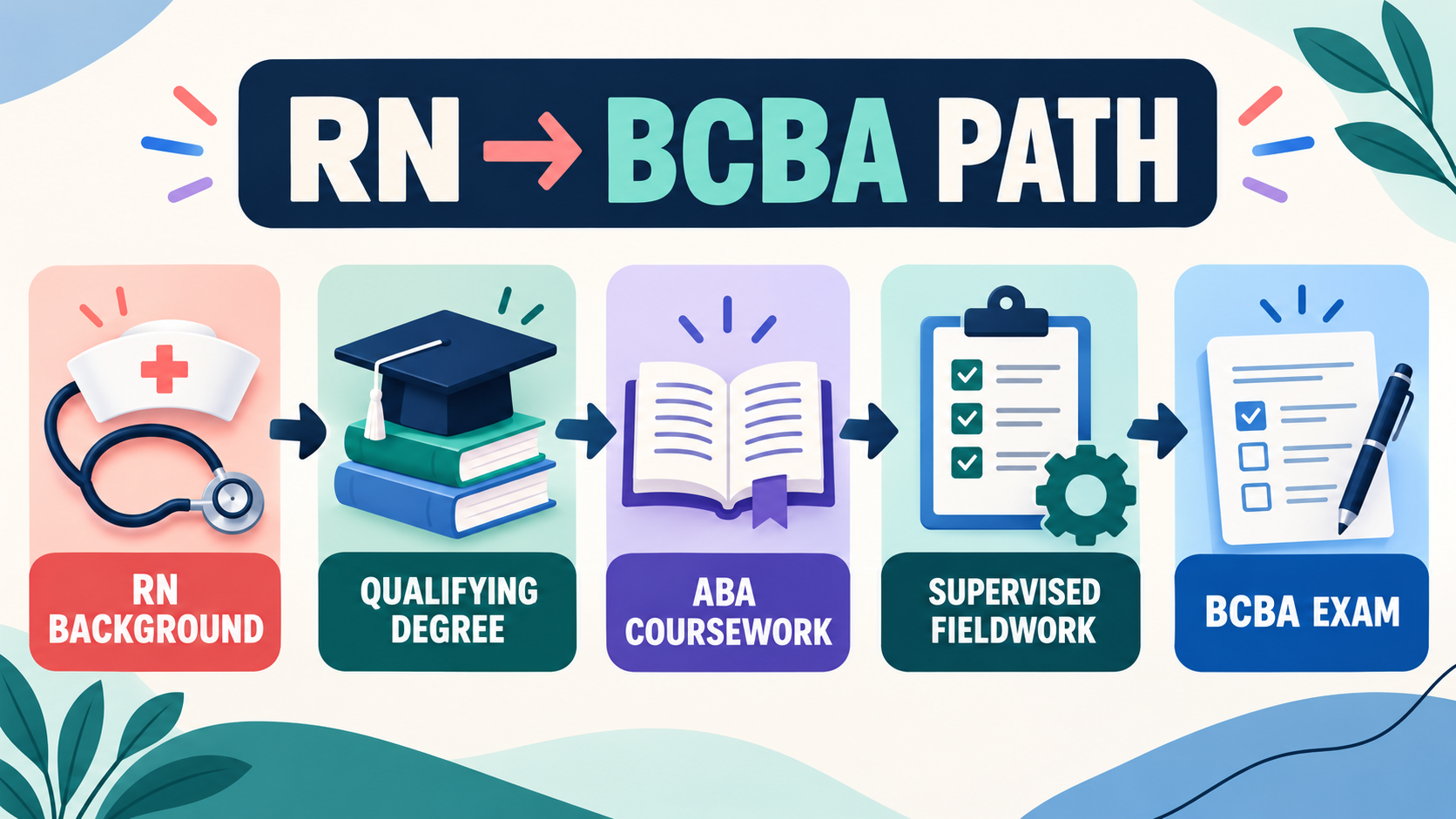
Think of the transition as a sequence rather than a single bridge. First, confirm that your existing degree satisfies the general degree prerequisite for the program you are considering. Next, select a qualifying graduate program or coursework route. Then complete the behavior-analytic curriculum, arrange fieldwork that is documented under the applicable rules, submit the application, and prepare for the exam.
| Your RN background may provide | You still need to verify or complete |
|---|---|
| Patient and family communication, handoffs, and team coordination | Behavior-analytic coursework and the pathway-specific degree requirement |
| Clinical observation, measurement habits, and detailed documentation | Supervised fieldwork in applied behavior analysis with a qualified supervisor |
| Experience noticing safety concerns and escalating risk | BCBA examination preparation and a complete certification application |
| Professional ethics, confidentiality, and scope-of-practice awareness | ABA-specific ethics, assessment, intervention, supervision, and social-validity competence |
The table is a planning tool, not a transfer-credit ruling. A university may accept some prior academic work for admission or general degree requirements, but that does not mean the BACB will treat nursing coursework as behavior-analytic coursework. Ask for the answer in writing and compare it with the current BACB handbook before you pay a deposit.
What Transfers From Nursing—and What Does Not
The most valuable transfer is often professional discipline rather than a specific course. An RN who is used to recording observable facts, communicating changes, protecting private information, and coordinating with several professionals may adapt well to behavior-analytic service delivery. Nursing can also build patience, calm decision-making, and sensitivity to how health conditions affect a person’s daily life.
Those strengths still need to be translated. Nursing documentation is not automatically an ABA measurement system. A medical symptom is not automatically a behavioral definition. A nursing intervention is not automatically a behavior-analytic intervention. In your new training, practice defining target behavior in observable terms, selecting a measurement system, interpreting patterns, considering function, and evaluating whether an intervention is effective and acceptable.
Also be careful with scope. A BCBA credential does not authorize medical diagnosis, medication changes, nursing orders, or practice outside applicable state law. If you retain your RN license, you may hold two professional identities, but you must make the role, authority, and limits clear to clients, families, employers, and team members. The safer plan is to ask how the program and future employer handle dual-role conflicts, emergency issues, and referrals.
Choose the 2027 BCBA Pathway
The BACB’s current BCBA Handbook and 2027 transition guidance should control your planning. The high-level comparison below explains the decision without pretending to replace the handbook.
| 2027 route | What it generally means for an RN | Question to verify |
|---|---|---|
| Pathway 1 | Earn a master’s degree or higher from an APBA-accredited or ABAI-accredited or recognized behavior-analysis program. | Is the program’s accreditation or recognition status valid for the degree dates and application route you will use? |
| Pathway 2 | Use a master’s degree or higher from a qualifying institution plus the specified behavior-analytic coursework. | Does the coursework provider meet the current Pathway 2 process, content, attestation, and timing rules? |
| Both | Complete the required applied behavior-analysis fieldwork and pass the BCBA examination. | Who will supervise, how will hours be documented, and which handbook applies when you submit? |
If your highest degree is a nursing master’s degree, do not assume that the word “master’s” settles the question. Pathway 2 still requires the behavior-analytic coursework, and Pathway 1 has program accreditation or recognition requirements. If you are choosing a new ABA master’s program, compare both the academic route and the fieldwork design before deciding that one is faster.
Fieldwork Is a Separate Requirement
Fieldwork is where many career changers discover that classroom completion is not the same as eligibility. The BACB’s fieldwork resources describe supervised fieldwork in applied behavior analysis, including a standard 2,000-hour option and a concentrated 1,500-hour option when the more intensive supervision requirements are met. The exact monthly limits, supervision percentages, observations, activities, forms, and supervisor qualifications must come from the current handbook.
Your RN clinical hours should not be presented as BCBA fieldwork unless the applicable BACB rules and a qualified supervisor support that conclusion. Nursing clinical experience may make you a stronger trainee, but it is not automatically applied behavior-analytic fieldwork. Before enrolling, ask whether the setting gives you regular opportunities to conduct or support ABA assessment, intervention, data review, caregiver or staff training, and other acceptable activities rather than only general health-care duties.
Use the BACB’s supervised-fieldwork FAQs and supervision resources with your supervisor. Keep your own records, confirm who signs each form, and ask what happens if a month misses a percentage, observation, or documentation requirement. A plan that is vague about fieldwork is not a complete RN-to-BCBA plan.
Questions to Ask a Program Before You Enroll
Use these questions in an admissions call or email:
- Which BACB pathway is this program designed to support for my expected application date?
- Is the program accredited or recognized in the way the current handbook requires, or does it use the Pathway 2 coursework-attestation process?
- Which of my nursing credits help with admission, and which—if any—are actually behavior-analytic coursework?
- Where do students complete fieldwork, and who is responsible for supervision, contracts, monthly forms, and corrective action?
- How does the program teach behavior measurement, functional assessment, intervention, ethics, cultural responsiveness, and exam content?
- What should I do if I plan to keep working as an RN while accruing fieldwork?
Good answers should name documents, people, and dates. Be cautious when a recruiter says “your RN license counts” without specifying what that means. It could mean your prior experience helps you enter the program, not that it waives an official BCBA requirement.
Use a 2027 Route Check Before You Apply
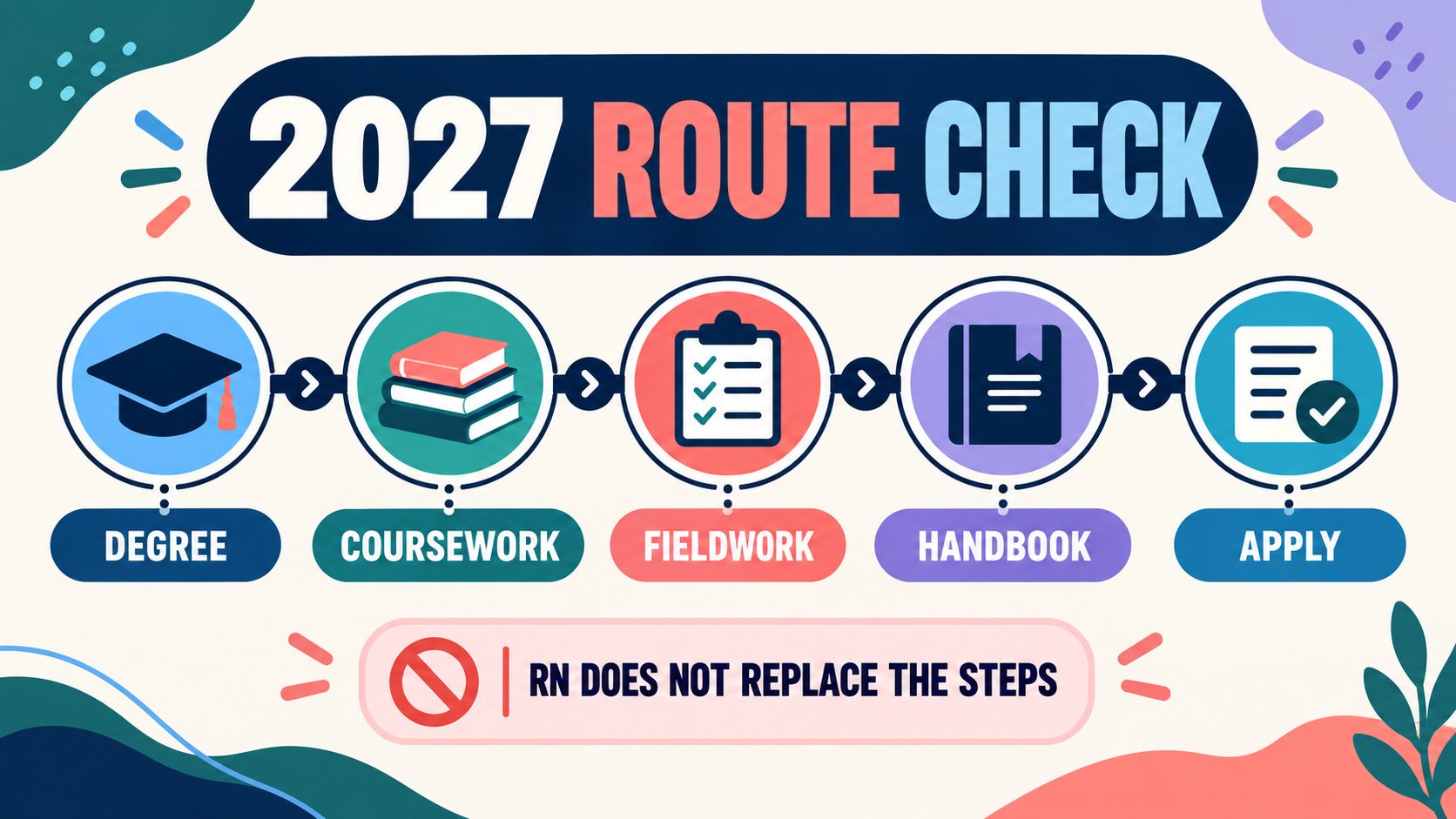
The BACB lists January 1, 2027 as a major eligibility and maintenance change date. The transition guidance says applicants who do not apply and meet the current requirements before that date must meet the new requirements that take effect on that date. Therefore, write down your intended application date and compare it with the handbook version and transition document that apply to you. Run this five-part check:
- Degree: identify the degree you already hold and the degree the selected pathway requires.
- Coursework: obtain a course map or attestation plan; do not infer ABA content from a course title alone.
- Fieldwork: confirm the supervisor, setting, contracts, hours, observations, and documentation process.
- Handbook: save the current BCBA Handbook, transition guidance, and relevant BACB forms.
- Application and exam: plan the application evidence, authorization timeline, and study schedule before assuming you are ready to test.
The transition date is a reason to verify, not a reason to rush into a program that cannot explain its pathway. Requirements and state practice rules can change, so revisit official sources whenever you move from exploration to enrollment or application.
Build an RN-Friendly BCBA Exam Plan
Your nursing background can shape how you study. Use your strength in clinical scenarios, but deliberately retrain the question you ask. Instead of “What medical action is safest?” ask “What observable behavior is occurring, what variable may be influencing it, what data support the decision, and what behavior-analytic procedure is justified?” Give extra practice to the concepts that do not map neatly onto nursing:
- operant and respondent relations, motivating operations, and stimulus control;
- measurement, graphing, experimental control, and interpreting single-case data;
- functional assessment, intervention selection, generalization, and maintenance;
- supervision, caregiver training, social validity, and behavior-analytic ethics.
After each question, explain why the answer is supported by the data and the contingency—not merely why it feels clinically compassionate. Then use the free BCBA mock exam as a baseline. Track whether a miss came from terminology, measurement, application, ethics, or reading the stem too quickly. That error log will be more useful than treating your RN experience as proof that every clinical scenario will feel familiar.
Common RN-to-BCBA Mistakes
- Assuming an RN license is a shortcut: it is a professional asset, not a substitute for the current BACB gates.
- Confusing a nursing master’s degree with ABA coursework: the degree level and the behavior-analytic content are separate questions.
- Counting clinical hours without a fieldwork decision: only count hours that meet the applicable requirements and are properly supervised and documented.
- Choosing a program by speed alone: a fast schedule is not useful if the program cannot explain accreditation, coursework, fieldwork, or application evidence.
- Blending roles with clients: make it clear when you are acting as an RN, a BCBA trainee, or another professional, and follow each role’s boundaries.
- Using old advice for a 2027 application: check the current BACB handbook and transition guidance close to the time you apply.
RN to BCBA FAQ
Does an RN need to become an RBT first?: Not as a general BACB prerequisite for BCBA certification. The relevant route is the one in the current BCBA Handbook: degree, behavior-analytic coursework, supervised fieldwork, and examination requirements. An RBT role may provide useful exposure to ABA, but it is not an automatic required step or a substitute for the BCBA requirements.
Can a BSN satisfy the BCBA degree requirement?: A BSN may help satisfy a university’s admission requirement, but do not assume it independently satisfies a 2027 BCBA pathway. The 2027 overview requires a master’s degree or higher for both BCBA pathways, with additional program or coursework conditions. Confirm your exact degree and route with the current BACB materials and the program.
Can RN clinical hours count as BCBA fieldwork?: Do not count them automatically. BCBA fieldwork must be applied behavior-analysis experience that meets the current requirements and is supervised and documented accordingly. Ask a qualified BCBA supervisor to evaluate a proposed setting before you rely on any hours.
Is RN to BCBA a good transition?: It can be a strong fit for someone who enjoys behavior change, data-based decision making, caregiver or team training, and long-term skill development. It is still a new discipline, not simply a medical specialization. Shadow the work, compare the training investment, and test your fit with introductory ABA study before committing to a program.
Bottom line: RN to BCBA is possible, but the RN credential is a starting asset rather than an eligibility shortcut. Map your degree, behavior-analytic coursework, supervised fieldwork, application date, and exam plan against the current BACB pathway. If you keep those gates separate, your nursing experience can become a real advantage without creating a misleading promise.
Take the Free BCBA Mock Exam
If you want a low-pressure way to check your recall, use the free practice resource below. Take the Free BCBA Mock Exam



