
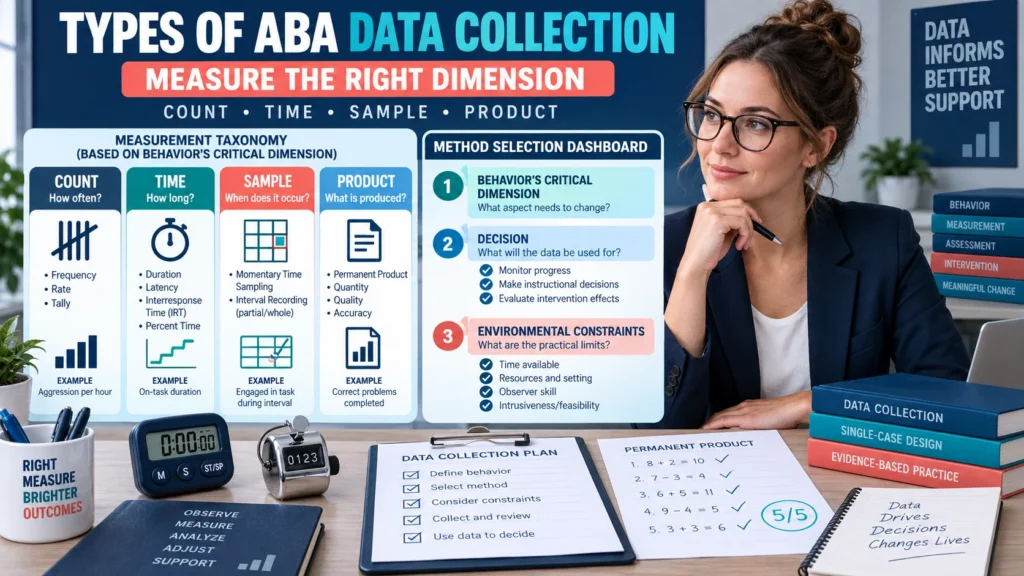
Short answer: the main types of data collection in ABA are continuous measures, discontinuous interval measures, permanent-product measures, trial-by-trial skill-acquisition data, and contextual records such as ABC data. Choose among them by asking what feature of the behavior matters most: how often it occurs, how long it lasts, when it begins, whether it occurs at a sample point, what it produces, or what happens before and after it.
Table of Contents
- What Types of Data Collection in ABA Are For
- Start With the Behavior’s Critical Dimension
- Types of Data Collection ABA: A Practical Taxonomy
- Continuous Measurement Captures Each Response
- Discontinuous Measurement Samples Behavior
- Permanent Product and Product-Based Measures
- Trial-by-Trial and Skill-Acquisition Data
- ABC and Contextual Data
- Choose a Method With a Four-Step Decision
- Compare the Main Types of Data Collection in ABA
- Common Exam Traps and Implementation Errors
- Frequently Asked Questions
- Sources
A good ABA data-collection method is not simply the easiest form to complete. It should represent the critical dimension of the operationally defined behavior, fit the observation setting, and support the decision the team needs to make. For the search phrase types of data collection ABA, that means comparing methods by what they measure rather than memorizing disconnected form names. The BACB Test Content Outline places operational definitions, direct and indirect measures, occurrence and temporal dimensions, continuous and discontinuous procedures, efficiency, validity, reliability, representative measurement, graphing, interpretation, and procedural integrity in the measurement domain. Use the current BACB BCBA Test Content Outline as the certification reference when an exam question depends on a formal measurement distinction.
This guide organizes common types of data collection in ABA around the measurement decision rather than around a list of form names. It uses “ABA” in the applied behavior-analysis sense and is intended for BCBA exam preparation and general study. In practice, the written measurement plan, supervisor direction, client needs, setting constraints, and applicable organizational requirements control.
What Types of Data Collection in ABA Are For
Data collection turns observations into information that can be compared across people, settings, sessions, and time. Before selecting a method, define the target behavior so that two trained observers can identify what counts and what does not count. Then identify the dimension that matters to the clinical or educational question. A behavior may need a frequency measure, a duration measure, a latency measure, a rate measure, an interval sample, a product measure, or a combination of measures.
For example, “tantrum” is too broad to determine a method. If the target is defined as crying above a specified volume, dropping to the floor, or hitting another person, the team can decide whether the important outcome is number of episodes, total time engaged, time to begin after an instruction, or whether the behavior occurred during selected intervals. The operational definition and the decision question come before the data sheet.
- Occurrence: Did the response happen, and how many times?
- Temporal dimension: How long did it last, how quickly did it begin, or how much time separated responses?
- Sampling: Did the behavior occur during a selected interval or at a particular moment?
- Product: What observable result did the behavior leave behind?
- Context: What antecedent, behavior, and consequence sequence surrounded the event?
Start With the Behavior’s Critical Dimension
The critical dimension is the feature of behavior that must change or be monitored for the intervention to be meaningful. A frequency count can show that a response is happening more or less often, but it cannot by itself show whether each episode is lasting longer. A duration measure can show time engaged, but it may not show how many separate episodes occurred. Selecting the wrong dimension can make an intervention look successful while the important feature of the behavior remains unchanged.
| Question | Likely dimension | Common method family |
|---|---|---|
| How many responses occurred? | Frequency or rate | Tally, frequency count, or rate per unit of time |
| How long was the behavior occurring? | Duration | Continuous duration recording or duration-per-opportunity |
| How quickly did it begin or repeat? | Latency or interresponse time | Timed latency or IRT recording |
| Did it occur during a sample? | Occurrence in an interval or at a moment | Partial interval, whole interval, or momentary time sampling |
| What observable result was completed? | Permanent product | Count, score, accuracy, or quality of the product |
The BACB outline also emphasizes efficiency, validity, reliability, representative measurement, and environmental constraints. The best method is not always the most detailed one: a simpler method that observers implement consistently may be more useful than a detailed method completed inaccurately. Document the tradeoff instead of allowing convenience to silently determine the measurement.
Types of Data Collection ABA: A Practical Taxonomy
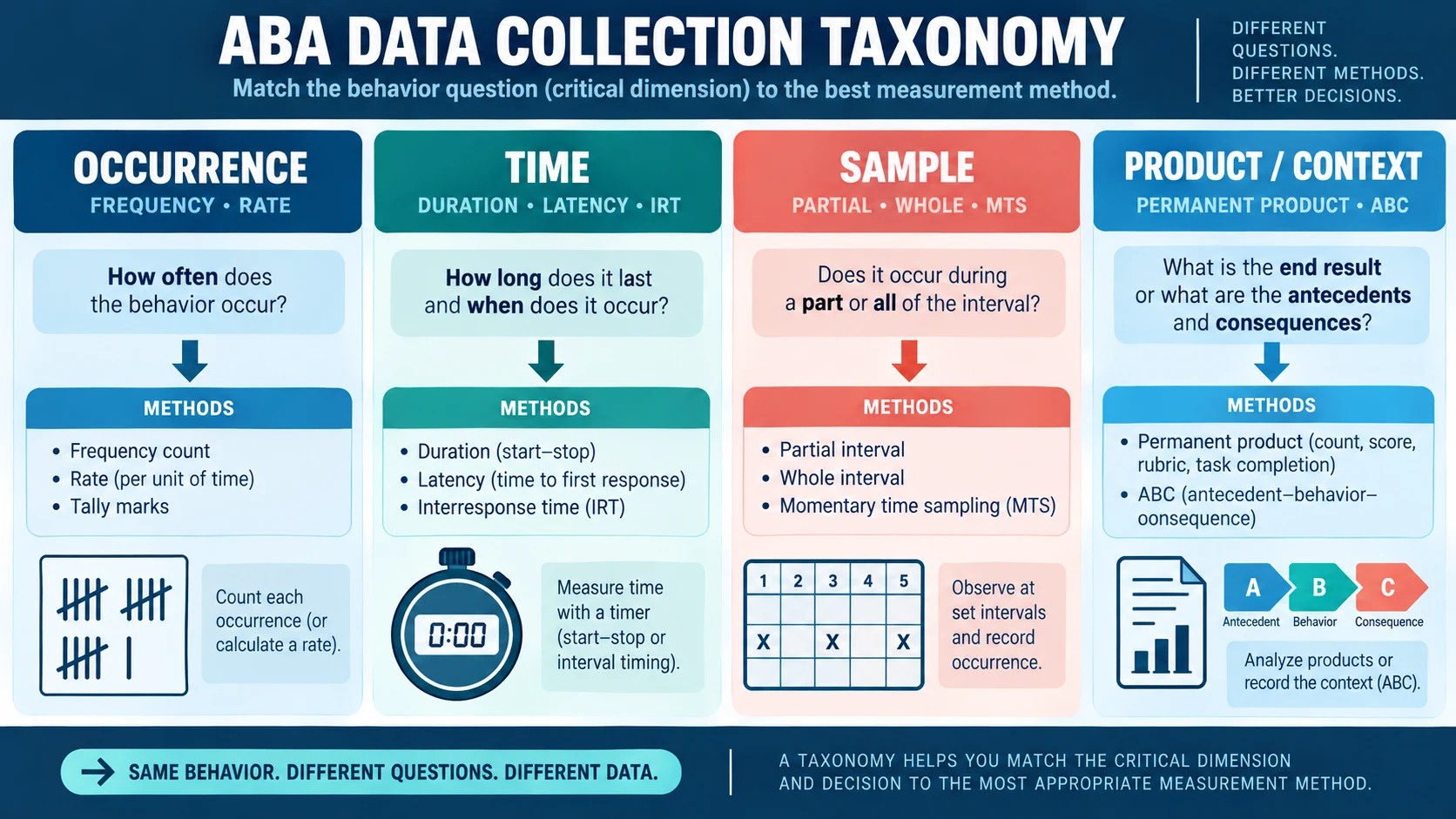
Most types of data collection in ABA can be understood as answers to four related questions: count the response, time the response, sample the response, or measure its product and context. The categories overlap in practice. A team might collect frequency and duration together, pair momentary time sampling with an interval-based treatment integrity check, or add ABC information to understand why a measured behavior changes.
Continuous Measurement Captures Each Response
Continuous measurement records every instance of the defined behavior, or records the relevant time for every opportunity, during the observation period. Common continuous measures include frequency, rate, duration, latency, and interresponse time. They are useful when the observer can detect responses reliably and when missing events would materially change the conclusion.
- Frequency: the number of responses during a defined observation period.
- Rate: the number of responses divided by a unit of time, which helps compare observations of different lengths.
- Duration: the amount of time a response or episode lasts.
- Latency: the time between an instruction or event and the beginning of the response.
- Interresponse time: the time between the end of one response and the beginning of the next response.
Continuous recording is a strong choice when the target is discrete, the behavior occurs at a manageable frequency, or the intervention depends on precise timing. When continuous recording is impractical, a representative discontinuous method may be appropriate, but the team should understand how its sampling rule can bias an estimate.
Discontinuous Measurement Samples Behavior
Discontinuous measurement divides an observation into intervals or samples and records behavior according to a rule. It is often used when continuous recording is impractical, but the rule changes what the resulting percentage means. The three common procedures are partial-interval recording, whole-interval recording, and momentary time sampling.
| Procedure | Score the interval when | Typical interpretation risk |
|---|---|---|
| Partial interval | The behavior occurs at any point during the interval. | Often overestimates duration or prevalence because a brief response can score the whole interval. |
| Whole interval | The behavior occurs for the entire interval. | Often underestimates behavior because a brief absence prevents a score. |
| Momentary time sampling | The behavior is occurring at the exact observation moment, often the end of the interval. | Can miss behavior that starts and stops between sample moments. |
For exam questions, track the scoring rule rather than relying on the name alone: any occurrence is partial interval, occurrence for the entire interval is whole interval, and the designated moment is momentary time sampling. The percentage is scored intervals divided by observed intervals, but its meaning depends on the rule.
Permanent Product and Product-Based Measures
Permanent-product recording measures the observable result left after the behavior occurs. Examples include the number of correctly completed math problems, assignments turned in, items sorted correctly, or objects placed in the designated location. The observer can sometimes score the product after the activity instead of watching every response, which makes this method efficient when the product reliably represents the target behavior.
A product is not automatically a valid measure. Confirm that the result cannot be produced without the target behavior, that one product does not hide multiple errors, and that independent observers can score it consistently. If a worksheet can be copied, corrected by someone else, or finished without the target skill, product counts may misrepresent behavior. Include accuracy, quality, prompts, or independent-versus-assisted completion when those features matter.
Trial-by-Trial and Skill-Acquisition Data
Skill-acquisition programs often record data by opportunity or trial. A trial-by-trial sheet can show whether the learner responded independently, needed a prompt, made an error, or did not respond. The useful unit is not simply “a trial was run”; it is the defined response under the defined prompt and consequence conditions.
- Define what counts as a correct response and how much time is allowed.
- Record the prompt level or error type if the instructional decision depends on it.
- Separate independent responding from prompted responding when independence is the goal.
- Specify how to handle no response, multiple responses, correction procedures, and mastered targets.
- Review both percentage correct and the number and quality of opportunities that produced it.
Percentage correct can change because the number or difficulty of opportunities changed. Interpret trial data with the teaching arrangement, prompt-fading plan, target set, and generalization conditions in view; a neat percentage without a clear denominator is not enough to describe skill acquisition.
ABC and Contextual Data
ABC recording documents an antecedent, the operationally defined behavior, and the immediate consequence. It is often used to identify patterns that may guide assessment or intervention hypotheses. ABC data are contextual rather than a substitute for a direct measure of the behavior’s frequency, duration, or intensity. A narrative note can tell you what happened around an event, but it may not estimate how often the event occurs across the day.
Make ABC forms specific enough to support comparison: define the time window, setting, task or demand, antecedent, exact response, consequence, and immediate environmental change. Keep observation separate from interpretation. “Staff removed the worksheet” is an observation; “the behavior was maintained by escape” requires more evidence.
Choose a Method With a Four-Step Decision
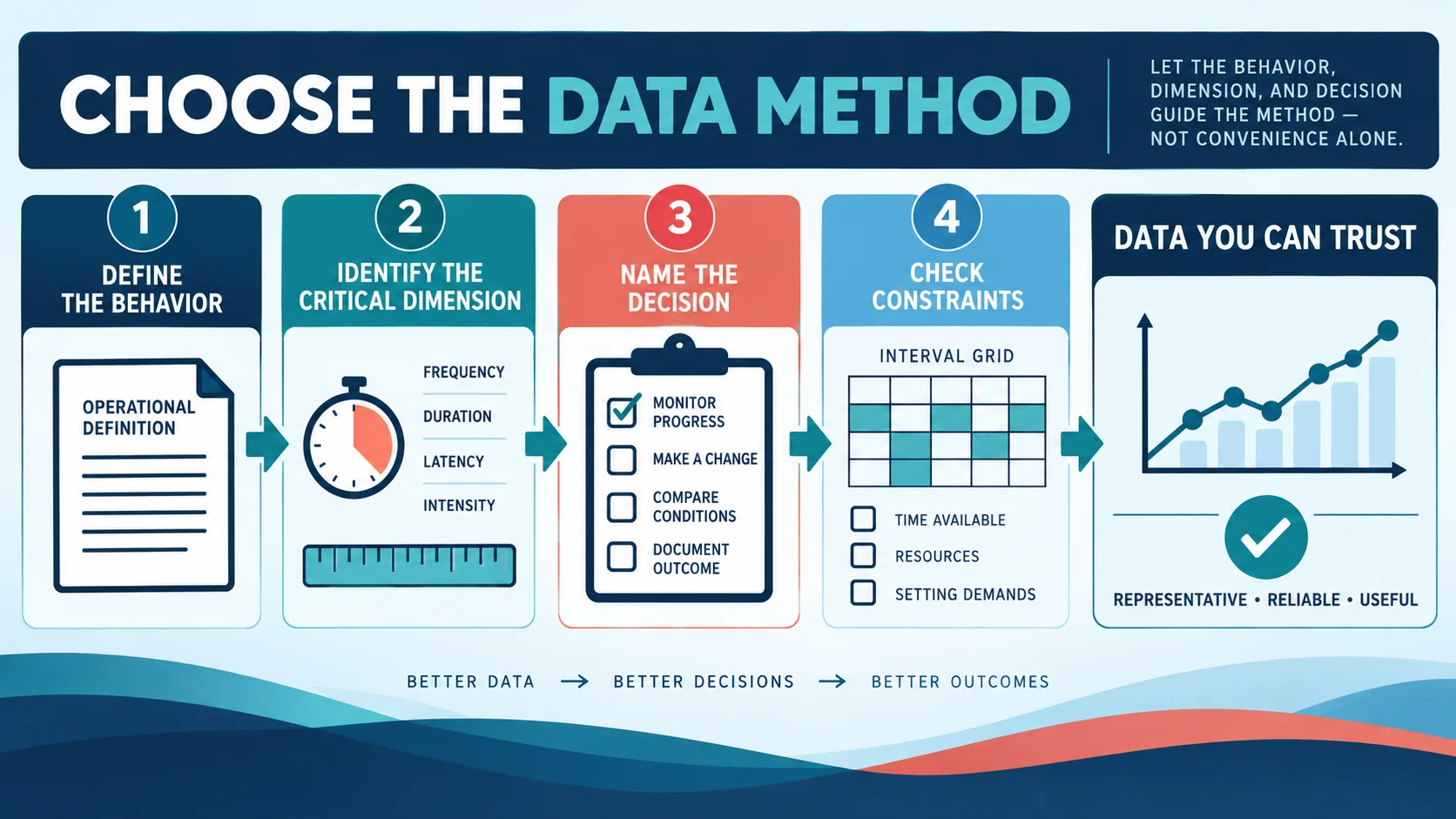
Use the following sequence when a question or real data plan asks which method to select. Start with the behavior and the decision, then test whether the method can be implemented with acceptable accuracy.
- Define the behavior. State the observable response, onset, offset, exclusions, and scoring unit. If observers cannot agree on what counts, refine the definition before choosing a measure.
- Identify the critical dimension. Decide whether the team needs occurrence, rate, time, latency, IRT, sampled occurrence, product accuracy, or context.
- Name the decision. Ask whether the data will monitor progress, compare conditions, select an intervention, evaluate generalization, or identify a need for reassessment.
- Check constraints. Consider observation length, response frequency, staff workload, setting demands, observer skill, privacy, and whether the method can be implemented reliably.
Then specify the recording rule in plain language. “Collect ABA data” is not a protocol. “At the end of each 10-second interval, score yes if the learner is engaged with the assigned material at that exact moment” is a protocol. Include the observation period, interval length, denominator, scoring rule, who records, how fidelity is checked, and how the graph will be interpreted.
Compare the Main Types of Data Collection in ABA
This table is a study shortcut, not a replacement for a measurement plan. The same method can fit one target and mislead for another.
| Method | Best fit | Remember |
|---|---|---|
| Frequency or rate | Discrete responses with a clear onset and offset | Rate accounts for different observation lengths. |
| Duration, latency, or IRT | Behavior where time is the critical feature | A count alone cannot answer a timing question. |
| Partial interval | Detecting any occurrence across an interval sample | Brief behavior can make the interval score positive. |
| Whole interval | Behavior expected to persist throughout the interval | Any gap can make the score negative. |
| Momentary time sampling | Behaviors that can be sampled at scheduled moments | Score only the specified moment. |
| Permanent product | A reliable, observable result remains after the response | Verify that the product represents the target response. |
| ABC recording | Describing events around behavior | Context does not by itself prove behavioral function. |
Common Exam Traps and Implementation Errors
- Confusing frequency with rate: the same frequency can produce different rates when observation periods differ.
- Calling a sample continuous: partial interval, whole interval, and momentary time sampling do not record every response.
- Reversing interval rules: partial interval is any occurrence, whole interval is occurrence for the entire interval, and momentary time sampling is the designated moment.
- Assuming every product is valid: the product must reliably represent the target behavior.
- Treating ABC notes as a function statement: an observed consequence is not proof of why behavior occurred.
- Ignoring denominator and opportunity: percentages require a clear number of intervals, trials, or opportunities.
- Choosing convenience without checking validity: an efficient method still needs to measure the feature that matters.
- Skipping procedural integrity: if observers use different timing, prompts, or scoring rules, the data may reflect implementation differences.
Frequently Asked Questions
Which ABA data method is best for duration?: Use duration recording when the amount of time engaged in the behavior is the critical dimension and the observer can identify onset and offset. An interval method may be used when continuous timing is not feasible, but the team should interpret sampled data according to its scoring rule rather than calling it an exact duration.
Does whole-interval recording overestimate or underestimate behavior?: Whole-interval recording commonly underestimates behavior because the response must occur for the entire interval to receive a score. A brief absence makes the interval negative even if the behavior occurred for most of the interval. The exact size of the bias depends on the behavior and interval arrangement.
When is permanent-product recording appropriate?: It is appropriate when a reliable, observable product remains after the behavior and the product cannot be produced without the target response. Check whether assistance, errors, copying, or product quality could make the product an incomplete representation of the behavior.
Is ABC data the same as a functional analysis?: No. ABC data describe naturally occurring events around behavior. A functional analysis systematically arranges conditions to test relations under a specific assessment design. ABC notes can inform assessment questions, but they do not automatically establish behavioral function.
Bottom line: when comparing types of data collection in ABA, define the behavior, identify the critical dimension, name the decision, and check the setting constraints. Then write a precise recording rule and interpret it according to the method’s strengths and limitations. For a study checkpoint, use our types of data collection ABA practice questions — Take the Free BCBA Mock Exam. It is not an official BACB product.
Sources
- BACB BCBA Test Content Outline, measurement and data-analysis task areas.
- BACB Ethics Code and ethics information, for professional record and conduct context.
- The Autism Kit: ABA data collection guide, supporting terminology and method comparison.
- Peer-reviewed discussion of measurement and behavioral observation, supporting context for selecting representative measures.



