
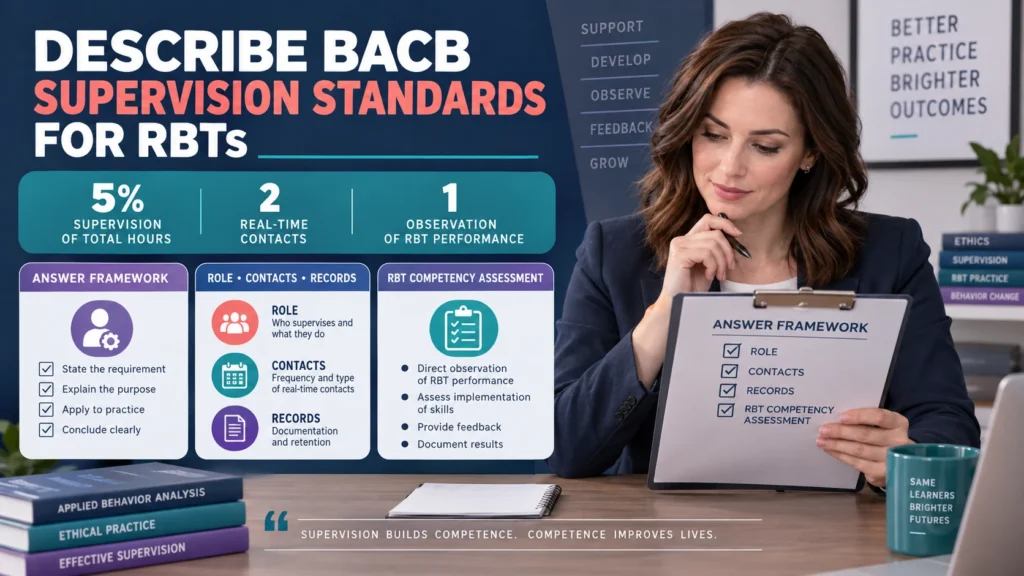
Short answer: to describe BACB supervision standards for RBTs, state the purpose and scope of ongoing supervision, give the monthly minimum, explain the required real-time contacts and observation, name the supervisor roles, and identify the records that prove the requirements were met. The current RBT Handbook sets ongoing supervision at a minimum of 5% of the hours spent providing behavior-analytic services each calendar month, with at least two face-to-face, real-time contacts and observation of service delivery during at least one meeting.
Table of Contents
- How to Describe BACB Supervision Standards for RBTs
- State the Monthly Requirement Without Blurring It
- Explain the Two-Contact Structure
- Name the Supervisor and Coordinator Roles
- Describe the Documentation and Audit Trail
- Show What Does Not Count as a Shortcut
- Apply the Standard to Three Scenarios
- Use a Five-Part Answer Framework
- Separate RBT Supervision From BCBA Fieldwork
- Common Competency-Assessment Answer Traps
- Frequently Asked Questions
- Sources
The wording matters because “RBT supervision” is not the same as a general staff meeting, a phone check-in, professional development, or BCBA supervised fieldwork. The BACB’s current competency-assessment materials list “Describe BACB Supervision Standards for RBTs” as an interview task. A strong answer therefore does more than recite 5%: it connects the number to the contact structure, client-focused oversight, documentation, and role boundaries.
This article is an exam and competency-assessment study guide, not an individualized certification decision. Requirements can change, and an organization may have additional policies. Use the current BACB RBT Handbook, the BACB portal, and the responsible supervisor when a real record or credential is at issue.
How to Describe BACB Supervision Standards for RBTs
Begin with the purpose: an RBT practices under the close, ongoing supervision of a qualified RBT Supervisor and/or RBT Requirements Coordinator who is responsible for the RBT’s work. The purpose is to support high-quality behavior-analytic services and develop or maintain the RBT’s behavior-analytic, professional, and ethical repertoires. Then give the minimums in a logical order rather than listing isolated numbers.
- Scope: the rule applies to ongoing supervision of RBT service delivery, at each organization where the RBT provides behavior-analytic services.
- Amount: supervision is at least 5% of the hours spent providing behavior-analytic services in each calendar month.
- Contacts: supervision includes at least two face-to-face, real-time contacts each month.
- Structure: at least one contact is individual, the other may be an interactive small-group meeting, and at least one meeting includes observation of the RBT providing services.
- Evidence: the RBT and supervisor retain accurate supervision documentation and keep the BACB portal or organizational records current when required.
That five-part opening is concise enough for an interview and complete enough to invite follow-up questions. If the assessor asks for an example, calculate the monthly percentage, describe a qualifying observation, and explain how the record would be stored. If the assessor asks about a problem, identify the missing requirement and seek direction rather than inventing a correction.
State the Monthly Requirement Without Blurring It
The 5% rule is based on the hours an RBT spends providing behavior-analytic services during each calendar month. It is not 5% of an employer’s total payroll hours, a yearly average, or a number that can be pooled across unrelated organizations. If an RBT provides 80 service hours at one organization during a month, the minimum percentage calculation is 4 hours of supervision for that organization, subject to the other contact and observation requirements.
| Part of the answer | Say this clearly | Avoid this mistake |
|---|---|---|
| Time frame | The calculation is made for each calendar month. | Averaging a missed month over a quarter or year. |
| Denominator | Use hours spent providing behavior-analytic services. | Using every paid work hour without checking what the handbook defines. |
| Organization | Meet the requirement separately at each organization where services are provided. | Combining 2% at one organization with 3% at another. |
| Other conditions | The percentage does not replace the two contacts, individual-session, and observation conditions. | Treating the percentage alone as complete compliance. |
When you describe the standard aloud, say “at least 5%” rather than presenting 5% as a target that can be reduced whenever scheduling is difficult. Also distinguish the BACB minimum from a supervisor’s clinical judgment. A supervisor may provide more oversight when client needs, performance, risk, or training priorities call for it.
Explain the Two-Contact Structure
Supervision must include at least two face-to-face, real-time contacts per month. “Face-to-face” can be in person or, when permitted, through live videoconferencing or a similar method that supports real-time interaction. The handbook does not treat a phone call or an email exchange as a qualifying contact. Passive video monitoring without real-time interaction and feedback may not count either.
At least one of the two monthly sessions must be individual, meaning the RBT is not in a group with other RBTs or trainees. The other may be an interactive small-group meeting with 2–10 RBTs who share similar experiences. The number of supervisors in the room does not turn a large meeting into a qualifying small group, and a lecture watched by a large audience is not the same as interactive supervision.
At least one monthly supervision meeting must include the supervisor’s observation of the RBT providing services. In-person, on-site observation is preferred, but the handbook allows technology-based observation when applicable laws are followed. The observation should lead to feedback, modeling, behavioral skills training, or another supervisory activity. A camera left on without interaction does not demonstrate that supervision occurred.
Name the Supervisor and Coordinator Roles
A complete answer explains who is responsible. An RBT Supervisor provides supervision and is responsible for the services the RBT provides under that supervisor’s supervision. An RBT Requirements Coordinator manages the organization-level system when multiple supervisors are involved, coordinates supervision, and ensures that requirements are being met. An organization may have more than one coordinator, but an RBT may have only one Requirements Coordinator per organization.
The BACB’s supervision page lists BCBA certificants as people who may serve as an RBT Supervisor or RBT Requirements Coordinator and BCaBA certificants as people who may serve as an RBT Supervisor, subject to the applicable handbook requirements. Supervisors who oversee RBTs must complete the required 8-hour supervision training before providing supervision. In a competency answer, avoid implying that any experienced technician can automatically serve as the responsible supervisor.
| Role | What to describe | Useful follow-up |
|---|---|---|
| RBT Supervisor | Provides supervision and takes responsibility for supervised RBT services. | Who observes the RBT, gives feedback, and knows the client-specific work? |
| Requirements Coordinator | Coordinates the organization’s supervision structure when multiple supervisors are involved. | Who confirms the monthly calculation and keeps the organization’s system aligned? |
| RBT | Works under close, ongoing supervision and participates honestly in documentation and escalation. | What should the RBT do when a contact or observation is missing? |
Describe the Documentation and Audit Trail
To describe the standards well, explain how someone could verify them later. The BACB materials point to records showing the days and times services were provided, the dates and duration of supervision, the format of each contact, dates of direct observation, names of supervisors, the supervisor’s relationship to the client, and additional records when entries do not match. The exact organizational form can vary, but the evidence should be specific enough to reconstruct the month.
The current handbook says the RBT and the RBT Supervisor or Requirements Coordinator must retain supervision documentation for at least 7 years, even when the relationship ends or another person assumes responsibility. Records should be stored in a secure, organization-approved system that protects client information. A calendar invitation alone proves that a meeting was scheduled; it does not prove its duration, content, interaction, or observation.
Portal responsibility is another useful boundary. If a supervisor or coordinator relationship changes, follow the current BACB process for adding or removing the responsible person and verify that the record is reflected correctly. Do not assume that an internal employer schedule updates the BACB account automatically. The BACB checklist for RBT Supervisors and Requirements Coordinators can help organize the process, but the current handbook controls.
Show What Does Not Count as a Shortcut
Assessors often test the boundary conditions. A strong answer names the tempting shortcut and corrects it without becoming argumentative.
- Phone-only or email-only contact: communication may support coordination, but it is not one of the required face-to-face, real-time contacts by itself.
- Passive video: leaving a camera running without real-time interaction or feedback may not qualify as supervision.
- One large training: a lecture or a group larger than the small-group limit is not automatically a qualifying interactive supervision meeting.
- Professional development double count: ongoing RBT supervision and professional development are separate requirements; one event should not be counted for both.
- Cross-organization pooling: hours or contacts at different organizations do not automatically satisfy each organization’s responsibility.
- Backdating: a missing contact or observation should be reported and addressed through the responsible supervisor or current BACB process, not silently rewritten.
Apply the Standard to Three Scenarios
Use examples to demonstrate understanding. These are study scenarios, not permission to improvise a compliance remedy.
- Two organizations: an RBT provides 40 service hours at Organization A and 40 at Organization B. The answer should say that the 5% calculation is made separately for each organization, so each organization has a 2-hour minimum calculation before checking the contact and observation rules. The RBT should not combine the 80 hours into one informal total.
- One group meeting and one email: the RBT attends an interactive meeting with 6 RBTs and exchanges several emails with the supervisor. The email is useful communication, but the answer should identify that a second face-to-face, real-time contact is still needed and that at least one of the two monthly sessions must be individual.
- Two live meetings with no observation: the supervisor holds two real-time meetings, one individual and one small group, but never observes service delivery. The answer should identify the missing observation requirement and recommend prompt escalation to the responsible supervisor or coordinator rather than changing the record.
Use a Five-Part Answer Framework
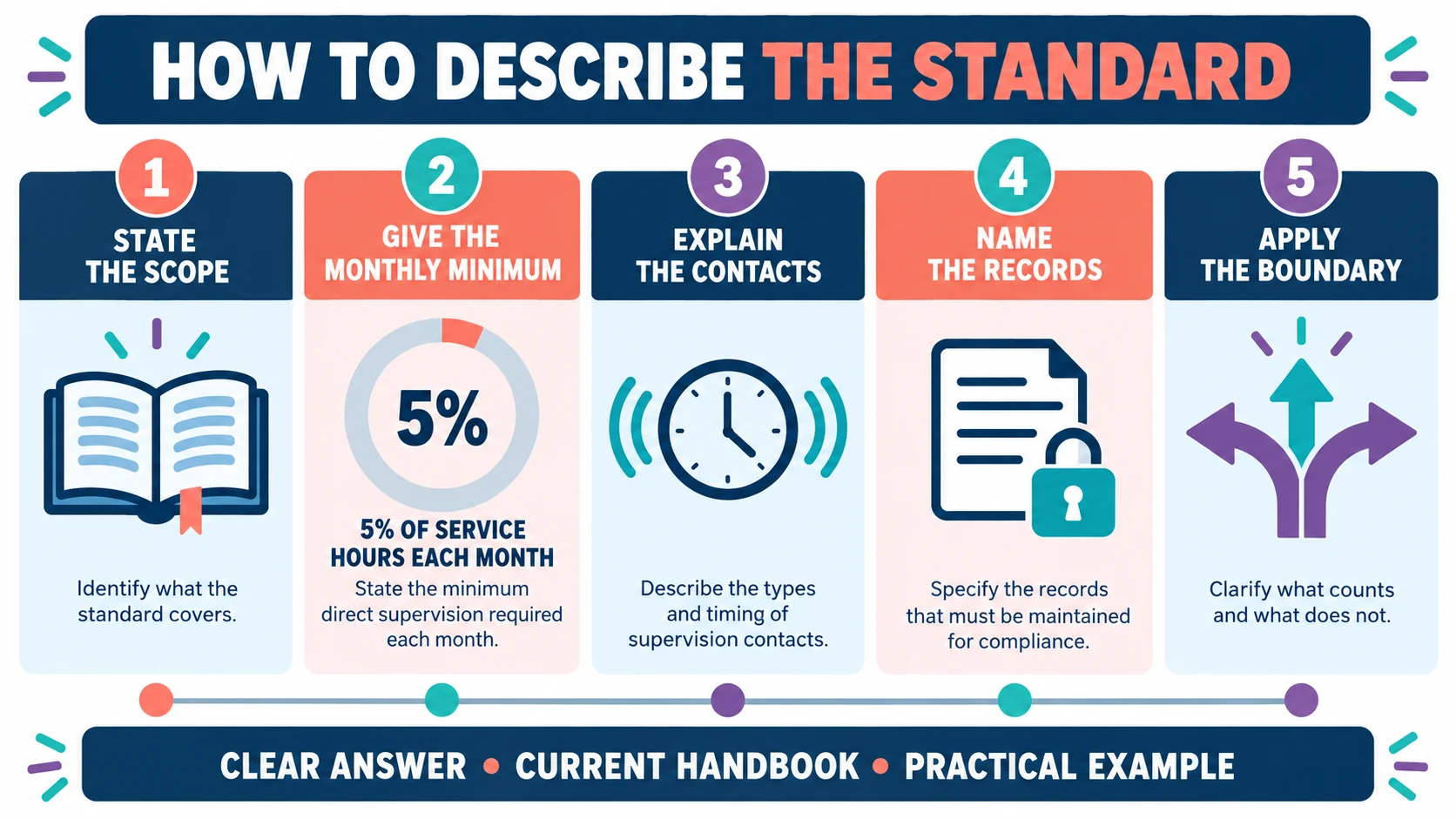
When the assessor asks you to describe the standard, use this order: scope, amount, contacts, evidence, boundary. This keeps the answer short while showing that you understand how a rule works in practice.
- Scope: say that the RBT provides behavior-analytic services under close, ongoing supervision and that the requirement applies at each organization.
- Amount: state at least 5% of service hours in each calendar month.
- Contacts: state two face-to-face, real-time contacts, at least one individual, with observation during at least one meeting.
- Evidence: name monthly service hours, dates, durations, formats, participants, observation, feedback, supervisor identity, and secure retention.
- Boundary: distinguish supervision from professional development, passive monitoring, phone or email, and BCBA fieldwork.
End with a professional action statement: “If I am unsure whether a contact or record qualifies, I will document what actually occurred and ask my supervisor, Requirements Coordinator, or the BACB for the current process.” That answer demonstrates ethical recordkeeping and clinical direction rather than guessing.
Separate RBT Supervision From BCBA Fieldwork
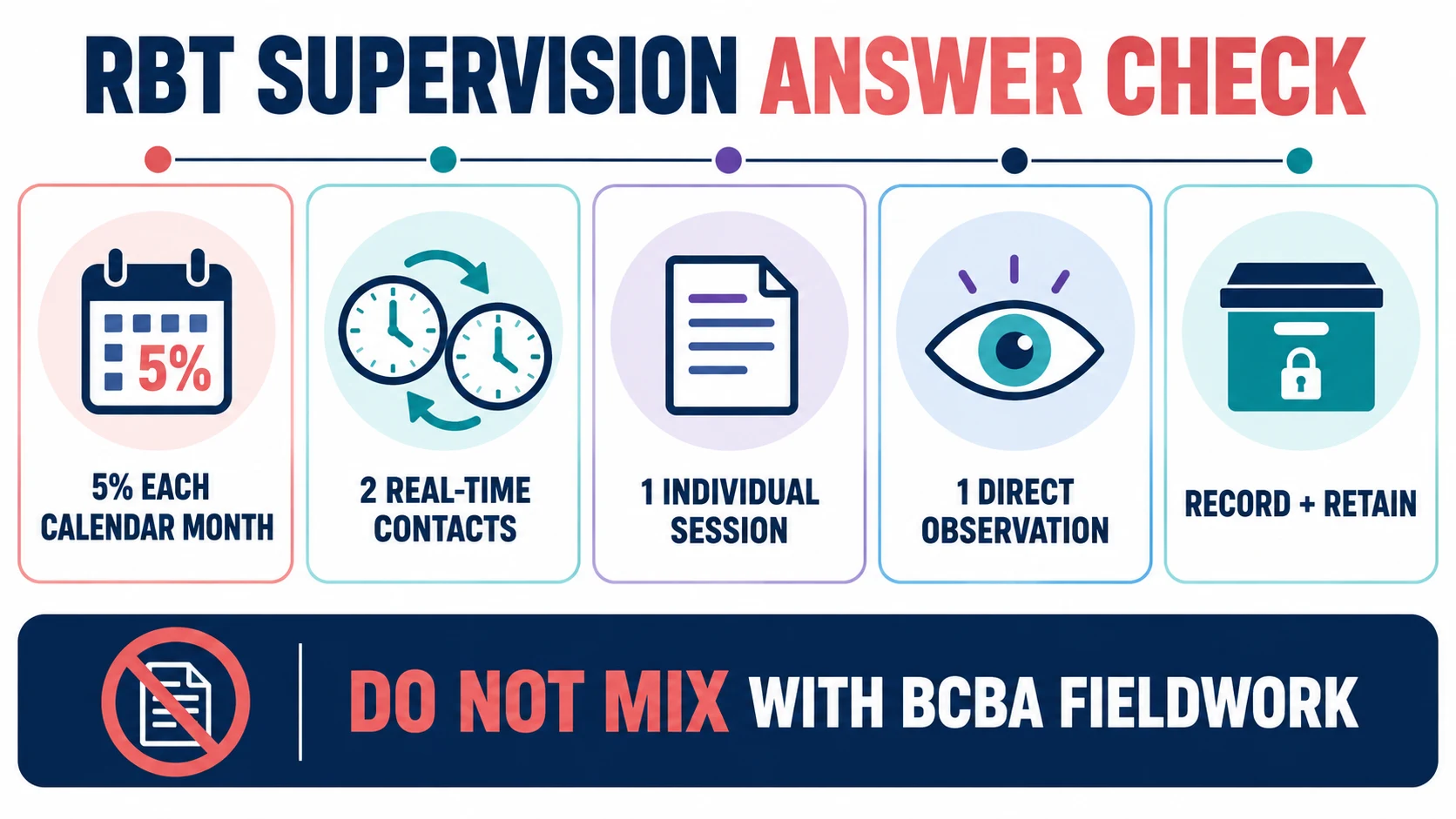
Do not answer an RBT supervision question with BCBA supervised-fieldwork rules. RBT supervision maintains and supports current RBT service delivery and certification. BCBA or BCaBA supervised fieldwork develops competencies for a future credential under a different handbook and documentation structure. The two pathways can involve related professionals, but their requirements are not interchangeable.
An RBT may later ask whether certain work can count toward BCBA or BCaBA fieldwork. That is a separate question for the applicable fieldwork rules and a qualified supervisor. A service-delivery supervision meeting should not be relabeled as fieldwork simply because the RBT has career goals. Likewise, a training or fieldwork activity should not be used to erase a missing RBT supervision contact.
Common Competency-Assessment Answer Traps
- Reciting only “5%”: the answer is incomplete without contacts, observation, role, and evidence.
- Calling every meeting face-to-face: real-time interaction and the permitted format matter.
- Forgetting “each organization”: the calculation is not automatically pooled across employers.
- Ignoring the individual session: at least one of the two monthly sessions must be individual.
- Using “group training” for supervision: the small-group condition requires an interactive meeting with 2–10 RBTs who share similar experiences.
- Confusing observation with video recording: observation belongs inside a supervision meeting with real-time interaction and feedback.
- Promising a fix: when a requirement is missed, escalate and follow the current process; do not invent a backdated record.
- Mixing credentials: keep RBT maintenance standards separate from BCBA/BCaBA fieldwork requirements.
Frequently Asked Questions
What is the shortest accurate answer to this competency-assessment task?: Say that RBTs need close, ongoing supervision; at least 5% of their behavior-analytic service hours each calendar month; at least two face-to-face, real-time contacts; at least one individual session; and observation of service delivery during at least one meeting. Add that the records must be accurate and retained, and that the rule is separate from professional development and BCBA fieldwork.
Does the 5% requirement apply separately at each organization?: Yes. Describe the calculation by organization and calendar month. Hours at two organizations should not be blended into one total for purposes of showing that each organization met its own supervision responsibility.
Can one meeting satisfy every requirement?: No. The monthly structure requires at least two face-to-face, real-time contacts, including at least one individual session and observation of service delivery during at least one meeting. Professional development is also separate from ongoing supervision.
What should an RBT do when a supervision requirement is missed?: Document what actually happened, notify the responsible supervisor or Requirements Coordinator promptly, and follow the current BACB or organizational process. Do not backdate, alter, or relabel a record to make the month appear complete.
Bottom line: a clear answer to “describe BACB supervision standards for RBTs” follows five steps: define the scope, state the 5% monthly minimum, explain two real-time contacts and one observation, name the record and role responsibilities, and draw the line around shortcuts and BCBA fieldwork. For additional study practice, try our describe bacb supervision standards for rbts practice questions — Take the Free BCBA Mock Exam. It is not an official BACB product.
Sources
- BACB RBT Handbook, current certification and ongoing-supervision requirements.
- BACB RBT supervision resource page, current supervision resources and role context.
- BACB Supervision, Assessment, Training, and Oversight, supervisor roles and 8-hour supervision training.
- BACB RBT Recertification Competency Assessment, including the supervision-standards interview task.



