
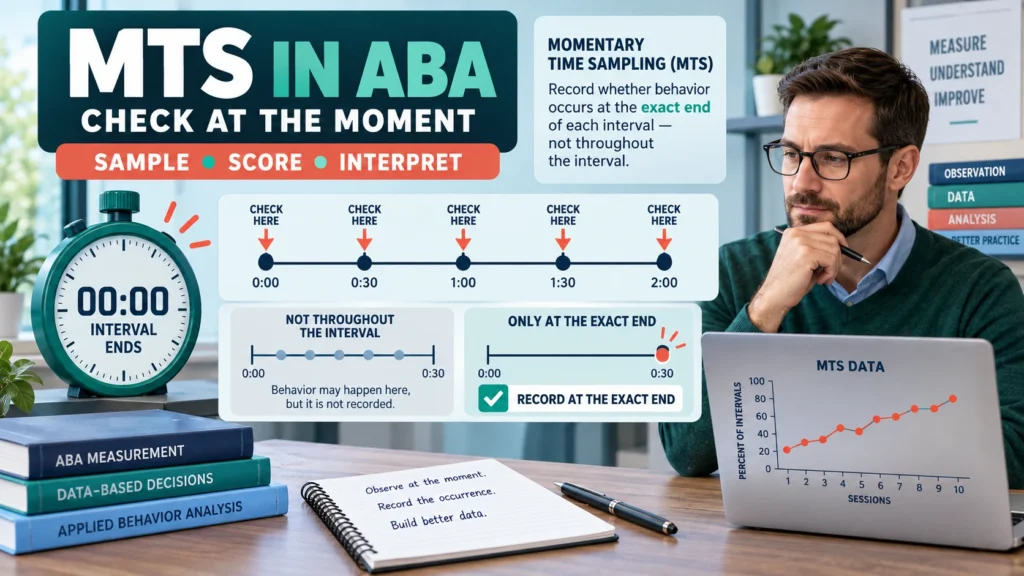
MTS in ABA means momentary time sampling: divide an observation into intervals, check whether the target behavior is occurring at the exact end of each interval, and score the sample as occurrence or nonoccurrence. You do not score everything that happened during the interval.
Table of Contents
- What MTS Means in ABA
- A 10-Interval MTS Example
- MTS, Partial Interval, and Whole Interval Use Different Rules
- How to Collect MTS Data
- Score MTS Without Turning It Into Duration
- When MTS Is a Reasonable Measurement Choice
- Check Reliability and Interpret the Estimate
- Common MTS ABA Exam Traps
- Frequently Asked Questions
- Sources and Verification Notes
- Take the Free BCBA Mock Exam
People searching for MTS ABA often need three things at once: the exact collection rule, a numerical example, and a comparison with partial- and whole-interval recording. The most important phrase to remember is at the moment the interval ends. A response that happened earlier but is absent at the sample moment is not scored as occurring for that MTS interval.
The current BACB BCBA Test Content Outline (6th ed.) places discontinuous measurement, validity and reliability, and measurement selection in the measurement domain. This guide is an educational study aid. Use the current BACB outline, the operational definition, and qualified supervision or clinical guidance when choosing a measurement system for real services.
What MTS Means in ABA
Momentary time sampling is a discontinuous measurement procedure. An observer sets a time interval, waits until the interval ends, and records whether the target behavior is occurring at that precise moment. The observer may not need to continuously watch every second between sample moments, which can make MTS practical when continuous recording is not feasible.
MTS is usually reported as a percentage of sample intervals with behavior occurring at the sample moment. This normalization can help compare observations with different total interval counts, but only when the interval schedule and scoring definition remain consistent: percentage of MTS intervals with occurrence = intervals scored occurrence ÷ total intervals × 100
That percentage is an estimate based on the selected moments. It is not automatically a percentage of total time, a frequency count, a duration measure, or the number of episodes that occurred between checks. The measurement can be useful, but only when the operational definition and method fit the behavior and decision.
- Set the interval: choose the observation length and interval length before collecting data.
- Wait for the sample moment: use a timer or another consistent cue.
- Check at the end: score occurrence only if the behavior is happening at that moment.
- Calculate the percentage: divide positive sample moments by total sample moments.
A 10-Interval MTS Example
Suppose an observer measures on-task behavior during a 5-minute activity using ten 30-second intervals. The timer signals at 0:30, 1:00, 1:30, and so on. At each signal, the observer looks at the learner and marks “+” if the operational definition of on-task behavior is occurring at that exact moment. The observer marks “–” if it is not. The record contains six “+” marks and four “–” marks. The MTS score is: 6 positive sample moments ÷ 10 total sample moments × 100 = 60%
That result means on-task behavior was observed at 60% of the selected sample moments. It does not mean the learner was on task for exactly 60% of the five minutes. The learner may have been on task for long periods between checks, or may have started and stopped several times without those changes being recorded.
MTS, Partial Interval, and Whole Interval Use Different Rules
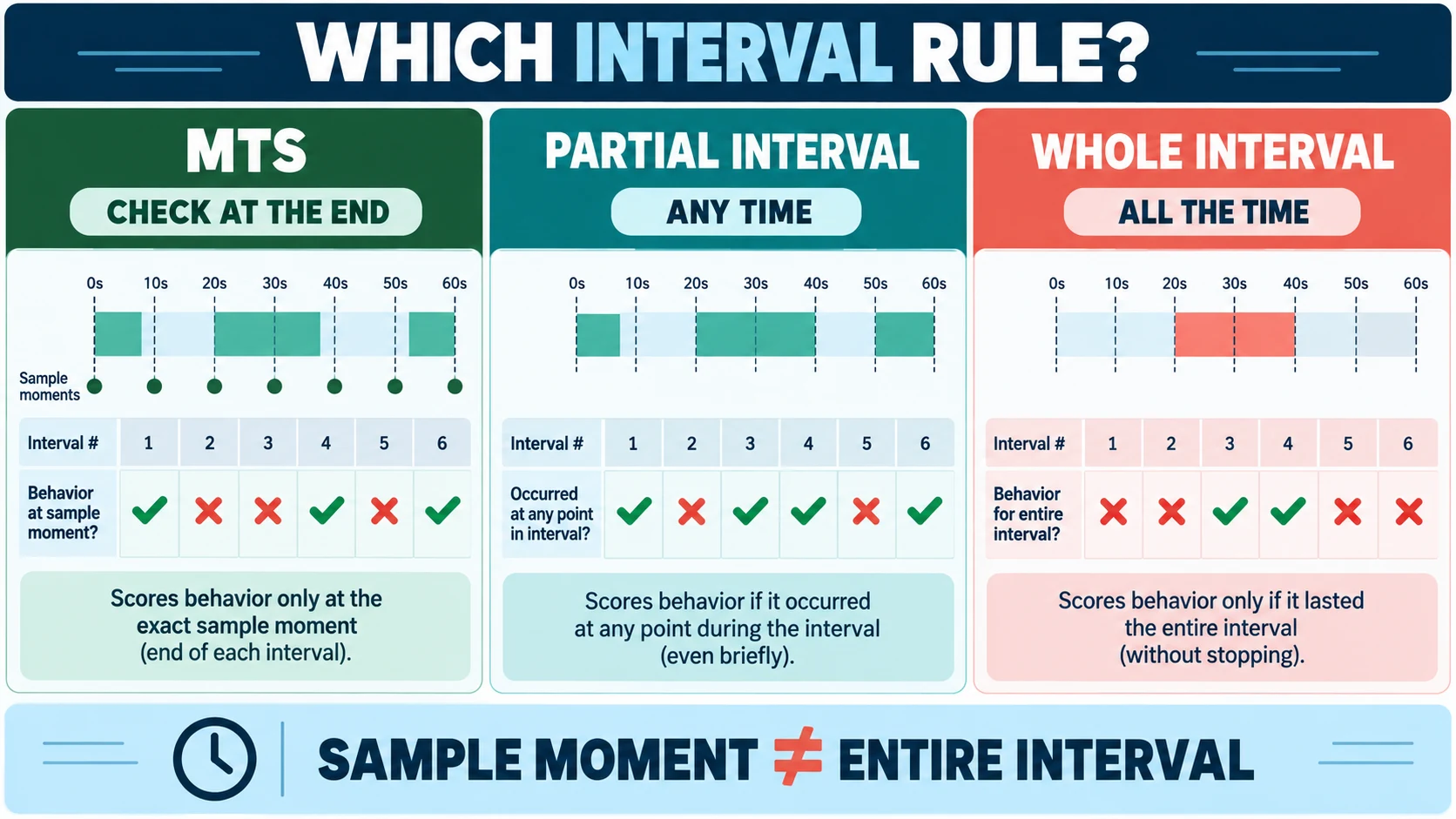
The three discontinuous methods are easy to confuse because all divide an observation into intervals. The scoring rule—not the existence of a timer—determines the procedure:
| Procedure | When do you score occurrence? | Common interpretation risk |
|---|---|---|
| MTS | The behavior is occurring at the exact end of the interval. | Treating the percentage as continuous duration or total frequency. |
| Partial interval | The behavior occurs at any time during the interval, even briefly. | It can overestimate behavior when brief occurrences count the same as long occurrences. |
| Whole interval | The behavior occurs for the entire interval without stopping. | It can underestimate behavior when the response is valuable but does not last continuously. |
These are general interpretation tendencies, not guarantees for every behavior. The direction and size of measurement error depend on the behavior’s duration, distribution, interval length, and the question being asked.
How to Collect MTS Data
Use a consistent collection routine:
- Define the behavior: write observable start and stop criteria so another observer can identify occurrence at the sample moment.
- Set the schedule: specify total observation time, interval length, sample cue, and whether every interval is scored.
- Start the timer: begin the observation and keep the interval cue consistent.
- Score only the moment: look at the behavior when the interval ends and mark occurrence or nonoccurrence.
- Save the record: calculate the percentage of positive moments and record contextual variables that may affect interpretation.
Do not use “the behavior happened sometime” as an MTS criterion. If the target was present for five seconds at the beginning but absent at the end, that interval is scored nonoccurrence under MTS. If the behavior was absent until the final second and then occurred at the signal, it is scored occurrence.
Score MTS Without Turning It Into Duration
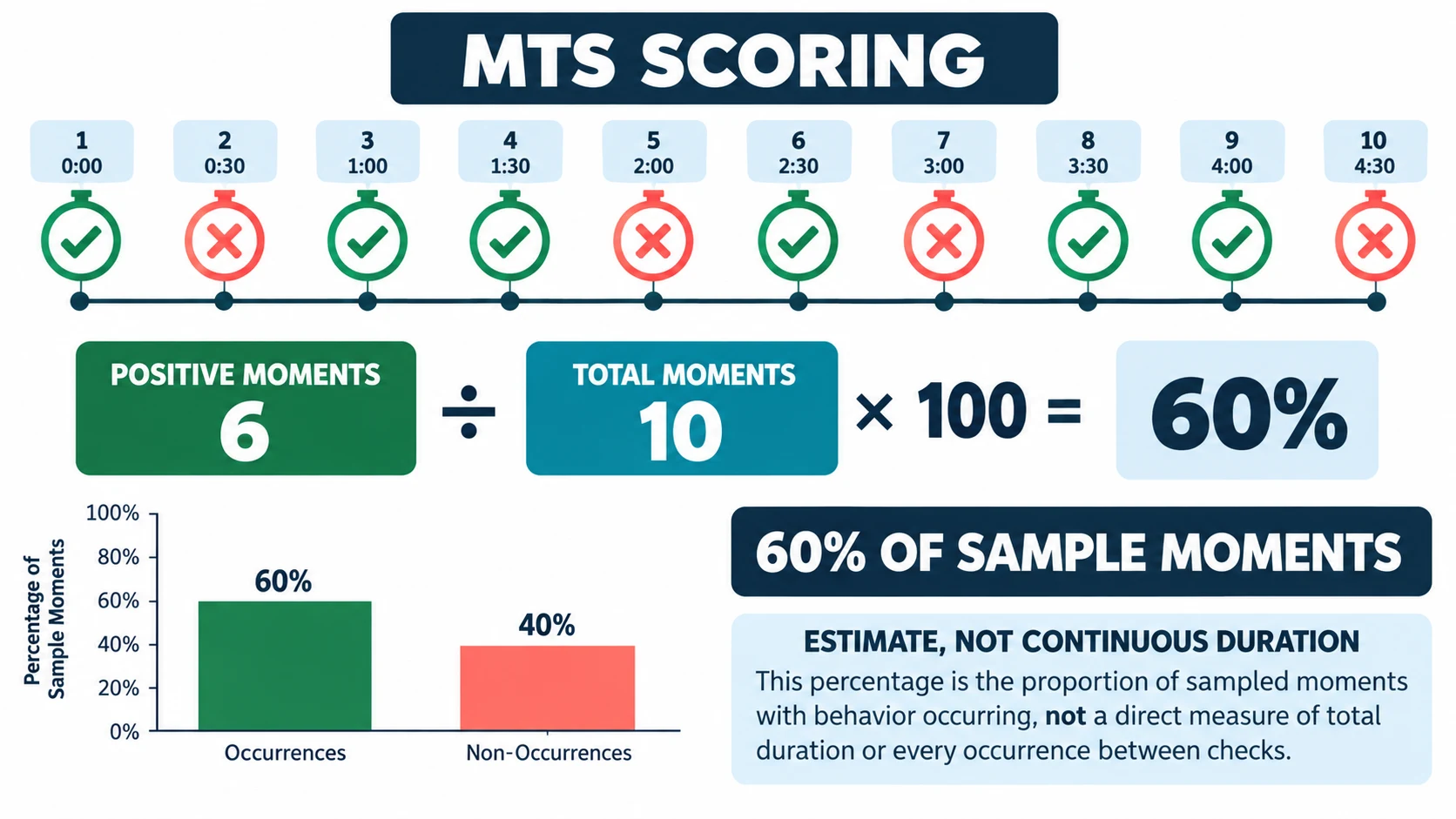
A clear data sheet separates the sample moment from the rest of the interval. Mark each sample with a plus or minus, count the pluses, and calculate the percentage. If there are 8 positive moments out of 20, the score is 40%. The denominator is the number of scheduled sample moments, not the number of seconds in the observation.
When writing the result, name the measurement. “On-task behavior occurred during 40% of MTS sample moments” is more precise than “the learner was on task 40% of the time.” The second sentence makes a duration claim that MTS did not directly measure.
- Correct: “The target occurred at 6 of 10 sample moments, or 60%.”
- Incorrect: “The target occurred for 60% of the observation.”
- Correct: “The result is a sample-based estimate that may miss events between checks.”
- Incorrect: “The result counts every occurrence in the interval.”
When MTS Is a Reasonable Measurement Choice
MTS can be useful for ongoing or extended behavior, group activities, classroom engagement, social participation, or situations in which the observer has other responsibilities between sample moments. The method is attractive when a practical estimate is more useful than continuous observation and when the behavior is likely to be visible at planned checks.
It may be a poor fit when the target is brief, dangerous, rare, or defined by a single event that can happen entirely between sample moments. If the decision depends on exact frequency, latency, duration, or every occurrence, consider a continuous or event-based method. If the behavior’s pattern is unknown, collect enough information to evaluate whether the sample rule represents the dimension that matters.
Check Reliability and Interpret the Estimate
A measurement procedure is not useful just because it is easy to use. Review whether observers agree on the operational definition, timer, sample cue, and scoring rule. If two observers score different moments or use different interpretations of “occurring,” the percentage cannot be interpreted confidently.
- Run periodic observer-agreement checks when appropriate.
- Confirm that the timer and interval schedule match the written procedure.
- Review whether the interval is too long for the behavior’s duration and distribution.
- Graph the scores and look for trend, level, variability, and contextual changes.
- Reconsider the method if the data do not answer the clinical or educational question.
The BCBA outline treats measurement selection, validity, and reliability as linked decisions. A convenient data system is not automatically a representative one. The behavior’s critical dimension, the environment, the observer’s responsibilities, and the decision threshold all matter.
Common MTS ABA Exam Traps
- “Record if it happened anywhere in the interval.” That is partial interval, not MTS.
- “Record if it lasted the whole interval.” That is whole interval, not MTS.
- “MTS measures total duration.” It measures occurrence at selected moments and produces a sample-based percentage.
- “A plus means the behavior happened at least once.” A plus means it was occurring at the exact sample moment.
- “A longer interval is always better.” Interval length changes what the sample represents and can increase missed behavior.
- “Any percentage is a direct truth about behavior.” Interpret the score within the method, definition, context, and decision.
For targeted measurement practice, use the free BCBA Mock Exam to identify the scoring rule in short scenarios. It is a study resource, not a substitute for the current BACB outline or individualized measurement planning.
Frequently Asked Questions
What does MTS stand for in ABA?: MTS stands for momentary time sampling. The observer checks whether the target behavior is occurring at the exact end of each predetermined interval and records occurrence or nonoccurrence.
How do you calculate MTS percentage?: Divide the number of sample intervals scored as occurrence by the total number of sample intervals, then multiply by 100. Six positive moments out of ten equals 60% of sample moments.
Does MTS require continuous observation?: MTS is designed to score planned sample moments rather than every second of an interval. The observer still needs a reliable cue and must look at the target at each sample moment, but does not score all behavior between checks.
Is MTS an underestimate or an overestimate?: It can miss behavior that occurs between sample moments, but the direction of error is not a universal rule for every behavior. Interpret the estimate based on the behavior’s duration, distribution, interval length, and measurement question.
What is the main MTS exam clue?: Look for “at the end of the interval,” “when the timer sounds,” or “at the exact moment.” “Any time during the interval” signals partial interval; “throughout the entire interval” signals whole interval.
Sources and Verification Notes
The BACB test content outline is the primary source for the measurement-domain study task. Practice guides can illustrate the procedure, but the operational definition and the current official outline should control exam preparation and professional decisions.
- BACB BCBA Test Content Outline (6th ed.).
- BACB Test Content Outlines for BACB Certifications.
- BACB BCBA Handbook.
- RBT Hub: Momentary Time Sampling, for explanatory context.
Take the Free BCBA Mock Exam
A useful next step is to apply this idea in a fresh set of BCBA-style practice questions and review the feedback. Take the Free BCBA Mock Exam



