
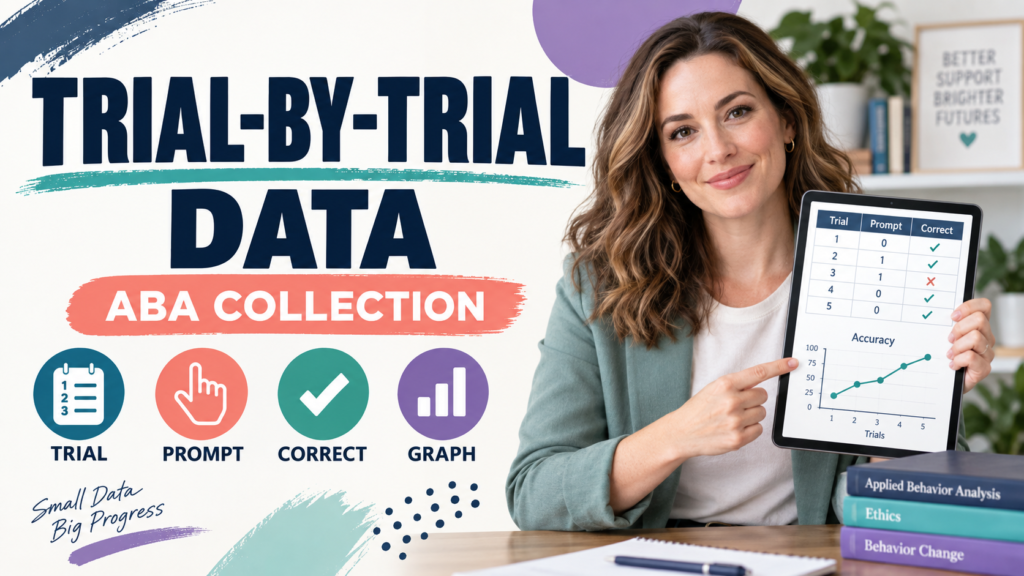
Trial by trial data collection ABA records what happens on each planned opportunity. It can reveal prompt dependence and error patterns that a single session percentage hides, but only when the trial definition and scoring rule stay consistent.
Table of Contents
- What Is Trial-by-Trial Data Collection ABA?
- How Do You Score Each Opportunity?
- How Do You Graph Trial by Trial Data Collection ABA?
- How Do Prompts Change the Data?
- What About Errors and Corrections?
- What Does the BCBA Exam Test?
- What Is the Bottom Line?
- Quick Review Checklist
- Take the Free BCBA Mock Exam
Trial by trial data collection ABA means recording the outcome of each defined opportunity rather than only a session total. A trial may be a discrete-trial teaching opportunity, a communication opportunity, a task-analysis step, or another planned chance to respond. The observer marks the response outcome, prompt level, error type, or other variable selected in the program.
Trial-level data are not automatically better than every other measurement. They are useful when the team needs to know which opportunities are successful, how errors are distributed, or whether independence is increasing. The BCBA Test Content Outline supports matching measurement to the decision.
What Is Trial-by-Trial Data Collection ABA?
Each trial has a defined beginning, response opportunity, scoring rule, and consequence. For a receptive-identification program, the instructor may present an array, deliver an instruction, wait for the response, record correct or incorrect, and then deliver the planned consequence. The form should also show whether the response was independent or prompted if independence is the target.
A trial is not simply every time the learner happens to respond during a session. The opportunity must be planned or defined. If the team counts unplanned responses in one session and planned trials in another, the denominator changes and the percentage becomes hard to interpret.
How Do You Score Each Opportunity?
Use mutually understandable codes. A simple system may include independent correct, prompted correct, incorrect, no response, and not applicable. Add an error code only if the team will use it. For example, recording “wrong item” may support a teaching decision; recording ten different error labels that nobody reviews adds burden without clarity.
| Code | Meaning | Common decision |
|---|---|---|
| Independent correct | Target response occurred without the defined prompt | Monitor acquisition and mastery |
| Prompted correct | Correct response occurred after assistance | Plan prompt fading |
| Incorrect | Response did not meet the definition | Analyze error and teaching arrangement |
| No response | No target response within the planned interval | Review latency, prompt, and motivation |
How Do You Graph Trial by Trial Data Collection ABA?
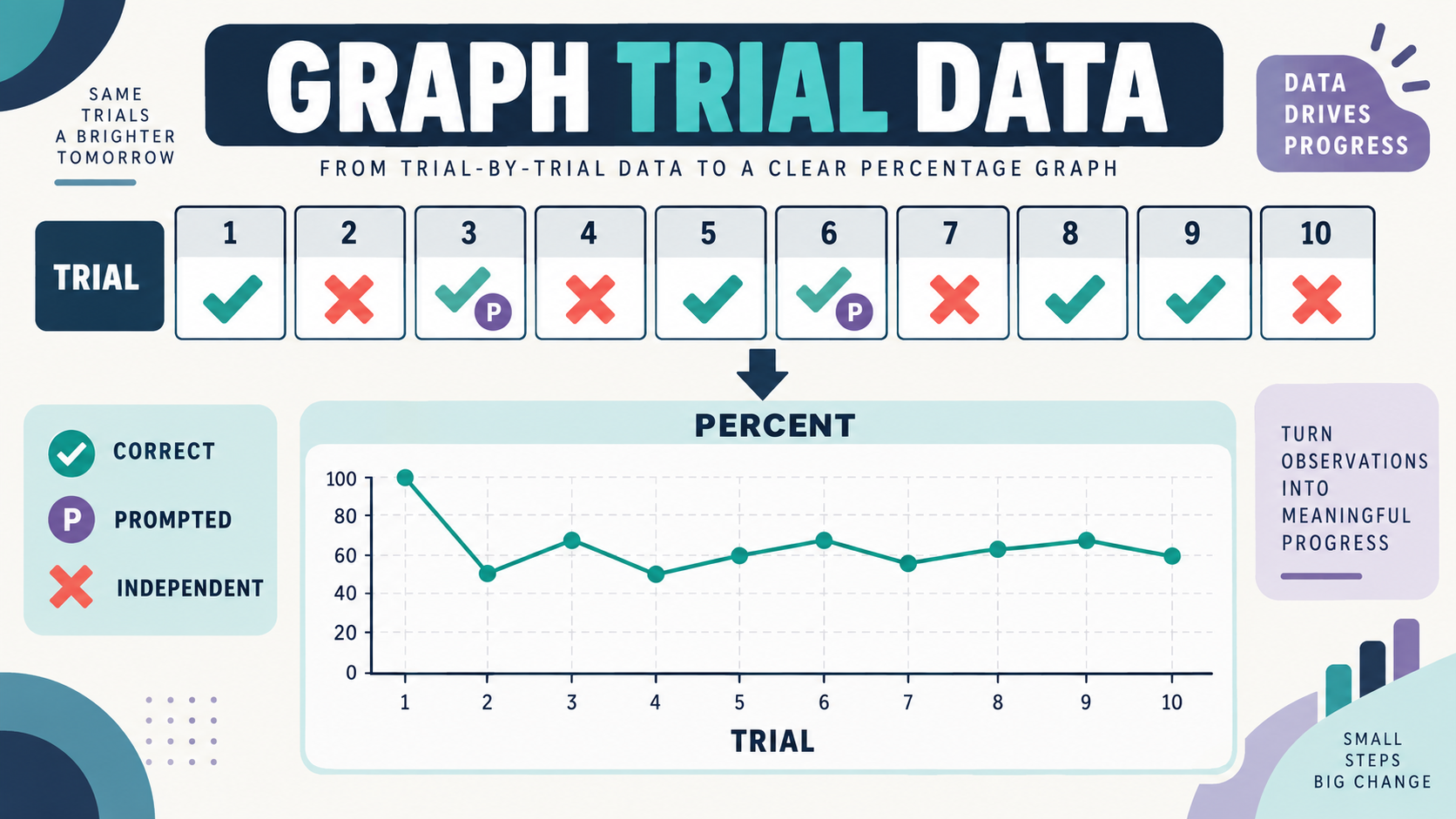
Graph the summary that answers the question. Percentage of independent trials can show acquisition, while a separate prompt-level display can show fading. A cumulative record may show total correct trials, but it can hide whether errors cluster around one target. A step or target matrix may be better when the team needs item-level detail.
Label the number of opportunities and phase. If baseline has 10 trials and intervention has 20, compare percentages carefully and keep the denominator visible. Mark changes in prompt, materials, instructor, or criterion. Data points should not be connected across conditions in a way that suggests the same teaching procedure continued unchanged.
Before the first trial, decide what happens when an opportunity is interrupted, skipped, or repeated. For example, a learner may leave the teaching area, the instructor may deliver an accidental extra prompt, or the material may be unavailable. A short note beside the row preserves the context without silently turning an unusual event into a correct or incorrect score. Review the rule with every observer and practice a few sample trials together. Consistent scoring matters more than a complicated form because the graph is only as trustworthy as the opportunity definitions behind it.
How Do Prompts Change the Data?
If the target is independent performance, prompted correct trials should not be counted as independent correct. They may still be useful for measuring total acquisition, but the label must be clear. A learner who answers correctly only after a model has not demonstrated the same level of independence as a learner who answers after the instruction alone.
Record prompt type and level when the team is fading prompts. A graph of percentages without prompt data may show improvement while the instructor is quietly increasing assistance. Prompt data makes the learning history visible.
What About Errors and Corrections?
Use a correction procedure that is defined before the session. If a correction creates a second opportunity, decide whether that opportunity enters the denominator or is tracked separately. Otherwise, a learner can receive repeated practice after an error and the session percentage may look different from the original opportunity score.
Keep the consequence consistent enough to interpret, but do not let data collection override safety, communication, or the person’s access to a meaningful activity. The BACB Ethics Code provides the professional context for individualized and respectful implementation.
What Does the BCBA Exam Test?
- Trial is an opportunity: it is not every response in an unstructured session.
- Prompted correct is not independent correct: code the level that matches the goal.
- Percentage needs a denominator: state how many eligible opportunities were scored.
- Corrections can change the count: decide how repeated opportunities are handled.
- Session totals hide patterns: inspect target, error, and prompt distributions when needed.
- Graph labels matter: mark phase, prompt, criterion, and relevant setting changes.
What Is the Bottom Line?
Trial by trial data collection ABA is powerful because it preserves the opportunity-level pattern. Define the trial, score independence and prompts separately, protect the denominator, and graph the summary that matches the decision. For more practice with measurement and skill-acquisition questions, try the free BCBA mock exam. It supports studying, but individualized programming still requires supervision and data review.
For targeted review, use our trial by trial data collection ABA practice questions to apply the concept in exam-style scenarios.
Quick Review Checklist
Use this final checklist to turn trial by trial data collection ABA into exam-ready reasoning. The goal is not to memorize a label in isolation; it is to identify the relevant evidence and explain why the best answer fits the scenario. Key ideas to review:
- State the central definition or decision point for trial by trial data collection ABA in your own words.
- Identify the detail that makes trial by trial data collection ABA different from its closest related ABA term.
- Separate the observable facts in a scenario from assumptions that are not supported by the facts.
- Write one example and one nonexample so you can recognize the concept in a new setting.
Exam application checks:
- Ask what the question is actually requesting before comparing the answer choices.
- Mark the antecedent, response, consequence, or other evidence that supports the selected answer.
- Look for a distractor that describes a related process but does not answer the specific question.
Final self-check:
- Explain how you would verify the interpretation with clear observations or data.
- Change one detail in the scenario and decide whether your answer should change.
- Give a one-sentence rationale that a supervisor or study partner could evaluate.
Take the Free BCBA Mock Exam
When you are ready to apply the idea, use the free practice resource below for additional feedback. Take the Free BCBA Mock Exam



