

Local response rate ABA analysis asks how quickly responses occur inside a defined segment, not merely how many responses occurred in the whole session. That distinction can reveal bursts, pauses, and setting effects that an overall average hides.
Table of Contents
- What Does Local Response Rate ABA Mean?
- How Do You Calculate Local Response Rate?
- How Do You Graph Local Response Rate ABA Data?
- How Is Local Rate Different From Overall Rate?
- What Measurement Problems Distort Local Rate?
- What Does the BCBA Exam Test?
- What Is the Bottom Line?
- Quick Review Checklist
- Take the Free BCBA Mock Exam
Local response rate ABA can be understood as the response rate calculated for a defined local observation segment, such as a minute, a component of a session, or a particular condition. Rate is count divided by time. The word “local” signals that the analyst is looking at a smaller part of the observation rather than only one overall session summary.
Define the segment before calculating. “During the difficult task” may be a useful condition, but the start and end must be observable. The BCBA Test Content Outline supports precise measurement and visual analysis; a local rate is useful only when the numerator and denominator are both clear.
What Does Local Response Rate ABA Mean?
Suppose a learner emits 12 responses during a 10-minute session. The overall rate is 1.2 responses per minute. If 8 responses occur in a two-minute task segment, the local rate for that segment is 4 responses per minute. The two numbers describe different slices of the same observation and should not be treated as competing answers.
Local rate can be calculated within a condition, time block, activity, or response opportunity set. It is not automatically the same as momentary frequency or a “hot” part of a graph. The segment must be defined for a clinical or analytic reason.
How Do You Calculate Local Response Rate?
Count the defined responses in the segment and divide by the exact time observed. If the team records 15 mands in 3 minutes, the local rate is 5 mands per minute. If the segment lasts 90 seconds, convert the time consistently before comparing it with other segments. A rate per minute is not comparable with a rate per hour unless the unit is standardized.
| Segment | Count | Time | Rate |
|---|---|---|---|
| Whole session | 12 | 10 min | 1.2/min |
| Demand segment | 8 | 2 min | 4/min |
| Break segment | 1 | 2 min | 0.5/min |
How Do You Graph Local Response Rate ABA Data?
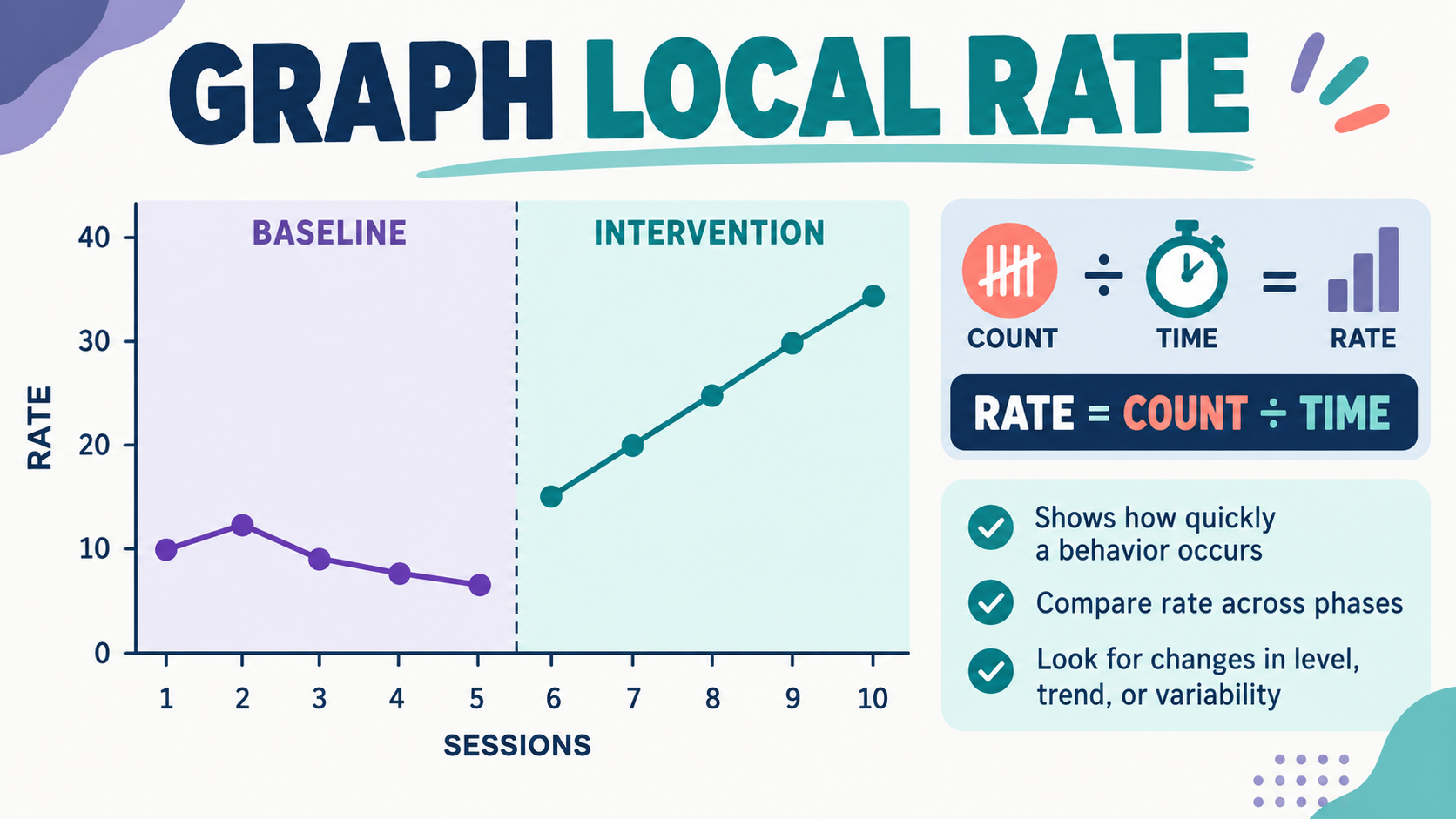
Choose the x-axis unit that preserves the segment meaning. You might plot each time block, each activity, or each condition in chronological order. Label the denominator and use the same unit for every point. If segments differ in length, the rate calculation helps standardize them, but the segment boundaries still need to be visible in notes or labels.
When a local spike appears, inspect the context before deciding that the intervention worked or failed. A high rate during a preferred activity may be appropriate, while a high rate during a safety-risk behavior may require a different interpretation. Local analysis helps locate the pattern; it does not assign the behavior a function by itself.
How Is Local Rate Different From Overall Rate?
Overall rate summarizes the entire observation. Local rate summarizes a selected part. Overall rate is useful for broad progress monitoring, while local rate can reveal within-session changes, response acceleration, pauses, or effects of a task component. Use both when the decision requires both perspectives.
Do not average local rates blindly. If segments have different durations, an unweighted average of segment rates may not equal the overall rate. To compute the overall rate, add all responses and divide by the total time. Explain whether a reported “average local rate” is weighted, unweighted, or simply a descriptive comparison.
What Measurement Problems Distort Local Rate?
Short segments magnify small counting errors. If one response is missed in a 30-second segment, the rate can change substantially. Segment boundaries can also be shifted by delayed timing, and staff may count opportunities differently across activities. Train observers on the start and stop rule, record actual observation time, and examine agreement when the decision is important.
What Does the BCBA Exam Test?
- Rate is count divided by time: a count alone is not a rate.
- Local does not mean momentary: it refers to a defined segment, not a single time sample.
- Units must match: responses per minute and responses per hour cannot be compared without conversion.
- Overall rate is not the average of every local rate: use total count divided by total time for the overall value.
- Context is not function: a local spike identifies where responding changed, not why it changed.
- Short windows need caution: a small error can produce a large local-rate difference.
Use local-rate analysis when the timing pattern itself is part of the question. A session-wide rate can look unchanged even when responding accelerates after a cue and then pauses during a difficult step. Segmenting the session may help the team decide whether to alter the task, change the schedule, or collect a different dimension. It should make the next decision clearer, not simply create more numbers.
Before comparing two local segments, document the activity, the observer, the exact clock time, and any event that could change access to responding. A two-minute work segment followed by a two-minute break is not interchangeable with two consecutive work segments. Mark transitions on the graph or in the data note so a reader can tell whether a change reflects the intervention, the setting, or the length of an opportunity. When possible, review several segments instead of selecting only the highest or lowest rate. That small discipline makes the local analysis more defensible and easier for another practitioner to reproduce.
What Is the Bottom Line?
Local response rate ABA analysis makes within-session patterns visible. Define the segment, count the same response, standardize the time unit, graph the context, and compare local with overall rate without confusing either one with function. For more practice with measurement calculations and graph interpretation, try the free BCBA mock exam. It is a study resource, not a substitute for individualized assessment.
For targeted review, use our local response rate ABA practice questions to apply the concept in exam-style scenarios.
Quick Review Checklist
Use this final checklist to turn local response rate ABA into exam-ready reasoning. The goal is not to memorize a label in isolation; it is to identify the relevant evidence and explain why the best answer fits the scenario. Key ideas to review:
- State the central definition or decision point for local response rate ABA in your own words.
- Identify the detail that makes local response rate ABA different from its closest related ABA term.
- Separate the observable facts in a scenario from assumptions that are not supported by the facts.
- Write one example and one nonexample so you can recognize the concept in a new setting.
Exam application checks:
- Ask what the question is actually requesting before comparing the answer choices.
- Mark the antecedent, response, consequence, or other evidence that supports the selected answer.
- Look for a distractor that describes a related process but does not answer the specific question.
Final self-check:
- Explain how you would verify the interpretation with clear observations or data.
- Change one detail in the scenario and decide whether your answer should change.
- Give a one-sentence rationale that a supervisor or study partner could evaluate.
Take the Free BCBA Mock Exam
When you are ready to apply the idea, use the free practice resource below for additional feedback. Take the Free BCBA Mock Exam



