
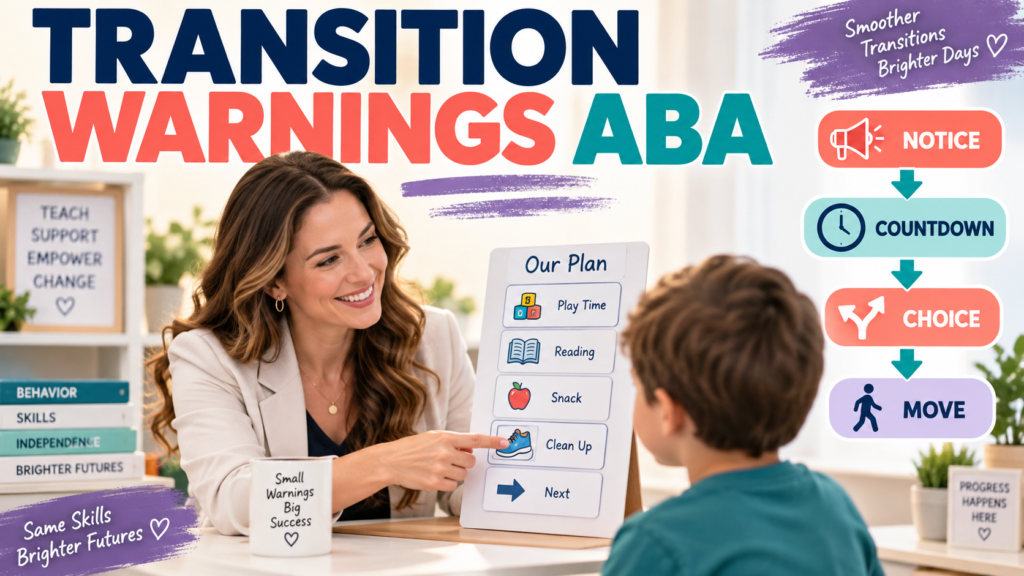
Transition warnings ABA practitioners use can make a change more predictable, but a warning is not automatically a complete behavior intervention. Learn how to choose the signal, pair it with a clear next step, and review the data.
Table of Contents
- What Does a Transition Warning Mean in ABA?
- Why Can Advance Notice Help?
- Which Types of Transition Warnings ABA Teams Use?
- How Should a BCBA Individualize the Signal?
- What Should Happen After the Warning?
- When Is a Warning Not Enough?
- What Data Should Be Collected?
- How Should a BCBA Evaluate a Transition Warning?
- How Can Warnings Be Faded?
- Key Takeaways for BCBA Study and Practice
- Sources and Further Reading
- Quick Review Checklist
- Take the Free BCBA Mock Exam
When a learner moves from a preferred activity to a less preferred one, the difficult moment may appear before the new task even begins. A transition warning in ABA is an antecedent signal that tells the learner a change is approaching. It may be verbal, visual, gestural, auditory, or a combination of these formats. The practical goal is not to force compliance. The goal is to make the upcoming change more discriminable so the learner has useful information about what is ending, what is next, and what support is available.
That distinction matters for BCBA exam questions and for practice. A warning may be part of an antecedent intervention, but the signal alone does not explain why transition-related behavior occurs or guarantee that the behavior will decrease. Good programming connects the warning to the learner’s communication repertoire, the function of behavior, reinforcement, and measurable outcomes.
What Does a Transition Warning Mean in ABA?
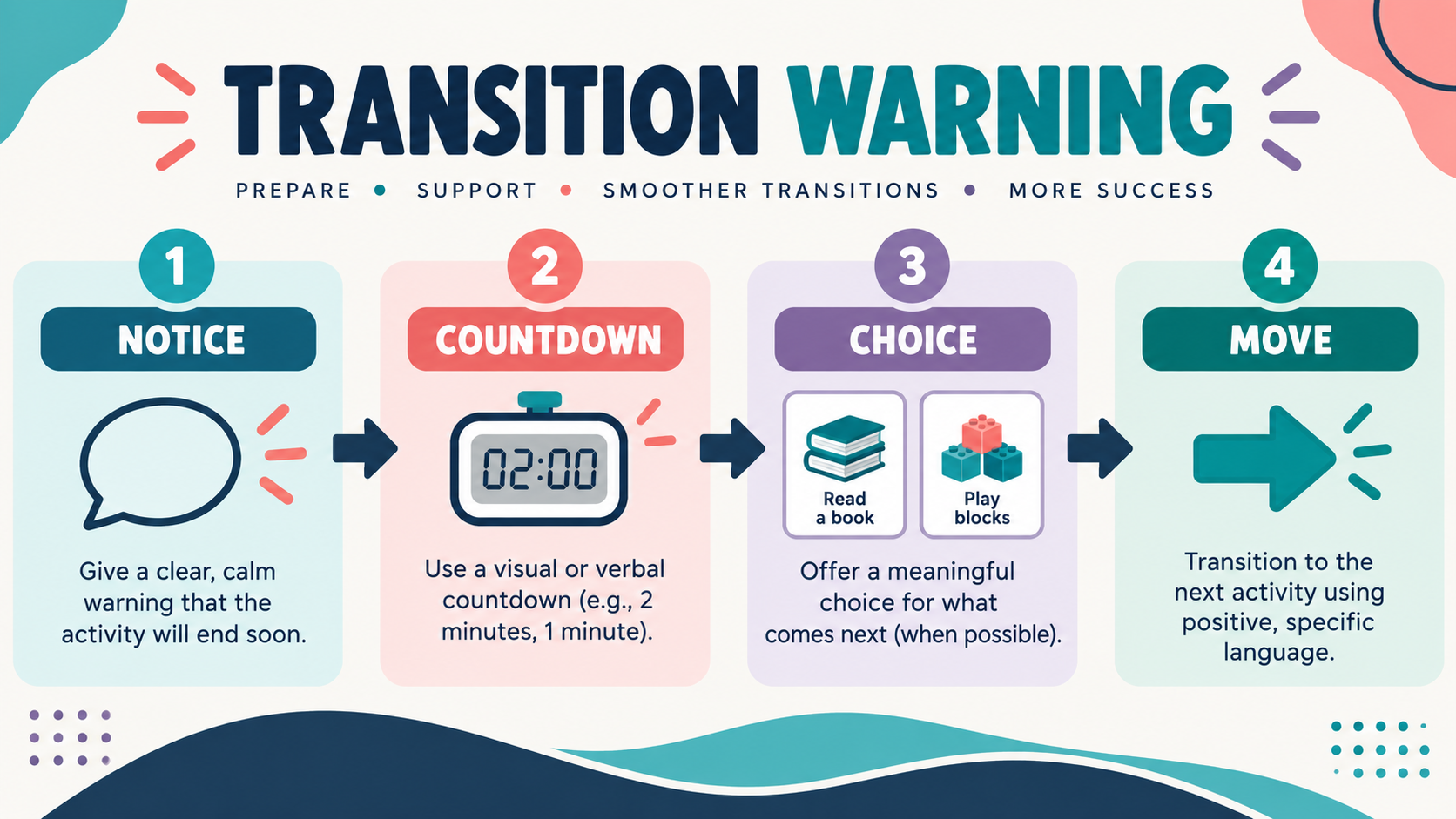
A transition warning is advance notice about an upcoming change in activity, location, person, demand, or routine. For example, a practitioner might say, “Two more minutes, then clean up,” point to the next picture on a visual schedule, show a timer, or use a consistent gesture paired with a spoken cue. The warning should give information that is meaningful to the individual, not merely announce that an adult is about to deliver a demand.
In behavior-analytic terms, the warning changes the antecedent conditions around the transition. It can reduce uncertainty, clarify the response requirement, or make the next activity easier to contact. It does not replace an assessment. If the behavior is maintained by escape, attention, access to a preferred item, or automatic reinforcement, the warning should be considered alongside those variables.
Why Can Advance Notice Help?
Sudden changes can be difficult when the learner cannot predict when an activity will end or what will happen next. Advance notice may allow time to finish a response, shift attention, access a communication response, or prepare for a change in sensory and social demands. It can also make the next activity more discriminable when the signal includes a meaningful picture, object, location cue, or short statement.
The research should be described carefully. Practice reviews report useful applications of advance notice, visual schedules, and other signals, but results are not uniform across learners or situations. A recent synthesis also cautions that signaling stimuli by themselves may not be sufficient and may work better when paired with consequence-based procedures or other individualized components. Therefore, “give a warning” is a hypothesis to test, not a universal answer.
Which Types of Transition Warnings ABA Teams Use?
The best format is the one the learner can notice, understand, and use. A verbal warning may be efficient for a learner who understands spoken time cues. A visual schedule, first-then display, countdown card, or timer may provide a more stable reference for a learner who benefits from visual information. A gesture, object cue, song, or vibration can be useful when speech is not the most effective channel.
| Signal type | What it can clarify | Question for the team |
|---|---|---|
| Verbal or auditory | That the current activity is ending and a change is near | Does the learner reliably notice and understand the cue? |
| Visual | What comes next, where it will happen, or how much time remains | Can the learner access and use the visual without excessive prompting? |
| Gestural or object cue | The response or destination associated with the next activity | Is the cue paired consistently with the same transition meaning? |
How Should a BCBA Individualize the Signal?
Start with observation rather than choosing a favorite tool. Record what happens before the transition, what the learner does, what adults do next, and whether the learner has a functional way to request more time, help, a break, or a different arrangement. Consider receptive language, visual discrimination, motor access, sensory variables, cultural and family routines, and whether the learner has shown a preference for one type of information.
The signal should be brief, consistent, and paired with an accurate next-step cue. If “two minutes” is used, the team should have a reasonable way to represent that interval. If a picture schedule is used, the next picture should correspond to the actual activity. Avoid presenting a warning and then repeatedly delaying or changing the plan without communicating the change; that can make the signal less useful.
What Should Happen After the Warning?
A warning is only one part of the transition sequence. The learner still needs a clear response opportunity. The team might offer a choice within the next activity, prompt a functional communication response, use a transition object, or arrange reinforcement for an observable transition behavior. For example, the target might be walking to the next area, handing over a finished item, beginning the first step, or appropriately requesting assistance.
Use the least intrusive support that is effective and plan how prompts will be faded. A warning should not become a repeated verbal demand that escalates when the learner does not move immediately. If the transition is unsafe or the behavior is severe, follow the approved behavior plan and obtain qualified clinical guidance rather than improvising a new procedure.
When Is a Warning Not Enough?
A transition signal may not address the maintaining variable. A learner who avoids a painful or overly difficult task may need task modification, choice, teaching, or reinforcement—not simply earlier notice. A learner who seeks attention may need a more efficient communication response and differential reinforcement. A learner whose behavior is related to sensory conditions may need an environmental or sensory assessment.
Research on transition-related behavior also shows why components should be evaluated instead of assuming that a visual schedule or warning works in isolation. If data show no improvement, check whether the cue is understood, whether the next activity is accurately represented, whether the transition consequence is reinforcing, and whether the plan is accidentally reinforcing delay or problem behavior.
What Data Should Be Collected?
Choose measures that match the target. Transition latency can show the time from the signal or instruction to movement or task initiation. Frequency, duration, or intensity may be appropriate for problem behavior. You may also record independent use of the schedule, functional communication, percentage of transitions completed, prompt level, and whether reinforcement was delivered as planned.
Define the start and stop points before collecting data. “Successful transition” might mean moving within a specified interval, arriving safely, and beginning the first step with no more than a planned prompt. Review patterns across activities, staff, locations, time of day, and preference conditions. A lower average latency with more intrusive prompting is not automatically the same outcome as independent, comfortable participation.
How Should a BCBA Evaluate a Transition Warning?
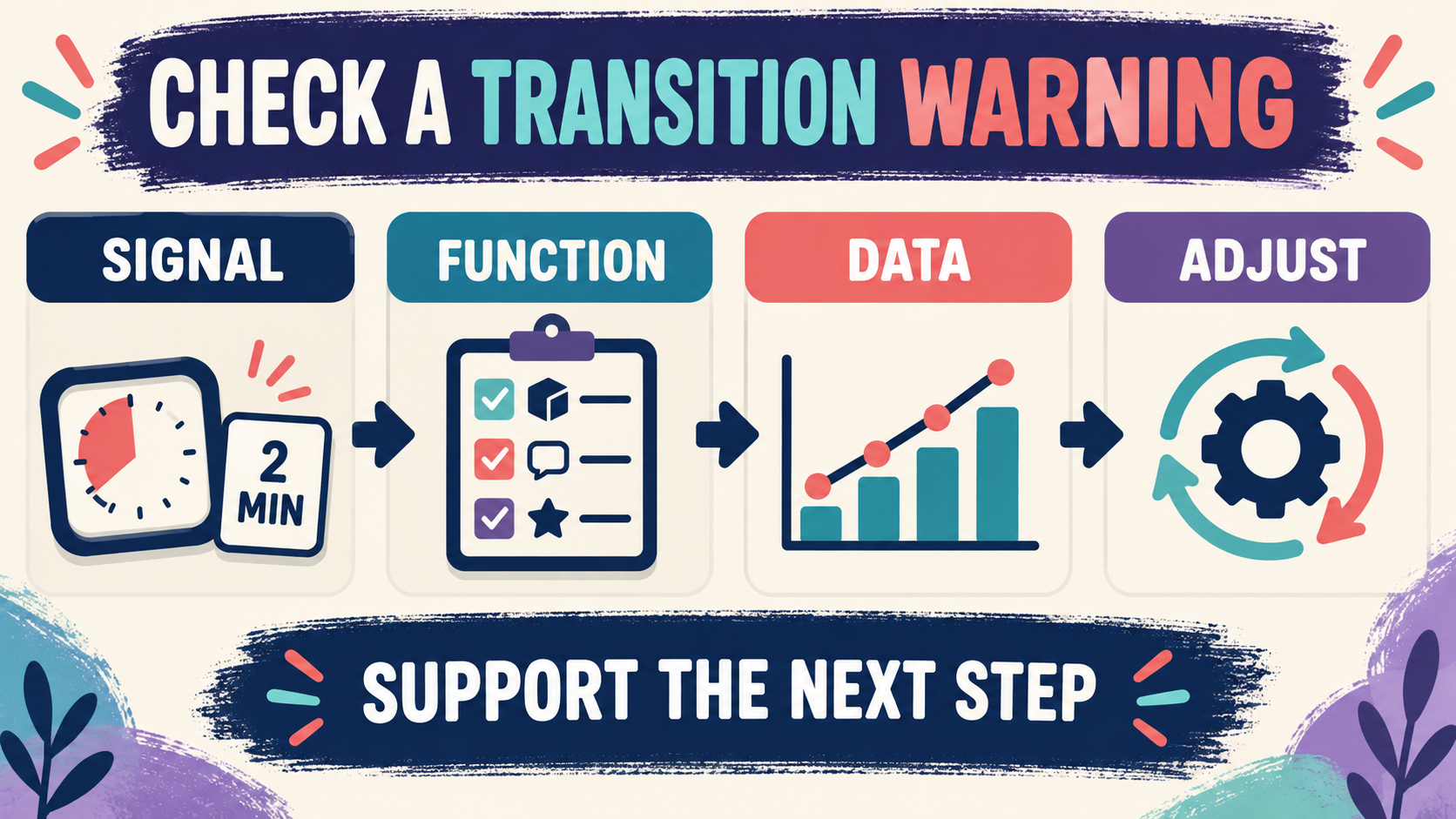
Use a small, testable decision sequence. First, define the transition and the target response. Second, identify the relevant antecedent and consequence variables. Third, select one signal that the learner can access and understand. Fourth, teach the response and arrange the planned consequence. Fifth, collect data and compare the result with the agreed decision rule. If the outcome is weak, change one meaningful component at a time when feasible so the team can learn what mattered.
For exam reasoning, watch for answer choices that treat an antecedent cue as a guaranteed treatment, skip functional assessment, or define success only as immediate adult-directed compliance. Stronger reasoning describes an observable response, an individualized support, an ethical and effective consequence arrangement, and data-based review.
How Can Warnings Be Faded?
Fading should preserve the learner’s access to information while reducing unnecessary adult prompts. The team might move from a spoken countdown to a visual cue, shorten the number of warnings, increase the interval between the cue and the transition, or teach the learner to check an independent schedule. Do not fade solely because the learner looks successful for one session. Use stable data across relevant contexts and maintain a way for the learner to request information or support.
Key Takeaways for BCBA Study and Practice
- A transition warning is advance notice about an upcoming change; it is not automatically a complete intervention.
- Choose verbal, visual, gestural, object, or auditory signals based on the learner’s communication and access needs.
- Pair the warning with a clear next step, a teachable response, and an accurately arranged consequence.
- Use functional assessment and data to decide whether the signal helps, needs modification, or should be replaced.
- Look beyond immediate compliance: independence, communication, safety, dignity, and generalization also matter.
Want to practice the reasoning? Try the free BCBA mock exam and use transition scenarios to practice separating antecedent supports, functional assessment, reinforcement, and measurement. A practice set can support preparation, but it cannot guarantee an examination result.
Sources and Further Reading
For research context, see the advance-notice practice guidelines, the JABA visual-schedule study, and the recent transition-intervention synthesis. For exam-domain context, consult the official BACB Task List and follow the current BACB materials when requirements or terminology change.
For targeted review, use our transition warnings ABA practice questions to apply the concept in exam-style scenarios.
Quick Review Checklist
Use this final checklist to turn transition warnings ABA into exam-ready reasoning. The goal is not to memorize a label in isolation; it is to identify the relevant evidence and explain why the best answer fits the scenario. Key ideas to review:
- State the central definition or decision point for transition warnings ABA in your own words.
- Identify the detail that makes transition warnings ABA different from its closest related ABA term.
- Separate the observable facts in a scenario from assumptions that are not supported by the facts.
- Write one example and one nonexample so you can recognize the concept in a new setting.
Exam application checks:
- Ask what the question is actually requesting before comparing the answer choices.
- Mark the antecedent, response, consequence, or other evidence that supports the selected answer.
- Look for a distractor that describes a related process but does not answer the specific question.
Final self-check:
- Explain how you would verify the interpretation with clear observations or data.
- Change one detail in the scenario and decide whether your answer should change.
- Give a one-sentence rationale that a supervisor or study partner could evaluate.
Take the Free BCBA Mock Exam
If you want a low-pressure way to check your recall, use the free practice resource below. Take the Free BCBA Mock Exam



