

ABA ETHICS · NEURODIVERSITY · EVIDENCE If you are asking why do people say ABA is bad, you deserve an answer that takes criticism seriously without pretending that every ABA service, historical practice, or research claim is identical. This ABA criticism guide asks what a service targets, whose goals define success, how assent and refusal work, and what outcomes are actually measured.
Table of Contents
- Why Do People Say ABA Is Bad?
- Which ABA Criticism Categories Should a BCBA Candidate Separate?
- How Do History and Lived Experience Matter?
- Why Are Assent and Dignity Central?
- What Does the Evidence Question Actually Ask?
- What Does Ethical ABA Look Like Today?
- What Are the BCBA Exam Takeaways?
- Frequently Asked Questions
- Sources for Further Study
- Take the Free BCBA Mock Exam
Why Do People Say ABA Is Bad?
People criticize ABA for several overlapping but distinct reasons. Autistic people and other stakeholders describe experiences of being trained to look more “normal,” having harmless self-regulation treated as a problem, being pushed through tasks when they wanted to stop, or having adult convenience valued over communication and autonomy. Other criticism concerns historical practices, coercive procedures, narrow definitions of success, limited participation in goal setting, and research that may not measure long-term quality of life or harms well.
Those concerns are not answered by saying “ABA is evidence-based” or “ABA is abusive.” ABA is a science and professional field that includes many procedures and service models. A specific program still has to be evaluated on its goals, consent and assent practices, procedures, competence, risks, benefits, cultural responsiveness, and outcomes. A code of ethics is an important floor; it is not proof that every provider meets the floor in every session.
A balanced answer therefore has three parts: listen to the criticism and lived experience, check what the current ethics standards require, and evaluate the actual service rather than an abstract label. Families, autistic adults, learners, and clinicians can disagree about a particular goal while still agreeing that the person’s safety, communication, dignity, and quality of life matter.
Which ABA Criticism Categories Should a BCBA Candidate Separate?
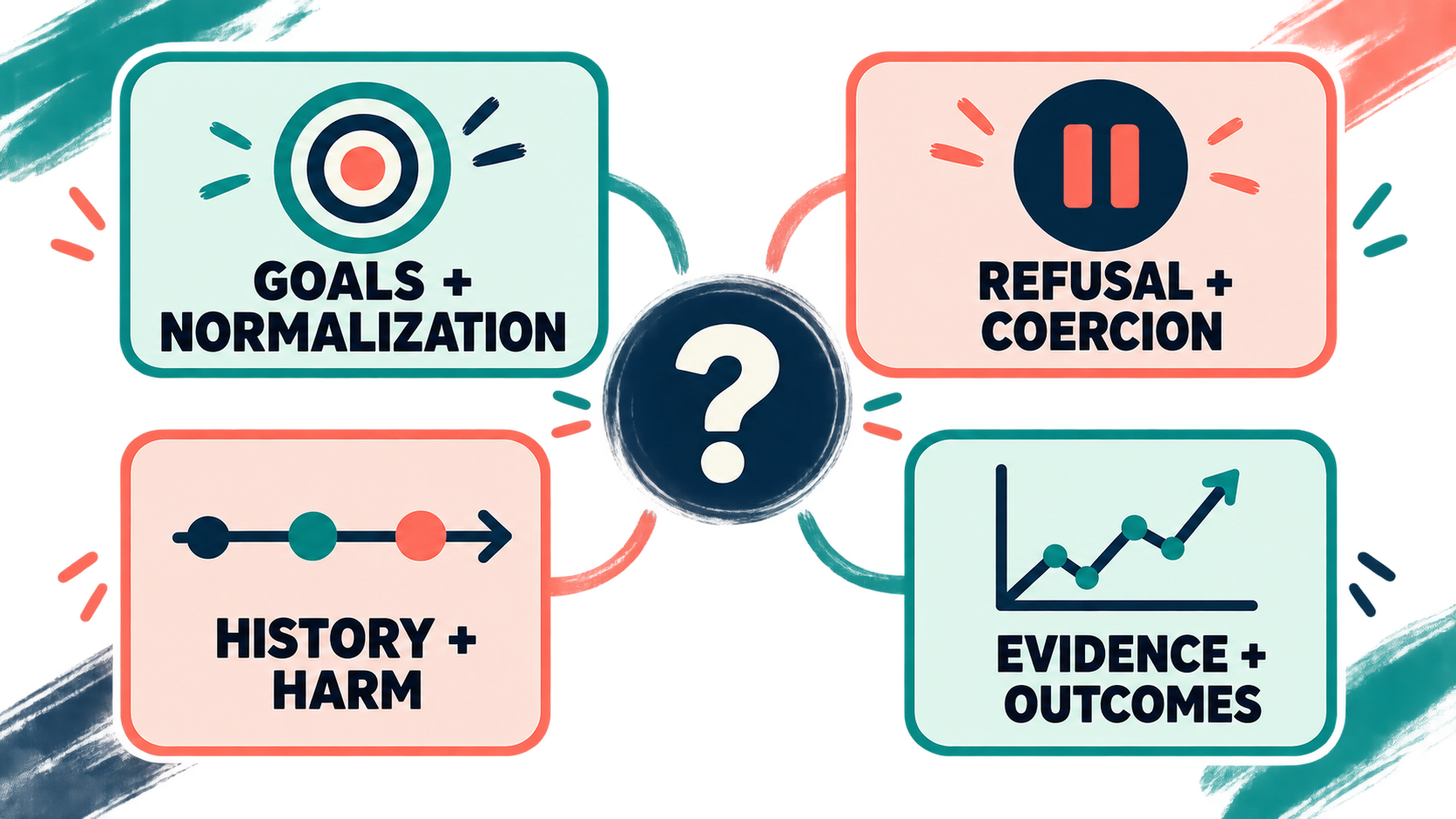
The word “bad” compresses multiple claims. Separate them before deciding whether evidence supports the claim:
| Concern | What the concern is about | Question to ask about a service |
|---|---|---|
| Goals and normalization | Whether targets suppress harmless autistic traits or prioritize appearance over participation and wellbeing. | Who chose the goal, what benefit does it create, and can the learner decline or choose another way? |
| Coercion and refusal | Whether “no,” distress, or a request for a break is treated as communication or simply blocked. | What happens when the person refuses, and how is assent checked throughout the service? |
| Historical harm | Past and present use of punitive, aversive, demeaning, or non-consensual practices in behavior programs. | What procedures are prohibited, how are risks reviewed, and who can stop the program? |
| Evidence and outcomes | Whether studies measure meaningful quality-of-life outcomes, long-term effects, and possible harms as well as skill change. | What data are collected, what counts as success, and how are side effects or adverse experiences reported? |
How Do History and Lived Experience Matter?
Historical context changes how people hear professional assurances. Behavior analysis has a long research tradition, but behavior-analytic services have not been experienced uniformly. Earlier programs and some later programs used goals, language, or procedures that many autistic people describe as coercive or identity-suppressing. A person who was repeatedly denied a break, punished for communication, or taught to hide distress may reasonably assess a new promise of “modern ABA” through that history.
Lived experience is not a randomized trial, but it is not disposable anecdote either. It can identify outcomes a program failed to measure: fear, masking, loss of trust, reduced self-advocacy, or learning that “no” will not be honored. A strong service treats those reports as safety and quality information. A strong research program also asks whose outcomes were included, how participants described the experience, and whether the measures reflect the person’s priorities.
At the same time, one person’s experience cannot establish that every behavior-analytic intervention has the same effect. The correct response to disagreement is better specification: Which goals? Which procedures? Which setting? Which consent process? Which outcomes? Which time period? Broad claims become more useful when they are attached to an observable service model.
Why Are Assent and Dignity Central?
Consent is normally provided by an authorized decision-maker when required; assent is the learner’s observable willingness to participate when the person cannot provide legally sufficient informed consent. The current BACB Ethics Code addresses dignity, respect, and assent-related responsibilities. Assent is not a single signature. It is an ongoing process of noticing communication, offering meaningful choices, explaining what will happen in an accessible way, and responding when the person withdraws cooperation.
Assent can be imperfect and context-dependent. A learner may agree to practice one skill but not another, or may participate until a task becomes painful or overwhelming. A provider should have a plan for pause, refusal, alternative communication, and re-evaluation. “The person complied” is not the same as “the person was willing, safe, and benefiting.”
Dignity also affects target selection. Eye contact, still hands, quiet bodies, and “looking typical” are not automatically socially significant outcomes. A goal is more defensible when it improves access, communication, safety, independence, self-advocacy, relationships, or a personally chosen activity. A behavior may be reduced because it causes injury or blocks participation, not merely because another person finds it unusual.
What Does the Evidence Question Actually Ask?
“Does ABA work?” is too broad to answer without specifying a population, intervention, comparison, outcome, and time frame. Evidence can support some procedures for some outcomes while leaving uncertainty about others. A review may find gains in language or adaptive skills but not establish that every program improves adult quality of life. A study may report behavior reduction without measuring whether the replacement behavior increases autonomy.
Evidence evaluation should therefore include benefit and burden. Ask whether the design measured the outcome that matters, whether participants were represented in the goal-setting process, how adverse events or dropouts were handled, and whether results generalized beyond a clinic. Also ask whether the service uses data to stop or change an intervention when it is ineffective or harmful.
- Outcome validity: Does the measure reflect the learner’s chosen priorities and daily life?
- Procedural clarity: Can another qualified professional explain what was actually done?
- Individual fit: Was the plan adapted to communication, sensory, cultural, and medical needs?
- Side-effect review: Are distress, avoidance, masking, new problem behavior, and loss of trust monitored?
- Long-term value: Does the skill remain useful after prompts, tokens, or intensive adult support are reduced?
What Does Ethical ABA Look Like Today?
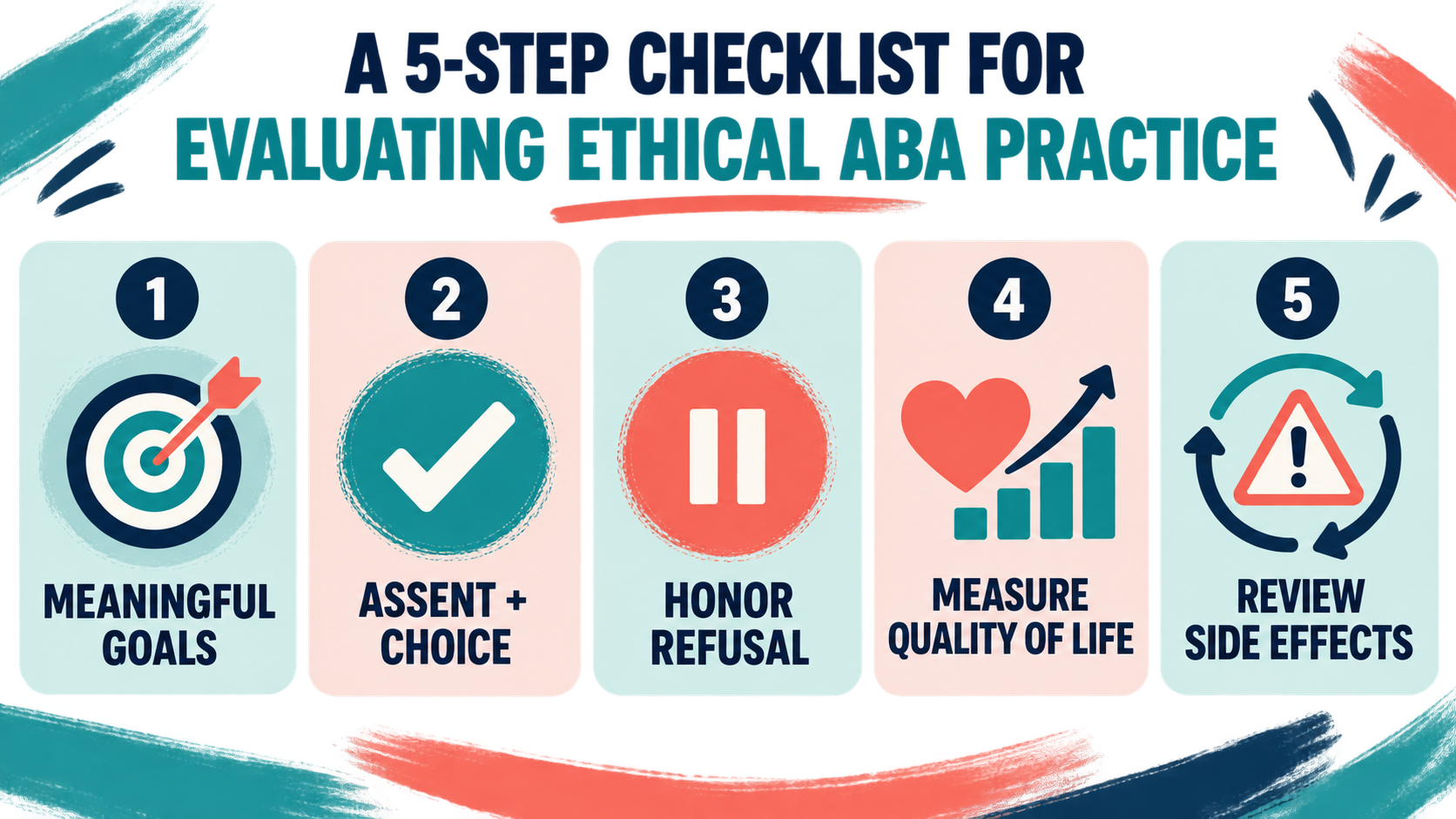
There is no single visual test for ethical practice, but a provider should be able to answer specific questions. The program should begin with assessment and a meaningful reason for intervention. The learner and relevant stakeholders should understand the plan in an accessible way. The provider should use the least intrusive effective approach, protect dignity, monitor risk, and change course when the data or the learner’s experience says the plan is not working.
- Ask what the goal is for. Request the everyday benefit, not only the label of the target behavior.
- Ask who selected it. The learner’s priorities and communication should be visible in the decision.
- Ask how refusal works. Clarify what happens when the person says no, requests a break, or shows distress.
- Ask what is not targeted. A thoughtful provider can explain why harmless self-regulation and identity-related behavior are not automatically treated as deficits.
- Ask how progress is measured. Look for independence, quality of life, generalization, and side-effect data—not compliance alone.
- Ask how concerns are escalated. There should be a clear route to the supervisor, clinical director, ethics process, or another authority when safety or dignity is at risk.
Families and learners can also ask to see the written plan, discuss alternatives, seek a second opinion, or stop a service when the arrangement no longer fits. A respectful provider will treat those questions as part of informed decision-making rather than disloyalty.
What Are the BCBA Exam Takeaways?
For a BCBA exam question asking why do people say ABA is bad, do not choose an answer that treats either praise or criticism as a universal fact. The best reasoning identifies the ethical issue, considers assent and dignity, evaluates the social significance of the goal, checks the evidence and side effects, and adapts practice to the person.
- Separate criticism of a specific goal or procedure from a claim about the entire field.
- Take autistic lived experience seriously as information about outcomes and acceptability.
- Do not equate compliance or normalization with quality of life.
- Use informed consent, ongoing assent, meaningful choice, and functional communication.
- Measure benefits, harms, generalization, maintenance, and socially valid outcomes.
After reviewing the ethics distinctions, the site’s free BCBA mock exam can provide additional scenario practice. It is an independent study resource, not official BACB content and not a guarantee of certification.
Frequently Asked Questions
Does criticism mean that every ABA service is harmful?: No. It means that some people have experienced harm or unacceptable goals and that services must be evaluated rather than assumed safe because they use the ABA label. A specific program should be reviewed for goals, procedures, assent, dignity, evidence, and outcomes.
Can ABA be neurodiversity-affirming?: Some behavior analysts argue that it can when it supports autonomy, communication, access, safety, and personally meaningful goals while respecting neurodivergent ways of being. The label is not enough; examine what the service actually targets and how it responds to refusal and difference.
Why is eye contact often part of the criticism?: Eye contact can be uncomfortable, unsafe, or unnecessary for communication for some people. Treating it as an automatic goal can prioritize appearance over function. If a visual-orienting skill is genuinely needed for a chosen activity, the rationale and learner’s willingness still matter.
Sources for Further Study
- BACB Ethics Code for Behavior Analysts — current standards for dignity, client welfare, competence, and ethical practice.
- Affirming Neurodiversity within Applied Behavior Analysis — peer-reviewed discussion of autistic advocacy and practice implications.
- Autistic Experiences of Applied Behavior Analysis — recent autistic-centered perspectives and support implications.
- Dignity and Respect: Why Therapeutic Assent Matters — assent and dignity discussion.
- Applied Behavior Analysis Evidence Review — evidence, uncertainty, benefits, and gaps to consider.
For targeted review, use our ABA criticism practice questions to apply the concept in exam-style scenarios.
Take the Free BCBA Mock Exam
If you want a low-pressure way to check your recall, use the free practice resource below. Take the Free BCBA Mock Exam



