
Short answer: Contingencies of Reinforcement: A Theoretical Analysis is B. F. Skinner’s 1969 book about how behavior is selected and maintained through relations among behavior, consequences, and the environment. It is a theoretical and philosophical analysis of behavior science, not a step-by-step BCBA intervention manual. For BCBA study, the book is most useful when it helps you connect contingency, operant behavior, schedules, stimulus control, and the difference between describing behavior and explaining its environmental relations.
Table of Contents
- Contingencies of Reinforcement A Theoretical Analysis: Book Overview
- What does “theoretical analysis” mean in the book?
- Which Skinner concepts matter for BCBA study?
- How does the book connect to applied behavior analysis?
- How should BCBA candidates study the book?
- What are common exam traps?
- Contingencies of Reinforcement FAQ
- Take the Free BCBA Mock Exam
The exact search phrase contingencies of reinforcement a theoretical analysis points to a book-focused information need. A reader searching it may want the publication details, a plain-language summary, the main concepts, or help connecting Skinner’s work to modern applied behavior analysis. This guide answers those needs without pretending that the book is the current BACB blueprint or that reading a historical text guarantees exam coverage.
Skinner’s work matters because it treats behavior as a subject for a natural-science analysis. The practical lesson for a BCBA candidate is not to memorize a famous title. It is to ask what environmental event follows a response, under what conditions, and whether the relation changes the future probability of behavior. Table of Contents
Contingencies of Reinforcement A Theoretical Analysis: Book Overview
Contingencies of Reinforcement: A Theoretical Analysis is a book by Burrhus Frederic Skinner, commonly known as B. F. Skinner, first published by Appleton-Century-Crofts in 1969. The B. F. Skinner Foundation identifies it as one of Skinner’s books, and the bibliographic record describes a work of roughly 319 pages. It brings together theoretical discussions about behavior, the environment, operant behavior, experimental analysis, culture, and related issues.
For a reader using the search phrase contingencies of reinforcement a theoretical analysis, the key point is that the query names a book and its analytic purpose. It is not a request for another generic list of reinforcers.
The word contingency is central. In behavior analysis, a contingency describes a relation in which the occurrence or arrangement of one event changes the conditions for another event. A reinforcement contingency is not simply “a reward.” It describes how a response contacts a consequence in a context and how that consequence affects later responding. The book’s title therefore points to an analysis of relations, not a catalog of prizes.
| Book detail | What to know | BCBA study boundary |
|---|---|---|
| Author | B. F. Skinner | Know the historical association; do not treat the author’s name as the answer to every contingency question. |
| Original publication | 1969, Appleton-Century-Crofts | Publication history is different from the current BCBA examination outline. |
| Subject | Behavior, environment, operant analysis, and contingencies | Use it to sharpen conceptual analysis, not as an intervention recipe. |
| Best study use | Connect historical theory to present-day contingency reasoning | Pair the historical text with current BACB materials and applied examples. |
The book is different from a modern study guide in both purpose and voice. It does not begin with “what will be on the exam?” Instead, it examines what it means to explain behavior in terms of environmental relations. That difference is exactly why a learner should read it selectively and translate each idea into observable variables and contingencies.
What does “theoretical analysis” mean in the book?
In this title, “theoretical analysis” does not mean speculation detached from behavior. It refers to organizing the concepts used to interpret behavioral data and to examining the assumptions behind a science of behavior. Skinner’s approach asks whether a concept helps identify variables that can be observed, manipulated, and related to changes in behavior.
A theory can be useful when it guides measurement and prediction. For example, saying that a response is reinforced is not the end of the analysis. The analyst must identify the consequence, specify the context in which it occurs, and check whether future responding changes. The theoretical term becomes useful because it directs attention toward a testable relation.
This perspective also explains why a contingency is more precise than a mentalistic label. “The learner wanted to comply” may be a report about a private event or an interpretation, but it does not specify what changed in the environment. “The learner’s response produced a break from a task, and responding increased when that contingency operated” identifies a relation that can be measured and evaluated. A theoretical analysis should therefore move through three levels:
- Description: What did the person do, and how was it measured?
- Relation: What antecedent and consequence were arranged around the response?
- Test: Did changing the relevant environmental relation produce a corresponding change in behavior?
The third level matters for BCBA work. A plausible story is not the same as experimental evidence, and an observed sequence is not automatically a functional relation. The book’s theoretical emphasis can help a learner resist jumping from a label to a conclusion.
Which Skinner concepts matter for BCBA study?
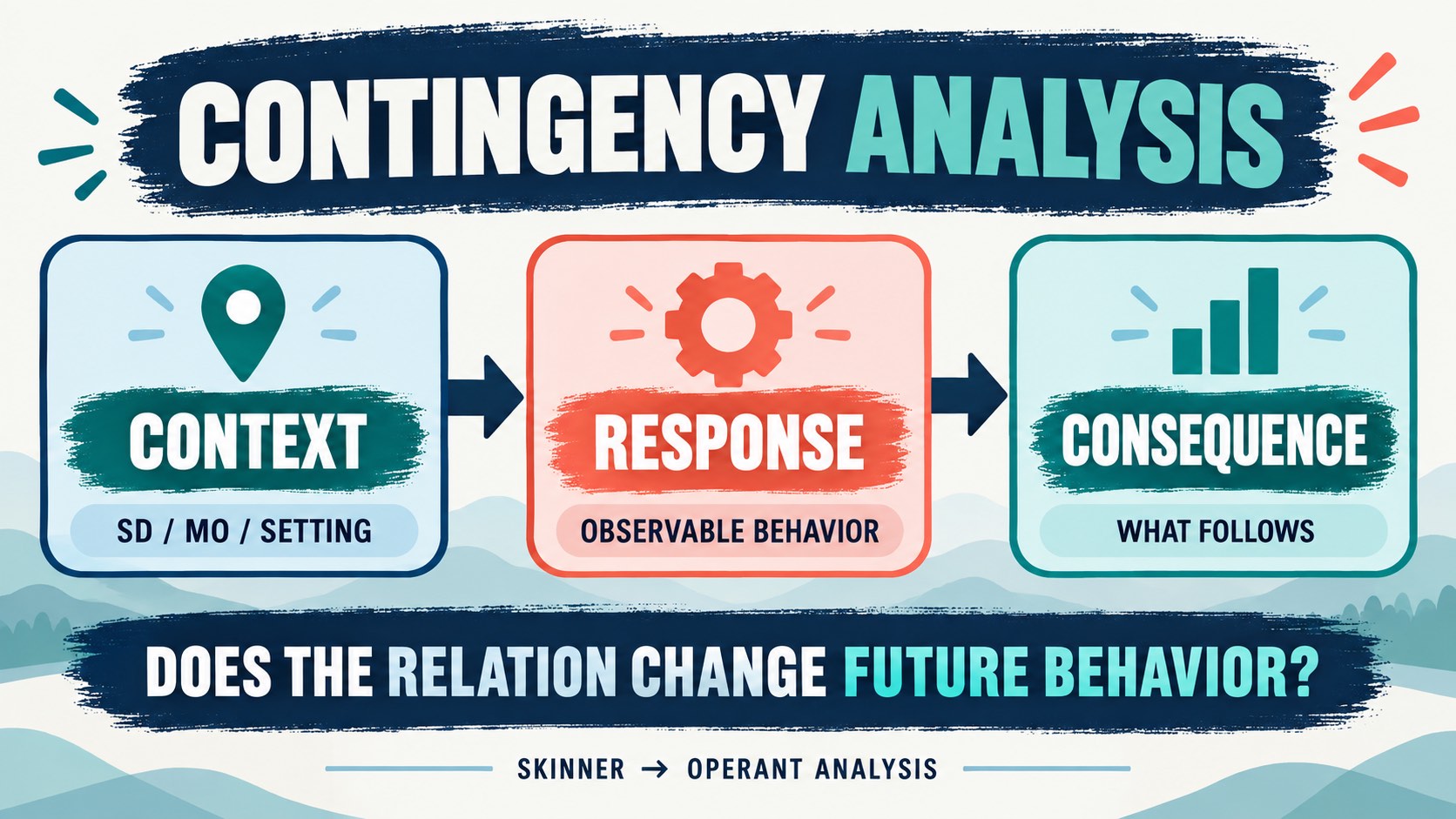
The book covers more than one exam definition, but several ideas provide a useful conceptual bridge to the current practice of behavior analysis. Operant behavior is selected by its consequences: Operant behavior is behavior whose future probability is affected by its consequences. The response does not need to be voluntary in a philosophical sense, and the consequence does not need to be pleasant. The analyst looks for a change in later responding. This is why reinforcement is defined by effect rather than by the appearance of the stimulus. Contingencies include context
A consequence does not operate in a vacuum. The presence of an antecedent, a motivating operation, a discriminative stimulus, a competing consequence, or a history of reinforcement can change the probability of a response. A BCBA scenario may describe the same consequence in two settings and ask why behavior differs. The answer usually depends on the full contingency and learning history rather than on the consequence label alone. Schedules organize contact with reinforcement
Schedules specify when or how often a consequence is delivered in relation to responding. Fixed-ratio, variable-ratio, fixed-interval, variable-interval, and continuous reinforcement are not interchangeable labels. The book’s theoretical frame helps explain why schedule terms matter: they describe patterns of environmental contact that can produce different response patterns and resistance to change. Contingency-shaped and rule-governed behavior are not identical
Behavior can change through direct contact with consequences or through a verbal description of what will happen. A rule may alter behavior before the learner contacts the stated consequence, while contingency-shaped behavior reflects direct exposure to the relation. The distinction is useful when a scenario includes instructions, self-rules, or a learner’s history of contacting outcomes.
Selection occurs at more than one level: Skinner’s broader analysis discusses selection by consequences across biological, behavioral, and cultural levels. A BCBA candidate does not need to turn every clinical question into a philosophy essay. The practical lesson is to identify which level the question is asking about and not confuse a species-level explanation, an individual learning history, and a cultural practice.
How does the book connect to applied behavior analysis?
Applied behavior analysis translates behavioral principles into socially meaningful assessment and intervention. A historical theoretical book can support that work by clarifying how to define behavior, identify environmental variables, and evaluate functional relations. It does not replace a behavior plan, a functional behavior assessment, a measurement system, or a current ethical standard.
Consider a simple study scenario. A learner engages in task refusal when difficult work is presented. After refusal, the task is removed, and refusal becomes more likely. A purely descriptive summary might say, “the learner avoids work.” A contingency analysis asks what event follows refusal, whether removal is contingent on the response, whether the pattern is replicated, and what happens when the arrangement changes. The theoretical lens improves the question; data are still needed to support the answer.
The same logic applies to skill acquisition. If a learner begins responding more often after a teacher delivers praise, the analyst should define the target response, record the timing and quality of praise, and examine later performance. Saying “praise motivated the learner” may be a hypothesis, but it does not establish reinforcement without evidence of an increase in behavior. The book’s emphasis on relations keeps the analysis functional and testable.
For current standards, use the BACB BCBA Test Content Outline as the exam framework and Skinner’s book as historical/conceptual background. Do not claim that BACB endorses the book, that the title predicts exact exam questions, or that historical terminology automatically maps one-to-one onto every current definition.
How should BCBA candidates study the book?
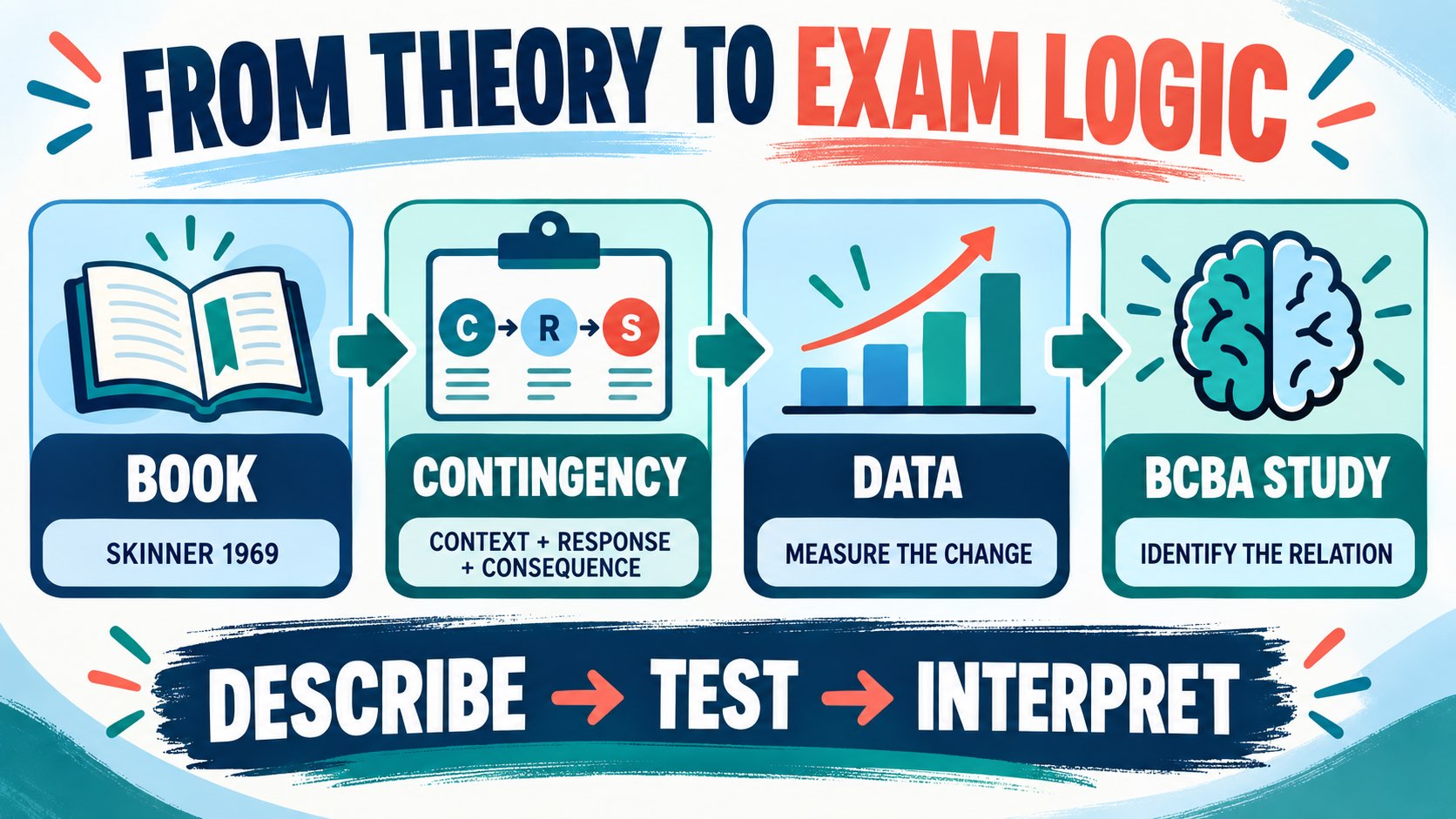
Most candidates do not need to memorize every chapter or reproduce Skinner’s prose. Use a translation routine that turns theory into an exam-ready relation:
- Name the behavior. Write an observable response and a measurement dimension.
- Identify the antecedent context. Note the stimulus, motivating operation, rule, or setting event that matters.
- Identify the consequence. State what changed immediately after responding.
- Predict the behavioral effect. Ask whether the response should increase, decrease, or remain uncertain.
- Check the evidence. Separate a plausible contingency from data that demonstrate a functional relation.
Then compare the idea with an existing BCBA topic. For example, if the passage discusses schedules, review the relevant schedule definitions. If it discusses rules, compare rule-governed and contingency-shaped behavior. If it discusses the environment, connect the passage to antecedent control and consequence effects. This prevents the historical book from becoming an isolated memorization task.
- Keep one note for the book’s historical claim or concept.
- Keep one note for the current BACB terminology that overlaps or differs.
- Write one original scenario showing the contingency and the data needed to test it.
What are common exam traps?
- Author-name matching: choosing Skinner merely because the stem uses the word “reinforcement.” Identify the behavioral relation first.
- Reward language: assuming that a preferred item is a reinforcer without checking its effect on future behavior.
- Sequence equals function: treating “response followed by consequence” as proof that the consequence caused the behavior change.
- History equals current function: assuming that a stimulus that reinforced behavior in the past still has the same effect now.
- Historical text equals current policy: using a 1969 theoretical work as a substitute for the current BACB outline, ethics requirements, or clinical supervision.
Contingencies of Reinforcement FAQ
Who wrote Contingencies of Reinforcement: A Theoretical Analysis ?: B. F. Skinner wrote the book. It was first published in 1969 by Appleton-Century-Crofts. The B. F. Skinner Foundation and bibliographic records provide publication and edition information.
Is the book a BCBA exam study guide?: No. It is a historical and theoretical work. It can deepen your understanding of contingencies and operant analysis, but it should be paired with the current BACB materials, modern textbooks, and practice scenarios.
What is the main idea to remember?: Analyze behavior through relations among responses, environmental context, and consequences, then test whether changing the relevant relation changes future behavior. Do not stop at a mentalistic label or at the name of a stimulus. Where can I read more?: The B. F. Skinner Foundation edition provides an accessible source for the text, while Google Books’ bibliographic record confirms the 1969 title, author, publisher, and contents preview.
Next step: After reviewing the theory, practice identifying the contingency in short ABA scenarios. Our free BCBA mock exam can help you apply reinforcement, schedules, stimulus control, and measurement distinctions without claiming that one historical book predicts the exam.
Take the Free BCBA Mock Exam
When you are ready to apply the idea, use the free practice resource below for additional feedback. Take the Free BCBA Mock Exam



