

Short answer: Conjugate reinforcement in ABA is a reinforcement arrangement in which a measurable property of the reinforcer changes continuously or proportionally with a measurable property of the learner’s response. A stronger, faster, larger, or more sustained response can produce a corresponding change in the intensity, clarity, duration, or amount of stimulation. The defining idea is covariation between responding and reinforcement—not simply using two reinforcers at the same time.
Table of Contents
- What is conjugate reinforcement in ABA?
- How does a conjugate reinforcement schedule work?
- What are the components of conjugate reinforcement?
- What does a conjugate-reinforcement example look like?
- How is it different from ordinary reinforcement schedules?
- What does research suggest about conjugate schedules?
- How should BCBA candidates analyze a scenario?
- What are common conjugate-reinforcement traps?
- Conjugate reinforcement ABA FAQ
- Take the Free BCBA Mock Exam
The phrase conjugate reinforcement ABA is easy to misread. It is not another name for continuous reinforcement, a fixed-ratio schedule, or a generic reward system. It describes a close response–reinforcer relation in which the learner’s ongoing behavior helps determine a dimension of what is delivered. This guide explains the concept, shows how it differs from familiar schedules, and gives BCBA candidates a practical way to analyze a scenario without overstating the research base.
Conjugate schedules are a specialized topic in behavior analysis and experimental work. They are useful for understanding automatically reinforced behavior and response-produced stimulation, but they are not a universal treatment recommendation or a substitute for functional assessment, measurement, and individualized clinical judgment. Table of Contents
What is conjugate reinforcement in ABA?
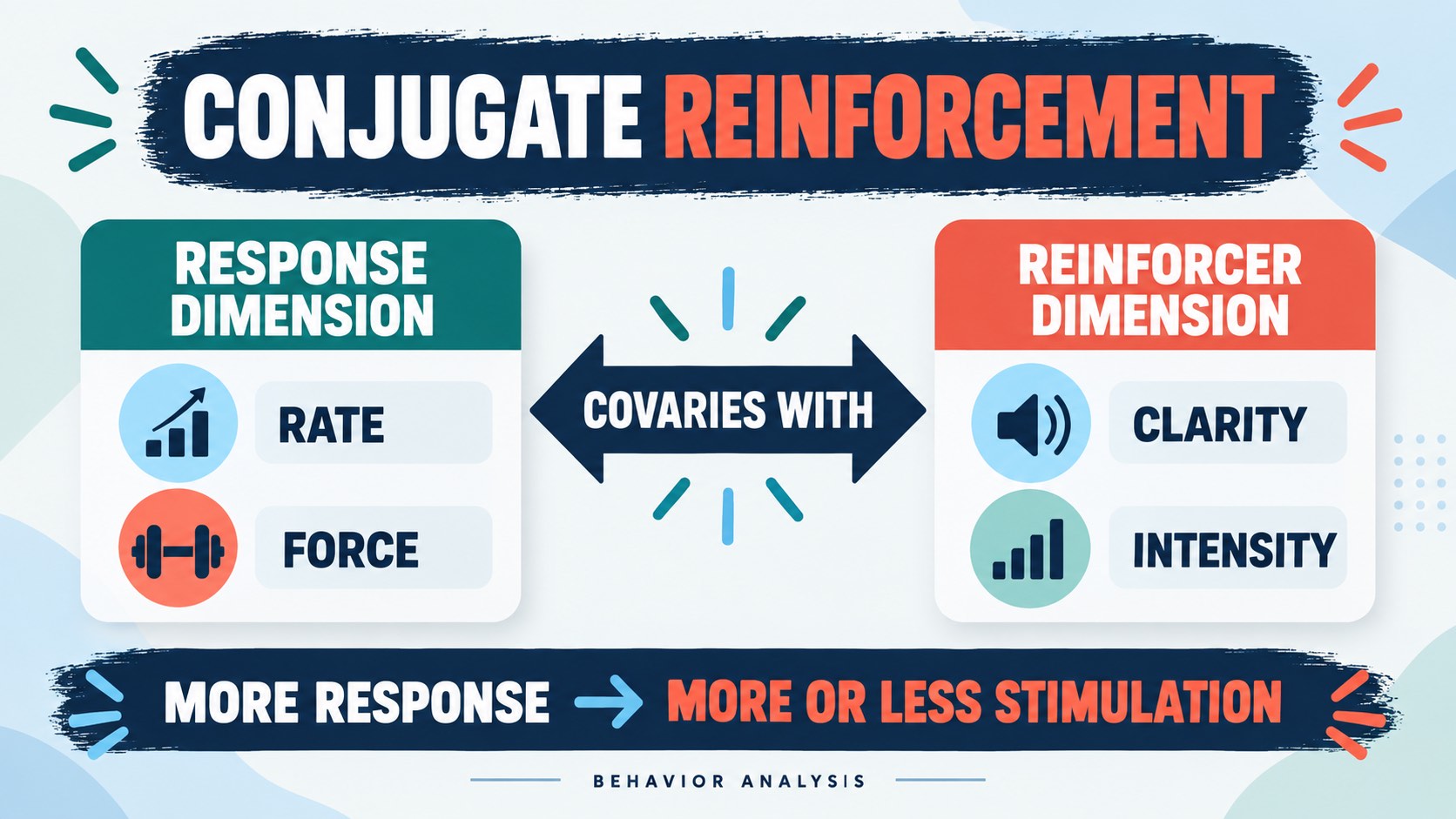
Conjugate reinforcement is a contingency in which a property of reinforcement covaries with a property of the response that produces it. The response and the consequence remain functionally related while the behavior is occurring. For example, a key press might make a visual image clearer, and the amount of clarity might change in relation to the rate or force of key pressing. The learner is not merely completing a response requirement and then receiving a separate, fixed event; the response changes a dimension of the stimulation itself.
The term conjugate highlights the coupling between two changing dimensions. One dimension belongs to behavior, such as response rate, force, amplitude, duration, or movement magnitude. The other belongs to the reinforcer, such as brightness, volume, duration, intensity, or amount of stimulation. When the planned relation makes changes in one dimension correspond to changes in the other, the arrangement is a conjugate schedule. A useful operational definition therefore has four parts:
- A response is measured along a relevant dimension.
- A consequence functions as reinforcement for that response under the arrangement.
- A measurable property of the consequence changes as a function of the response.
- The relation is arranged and measured clearly enough to distinguish covariation from coincidence.
Conjugate reinforcement should not be defined as “more than one reinforcer.” A procedure can combine praise and access to an activity without being conjugate. It becomes conjugate only when a specified property of the consequence changes in relation to a specified property of responding. Likewise, a larger reward after a fixed number of responses is not automatically conjugate; that may be an ordinary ratio arrangement if the consequence is still delivered as a discrete event after the requirement is met.
How does a conjugate reinforcement schedule work?
The easiest way to understand the mechanism is to ask what changes while the response changes. Imagine a learner pressing a key to control the clarity of a picture. At a low response rate, the image may remain faint. As the response rate increases, the image becomes clearer. If the learner slows down, the image may become less clear. The response is therefore connected to a continuously varying sensory consequence.
This arrangement has two related features. First, the consequence can be produced by the learner’s own behavior, which is why conjugate procedures often appear in discussions of automatic or sensory reinforcement. Second, the consequence is not necessarily constant across response episodes. Its dimension changes in the direction specified by the contingency. The analyst must identify that dimension rather than merely observing that “a reward followed the behavior.”
The relation can be positive or negative depending on the procedure. A positive conjugate arrangement might make stimulation more intense as responding increases. A conjugate punishment or reduction arrangement could make a valued stimulus less available as a response dimension changes, although a question using the word reinforcement should be analyzed for an increase in future behavior. The label depends on behavioral effect, not on whether the consequence looks pleasant. For study purposes, separate three questions:
- What response dimension is being measured? Rate, force, amplitude, duration, or another measurable property?
- What consequence dimension changes? Intensity, clarity, amount, duration, or another property?
- Does the consequence increase the future response? If not, the arrangement may involve stimulation but not reinforcement for that individual under those conditions.
What are the components of conjugate reinforcement?
A strong analysis names the relevant dimensions instead of using vague language such as “the behavior earns a better reward.” The following matrix is a compact way to organize the contingency.
| Component | Question to ask | Illustration |
|---|---|---|
| Response dimension | What aspect of behavior changes or is measured? | Key-press rate or force |
| Reinforcer dimension | What property of the consequence covaries with behavior? | Picture clarity or stimulation intensity |
| Contingent relation | What response–consequence rule connects the two? | Higher response rate produces greater clarity |
| Behavioral effect | Does responding increase across the relevant comparison? | Responding rises during the arrangement and falls during extinction |
| Measurement | How will the analyst verify the covariation and effect? | Record response rate and the programmed stimulation parameter |
What does a conjugate-reinforcement example look like?
Examples are easiest to classify when the response and consequence dimensions are stated explicitly. The examples below are educational illustrations of the relation; they are not instructions to implement a procedure with a learner without appropriate assessment, consent, supervision, and data review.
Response-produced visual clarity: In a laboratory arrangement, a participant presses a key while a visual display is partially obscured. The display becomes clearer in proportion to the rate or force of responding. If the participant’s responding increases when the clarity contingency is available and decreases when it is removed, the procedure demonstrates the logic of conjugate reinforcement. The crucial feature is that the response changes a dimension of the visual consequence.
A sensory consequence that covaries with movement: Suppose a movement produces stimulation whose intensity varies with the movement’s amplitude. If the stimulation increases the future probability of that movement under the tested conditions, the arrangement may be described as conjugate reinforcement. In applied research, conjugate schedules have also been discussed when a person’s behavior produces a sensory event that corresponds continuously to the behavior, such as controlling visual feedback. The analyst still needs evidence that the relation is reinforcing rather than assuming that any self-produced stimulation has that effect.
Teaching illustration: quality-linked feedback: As a teaching illustration, imagine that a learner’s response quality controls the amount or intensity of immediate feedback. This could resemble conjugate reinforcement only if the dimension of feedback is systematically linked to the response dimension and the feedback increases later responding. If the teacher simply delivers the same praise after every correct response, that is ordinary continuous reinforcement, not necessarily a conjugate schedule. A vivid example is not enough; the response–consequence mapping must be specified.
How is it different from ordinary reinforcement schedules?
Many errors happen because a question mentions a consequence that changes and the learner immediately chooses “conjugate.” Compare the arrangement with the established alternatives before labeling it.
| Arrangement | Defining relation | Key contrast with conjugate reinforcement |
|---|---|---|
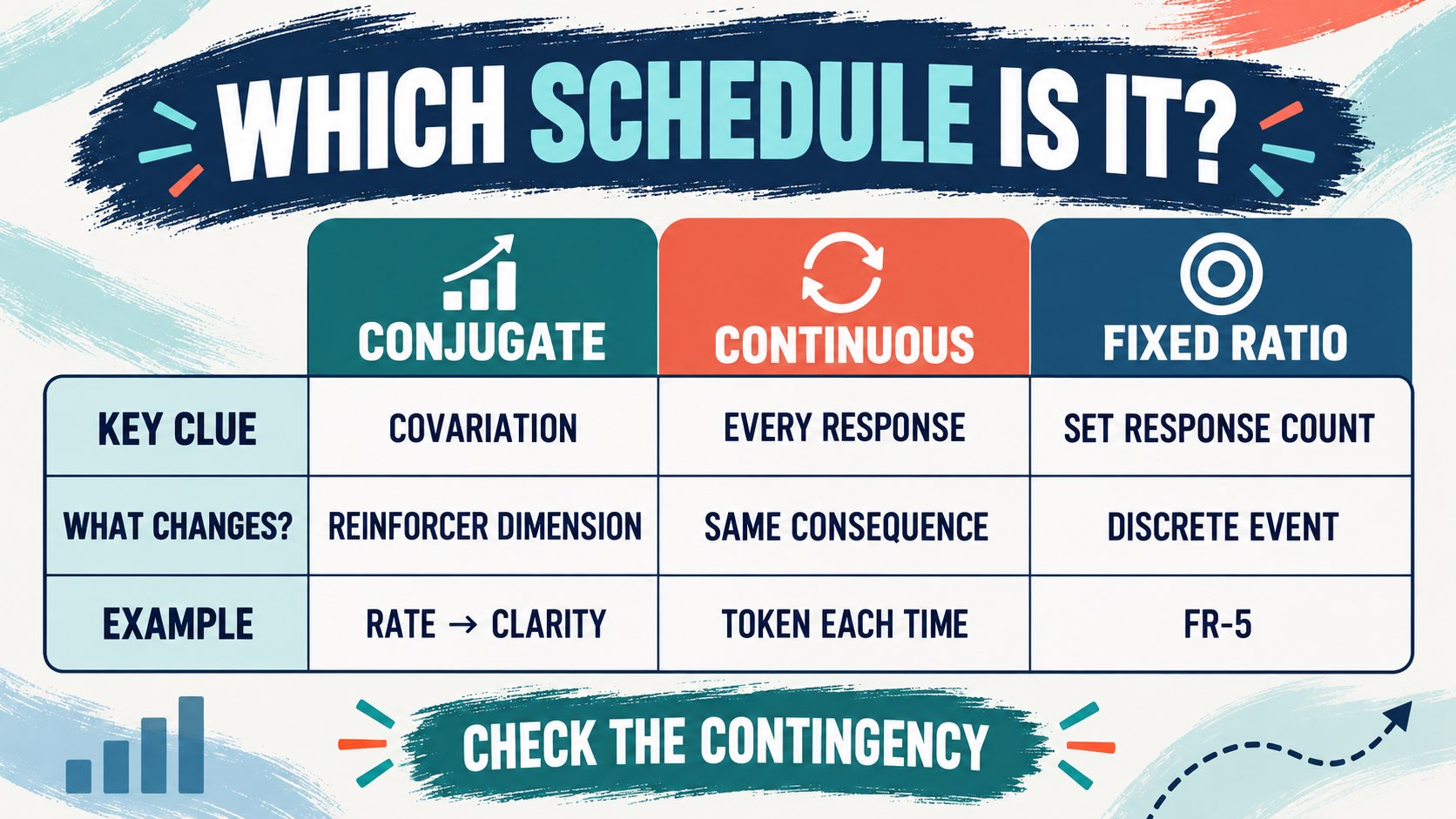
| Continuous reinforcement / CRF | Each defined response produces a consequence | The consequence can remain a fixed, discrete event; no covarying dimension is required. |
| Fixed-ratio schedule | A set number of responses produces a consequence | The requirement is discrete; the consequence does not have to vary continuously with response properties. |
| Compound or multiple reinforcement | Two or more components are arranged under stated conditions | Combining components alone does not establish response–reinforcer covariation. |
| Conjugate reinforcement | A response dimension and a reinforcer dimension change in correspondence | The defining clue is the continuous or proportional covariation, plus evidence of reinforcement. |
Another useful distinction is between response-produced stimulation and conjugate reinforcement. A behavior may produce sensory feedback, but that feedback is not automatically a reinforcer. Functional effects are demonstrated by changes in future behavior. This distinction is especially important when a case description includes automatically maintained behavior, because the function must be tested rather than inferred from appearance.
What does research suggest about conjugate schedules?
Conjugate reinforcement has a longer history in developmental and experimental research than in routine applied practice. A review by Rapp described conjugate procedures as arrangements in which a property of reinforcement varies with a response property and discussed their possible use in assessing automatically reinforced behavior. That review also emphasized the need to examine how the procedure is designed rather than treating the label as a complete functional analysis.
Later experimental work examined response-sensitive changes in stimulus clarity and reported that responding changed across conjugate reinforcement, extinction, and related comparison conditions. Applied studies have also used conjugate arrangements to examine behavior that appears to produce its own visual stimulation. These findings support the concept as a useful analytic tool, but they do not mean that every conjugate arrangement will reinforce every learner or that the procedure is automatically appropriate for clinical treatment.
- Concept evidence: the source must describe a response property and a reinforcer property that covary.
- Behavioral evidence: the analyst still checks whether the arrangement changes future responding under the tested conditions.
- Clinical boundary: a research demonstration does not replace assessment, consent, supervision, ethical review, or individualized data.
For a BCBA student, the safest takeaway is methodological: define the response and reinforcer dimensions, specify the covariation rule, measure behavior across relevant conditions, and interpret the effect functionally. The current BACB BCBA Test Content Outline provides the examination framework, but it should not be represented as publishing an official conjugate-reinforcement definition, guaranteed question wording, or a promise that this niche term will appear on a particular exam.
How should BCBA candidates analyze a scenario?
Use the following five-step routine when a practice stem describes response-sensitive feedback or stimulation:
- Underline the response dimension. Is the stem describing rate, force, amplitude, duration, or another measurable aspect of behavior?
- Circle the consequence dimension. What changes: brightness, clarity, intensity, amount, duration, or access?
- Draw the relation. Write “more response dimension → more or less consequence dimension.” If no covariation is described, do not invent one.
- Check the behavioral effect. Does the response increase in a comparison showing reinforcement? A consequence that follows behavior is not automatically a reinforcer.
- Rule out the simpler label. If the stem only says every response earns the same token, choose continuous reinforcement. If it says a fixed number of responses earns a reward, analyze the ratio schedule. Choose conjugate only when the consequence property changes with the response property.
This method keeps the analysis tied to the contingency instead of to a memorable word such as “sensory,” “automatic,” or “intensity.” Those words can be relevant clues, but none of them alone proves a conjugate schedule.
What are common conjugate-reinforcement traps?
- Trap: treating conjugate as a synonym for combined reinforcement. The defining relation is covariation, not the number of reinforcers.
- Trap: confusing CRF with conjugate reinforcement. Reinforcing every response says how often a consequence is delivered; it does not say whether a consequence dimension varies with responding.
- Trap: assuming sensory stimulation is automatically reinforcing. Test the effect on future behavior and consider alternative functions.
- Trap: ignoring the response dimension. “The reward gets better” is incomplete until the analyst states what aspect of responding makes it better.
- Trap: turning a research procedure into a treatment prescription. A laboratory demonstration or conceptual model does not replace assessment, supervision, ethical review, or individualized data.
Conjugate reinforcement ABA FAQ
Is conjugate reinforcement the same as continuous reinforcement?: No. Continuous reinforcement means that each occurrence of a defined response produces a consequence. Conjugate reinforcement describes covariation between a response property and a reinforcer property. An arrangement could deliver stimulation frequently and still fail to be conjugate if the stimulation does not change in relation to responding.
Is conjugate reinforcement always automatic?: No. Conjugate procedures are often discussed with response-produced or automatically reinforced stimulation, but the word describes the response–consequence relation. The analyst must still identify the consequence and its behavioral effect rather than infer automatic reinforcement from the term alone.
What is the shortest definition to remember?: Remember: a response dimension covaries with a dimension of reinforcement, and the change strengthens the response under the tested conditions. Then check whether the stem actually provides those elements.
Next step: After reviewing the definition, test yourself with a small set of BCBA practice questions and explain why each distractor fails. Our free BCBA mock exam can help you practice the broader reinforcement and measurement distinctions without treating one niche concept as a guarantee of exam coverage. Sources for further study: Rapp’s review of conjugate reinforcement; MacAleese, Ghezzi, and Rapp on revisiting conjugate schedules; and Rapp and colleagues on conjugate reinforcement in an assessment of automatically reinforced behavior.
Take the Free BCBA Mock Exam
When you are ready to apply the idea, use the free practice resource below for additional feedback. Take the Free BCBA Mock Exam



