
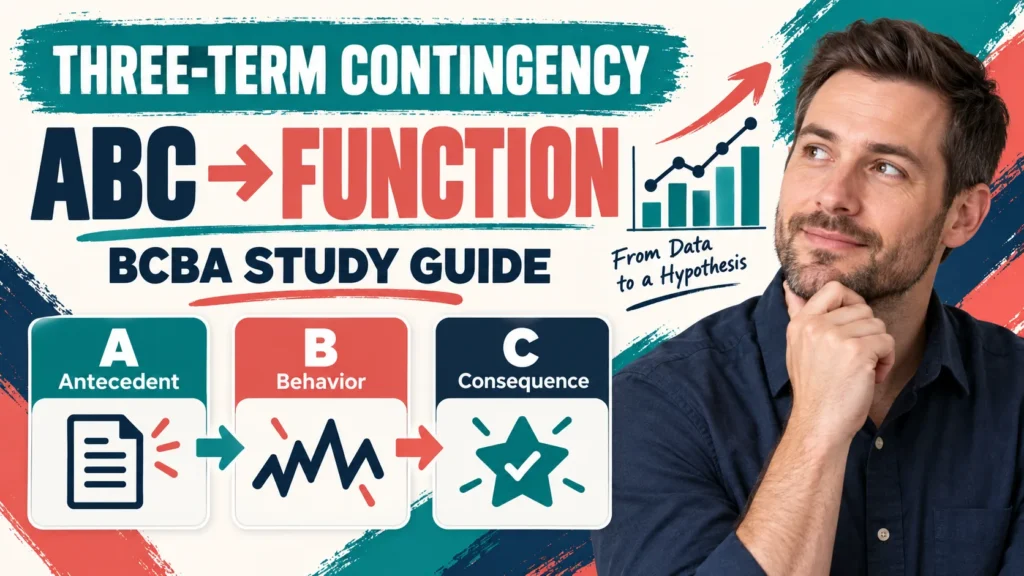
If you are studying three term contingency ABA, start with the familiar ABC sequence: antecedent, behavior, and consequence. The useful exam skill is not merely naming the three terms. It is deciding exactly what happened before the response, describing the response so another observer could code it, identifying what immediately followed, and treating any proposed function as a hypothesis that needs a pattern of evidence.
Table of Contents
- What Is Three Term Contingency ABA?
- Separate Setting Events From the Immediate Antecedent
- Write the Behavior So Someone Else Can Code It
- Read the Consequence Without Overcalling Reinforcement
- Move From an ABC Note to a Functional Hypothesis
- Read Patterns by Possible Function
- Choose the Next Data or Assessment Step
- Use the Three-Term Contingency on BCBA Questions
- FAQ
- Take the Free BCBA Mock Exam
The three-term contingency is a framework for analyzing operant behavior, not a shortcut that proves why one event occurred. A single ABC note can guide the next question, but it usually cannot establish a function by itself. This article gives you a practical path from an ABC observation to a cautious functional hypothesis and a next data or assessment step. For the broad definition and introductory examples, see the existing three term contingency ABA guide. This page owns the narrower ABC-to-hypothesis decision task.
What Is Three Term Contingency ABA?
The three-term contingency describes a relation among an antecedent, a behavior, and a consequence. The antecedent is the relevant condition that occurs before the response. The behavior is the observable response. The consequence is what immediately follows. The relation becomes behavior-analytic when the analyst asks how those events relate and whether the consequence changes the future likelihood of the behavior.
| Term | Study question | Evidence to write down |
|---|---|---|
| Antecedent (A) | What relevant event or condition occurred immediately before the response? | Observable instruction, demand, item removal, attention change, or stimulus condition, plus timing. |
| Behavior (B) | What did the person do that another observer could identify? | Topography, onset, duration or count when relevant, and the operational definition used. |
| Consequence (C) | What changed immediately after the response? | Attention, item, break, task change, physical event, or no observable change, without assuming its function. |
Do not confuse “consequence” with “reinforcer.” A consequence is defined by its position in the sequence. It is a reinforcer only if the behavior increases in the relevant conditions after that consequence. Similarly, a condition can be important background context without being the immediate antecedent in the ABC entry.
Separate Setting Events From the Immediate Antecedent
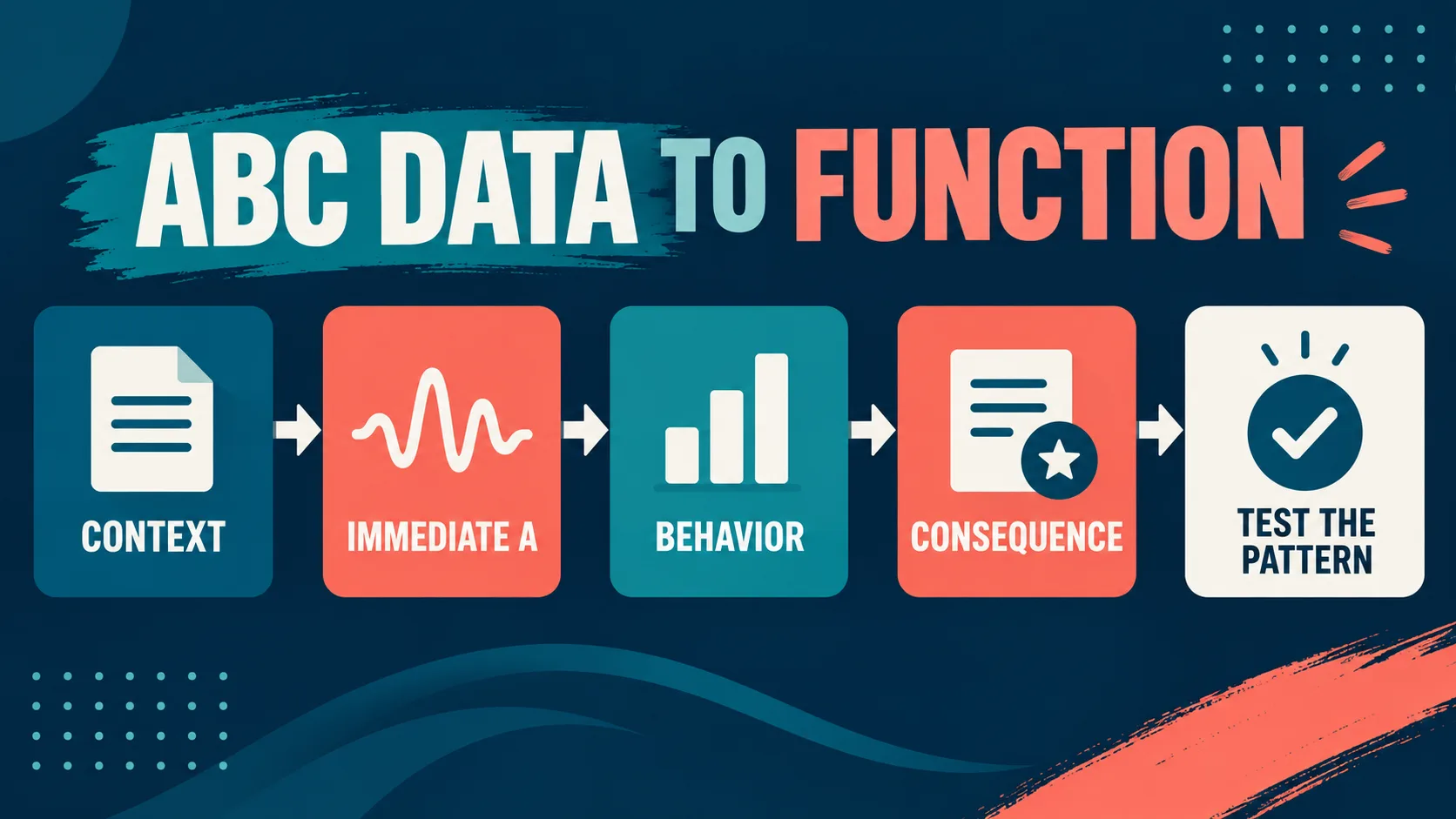
A common three-term contingency error is placing every event that happened earlier into the A column. Sleep loss, a schedule change, a prior interaction, restricted access, or an establishing operation may alter the value of a consequence or the likelihood of responding. Those variables can matter, but they are not automatically the immediate antecedent.
| Event type | Example | How to record it |
|---|---|---|
| Setting event | A change earlier in the day makes a later outcome more or less valuable. | Record it as context or a setting event, with timing separate from the immediate A. |
| Motivating operation | A condition changes the value of a consequence or evokes behavior that has produced it. | Describe the value-altering or evoking role; do not label every prior event an MO without evidence. |
| Immediate antecedent | A worksheet is presented immediately before the learner tears it. | Place the event immediately preceding the response in the A column. |
| Discriminative stimulus | A stimulus signals that a response may contact a consequence in that context. | Describe the stimulus-control relation only when the scenario supports it; see the SD in ABA guide. |
A helpful note format has two layers: “context or setting events” and “immediate ABC.” Keeping those layers separate prevents a distant event from replacing the event that directly preceded the response. It also makes later comparisons easier when you ask whether the same behavior occurs under different immediate antecedents.
Write the Behavior So Someone Else Can Code It
The B column should describe an observable response, not an interpretation. “Refused because the task was hard” combines a response, a possible private event, and a hypothesis. “Pushed the worksheet to the floor and turned away for 10 seconds” gives another observer something to identify and measure.
| Weak wording | More observable wording | Why it helps |
|---|---|---|
| Was noncompliant. | Did not begin the presented worksheet within 30 seconds and pushed it away. | Defines what counts, when it starts, and what form occurred. |
| Had a tantrum. | Cried above conversational volume, dropped to the floor, and kicked twice. | Separates several topographies that can be counted or timed. |
| Wanted attention. | Tapped the adult’s arm and said “look” after the adult turned away. | Records the response without treating the possible function as a fact. |
- Use action words that an observer could see or hear.
- State the onset and offset when duration changes the interpretation.
- Separate multiple topographies if they may have different consequences.
- Do not put “attention,” “escape,” or “sensory” in the behavior definition.
Read the Consequence Without Overcalling Reinforcement
In an ABC note, the C column describes what happened after the behavior. It does not automatically tell you what maintained the behavior. If a learner tears a worksheet and the worksheet is removed, escape is a reasonable hypothesis to investigate, but the note alone does not prove that escape is the maintaining function. You need repeated observations or a suitable assessment process.
| Observed consequence | Possible hypothesis | What the note cannot prove alone |
|---|---|---|
| Adult talks to the learner after the response. | Social attention may be relevant. | That attention is reinforcing or that no other consequence mattered. |
| Demand is delayed or removed. | Escape from the task may be relevant. | That the behavior will increase when escape is delivered in every context. |
| An item is delivered. | Access to a tangible or activity may be relevant. | That the item, rather than attention or a change in effort, controlled the response. |
| No social consequence is observed. | Automatic reinforcement may be considered if the broader pattern supports it. | That “automatic” is established simply because an adult did not respond. |
Write “the consequence observed was…” before writing “the possible function is….” That simple order keeps observation and interpretation separate. It also helps on BCBA questions where a distractor jumps from a single consequence to a certain function.
Move From an ABC Note to a Functional Hypothesis
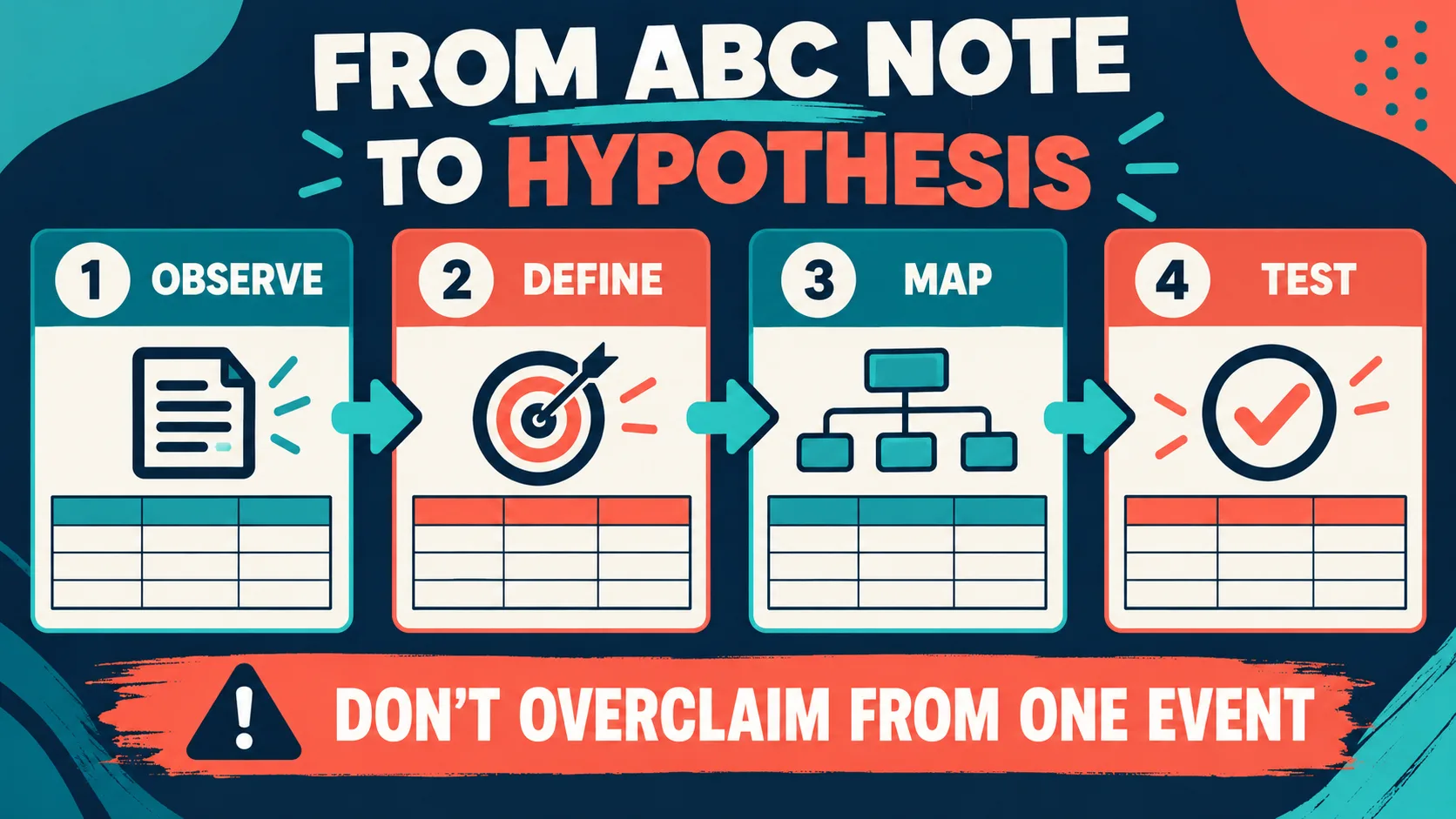
A functional hypothesis is a concise, testable statement about the relation among conditions, behavior, and outcome. It should identify the pattern you suspect without pretending that a descriptive observation is the same as a functional analysis.
| Step | Question | Output |
|---|---|---|
| 1. Observe | What happened before, during, and immediately after? | A complete, time-ordered ABC entry. |
| 2. Define | Could another observer identify the behavior? | An observable operational definition. |
| 3. Map | What antecedent-consequence pattern repeats? | A tentative relation and possible function. |
| 4. Test | What additional data or assessment would challenge or support it? | A next measurement or assessment decision. |
For example, a cautious statement might read: “When a writing task is presented, the learner pushes the paper away; in several observations, the task is then delayed. Escape from the task is a hypothesis to evaluate.” That sentence is stronger than “the behavior is escape-maintained” when the available evidence is only descriptive.
- Name the observable pattern before naming a possible function.
- State what repeated observation would make the hypothesis more or less plausible.
- Record the next data or assessment decision instead of jumping straight to treatment.
Read Patterns by Possible Function
Function is about the consequence that changes future behavior, not the appearance of the response. The same topography can have different functions, and different topographies can produce the same outcome. Use a table like this to organize possibilities, then look for repeated evidence.
| Possible function | Antecedent pattern to inspect | Consequence pattern to inspect |
|---|---|---|
| Attention | Adult attention is absent, delayed, or directed elsewhere. | An adult talks, looks, approaches, or otherwise responds after the behavior. |
| Escape or avoidance | A demand, difficult task, or aversive event is present. | The task is removed, delayed, shortened, or made easier. |
| Tangible or activity access | An item or activity is unavailable, interrupted, or visible. | The item or activity is delivered after the response. |
| Automatic | The pattern does not depend clearly on a socially mediated event. | The response itself or its sensory product may persist without a social consequence. |
This is a study map, not a diagnostic checklist for an individual. The current BACB outline includes assessment, measurement, and data-based decision tasks, but it does not turn a casual ABC note into an automatic intervention authorization. In a real service setting, follow the responsible team, consent requirements, risk safeguards, and current professional standards.
Choose the Next Data or Assessment Step
The best next step depends on the question you still cannot answer. If the behavior definition is vague, improve the definition. If the timing is unclear, collect more direct ABC observations. If a repeated pattern suggests a function but alternative explanations remain, a qualified professional may consider a more systematic assessment.
| Unanswered question | Study-level next step | Do not claim yet |
|---|---|---|
| What exactly is the response? | Refine the operational definition and check observer agreement. | That different topographies are one response class without evidence. |
| What usually occurs before and after? | Collect repeated descriptive ABC observations across relevant contexts. | That one vivid event represents the whole pattern. |
| Does the suspected function cause the behavior to change? | Review assessment options with the qualified behavior-analytic team. | That descriptive data alone establish a causal function. |
| Is the intervention working? | Select a measurement plan and make data-based decisions about procedural integrity and outcomes. | That improvement or worsening has one cause without checking competing variables. |
- Ask what evidence would disconfirm your first hypothesis.
- Compare relevant opportunities instead of counting only the most dramatic events.
- Keep observation, interpretation, and intervention decisions in separate lines of your notes.
- Use the current BACB Test Content Outline rather than a retired task-list label when planning exam review.
Use the Three-Term Contingency on BCBA Questions
The current BACB Test Content Outline index identifies the BCBA Test Content Outline (6th ed.) as the current exam-scope document. The outline includes concepts and principles, measurement, behavior assessment, and behavior-change content. For a three-term-contingency vignette, use this order:
- Underline the event immediately before the response and separate it from earlier context.
- Rewrite the behavior in observable terms.
- Circle the immediate consequence and state exactly what changed.
- Decide whether the question asks for an ABC label, a possible function, a measurement choice, or an assessment decision.
- Reject answer choices that treat one descriptive observation as proof of a maintaining function.
For an official scope check, use the BCBA Test Content Outline and the BACB examination information. When you are ready to practice, use the free BCBA mock exam. It is original practice content, not an official BACB examination, eligibility decision, score predictor, or passing guarantee.
FAQ
What are the three terms in ABA? The three terms are antecedent, behavior, and consequence. The framework organizes what happened before an observable response, the response itself, and what immediately followed. Is ABC data the same as a functional analysis? No. ABC data are descriptive observations. They can suggest a functional hypothesis, while a functional analysis is a more systematic assessment process conducted by qualified professionals under appropriate safeguards.
Is a setting event the same as the antecedent? Not necessarily. A setting event may change the context or value of a consequence, while the immediate antecedent is the relevant event directly preceding the response. Record both when they are supported, but keep them separate. Does the consequence automatically reinforce the behavior? No. “Consequence” describes what followed. To call it a reinforcer, you need evidence that the behavior increases under relevant conditions after that consequence.
What is the best way to study the three-term contingency for the BCBA exam? Practice labeling A, B, and C in short vignettes, rewrite vague behavior descriptions operationally, and explain why a proposed function is or is not supported by the available pattern.
Bottom line: The three-term contingency in ABA is more than an ABC acronym. Use it to organize the observation, then move carefully from context to immediate antecedent, observable behavior, consequence, repeated pattern, and the next testable question.
Take the Free BCBA Mock Exam
A useful next step is to apply this idea in a fresh set of BCBA-style practice questions and review the feedback. Take the Free BCBA Mock Exam



