
If a BCBA study question says the behavioral dimension of ABA refers to something, the best short answer is the behavior itself being described in observable and measurable terms. The question is asking whether the target is a defined response that another trained observer could identify and record, not whether the behavior has a particular cause or whether an intervention worked.
Table of Contents
- What the behavioral dimension of ABA refers to: the one-sentence answer
- Turn the sentence into an observation rule
- Three kinds of wording that sound behavioral but are not precise
- Read the question stem before choosing an ABA dimension
- Behavioral versus applied, analytic, and effective
- Use a four-step answer check
- Common traps in “refers to” questions
- FAQ about the behavioral dimension
- Sources for Further Study
- Take the Free BCBA Mock Exam
This page is built for the sentence-completion and multiple-choice intent behind that exact search. It gives you a compact definition, a wording test, examples, and a way to separate the behavioral dimension from applied, analytic, and effective. The seven dimensions come from the classic Baer, Wolf, and Risley framework; use the current BACB outline and your approved study materials for current exam content.
What the behavioral dimension of ABA refers to: the one-sentence answer
The behavioral dimension refers to selecting and describing behavior as the object of analysis. In a study answer, that usually means the target is stated as an observable response and in a form that supports direct or otherwise clearly defined measurement. “The learner is unmotivated” is an interpretation or label. “The learner pushes the worksheet away within 10 seconds of presentation” describes a response that can be examined.
That does not mean every behavior must be visually obvious to every person, or that a private event can never be discussed. The practical test is whether the term has a clear behavioral referent and a defensible way to measure it. A self-report, a response product, or another defined measure may be appropriate in context. The mistake is treating a trait, intention, or assumed cause as if it were a measured response.
| Wording | Behavioral test | Why |
|---|---|---|
| “Hits the table three times in five minutes” | Passes | A response, unit, and observation window are stated |
| “Has poor self-control” | Needs operational clarification | It labels a pattern without saying what the person does |
| “Wants to escape the task” | Does not describe the response | It proposes a function or private event; the response still needs definition |
| “Completes four of five steps independently” | Usually passes | The response and scoring rule can be observed and measured |
For a “refers to” question, start with the noun phrase after the blank or prompt. If the answer option names a measurable response or a precise target, it is moving toward the behavioral dimension. If it names social importance, causal evidence, or successful change, it may be testing another dimension instead.
Turn the sentence into an observation rule
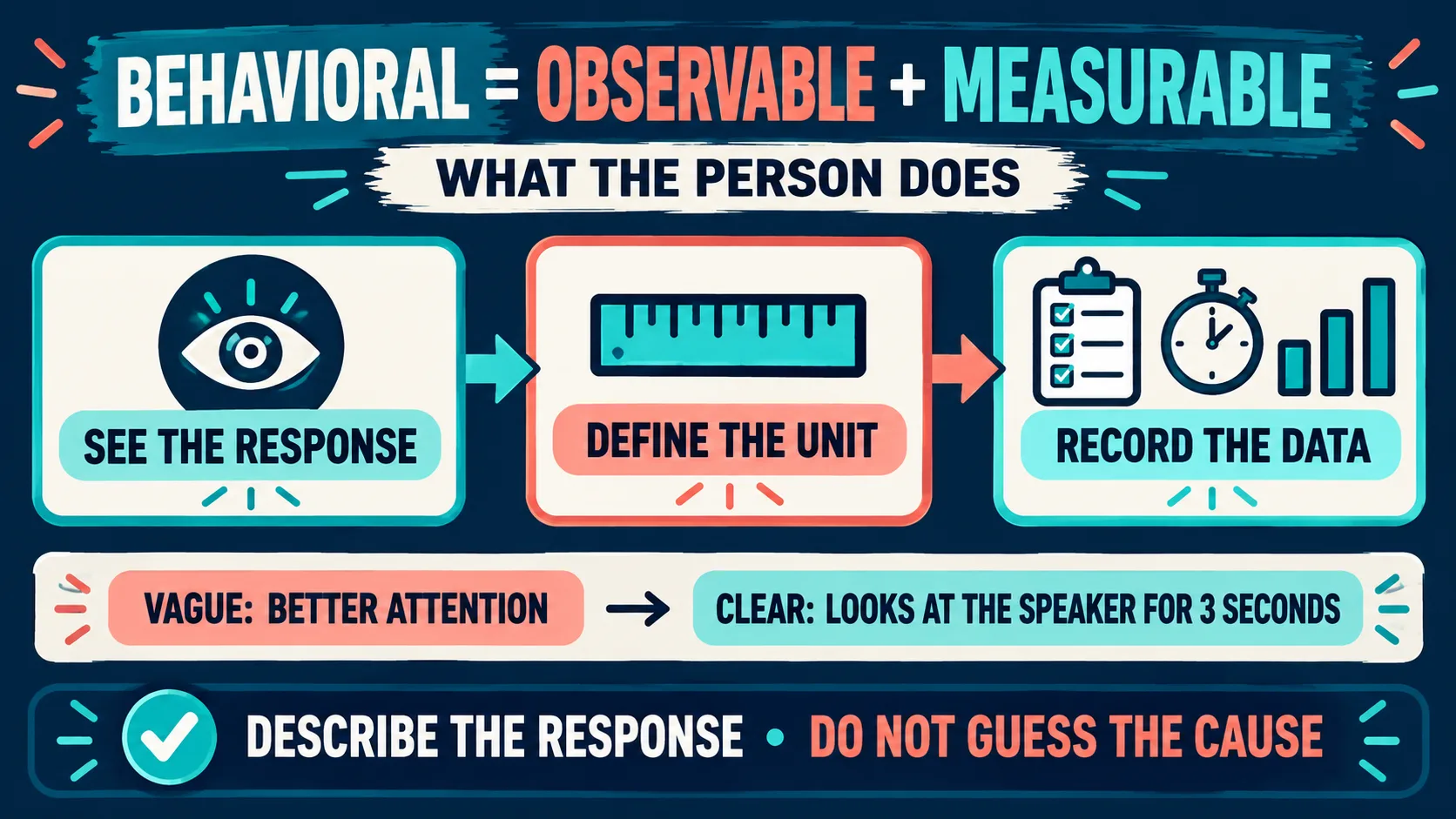
The fastest way to apply the definition is to turn an abstract sentence into an observation rule. Ask what an observer would look for, what starts and ends the response, what unit will be counted, and what conditions surround the observation. You are not trying to write a complete behavior plan in a multiple-choice question. You are checking whether the answer has a behavioral referent rather than a mentalistic shortcut.
- Name the response: use an action or response product instead of a personality label.
- Define the unit: decide whether the relevant dimension is count, rate, duration, latency, percentage, or a task step.
- Set the context: identify the instruction, material, setting, or observation window when those details matter.
- Choose a record: make sure the description can lead to consistent data collection.
Consider the difference between “improves attention” and “orients toward the instructor within five seconds of a direction and maintains eye gaze for three seconds.” The second statement may still need context and a careful definition of “orients,” but it gives the reader a response and a measurement path. The behavioral dimension is not a promise that the target is important or effective; it is a test of what is being described.
Three kinds of wording that sound behavioral but are not precise
Many distractors look scientific because they use behavior-analytic vocabulary. Read the actual claim instead of rewarding a familiar word. A sentence can contain “behavior,” “function,” or “intervention” and still fail to identify the response that the behavioral dimension requires. The following patterns are useful when a stem asks what the dimension refers to.
- Trait wording: “is aggressive,” “is lazy,” or “has poor attention” may summarize concern but does not define a response.
- Cause wording: “refuses because work is difficult” proposes an explanation; it does not tell you what refusal looked like or how it was counted.
- Outcome wording: “the program was successful” describes a conclusion; it does not identify the target behavior or the data supporting the conclusion.
- Procedure wording: “used differential reinforcement” identifies an intervention label; it does not by itself demonstrate that the target was behaviorally defined.
| Vague phrase | Ask what is missing | More useful direction |
|---|---|---|
| “More independent” | Independent on which response or task step? | State the step completed without a prompt |
| “Calmer in class” | Which observable responses changed? | Count a defined vocal, motor, or task response |
| “Avoids demands” | What does avoidance look like? | Define the response and record when it occurs |
These rewrites are study examples, not clinical prescriptions. In real practice, the final definition must fit the learner, setting, measurement system, and professional scope. For the exam-style question, the key move is simpler: remove the label and look for the response that can be observed and measured.
Read the question stem before choosing an ABA dimension
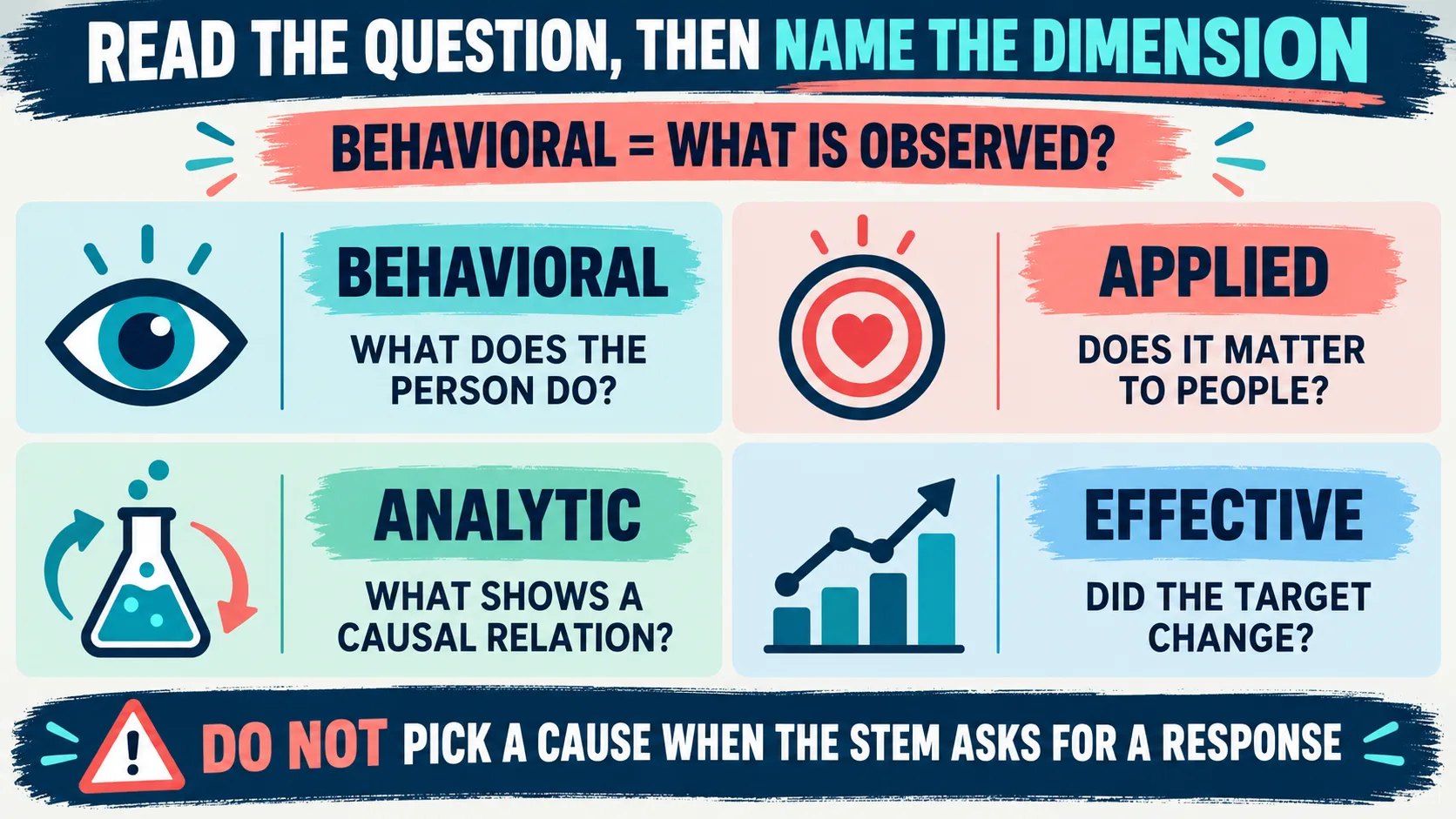
The seven dimensions are related, so a single scenario can contain clues for more than one. A test question usually gives you a target clue by asking what a statement demonstrates, what feature is missing, or which description best fits a dimension. Before looking at the answer choices, underline the verb in the stem: describes, matters, demonstrates causality, changed, generalizes, or uses a procedure. That verb tells you what to evaluate.
- If the stem asks “what does the person do?” look for the behavioral dimension.
- If it asks whether the target matters to the client or community, consider the applied dimension.
- If it asks whether the intervention produced the change, look for analytic evidence.
- If it asks whether the target improved meaningfully, consider effectiveness and the outcome data.
This is a reading strategy, not a claim that one word always maps to one answer. The correct choice still depends on the facts supplied. “Observable” is a strong behavioral clue, but a scenario may also ask whether the selected behavior is socially important or whether an intervention changed it. Match the answer to the question being asked, not just to the most familiar vocabulary.
Behavioral versus applied, analytic, and effective
When a question presents four dimension names together, use the question each name answers. Behavioral focuses on the target response and its measurement. Applied focuses on social importance. Analytic focuses on evidence that the intervention or environmental change produced the outcome. Effective focuses on whether the change is meaningful in practice. The dimensions can coexist, but they are not interchangeable definitions.
| Dimension | Core question | Do not substitute it with |
|---|---|---|
| Behavioral | What response is being described and measured? | A trait, motive, or diagnosis |
| Applied | Does the target address a meaningful social concern? | A claim that the response is well defined |
| Analytic | Does the evidence support a functional relation? | A simple before-and-after impression |
| Effective | Did the behavior change enough to matter? | A procedure name without outcome data |
The original dimensions article by Baer, Wolf, and Risley described a framework for judging applied behavior analysis. It is a useful conceptual source, while the current BACB Test Content Outline organizes the knowledge and skills used for the current BCBA examination. Keep those roles separate: a historical framework can explain the concept, but an official current outline is the place to verify current certification-exam content.
Use a four-step answer check
For a sentence-completion question, you can make the answer choice earn its place by running four quick checks. This is especially useful when several options sound reasonable and the question is testing discrimination rather than recall. The goal is not to memorize a magic phrase; it is to identify whether the option describes the right object, at the right level, for the right question.
| Check | Question to ask | Keep the option when… |
|---|---|---|
| Object | Is it describing a response? | The answer names what the person does or produces |
| Precision | Could someone define the unit? | The wording supports a clear observation or record |
| Question fit | Does it answer “refers to” rather than “worked”? | It defines the dimension instead of claiming success or cause |
| Evidence | What would you measure next? | The answer leads naturally to data collection |
Practice with original scenarios rather than trying to remember released exam questions. For example, compare “the student is cooperative” with “the student begins the requested step within 10 seconds and completes it without a verbal prompt.” The second sentence gives you something to define and measure. It still does not tell you whether the target is applied, analytic, or effective, so read the rest of the stem.
Common traps in “refers to” questions
- Choosing “visible” as the entire definition: the key is a clear behavioral referent and measurement plan, not a simplistic rule that ignores context.
- Choosing function instead of response: escape, attention, or automatic reinforcement explains a relation; it is not the topography of the response itself.
- Choosing “effective” because the graph improved: improvement addresses outcome; the behavioral dimension still asks what was measured.
- Choosing “applied” because the goal sounds helpful: social importance is a separate question from whether the target is precisely defined.
- Choosing “analytic” because data appear: data collection alone does not establish a functional relation.
- Confusing an operational definition with the whole dimension: an operational definition is a tool that can demonstrate behavioral precision; the dimension is broader.
FAQ about the behavioral dimension
What does the behavioral dimension of ABA refer to?: It refers to the behavior selected for analysis being described as a defined response that can be observed and measured in a defensible way. The exact measure depends on the behavior and context. It does not mean that a trait, motive, diagnosis, or intervention label is automatically a behavioral definition.
Is the behavioral dimension the same as an operational definition?: No. An operational definition is a practical way to specify a response so it can be identified consistently. The behavioral dimension is a broader feature of applied behavior analysis. A strong operational definition often helps demonstrate the behavioral dimension, but the terms are not identical in every question.
Are the seven dimensions a current BACB rule?: The seven-dimensions framework is a classic conceptual description of applied behavior analysis. The current BCBA examination uses the current BACB Test Content Outline, so verify current exam content there. Use the dimensions as a study framework and do not treat an old article or flashcard as a substitute for the current official outline.
How should I practice this question type?: Write a vague label, rewrite it as an observable response, choose a measurement dimension, and then explain why the other dimension names answer different questions. That sequence builds discrimination without claiming that any practice item is a recalled or representative BACB exam question.
When you are ready to practice choosing concepts from scenario details, try the Free BCBA Mock Exam. It provides practice and feedback; it does not replace the current BACB outline, coursework, supervision, or official examination information.
Sources for Further Study
- BACB: BCBA Test Content Outline (6th ed.)
- BACB: Test Content Outlines for BACB Certifications
- Baer, Wolf, and Risley: Some Current Dimensions of Applied Behavior Analysis
- Journal of Applied Behavior Analysis: original 1968 paper
- BCBA Mock Exam: seven dimensions overview
This article is educational and uses an original study framework. It is not an official BACB definition or a promise about any live exam question. Verify current certification and examination information in official BACB sources.
Take the Free BCBA Mock Exam
When you are ready to apply the idea, use the free practice resource below for additional feedback. Take the Free BCBA Mock Exam



