
An ABA term cheat sheet is useful when it helps you make a decision, not when it becomes another wall of disconnected definitions. The strongest quick reference links each term to the question it answers, the data or context that matters, and a common confusion. That turns a short review session into retrieval practice instead of passive highlighting.
Table of Contents
- ABA term cheat sheet: organize words before you memorize them
- Measurement and data terms: what changed?
- Assessment, intervention, and concept terms: why and how?
- Ethics, supervision, and practice terms: who and under what boundary?
- Turn each term into a decision, not a definition
- A printable five-column layout for review
- Common mistakes when using an ABA cheat sheet
- FAQ about ABA term cheat sheets
- Sources for Further Study
- Take the Free BCBA Mock Exam
This guide builds a category-based ABA term cheat sheet for BCBA preparation. It is not a replacement for the current BACB Test Content Outline, Ethics Code, handbook, coursework, or supervisor direction. Use it to sort a term, state a functional definition, create an original example and non-example, and decide what evidence you would look for next.
ABA term cheat sheet: organize words before you memorize them
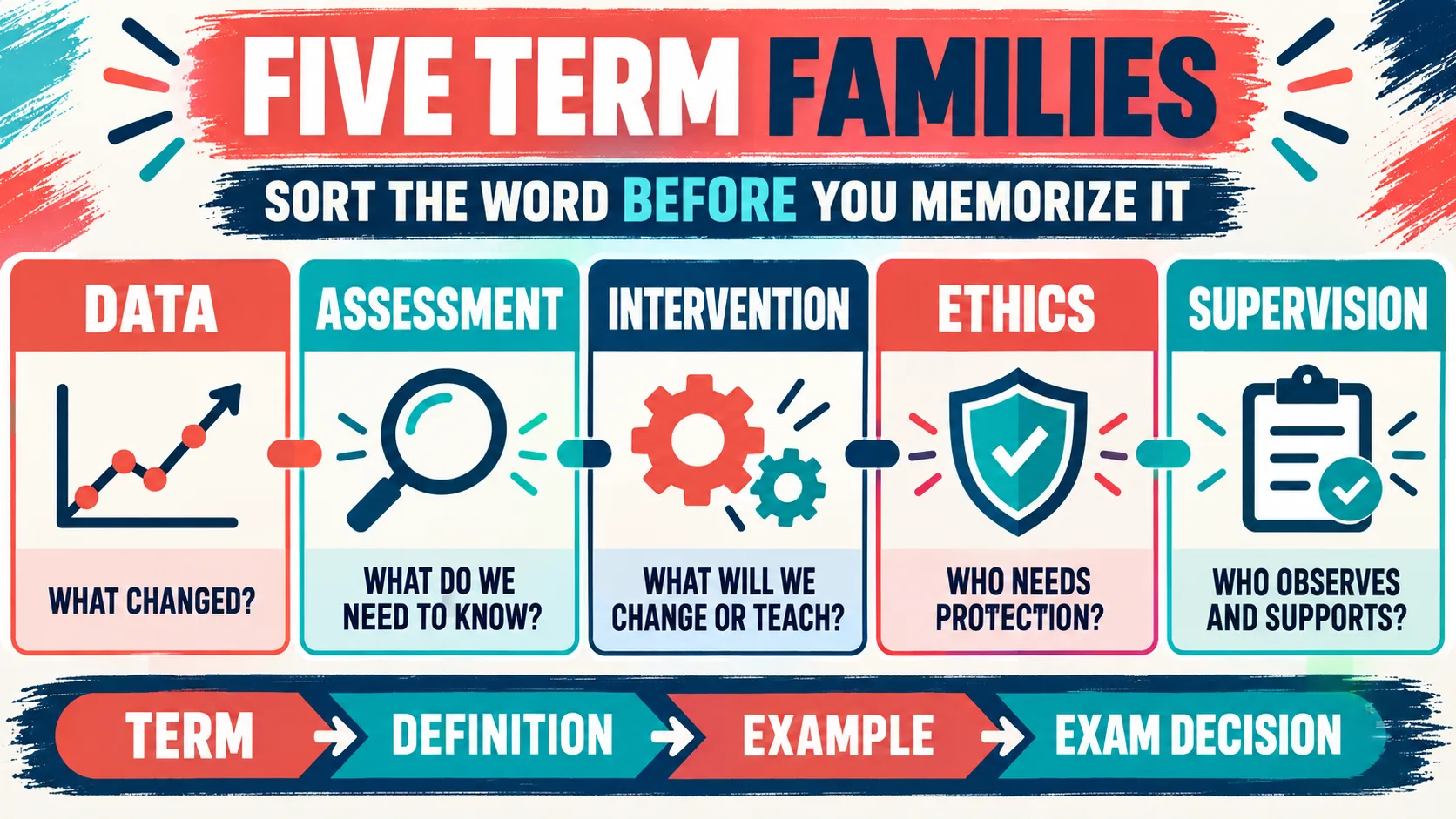
Start with the job a term performs. A measurement term tells you how behavior is represented in data. An assessment term tells you how information is gathered for a decision. An intervention term describes a change in conditions or teaching. An ethics term identifies an obligation or protected interest. A supervision term clarifies training, feedback, responsibility, or documentation.
| Term family | Representative terms | First question | Typical trap |
|---|---|---|---|
| Data | Frequency, rate, duration, latency, percentage, reliability | What changed, and how is it represented? | Choosing a measure because it sounds precise |
| Assessment | Preference, skill, functional, descriptive, social validity | What information is needed for the next decision? | Treating one assessment method as a universal answer |
| Intervention | Prompting, shaping, chaining, differential reinforcement, generalization | What condition or skill is being changed? | Naming a procedure without a target or outcome |
| Ethics | Competence, confidentiality, assent, boundaries, cultural responsiveness | Who is protected, and what obligation applies? | Using an old rule or a slogan without current context |
| Supervision | Feedback, performance monitoring, delegation, training, fieldwork | Who observes, supports, and documents performance? | Confusing a meeting with effective supervision |
The point of this table is not to memorize every term in one sitting. Use it as the top layer of a study map. When you add a word, give it a family, a one-sentence definition, an example, a non-example, and a question that would make the term relevant. If you cannot name the question, you may know the word but not yet know how to use it.
- Sort: place the word in the family that best describes its job.
- Connect: pair it with a close concept that could be confused with it.
- Apply: write a new scenario and identify the evidence that matters.
- Retrieve: close the sheet and explain the term without copying the sentence.
Measurement and data terms: what changed?
Measurement terms answer “what changed?” but they do not all answer it in the same way. Frequency is a count of responses. Rate relates a count to time. Duration records how long a response or episode lasts. Latency records the time between an event or instruction and the response. Percentage depends on a defined numerator and denominator.
Add a measurement term to your cheat sheet only after you can state the response, the observation window, and the unit. “Use frequency” is not a complete decision. Frequency may fit a discrete response, while duration may fit an episode with a clear start and stop. The target, context, and practical collection conditions should guide the choice.
| Term | Definition anchor | Example question |
|---|---|---|
| Frequency | How many responses occurred? | Is the same observation period used each time? |
| Rate | How many responses per unit of time? | Were observation periods different in length? |
| Duration | How long did the response last? | Does the response have a defensible beginning and end? |
| Latency | How long before the response began? | What event starts the timing interval? |
Keep reliability and validity in the same section, but do not merge them. Reliability asks whether measurement is consistent enough to trust. Validity asks whether the measure represents the intended behavior or construct. A measure can be consistent and still measure the wrong thing, so your cheat sheet should show the question each term answers rather than presenting both as “data quality.”
Assessment, intervention, and concept terms: why and how?
Assessment terms describe how information is gathered. A preference assessment helps identify selections a learner may make; a reinforcer assessment evaluates whether a consequence changes future responding; a functional assessment examines variables related to behavior. The method matters. Indirect, descriptive, and experimental approaches do not provide identical evidence, and “assessment” by itself does not establish a function.
Intervention terms describe what a practitioner changes or teaches. Prompting adds assistance to evoke a response. Shaping differentially reinforces successive approximations. Chaining links steps in a task analysis. Generalization concerns responding across people, settings, materials, or examples, while maintenance concerns responding over time as teaching conditions change.
- For an assessment term, write information → decision: what are you collecting and what will it inform?
- For an intervention term, write procedure → target → measurement: what changes, for which response, and how will you know?
- For a concepts-and-principles term, write relation → example → non-example: what environmental relation is present, and what only looks similar?
This structure prevents a frequent study error: memorizing a procedure name as though the name proves effectiveness. A cheat sheet should force you to add the target, context, and data. “Used prompting” is incomplete until you know which prompt, for which response, with what change in independence and what plan for fading or generalization.
Ethics, supervision, and practice terms: who and under what boundary?
Ethics terms change what action is acceptable. Competence asks whether the practitioner has appropriate education, training, and experience. Confidentiality concerns how information is collected, stored, used, and disclosed. Assent and consent depend on the service context and the people involved. Professional boundaries require attention to role, power, conflicts, and the risk of a multiple relationship.
Supervision terms identify responsibility and support. Feedback should be specific enough to guide performance. Performance monitoring uses observation or data to evaluate implementation. Delegation requires attention to the person’s role, training, competence, and oversight. Documentation should describe what actually happened; a title, meeting, or planned activity does not prove that a skill was demonstrated.
Use the current BACB ethics-code hub for current ethics sources, and use the current BCBA Test Content Outline when mapping a study term to exam domains. Your cheat sheet should store the source and the date you checked it for rules that can change.
Turn each term into a decision, not a definition
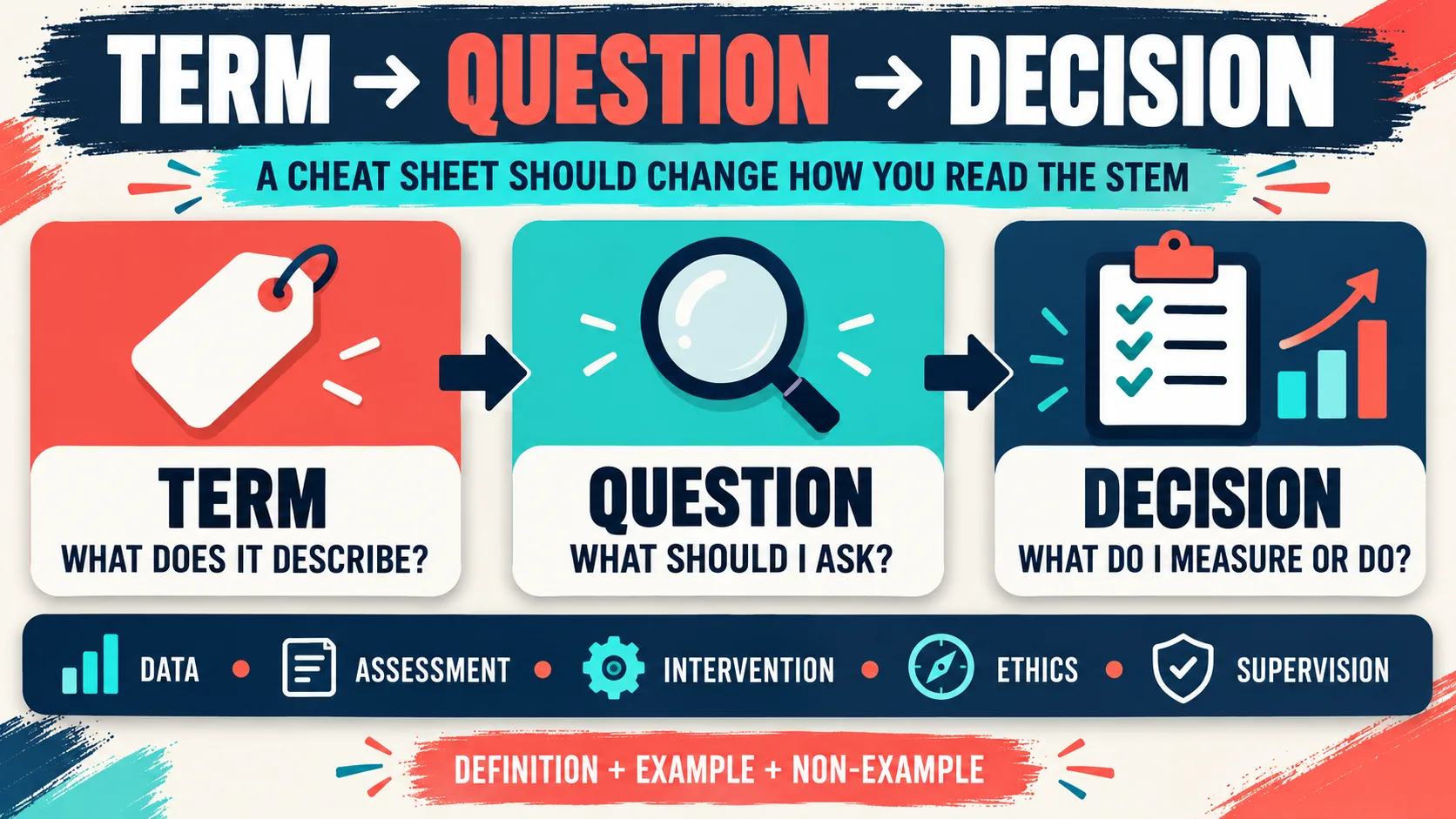
After you write a definition, add one action prompt. If the term is “duration,” ask what starts and ends the interval. If it is “social validity,” ask whose goals, procedures, and outcomes are being evaluated. If it is “differential reinforcement,” ask which response is reinforced, which response is not, and what the data show. The action prompt is what turns a glossary entry into an exam-ready retrieval cue.
- Say it plainly: define the term without repeating the term as its own definition.
- Build an original example: name the context, response, and relevant relation.
- Build a non-example: show a nearby concept that fails one essential feature.
- Name the data or obligation: decide what you would measure, verify, protect, or ask.
- Check the source: confirm current rules or ethics language in the official material.
For example, “generalization” is not simply “the skill gets better.” A useful entry could say that a learned response occurs with new people, materials, settings, or examples, then ask which stimulus or context changed. A non-example would be the same response repeating with the same materials and instructor, because that scenario does not yet demonstrate transfer across conditions.
A printable five-column layout for review
You can copy the following structure into a notebook or spreadsheet. Keep the rows short enough to scan, but specific enough that a future version of you can retrieve the relationship. The goal is not to produce a beautiful document; it is to make confusion visible before it appears in a practice question.
| Column | Write this | Example prompt |
|---|---|---|
| Term and family | The word and its category | What job does this word perform? |
| Definition | One functional sentence | What essential feature must be present? |
| Example and non-example | Two original scenarios | What nearby idea could fool me? |
| Data or obligation | What to measure, protect, or verify | What evidence would support the choice? |
| Source and check date | Official outline, ethics code, or approved text | Could this rule or wording have changed? |
Review the sheet in both directions. Start with a term and explain the decision it supports. Then start with a scenario and choose the term family that best describes the problem. If you can only recognize a term when it appears in alphabetical order, the sheet is still a lookup tool rather than a retrieval tool.
Common mistakes when using an ABA cheat sheet
- Making one giant list: a flat glossary hides the relationship between a word and the decision it supports.
- Copying definitions without examples: recognition is weaker than explaining a new scenario.
- Using synonyms as definitions: “latency is a delay” does not identify the timing interval.
- Mixing current and old rules: keep a source and check date beside certification or ethics information.
- Calling every procedure effective: a procedure name is not outcome evidence.
- Forgetting close concepts: pair frequency with rate, preference assessment with reinforcer assessment, and prompting with fading.
FAQ about ABA term cheat sheets
Is an ABA term cheat sheet the same as a glossary?: A glossary is mainly a lookup resource. A useful cheat sheet adds categories, close-concept contrasts, examples, non-examples, and the decision or data question connected to each term. You can use an existing ABA terms guide for definitions, then build the decision columns yourself.
Should I make one cheat sheet for every BCBA domain?: Use the current BCBA Test Content Outline to organize domains, but do not force every term into only one context. Some concepts appear in measurement, assessment, intervention, ethics, or supervision scenarios. Add the question the term answers so you can move it across contexts when the stem changes.
Can a PDF or flashcard deck replace an ABA term cheat sheet?: A PDF or flashcard deck can be a format, not a guarantee of quality or currency. Check the source, date, and relationship between definitions and examples. For a review workflow, the five-column layout above is more valuable than collecting another file that you never retrieve from.
How do I use the cheat sheet with practice questions?: After each missed question, record the term family, the essential feature you missed, the distractor you chose, and the evidence that would have corrected you. Write an original example rather than copying the practice item. This keeps the sheet useful for learning without implying that any practice question is a released or recalled BACB item.
When you are ready to move from term recognition to scenario application, try the Free BCBA Mock Exam. It is a practice and feedback resource, not a replacement for the current BACB outline, ethics code, coursework, or supervision.
Sources for Further Study
- BACB: BCBA Test Content Outline (6th ed.)
- BACB: Ethics Codes
- BACB: BCBA fieldwork resources
- BCBA Mock Exam: ABA terms PDF resource
- BCBA Mock Exam: ABA flashcards resource
This article is an educational study framework, not an official BACB glossary or exam blueprint. Confirm current certification, ethics, and examination information in official BACB sources.
Take the Free BCBA Mock Exam
When you are ready to apply the idea, use the free practice resource below for additional feedback. Take the Free BCBA Mock Exam



