

How many unrestricted hours for BCBA fieldwork do you actually need? The short answer for the 2027 requirements is a percentage, not a single weekly number: at least 60% of your total supervised fieldwork hours must be unrestricted. The part that makes planning difficult is deciding which rule set applies, separating restricted from unrestricted work, and keeping documentation that lets a supervisor verify the calculation.
Table of Contents
- How many unrestricted hours for BCBA? Start with the percentage
- The 60% calculation in a real tracking sheet
- What can count as unrestricted BCBA fieldwork?
- Restricted and unrestricted hours: keep the categories separate
- How the 2027 transition changes the answer
- A monthly tracking system that can survive review
- Common mistakes when people count unrestricted hours
- FAQ about unrestricted BCBA hours
- Sources for Further Study
- Take the Free BCBA Mock Exam
This guide gives you the math, practical examples, and a tracking system for the question how many unrestricted hours for bcba applicants should plan to record. It is an educational explanation, not a replacement for the current BACB handbook, fieldwork forms, ethics requirements, or supervisor guidance. Always verify the rule set attached to your application date before treating a number as final.
How many unrestricted hours for BCBA? Start with the percentage
Under the BACB’s published 2027 BCBA requirements, at least 60% of total supervised fieldwork hours must be unrestricted. That means the first calculation is total applicable fieldwork hours × 0.60. If someone completes the full 2,000-hour supervised pathway under the 2027 rules, the arithmetic floor is 1,200 unrestricted hours. A concentrated pathway has a different total-hour requirement, so do not copy a number from one pathway into the other.
| 2027 pathway | Published total | 60% arithmetic floor | What to verify |
|---|---|---|---|
| Supervised fieldwork | 2,000 hours | 1,200 unrestricted | Application date, monthly forms, supervision, and the current handbook |
| Concentrated fieldwork | 1,500 hours | 900 unrestricted | Concentrated-path documentation and the applicable temporal-value rules |
Those figures are planning math, not permission to record any activity as unrestricted. The BACB page also sets limits and supervision conditions for fieldwork periods, and the official forms control what must be recorded. A good plan therefore answers three questions together: which pathway are you using, which requirements apply to your application, and what evidence will your supervisor sign for each period?
- Use the percentage: calculate the unrestricted floor from the total applicable fieldwork hours.
- Use the pathway: supervised and concentrated totals are not interchangeable.
- Use the official form: a private spreadsheet helps you plan, but it does not replace required documentation.
- Use supervisor review: borderline activities should be discussed before you depend on them to meet the percentage.
The 60% calculation in a real tracking sheet
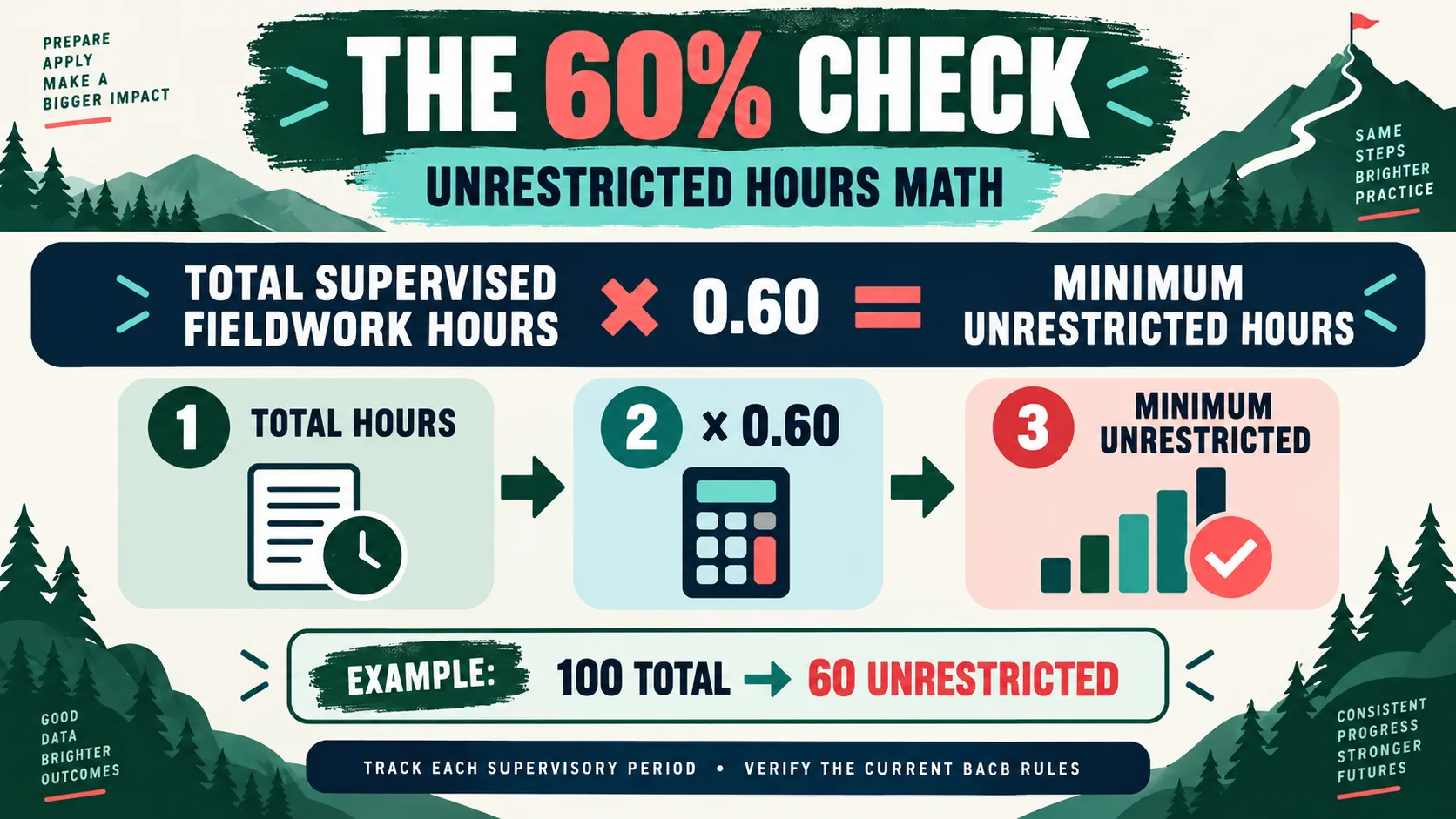
The easiest way to prevent a late surprise is to calculate the unrestricted floor every supervisory period instead of waiting until the end of fieldwork. For example, if your period contains 50 total fieldwork hours, the planning floor is 30 unrestricted hours. If you record only 20 unrestricted hours, you have a 10-hour gap to discuss and correct in a future period rather than discovering the problem after hundreds of hours have accumulated.
| Total in the period | Calculation | Minimum unrestricted target | Planning note |
|---|---|---|---|
| 20 hours | 20 × 0.60 | 12 hours | Lowest example; verify the period is valid for your rule set |
| 50 hours | 50 × 0.60 | 30 hours | A practical checkpoint for a mixed month |
| 100 hours | 100 × 0.60 | 60 hours | Useful example, not a recommended monthly quota |
| 160 hours | 160 × 0.60 | 96 hours | Check the maximum period and supervision requirements |
Round conservatively when the result is not a whole number, and keep the unrounded calculation in your notes. More importantly, calculate from the hours that are actually valid for the period. Missing signatures, an incorrect date range, or a category that your supervisor cannot support may reduce the usable total even when the spreadsheet formula looks correct.
What can count as unrestricted BCBA fieldwork?
Unrestricted fieldwork generally involves activities that use behavior-analytic skills beyond simply delivering routine treatment to a client. The activity should be appropriate to the trainee’s role, connected to behavior-analytic practice, supervised as required, and documented clearly. The label alone is not enough: “worked on a program” does not explain what you analyzed, designed, implemented, evaluated, or learned.
- Reviewing data and using it to evaluate progress, treatment integrity, or the need for a change.
- Helping design, revise, or evaluate a behavior-change or skill-acquisition program under appropriate supervision.
- Conducting or assisting with assessment activities that fit your training and assigned responsibilities.
- Training caregivers, teachers, or staff and checking whether the training transferred to performance.
- Writing behavior-analytic documentation, summaries, graphs, or recommendations that are reviewed by a qualified supervisor.
- Participating in case conceptualization, program evaluation, or consultation when the activity is properly supervised and recorded.
Use the BACB’s BCBA fieldwork resources and your supervisor’s current fieldwork plan to decide whether a proposed activity fits. Our related BCBA hour requirements guide can provide context, while the detailed activity examples should remain subordinate to the official requirements and your supervisor’s documentation decision.
Restricted and unrestricted hours: keep the categories separate
Restricted work is not automatically bad work. Direct implementation can be valuable, necessary, and part of learning to provide services. The problem occurs when a trainee assumes that every clinically useful hour is unrestricted. To answer how many unrestricted hours for BCBA fieldwork you still need, maintain separate running totals and ask your supervisor to review the classification before the numbers become difficult to reconstruct.
- Restricted: direct implementation or other activities that are primarily the delivery of an established program.
- Unrestricted: activities that require broader analysis, design, evaluation, assessment, consultation, training, or documentation within the approved fieldwork role.
- Unclear: work that may fit either category depending on what you actually did, the level of independence, and the evidence available.
For an unclear activity, record the concrete behavior rather than a favorable label. Write what data you reviewed, what decision you made, what feedback you received, and what the supervisor observed. A defensible note is more useful than “unrestricted supervision work” because it allows another reviewer to understand the activity without guessing what happened.
How the 2027 transition changes the answer
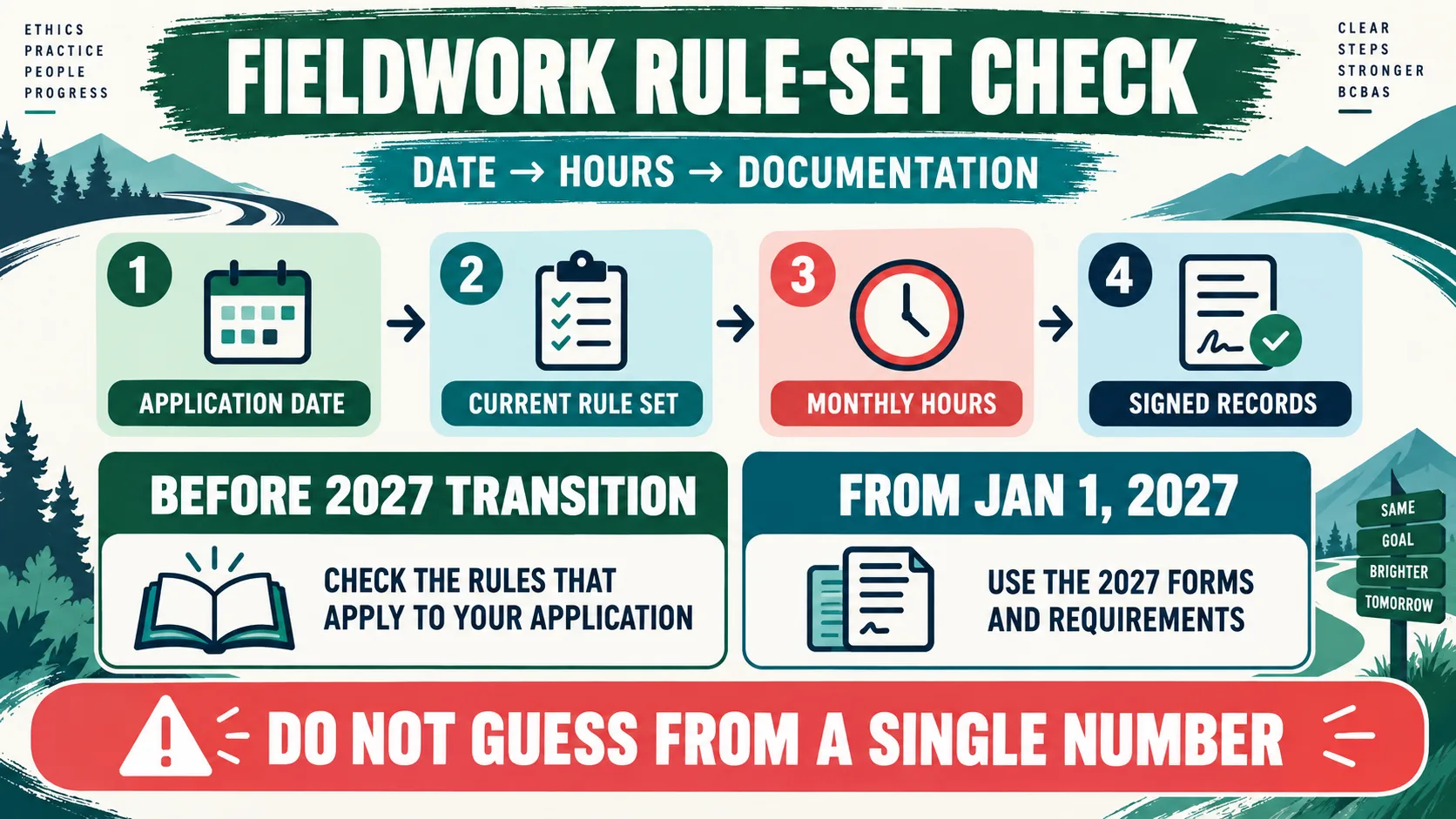
The date attached to your application matters. The BACB states that significant BCBA requirements changes take effect on January 1, 2027. Its transition guidance explains that a complete current-2022 application, including payment and required documents, must be received by December 31, 2026 to be reviewed under the current route. Applications handled from January 1, 2027 follow the 2027 requirements and forms. Check the official transition guidance rather than relying on a screenshot or a third-party calculator.
The 2027 page describes a 2,000-hour supervised pathway and a 1,500-hour concentrated pathway, along with the 60% unrestricted rule and other supervisory-period requirements. It also gives limits for hours in a supervisory period and specifies observation and supervision details. Those requirements work together. A correct 60% formula cannot rescue an incomplete monthly form, missing supervisor signatures, or hours recorded under the wrong path.
- Confirm whether your application is being evaluated under the current or 2027 requirements.
- Download the matching fieldwork forms and read their definitions before building your spreadsheet.
- Ask which activities your supervisor will approve as unrestricted before scheduling them repeatedly.
- Keep copies of signed monthly records and the final documentation in a secure location.
- Recheck the official BACB page whenever a deadline, form, or pathway decision changes.
A monthly tracking system that can survive review
A simple tracker should make your numbers explainable. Use one row per activity or activity block, then summarize the period only after the entries are complete. Avoid entering a single monthly total with no detail; that makes it difficult to prove why an hour was categorized as unrestricted and difficult to correct a mistake before the final application.
| Tracker field | What to record | Why it matters |
|---|---|---|
| Date and period | Start/end dates and hours for the valid supervisory period | Prevents mixing periods or using an invalid date range |
| Activity description | Concrete action, data reviewed, and decision or skill practiced | Supports the restricted/unrestricted classification |
| Category and hours | Restricted, unrestricted, or pending review; time spent | Keeps the 60% calculation visible while uncertainty is resolved |
| Supervisor evidence | Feedback, observation, initials, or signed monthly record | Connects your private log to the required documentation |
At the end of each period, compare total valid hours with the unrestricted floor, review the supervision and observation requirements, and flag any missing evidence. If your unrestricted percentage is below target, do not relabel past work after the fact. Bring the gap and the supporting notes to your supervisor, then make a forward-looking plan that stays inside the applicable requirements.
Common mistakes when people count unrestricted hours
- Using one universal number: the correct total depends on the pathway and application rule set.
- Counting direct service automatically: useful client work can still be restricted.
- Calling planning unrestricted without detail: record the analysis, decision, and feedback that occurred.
- Waiting until the end: a monthly review gives you time to resolve missing signatures or unclear categories.
- Mixing current and 2027 forms: the form and requirements should match the route under which your application is evaluated.
- Relying on a calculator alone: math cannot verify competence, supervision, observation, or documentation.
FAQ about unrestricted BCBA hours
Is the answer always 60%?: For the 2027 requirements, the published planning rule is at least 60% of total supervised fieldwork hours as unrestricted. You still need to confirm the pathway, application timing, current forms, and all other requirements. Do not use the percentage as a substitute for reading the official handbook or having your supervisor verify the record.
Does 60% mean I need the same number every week?: No. It is a percentage of the applicable total, and fieldwork is tracked by supervisory periods rather than by an arbitrary weekly quota. A stable monthly tracker is more useful than trying to force the same number of unrestricted hours into every week.
Can my supervisor decide that an activity is unrestricted?: Your supervisor’s review is important, but the activity must still fit the applicable BACB requirements and be documented honestly. Ask before relying on borderline work, describe what you actually did, and retain the official form and supporting evidence that connect the activity to your fieldwork plan.
Where should I verify the 2027 rules?: Start with the BACB’s 2027 BCBA requirements, the official transition explanation, and the fieldwork documentation FAQ. If you are unsure, ask your supervisor or contact the BACB rather than relying on an undated third-party summary.
When you understand your target percentage and want to practice applying BCBA concepts to scenarios, try the Free BCBA Mock Exam. It is a practice and feedback resource, not a substitute for the official BACB requirements, your supervisor’s fieldwork plan, or the documentation you must submit.
Sources for Further Study
- BACB: 2027 BCBA Requirements
- BACB: 2027 BCBA Requirements PDF
- BACB: 2027 BCBA and BCaBA Requirements
- BACB: 2027 transition guides
- BACB: Documenting Fieldwork FAQ
- BACB: BCBA fieldwork resources
This article is educational and is not an official BACB policy interpretation. Requirements, forms, deadlines, and application pathways can change; confirm the current official source before relying on a calculation.
Take the Free BCBA Mock Exam
When you are ready to apply the idea, use the free practice resource below for additional feedback. Take the Free BCBA Mock Exam



