
Short answer: A textual prompt in ABA is a written cue—such as a word, phrase, checklist, sentence starter, or written instruction—added to increase the likelihood that a learner will perform a target response. If you are studying textual prompt ABA, keep the basic classification in view: the writing is the prompt; the learner’s later action or spoken response is the behavior being taught. The prompt should be selected for the learner, paired with the relevant instruction or cue, followed by an appropriate consequence, and gradually faded so independent responding comes under the intended natural stimulus.
Table of Contents
- What is a textual prompt in ABA?
- How does a textual prompt work?
- What are examples of textual prompts?
- How is a textual prompt different from other prompts?
- How do you select and deliver a textual prompt?
- How do you fade a textual prompt?
- How does the BCBA exam test textual prompts?
- What mistakes should you avoid?
- Textual prompt ABA FAQ
- Take the Free BCBA Mock Exam
This distinction matters because textual prompt and textual behavior sound similar but describe different things. Textual behavior is a verbal operant involving a written verbal stimulus and a vocal response with point-to-point correspondence. A textual prompt is an instructional aid that helps evoke a target response. A written word can be the prompt in one teaching arrangement, but the same word can be the discriminative stimulus for textual behavior in another. Context, response requirement, and consequence determine how the term should be classified.
The Government of New Brunswick prompting guide describes textual prompts as written clues such as checklists, scenarios, instructions, keywords, or sample sentences. It also notes that the learner needs reading access and text at an appropriate level. Autism Speaks places prompting within antecedent interventions that can help establish discriminative control. This article is an exam-prep explanation, not an individualized treatment prescription. Table of Contents
What is a textual prompt in ABA?
A textual prompt is a written stimulus added to help a learner emit a correct target response. It may be a single keyword, a partial written answer, a sentence starter, a visual schedule made of words, a written step, or a short checklist. The format is less important than the functional role: the added text increases the probability of the response while the learner is acquiring or performing a skill.
For example, an instructor asks, “What do you do before crossing the street?” and places the written cue look both ways on a card. If the learner says “look both ways,” the card served as a textual prompt for the verbal response. If the instructor later removes the card and the learner answers when asked the question alone, control has begun to transfer away from the added text.
- Prompt: the added written cue that helps evoke the target.
- Instruction or natural cue: the stimulus that should eventually occasion the skill.
- Target response: what the learner must say or do, stated observably.
- Consequence: what follows the response and supports useful, appropriate responding.
- Fading plan: how the text will be reduced, delayed, or removed as independence grows.
A textual prompt is not automatically “less intrusive” or “better” than another prompt. A written cue may be a good match for a learner who can read but may be ineffective for someone who cannot yet access the text. Prompt choice depends on the response, reading skills, receptive-language profile, setting, safety, learner preference, and the amount of assistance needed.
How does a textual prompt work?
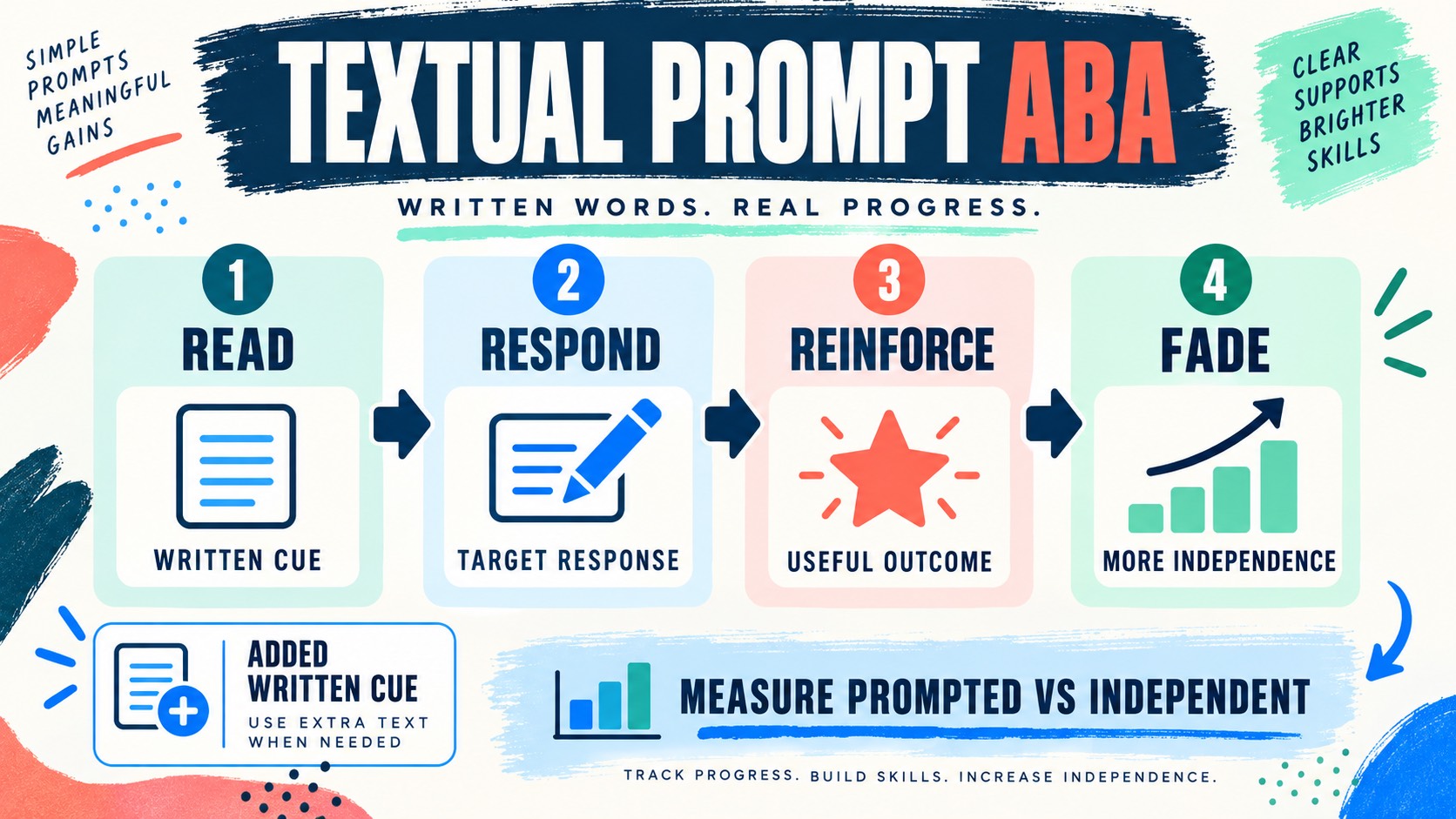
In a simple teaching trial, the instructor presents the relevant instruction or antecedent, provides the textual prompt according to the plan, waits for the learner’s response, and delivers the programmed consequence. The text can make the correct response more likely, but the instructional goal is not permanent dependence on the card. The goal is useful behavior that occurs with the natural cue or instruction.
Consider a learner practicing a two-step classroom routine. The teacher says, “Get ready for math,” and shows a written card: 1. Take out notebook. 2. Write the date. The card is a textual prompt if it is added to support the routine. The teacher can record whether the learner starts each step, how much of the text is needed, the delay before starting, and whether the routine generalizes to another class.
Prompting is often described as helping establish instructional or discriminative control. That does not mean the prompt itself is the learner’s long-term cue. Pair the text with the relevant instruction, reinforce the target response according to the plan, and arrange opportunities to test whether the learner responds when the added cue is absent. Research on textual prompts includes intraverbal and instruction-following applications, but a research procedure should not be treated as a universal protocol for every learner.
What are examples of textual prompts?
Examples are easiest to classify when the target response and the written aid are both explicit. The following examples are fictional teaching illustrations, not instructions to use without an individualized plan.
| Target skill | Written prompt | Target response | Independence check |
|---|---|---|---|
| Intraverbal answer | A partial written answer: “You cut paper with…” | Learner says “scissors” after the question. | Present the question without the written starter and score the answer. |
| Task sequence | A two-step written checklist: soap → rinse. | Learner completes both steps in order. | Use a shorter checklist or no card during a probe. |
| Conversation starter | A card reading “Can I join?”. | Learner uses the sentence during the planned social opportunity. | Fade the card to a keyword, then assess use with the natural opportunity. |
| Safety routine | Written cue: stop → check → ask. | Learner follows the taught safety response in the planned context. | Use carefully designed probes and do not remove needed safety supports casually. |
In each example, the text is not the final skill. A strong description says what happens before the prompt, exactly what the prompt contains, what response is expected, what consequence follows, and how independence will be tested. “Uses a visual” is too vague to identify a textual prompt or to measure progress.
How is a textual prompt different from other prompts?
Prompt labels describe the added assistance, not a permanent ranking of quality. A written instruction may be called textual; a picture, drawing, or schedule may be visual; a point or gaze shift may be gestural; and a spoken word or model may be verbal. The same teaching plan can combine prompts, but the analyst should describe which stimulus was added and what the learner actually responded to.
| Prompt type | Added stimulus | Example | Common boundary |
|---|---|---|---|
| Textual | Written words, symbols, or sentences. | A card says “open folder”. | Do not confuse the written prompt with textual behavior as a verbal operant. |
| Visual | Pictures, drawings, photos, icons, or other visual representations. | A picture of a toothbrush cues the routine. | Text can be part of a visual display, but the functional description should identify the controlling feature. |
| Gestural | A point, tap, gaze, or movement toward the response or stimulus. | The instructor points to the correct bin. | Accidental gestures can become unplanned prompts and should be considered in data review. |
| Verbal | An added spoken word, phrase, model, or sound. | The instructor says “scis…” to evoke “scissors.” | A spoken instruction that is the natural SD is not automatically a verbal prompt. |
The most important exam distinction is between a prompt and the intended discriminative stimulus. If a learner responds only when the written card is present, the card may have acquired too much control. The next question is not “Which prompt is best in the abstract?” It is “What does the learner need, what response is being taught, and how will control transfer to the relevant natural cue?”
How do you select and deliver a textual prompt?
Start with the learner and the response, not with a favorite prompt hierarchy. A textual prompt is a sensible candidate when reading is available, the task benefits from a stable written cue, and the text can be presented without creating an unnecessary barrier. Selection should also account for access technology, language, vision, motor demands, cultural context, and the learner’s preference.
- Define the response. Specify what the learner will say or do, when it should occur, and how it will be scored.
- Check prerequisite access. Confirm that the learner can see, read, interpret, or otherwise access the written format being considered.
- Choose the smallest useful text. A keyword may be enough; a full sentence may be unnecessary and harder to fade.
- Pair it with the relevant cue. The prompt should support, not permanently replace, the instruction, natural cue, or motivating context.
- Plan the consequence and data. Record prompted and independent responses separately so apparent accuracy does not hide prompt dependence.
- Plan the fading decision before teaching. Decide what performance pattern will justify reducing the words, delaying the card, or testing without it.
For example, if the target is answering “What do you cut paper with?” the written cue might be a partial answer rather than the complete word. If the learner can read the entire answer, showing the full word may produce correct responding but provide little evidence that the learner can answer independently. The least intrusive useful prompt is not a rigid rule; the prompt must be sufficient to support learning and feasible to fade.
How do you fade a textual prompt?
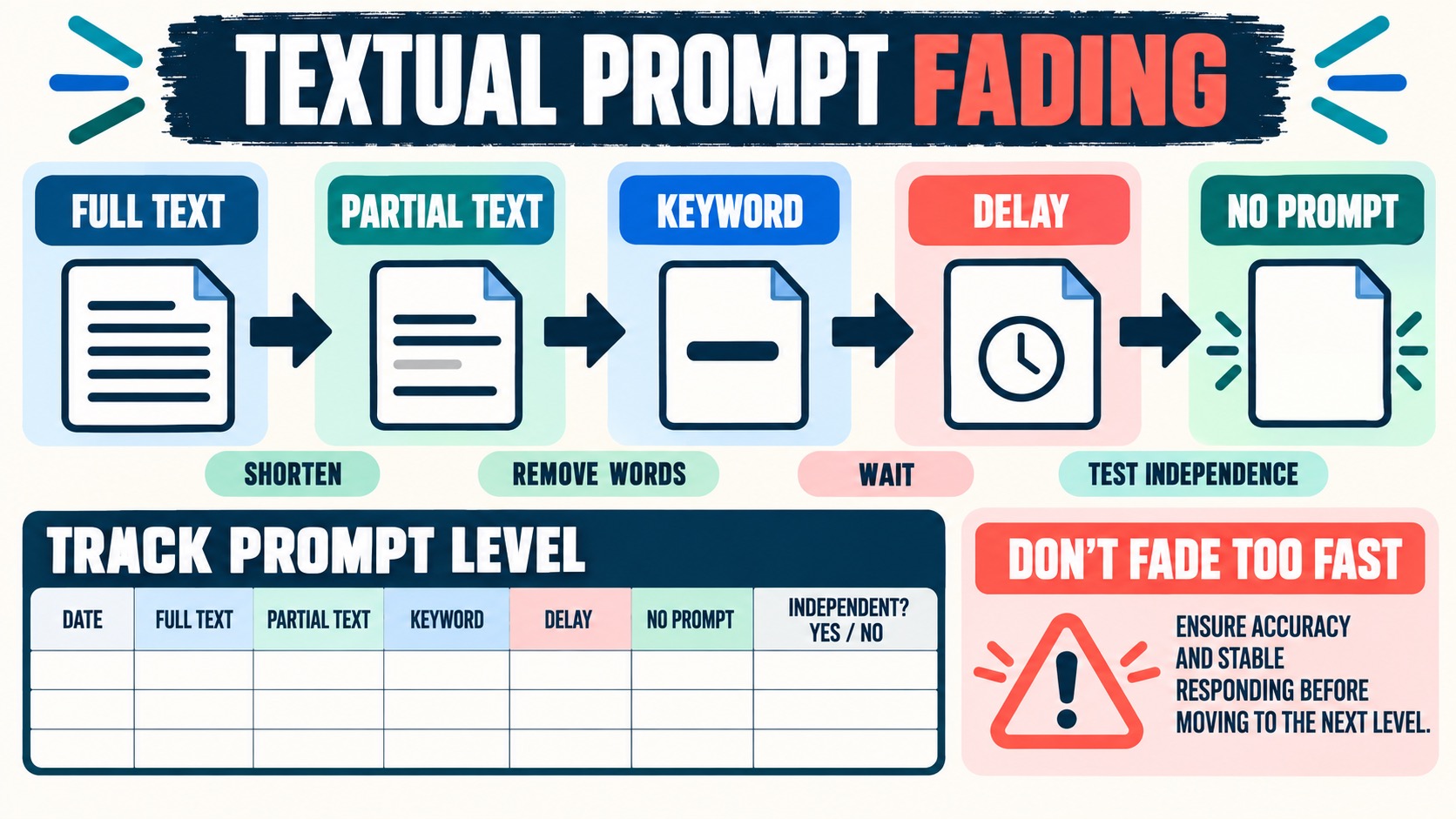
Prompt fading means systematically reducing the prompt’s assistance while preserving successful responding. With text, fading may involve shortening a sentence, removing words, changing a full answer to a keyword, increasing the delay before showing the cue, reducing the size or salience of the text when appropriate, or arranging a probe with no added text. The exact method should be specified rather than described as “fade as needed.”
A useful sequence might be full written model → partial written model → keyword → delayed keyword → no added text. The sequence is not universal, and a learner may need a different step or a temporary return to more support. Avoid fading so quickly that errors and frustration dominate, but also avoid leaving the full card in place after independent responding is possible.
- Record the prompt level used on each opportunity.
- Separate independent, prompted, incorrect, and no-response trials.
- Check whether the learner responds to the intended instruction without the card.
- Probe across people, materials, settings, and examples when generalization is part of the goal.
- Review maintenance after the prompt is reduced or removed.
- Adjust the plan when reading access, motivation, task difficulty, or implementation fidelity changes.
The New Brunswick guide describes most-to-least prompting and time delay as examples of fading approaches, while Autism Speaks emphasizes selecting prompts according to learner and context variables. Research studies can help a BCBA understand why textual prompts may support particular responses, but they do not eliminate the need for baseline, individualized assessment, data review, and ethical safeguards.
How does the BCBA exam test textual prompts?
In a BCBA-style vignette, first locate the written material and then ask what role it plays. If the instructor adds a card reading “hands in lap” to increase the chance of the learner sitting safely, it is functioning as a textual prompt. If the learner reads a word aloud with point-to-point correspondence, the question may instead be about textual behavior. If the instructor simply gives the natural written direction that defines the task, do not call it a prompt without evidence that it is supplemental assistance.
- Written cue added to evoke another response: likely a textual prompt.
- Written word read aloud: consider textual behavior and its correspondence features.
- Picture without written wording: likely a visual prompt.
- Point or tap toward the answer: likely a gestural prompt.
- Spoken partial answer: likely a verbal prompt.
- Correct response only with the card: identify possible prompt dependence and a need for control-transfer or fading data.
Use the free BCBA mock exam to practice sorting prompt type, response form, and fading logic under time pressure. It is an independent practice resource, not an official BACB product, does not reproduce official exam questions, and does not guarantee certification or exam performance.
What mistakes should you avoid?
- Calling every visual support a textual prompt: identify whether written language, a picture, placement, or a gesture is doing the relevant work.
- Confusing textual behavior with a textual prompt: classify the learner’s response and the function of the written stimulus.
- Showing the full answer forever: plan a fading or transfer procedure so the target skill is not tied unnecessarily to the card.
- Counting prompted accuracy as independent accuracy: code prompt level and independence separately.
- Ignoring reading access: written cues cannot help when the learner cannot access or understand the format.
- Using a generic prompt hierarchy: the appropriate prompt depends on the target, learner, context, safety, and data.
- Assuming research proves one best prompt: match the evidence and procedure to the learner rather than making a universal claim.
Textual prompt ABA FAQ
What is a simple textual prompt example?: A teacher asks a learner to start a routine and shows a written card saying “open notebook.” If the written card is added to increase the chance of the learner opening the notebook, it functions as a textual prompt. The instruction, prompt, response, and consequence should be described separately.
Is a textual prompt the same as a written instruction?: Not always. A written instruction can be the natural cue for a task. It is a textual prompt when the writing is supplemental assistance added to increase the likelihood of a target response. The function and teaching arrangement matter more than the fact that both use words.
Can a textual prompt be used for intraverbal behavior?: Yes. A written partial answer or target word can be used to support an intraverbal response, and empirical studies have evaluated textual prompts in intraverbal teaching. The article’s existing examples should not be treated as one universal protocol; prompt selection, fading, reinforcement, and measurement must fit the learner and target.
What is the difference between a textual prompt and a visual prompt?: A textual prompt uses written language, symbols, or words as the added cue. A visual prompt can use pictures, photos, drawings, or other visual representations. A page may contain both, so identify which feature is intended to control the response and measure whether that feature can be faded.
How do you reduce textual prompt dependence?: Record prompt level, reinforce independent responding as planned, and systematically reduce, delay, or remove the written cue while testing the natural instruction or context. Review errors, generalization, maintenance, and implementation fidelity before making the next change.
Bottom line: A textual prompt in ABA is written assistance added to evoke a target response. To classify it correctly, identify the added words, the learner’s response, the intended natural cue, and the fading/data plan. That sequence separates textual prompting from textual behavior and gives you the logic needed for both practice and BCBA exam questions.
Take the Free BCBA Mock Exam
When you are ready to apply the idea, use the free practice resource below for additional feedback. Take the Free BCBA Mock Exam



