

Short answer: A dense reinforcement schedule delivers reinforcement relatively frequently in relation to the target response or opportunity. The learner may contact the reinforcer after every correct response, after a very small response requirement, or at short response-independent intervals when a noncontingent arrangement is being used. “Dense” describes the rate of reinforcement; it does not name one single ratio or interval schedule.
Table of Contents
- What is a dense reinforcement schedule in ABA?
- How do you recognize schedule density?
- What are examples of dense reinforcement schedules?
- What is the difference between dense and thin schedules?
- Why can schedule density matter in treatment?
- How does schedule thinning relate to a dense schedule?
- How should BCBA candidates answer a schedule question?
- What are common dense-schedule traps?
- Dense reinforcement schedule FAQ
- Take the Free BCBA Mock Exam
The phrase dense reinforcement schedule often appears when a behavior analyst is teaching a new response, arranging functional communication training, or comparing a dense schedule with a lean schedule during schedule thinning. The correct interpretation depends on what is contingent, what is being measured, and whether the schedule is defined relative to another schedule. A dense schedule can help a response contact reinforcement efficiently, but density alone is not a guarantee of effectiveness, generalization, or clinical appropriateness.
This guide explains the definition, gives examples, distinguishes dense from continuous reinforcement, connects schedule density to research on NCR and FCT, and provides a BCBA-style decision rule. It is educational material, not a universal treatment protocol. Table of Contents
What is a dense reinforcement schedule in ABA?
A dense reinforcement schedule is an arrangement in which reinforcement is delivered at a relatively high rate. The comparison may be based on responses, time, opportunities, or another defined unit. For example, reinforcing every correct response is denser than reinforcing every fifth correct response. Delivering a functional reinforcer on a variable-interval 5-second schedule is denser than delivering it on a variable-interval 5-minute schedule, assuming the two schedules are otherwise comparable.
Density is therefore a relative description. The word does not tell you whether the schedule is fixed or variable, ratio or interval, contingent or noncontingent. It tells you that reinforcement is available more frequently or after a smaller requirement than in the comparison arrangement. A schedule can be dense and intermittent, such as a very short variable interval, or dense and continuous, such as reinforcement after every response.
In an applied example, a learner is taught to request a break. During acquisition, the request may contact the functionally relevant break quickly and consistently. That arrangement is dense compared with a later phase in which the request contacts a break after a delay or according to a leaner schedule. The analyst should still define the response, the reinforcer, the time or response requirement, and the conditions for changing the schedule.
| Question | What density tells you | What it does not tell you |
|---|---|---|
| How often is reinforcement available? | More frequently than the comparison schedule | Whether the schedule is ratio or interval |
| What is the requirement? | A smaller response or time requirement may be used | Whether reinforcement is contingent on the response |
| What is the behavioral purpose? | More opportunities to contact reinforcement | Whether the arrangement will work for every learner |
| How is it described? | Relative rate, access, or frequency | A complete schedule label or treatment decision |
How do you recognize schedule density?
Start by locating the schedule’s unit. A ratio schedule counts responses; an interval schedule measures time; an opportunity-based teaching arrangement counts valid trials; and a noncontingent schedule may deliver reinforcement independently of the target response. Then compare the reinforcement rate or requirement across conditions. Use these questions when reading a case:
- What behavior or opportunity is the schedule tied to? Identify the response, communication request, task, or interval.
- What consequence is delivered? Name the functionally relevant reinforcer rather than saying only “reward.”
- What is the current requirement? Record FR 1, FR 5, VI 10 seconds, a fixed-time interval, a delay, or another explicit rule.
- What is the comparison? A schedule is called dense or thin relative to a stated baseline, alternative, or later phase.
Do not infer density from the learner’s response rate alone. A learner can respond rapidly on a lean schedule, or respond slowly on a dense schedule. Density describes the programmed relation between behavior, opportunity, time, and reinforcement; it is not a synonym for high performance.
What are examples of dense reinforcement schedules?
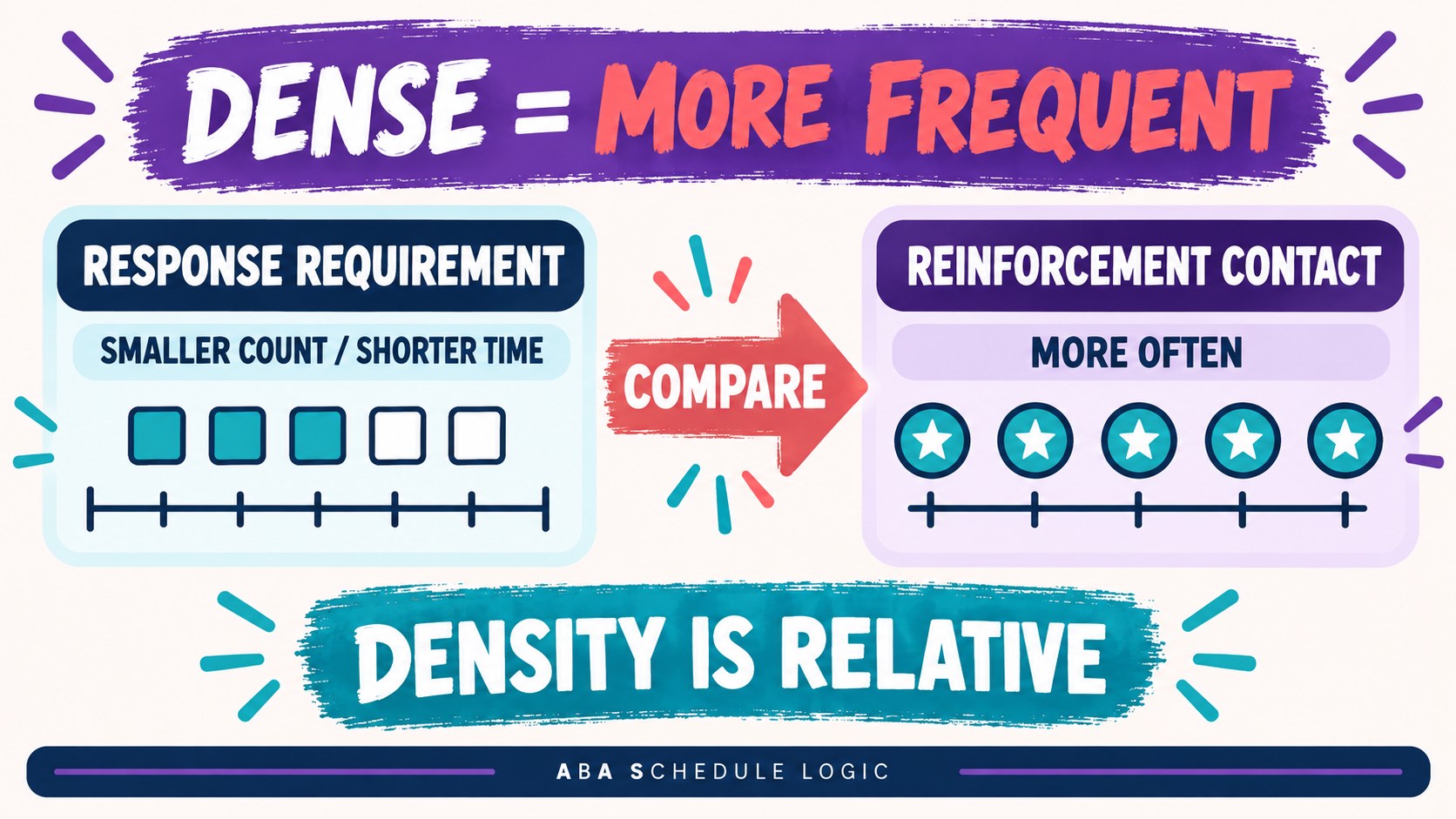
The examples below use simple numbers to make the comparison visible. They are study illustrations, not instructions for programming a real learner. Continuous reinforcement during acquisition: On a continuous reinforcement arrangement, every defined correct response produces the programmed reinforcer. This is commonly represented as CRF or FR 1. Compared with FR 5, in which five responses are required, CRF is denser because the learner contacts reinforcement after fewer responses. Continuous reinforcement is one way a dense schedule can be arranged, but “dense” is the broader relative description.
A small ratio requirement: Suppose a learner earns a token after one independent response in an early teaching phase and after five independent responses in a later phase. The FR 1 phase is denser than the FR 5 phase. If the token is delivered only after the defined response and the behavior increases, the arrangement also illustrates contingent reinforcement. The analyst should not call it conjugate reinforcement simply because the schedule is dense; the consequence property does not continuously covary with a response dimension.
A short interval in a time-based comparison: In a variable-interval arrangement, reinforcement becomes available after changing time intervals and the relevant response produces access after availability. A VI 10-second schedule is generally denser than a VI 2-minute schedule because reinforcement opportunities occur more frequently. In an FT or other noncontingent arrangement, the delivery is time-based rather than response-dependent. It can still be described as dense if the interval is short, but the contingency is different.
Dense functional communication training: During early functional communication training, the alternative communication response may contact the functionally relevant reinforcer on a dense schedule so the learner experiences that communication is effective. Later, the team may arrange delays, denial tolerance, signals, or a different schedule. The schedule decision depends on assessment, safety, data, and the learner’s context; the word “dense” does not prescribe one starting value.
What is the difference between dense and thin schedules?
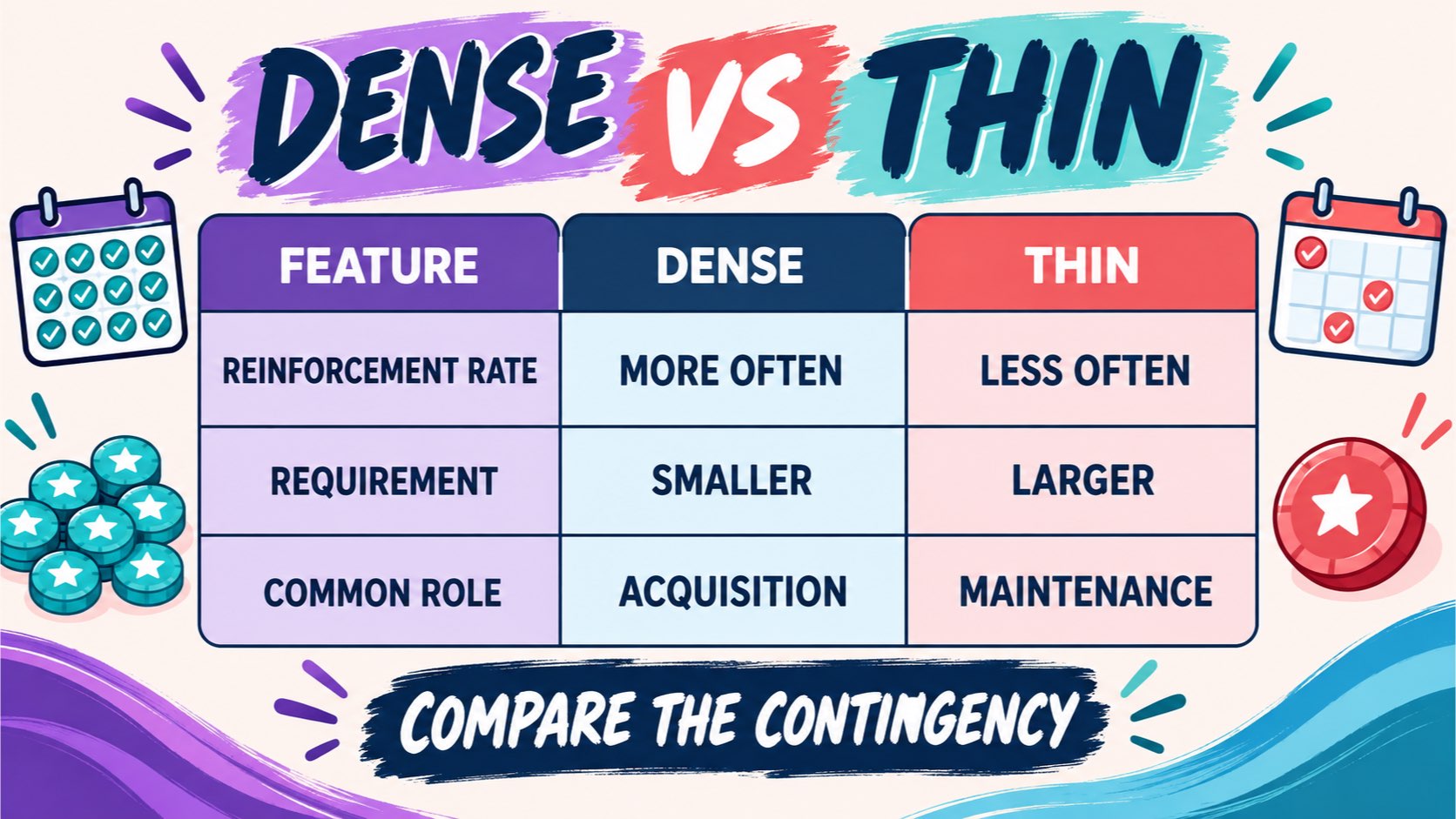
A dense schedule provides more frequent reinforcement or a smaller requirement than a thin schedule. The terms are comparative, so the same schedule could be dense in one comparison and thin in another. For instance, FR 5 is dense relative to FR 20 but thin relative to FR 1.
| Feature | Dense schedule | Thin schedule |
|---|---|---|
| Reinforcement rate | Relatively frequent | Relatively infrequent |
| Response requirement | Smaller ratio or shorter delay/interval | Larger ratio or longer delay/interval |
| Common study role | Acquisition, competition, or initial contact | Maintenance, practicality, or schedule thinning |
| Main caution | May be difficult to sustain or may affect persistence when changed | May not compete with the maintaining consequence if introduced too soon |
Why can schedule density matter in treatment?
Schedule density can matter because a new or alternative response must compete with an established behavior and its reinforcement history. If the alternative contacts a relevant reinforcer too rarely, the learner may continue using the old response. A dense initial arrangement can make the alternative response more efficient, but the relation must be individualized and measured.
Research on noncontingent reinforcement has compared dense and thin schedules and examined what happens as a schedule is thinned. One Journal of Applied Behavior Analysis study reported that dense NCR schedules could reduce problem behavior by altering motivating operations, while also noting that behavior could change as the schedule was thinned. Other research has compared dense reinforcement during functional communication training with demand fading or alternative schedule arrangements. These studies support careful analysis, not a rule that every learner should receive the densest possible schedule.
- Define the baseline. State what the dense condition is being compared with and which unit determines the requirement.
- Measure the trade-off. Track the target response, alternative response, reinforcement contact, and any relevant problem behavior.
- Protect the boundary. Treat research findings as evidence to interpret, not as a plug-in schedule for every learner or setting.
There are practical and ethical limits. A dense schedule may be difficult for caregivers or teachers to implement, may interrupt instruction, and may create a large change when reinforcement is later delayed. A clinician must consider function, assent, safety, feasibility, generalization, and data. The phrase “dense reinforcement schedule” should never be used as a shortcut for a complete intervention plan.
How does schedule thinning relate to a dense schedule?
Schedule thinning is the systematic movement from a denser reinforcement arrangement toward a leaner one. It may involve increasing a ratio requirement, increasing the interval between opportunities, adding a delay, or changing the availability rule. A thinning plan should state what changes, when it changes, what data support the change, and what happens if the alternative response weakens or problem behavior returns.
The site’s schedule thinning ABA guide covers the broader process. This article focuses on the starting concept: what makes a schedule dense and why the comparison must be explicit. The two topics support each other but should not be treated as duplicate definitions.
How should BCBA candidates answer a schedule question?
Use a short decision sequence:
- Identify the schedule unit. Is the question counting responses, measuring time, or delivering reinforcement independently of responding?
- Translate the rule. Convert the words into FR, VR, FI, VI, FT, a delay, or another defined arrangement.
- Compare density. Ask which condition provides more frequent reinforcement or a smaller requirement.
- Check the contingency. Determine whether the response is required for reinforcement or whether delivery is noncontingent.
- Do not overread the adjective. “Dense” describes relative rate; it does not identify the entire schedule or prove that a treatment is appropriate.
For current exam boundaries, use the BACB BCBA Test Content Outline and current course materials. Research examples can sharpen your reasoning, but they do not establish exact question wording or guarantee that a particular schedule-density phrase will appear on a future exam.
What are common dense-schedule traps?
- Trap: treating dense as synonymous with CRF. CRF is one dense arrangement; density also depends on the comparison and can describe intermittent schedules.
- Trap: ignoring the comparison. FR 5 is dense relative to FR 20 but thin relative to FR 1.
- Trap: confusing dense with contingent. A short fixed-time schedule can be dense and noncontingent; a dense ratio can be contingent.
- Trap: assuming dense is always better. The best schedule depends on function, learner variables, feasibility, safety, and data.
- Trap: thinning without a decision rule. Changing the schedule should be planned, measured, and reversible when the data show deterioration.
Dense reinforcement schedule FAQ
Is a dense reinforcement schedule the same as continuous reinforcement?
No. Continuous reinforcement delivers a consequence after every defined response. A dense schedule is a relative description of frequent reinforcement and can include CRF, a small ratio, a short interval, or another arrangement.
What is a simple example?
FR 1 is denser than FR 5 because one response, rather than five, produces the programmed consequence. A VI 10-second schedule is generally denser than a VI 2-minute schedule when the comparison is otherwise equivalent.
Why might a schedule start dense?
A dense arrangement may help a new or alternative response contact a relevant reinforcer often enough to compete with an established response. The decision must still be based on assessment and data, and it may later require systematic thinning.
Next step: Practice translating schedule descriptions into response requirements, time requirements, and contingency relations. Our free BCBA mock exam can help you compare CRF, ratio, interval, NCR, and schedule-thinning scenarios without treating one schedule label as a universal answer. Research for further study: Wallace and colleagues on dense and thin NCR schedules; Feind and colleagues on demand fading and a dense schedule during FCT; and Mitteer and colleagues’ survey of reinforcement-schedule thinning practices.
Take the Free BCBA Mock Exam
When you are ready to apply the idea, use the free practice resource below for additional feedback. Take the Free BCBA Mock Exam



