
Task analysis ABA examples are easiest to understand when you can see three things at once: the complete routine, the smaller observable steps, and the data that tells you where independence is changing. A task analysis is not just a checklist. It is a teachable sequence that should match the learner, the environment, and the skill’s natural outcome.
Table of Contents
- Task analysis ABA examples: the short answer
- Task analysis versus one-step instruction, chaining, and prompting
- Three worked task analysis ABA examples
- Turn the examples into a step-and-data map
- Choose the chaining path after looking at the data
- Collect data on steps, prompts, and independence
- Common mistakes in task analysis examples
- FAQ about task analysis in ABA
- Sources for Further Study
- Take the Free BCBA Mock Exam
This guide uses original examples for handwashing, packing a backpack, and preparing a snack. It also explains how task analysis connects to chaining, prompting, data collection, maintenance, and generalization. Use the examples as study models, then individualize the steps with the learner, caregiver, team, and current program requirements.
Task analysis ABA examples: the short answer
A task analysis breaks a complex routine into smaller, observable steps that can be taught and measured in sequence. For example, “pack a backpack” is too broad to score consistently. A useful analysis might define opening the backpack, locating the folder, placing the folder in the main compartment, adding the lunch container, checking the list, and closing the zipper.
The best steps describe what someone does, not what someone understands or feels. “Gets ready” is vague. “Places the folder inside the main compartment” is more observable. A step should also be small enough that the team can tell whether it was completed independently, completed with a prompt, or not completed yet. Keep three questions beside every task analysis:
- What is the complete skill or routine?
- What exact response marks each step as complete?
- What data will show increasing independence?
Task analysis versus one-step instruction, chaining, and prompting
These terms are related, but they are not interchangeable. A task analysis is the map of the sequence. Chaining is a way to teach the sequence. Prompting is assistance used to evoke a response, and prompt fading is the plan for reducing that assistance. A one-step instruction may target one response without representing a full chain.
| Term | Primary job | Example question | What to record |
|---|---|---|---|
| Task analysis | Breaks the whole skill into ordered, observable steps | What response completes this step? | Step sequence and clear response definition |
| Chaining | Arranges how the steps are taught and connected | Which part should be taught first? | Performance by step across trials |
| Prompting | Provides an antecedent assistance that evokes the response | What help is needed, and how will it fade? | Prompt level and independent responding |
| One-step instruction | Targets one defined response or component | Can the learner complete this response? | Accuracy, latency, or prompt needed for that response |
On the current BCBA Test Content Outline, use the official wording as the anchor for exam study. A homemade example can make the relationship easier to remember, but it should not replace the current outline or supervision.
Three worked task analysis ABA examples
The following examples are study models. The exact number and wording of steps should come from observation, learner performance, materials, safety requirements, and the team’s operational definitions. There is no universal “correct” step count for every learner or routine.
Example 1: handwashing: Possible sequence: walk to the sink; turn on the water; wet both hands; dispense soap; rub hands together; rinse; turn off the water; get a towel; dry hands; place the towel in the bin. If the learner already performs the first five responses independently, the teaching target may be the final part of the chain rather than the entire routine.
Define the step boundaries before collecting data. “Rub hands” may need a duration or topography rule so different instructors do not score different actions. If the target includes a health or safety standard, the team should state what counts as complete and follow applicable professional direction.
Example 2: packing a school backpack: Possible sequence: check the picture or written list; place the backpack on the chair; open the main zipper; locate the folder; place the folder in the main compartment; add the lunch container; add the water bottle; check that no item remains on the list; close the zipper; place the backpack by the exit.
This example shows why materials and context belong in the analysis. “Put away school materials” may be too broad if the learner needs to discriminate a folder from a lunch container. A photo list, labeled pocket, or consistent placement may be part of the instructional arrangement. Record whether the learner completed each step independently or needed a verbal, gestural, model, or physical prompt.
Example 3: preparing a cold snack: Possible sequence: retrieve the container; place it on the counter; open the lid; take the prepared food from the refrigerator; place it in the container; close the lid; carry the container to the table; eat the snack; return the container; wipe the work area. A safety boundary may require adult planning around appliances, cutting tools, allergies, and food storage.
Notice that “eat the snack” may not be the only relevant outcome. If the goal is a daily-living routine, returning the container and cleaning the area may be functional components. If the goal is only opening a container, adding every later step would make the analysis too broad. Start with the actual learner goal.
Turn the examples into a step-and-data map
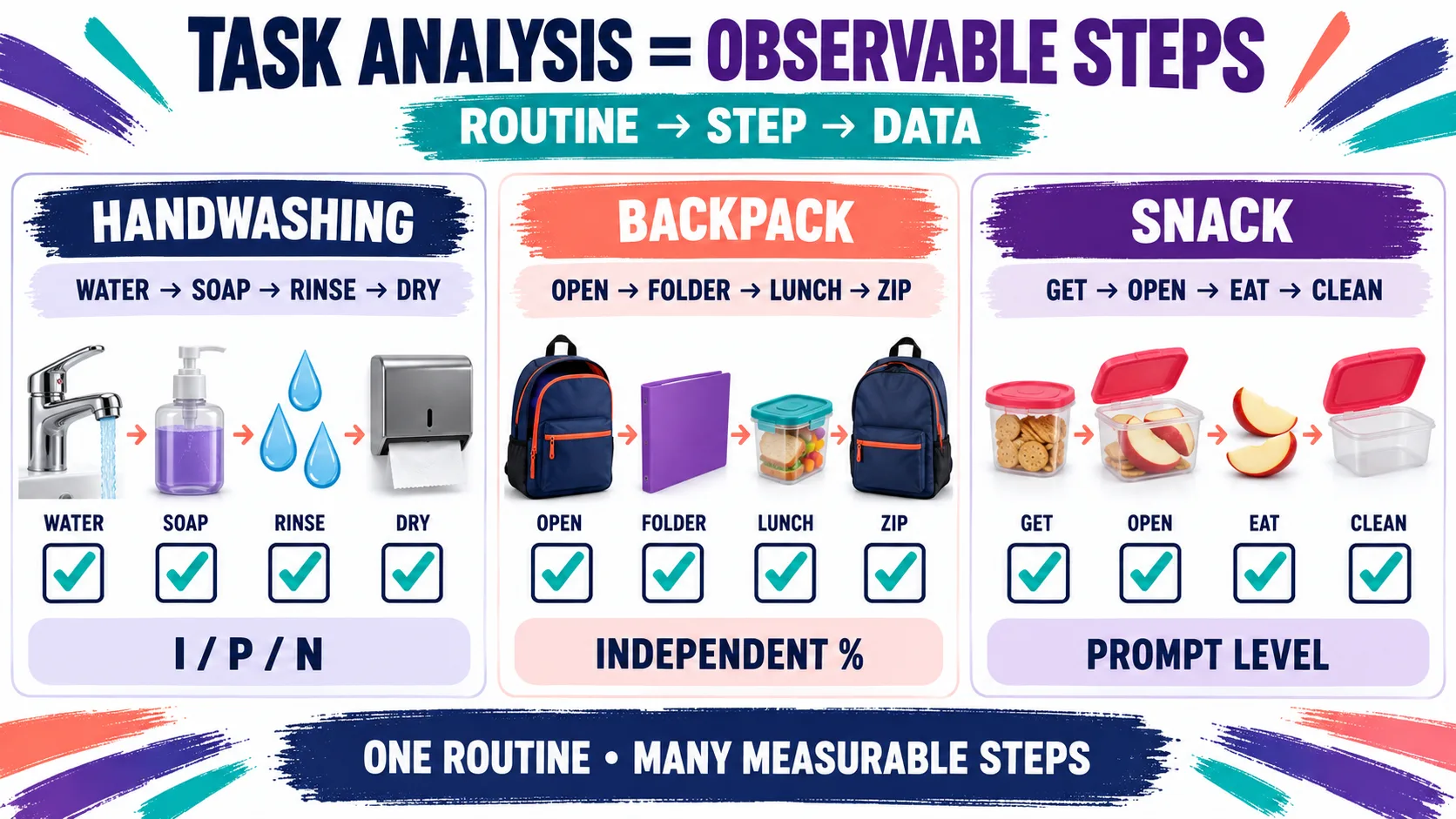
Across all three examples, the quality check is the same: each step should be observable, ordered, teachable, and measurable. If two instructors cannot agree whether the step happened, rewrite the step before blaming the learner or changing the chaining procedure.
Choose the chaining path after looking at the data
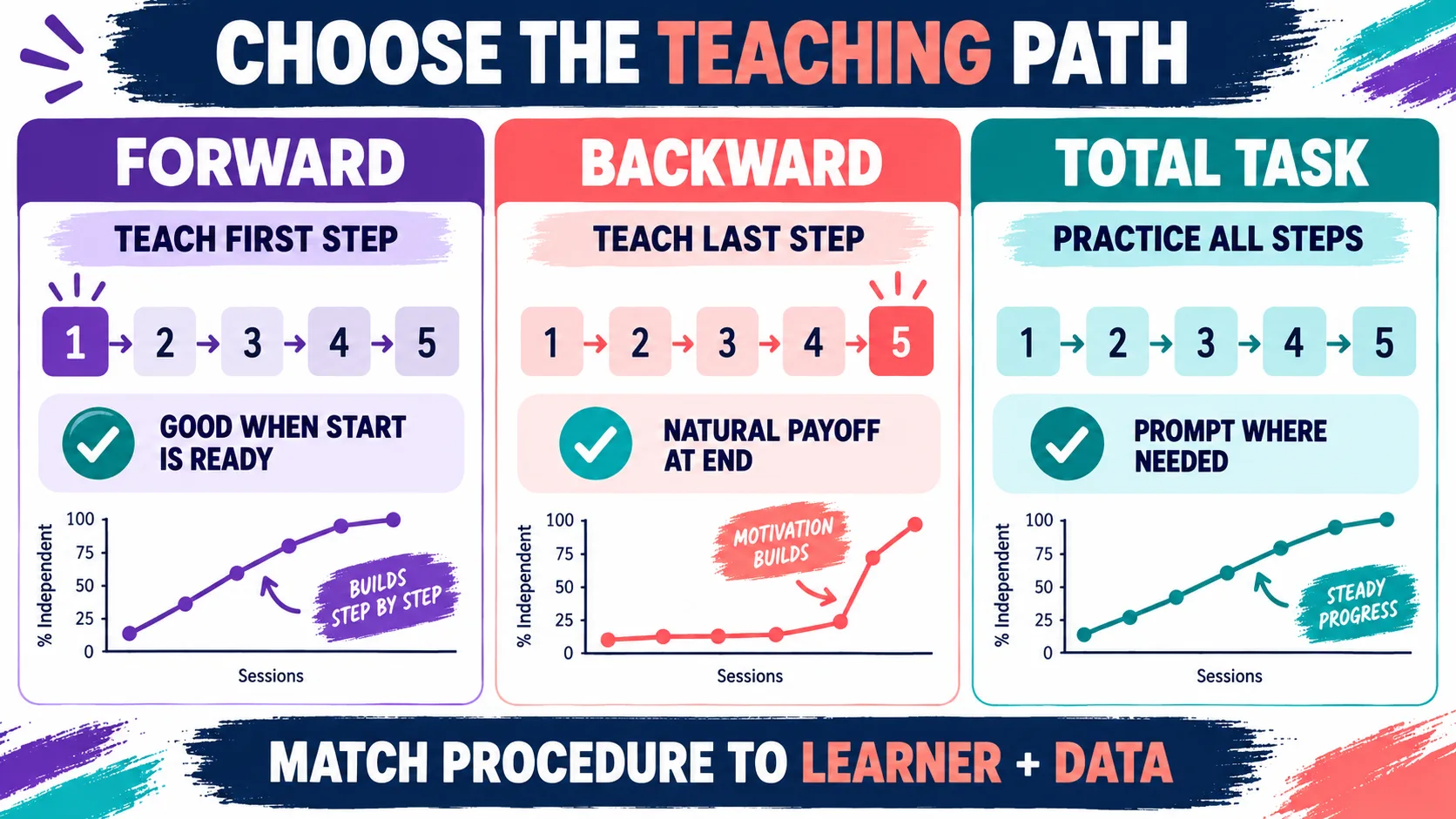
Forward chaining teaches the first step or steps first, then adds later steps. Backward chaining arranges teaching so the learner completes the final step and contacts the natural outcome at the end. Total-task presentation gives the learner an opportunity to practice the entire sequence in each trial, with prompting where needed.
Do not choose a method because it is always described as best. Consider the learner’s current repertoire, the natural reinforcer, safety, response effort, the number of steps, and the data from baseline. A learner may have strong component skills but need help with sequencing; another learner may benefit from completing the final step first because the immediate outcome is meaningful.
| Chaining option | Teaching emphasis | Useful data question |
|---|---|---|
| Forward | Build independence from the beginning of the chain | Is step 1 independent before step 2 is added? |
| Backward | Let the learner complete the terminal step and natural outcome | Does the last step become independent and meaningful? |
| Total task | Practice the whole sequence with step-specific prompts | Which steps need prompts, and are prompt levels decreasing? |
Chaining and task analysis should also leave room for prompt fading. If the learner completes a step only after a full prompt, the program needs a plan for transferring stimulus control and testing independence. A prompt that is never faded can make the data look successful while independence remains low.
Collect data on steps, prompts, and independence
A simple data system can record one code for each step on each trial. Teams may use codes such as I for independent, V for verbal prompt, G for gestural prompt, M for model, PP for partial physical prompt, FP for full physical prompt, and N for no response or incorrect response. Use the codes your team defines consistently; do not assume every program uses identical abbreviations.
Useful summaries include percentage of steps completed independently, the least intrusive prompt needed, latency to begin a step, and which steps remain unstable. A single total percentage can hide an important pattern: step 1 may be independent while step 6 needs a full prompt every time. Graphing the steps separately can show where instruction should change.
- Record the opportunity, step, response, prompt level, and consequence.
- Keep materials and instructions stable enough to interpret change.
- Probe without unnecessary prompts when the program calls for an independence check.
- Plan maintenance checks after the learner meets the initial criterion.
- Change people, materials, settings, or examples deliberately when programming generalization.
For more on displaying step-level data, the existing task-analysis graph guide is a separate read-only resource. This page focuses on worked examples and the decision that connects each example to its teaching and measurement plan.
Common mistakes in task analysis examples
- Writing labels instead of responses: “hygiene” is not a step; “dispenses one pump of soap” is closer to an observable response.
- Making a step too large: “gets dressed” may contain many actions with different prompt needs.
- Making a step too tiny without a reason: over-splitting can create unnecessary response effort and noisy data.
- Confusing the map with the teaching procedure: the task analysis does not automatically choose forward, backward, or total-task chaining.
- Scoring only the final outcome: a finished routine can hide where prompts or errors occurred.
- Ignoring context: a step that works at home may not generalize to a classroom, store, or workplace.
- Leaving prompts unplanned: assistance should be defined, recorded, and systematically faded when appropriate.
FAQ about task analysis in ABA
What is a simple task analysis example?: Handwashing is a simple example when the steps are defined clearly: approach the sink, turn on water, wet hands, apply soap, rub, rinse, turn off water, dry, and dispose of the towel. The exact sequence should match the learner’s materials, skill goal, and safety requirements.
Is task analysis the same as chaining?: No. Task analysis describes the steps in the skill. Chaining is the teaching arrangement that connects those steps. Forward, backward, and total-task procedures can use the same task analysis but teach it in different ways.
How many steps should a task analysis have?: There is no universal number. Use as many steps as needed for reliable observation, teaching, and measurement. If a step contains multiple responses with different prompt requirements, split it. If the analysis creates artificial fragments that do not help instruction, consider combining them.
What data should be collected for task analysis?: Common options include independent versus prompted performance for each step, prompt level, latency, errors, and maintenance or generalization probes. The best measure depends on the target and program question. Confirm the definitions, codes, and mastery criterion with the supervising BCBA or program team.
When you are ready to practice identifying skill-acquisition procedures in scenarios, try the Free BCBA Mock Exam. It is a practice and feedback resource, not a substitute for the current BACB outline, coursework, supervision, or individualized programming.
Sources for Further Study
- BACB: BCBA Test Content Outline (6th ed.)
- BACB: BCBA resources
- BCBA Mock Exam: task analysis guide
- BCBA Mock Exam: task-analysis graph guide
This article is an educational study framework. Use current official BACB materials and qualified supervision for certification preparation and clinical decision-making.
Take the Free BCBA Mock Exam
When you are ready to apply the idea, use the free practice resource below for additional feedback. Take the Free BCBA Mock Exam



