
The hourly rate for a BCBA does not have one official national number. When someone searches for hourly rate for BCBA, the figure they see may be an employee’s salary converted into an hourly equivalent, a contractor’s quoted rate, or a clinic’s billable service rate. Those numbers are not interchangeable.
Table of Contents
- Hourly rate for BCBA: the short answer
- Three numbers people call a BCBA hourly rate
- What current pay sources actually show
- How to convert a BCBA salary into an hourly equivalent
- Billable hours are not the whole BCBA job
- How to compare a BCBA offer beyond the rate
- Employee versus contractor hourly pay
- Six questions to ask before accepting the offer
- FAQ about BCBA hourly rates
- Sources for Further Study
- Take the Free BCBA Mock Exam
Current third-party job-posting snapshots put some BCBA postings near the low-$70s per hour, but those snapshots measure advertised opportunities—not guaranteed take-home pay. The U.S. Bureau of Labor Statistics publishes wage estimates through occupational surveys, while the BACB publishes certificant and profession data; neither source is a universal BCBA hourly-rate schedule. Use the number as a starting point, then check paid hours, benefits, taxes, workload, and cancelled sessions.
Hourly rate for BCBA: the short answer
If you need a quick answer, think of the hourly rate for a BCBA as a comparison number, not a promise. A recent posting-based market snapshot reported a $72.50 median for board-certified behavior analyst postings, while another review of BCBA job advertisements reported a $75 median among the ads it examined. Different samples, locations, employment models, and counting methods can produce different results.
That is why a responsible answer should include a date, market, source, and definition of “hour.” An employee may receive a salary for clinical, administrative, supervision, and meeting time. A contractor may be paid only for completed service units. A clinic may advertise a service rate that includes overhead and is not the clinician’s wage. Comparing those three numbers as if they were equal can make a weak offer look attractive.
For a broader annual-pay context, see the existing average pay for BCBA guide and BCBA salary guide. This page has a narrower job: explain how to interpret an hourly figure and compare the whole offer without changing those existing URLs.
Three numbers people call a BCBA hourly rate
Before comparing offers, label the number. The same “$75 per hour” can mean very different things depending on who pays it, what time is included, and what happens when a session is cancelled.
| Number | What it means | What to verify | Common mistake |
|---|---|---|---|
| Employee equivalent | Salary divided by the hours the employer actually pays | Paid admin, meetings, PTO, holidays, and guaranteed hours | Dividing salary by billable hours only |
| Contractor quote | The gross amount offered for a completed hour or service unit | Taxes, insurance, cancellations, travel, documentation, and unpaid gaps | Treating gross revenue as take-home pay |
| Service rate | What a payer, agency, or clinic bills for a service | What portion, if any, goes to the BCBA | Assuming the billed rate is the clinician’s wage |
Write the label beside every number you collect. “BCBA hourly rate” is incomplete until the offer tells you whether the rate applies to direct treatment, supervision, assessment, report writing, consultation, training, or all worked time.
What current pay sources actually show
The most useful sources answer different questions. The BLS explains how occupational wage estimates are produced and publishes hourly and annual estimates for occupations in its survey system. It does not provide a simple nationwide “BCBA rate card.” The BACB certificant data helps describe the credentialed population, but it is not a job-offer database.
| Source type | What it can tell you | What it cannot prove |
|---|---|---|
| BLS wage methodology | How official occupational wage estimates and distributions are built | That a specific BCBA offer equals a national BLS hourly wage |
| BACB data | Credential and certificant context | The rate an employer, payer, or contractor must offer |
| Job-posting snapshot | Advertised market signals for a date and sample | Guaranteed hours, accepted offers, benefits, or take-home pay |
| Your written offer | The terms you can actually compare and negotiate | A promise that workload or cancellations will never change |
For example, TrueRounds reports a $72.50 median for a recent set of board-certified behavior analyst postings and labels the result as a posting-based market figure. CertifyndABA reports a $75 median in its review of 136 BCBA advertisements. Those figures are useful directional signals, but the methods are not identical and neither is an official national BCBA wage. Record the source date and read the methodology before using a median in a negotiation.
How to convert a BCBA salary into an hourly equivalent
The simplest salary conversion is: annual salary ÷ paid hours in the year = employee hourly equivalent If an offer is $100,000 and the employer pays 2,080 hours, the simple equivalent is about $48.08 per paid hour. If the same salary requires 1,600 paid hours because the role is part-time or structured around fewer guaranteed hours, the equivalent is $62.50. That is not a trick; it shows why the denominator matters.
Do not silently substitute “billable hours” for “paid hours.” A BCBA may spend paid time in supervision, treatment planning, meetings, caregiver training, documentation, travel, training, and cancellations. A contractor may spend unpaid time on scheduling, taxes, credentialing, insurance, and business administration. Your comparison should calculate at least two figures:
- Paid-hour equivalent: salary divided by all guaranteed paid hours.
- Worked-hour reality check: expected annual gross pay divided by the hours you realistically work, including unpaid administrative and gap time.
- Net-pay planning number: gross pay minus taxes, benefits you must buy, and other required costs, divided by the hours you work.
These are planning calculations, not tax advice. For contractor decisions, ask a qualified tax professional how self-employment tax, estimated payments, deductions, and business expenses apply to your situation.
Billable hours are not the whole BCBA job
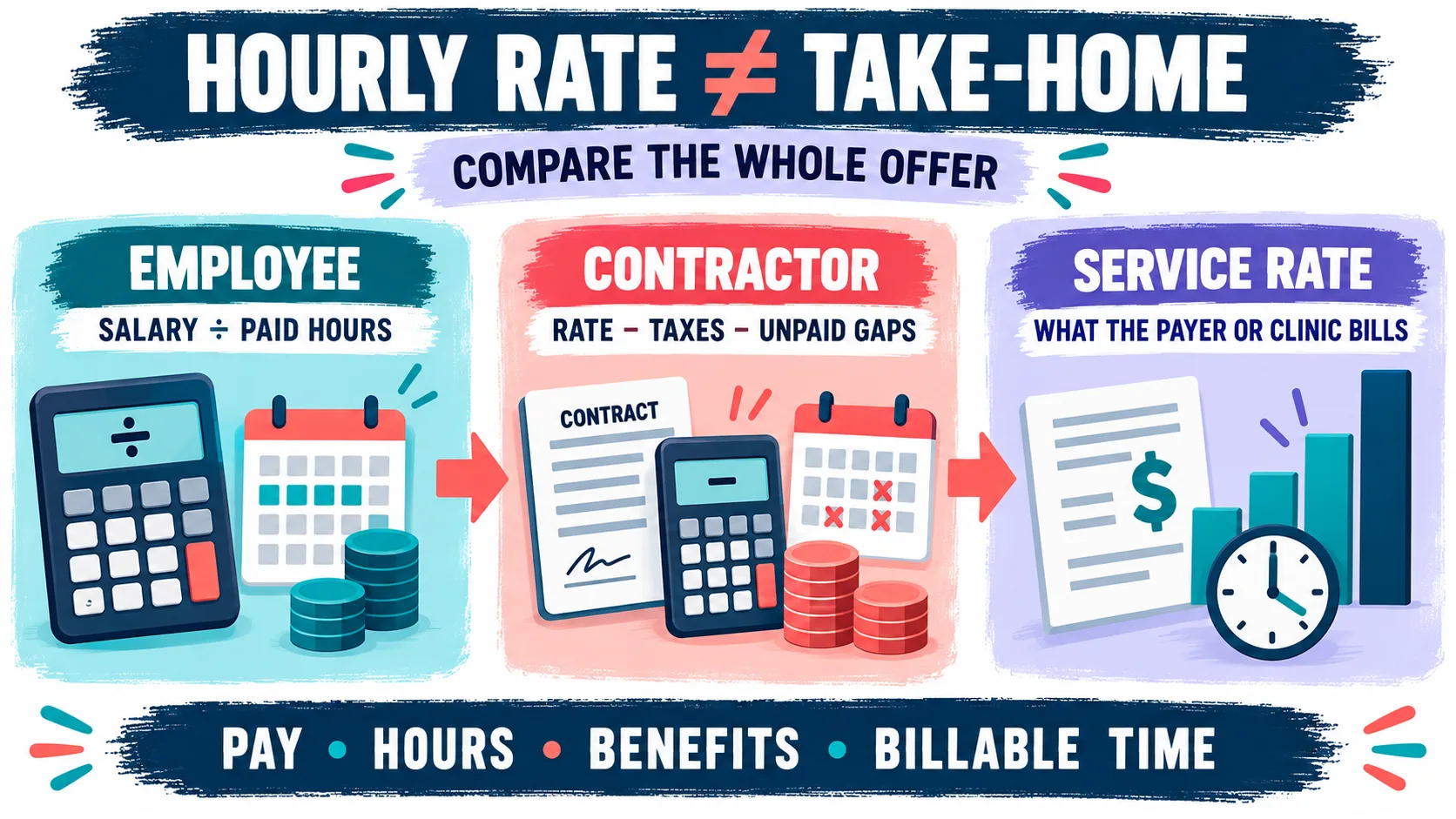
A billable target is a productivity expectation, not automatically a guarantee that every hour will be paid. Ask whether the target is measured weekly or monthly, whether indirect clinical work counts, and what happens when a client cancels. A role can advertise a strong hourly rate while transferring the risk of empty time to the clinician.
Likewise, a service rate is not necessarily a wage. A clinic may use the service revenue for rent, administrative staff, billing, technology, supervision, liability coverage, and other costs before setting compensation. When someone quotes a payer or agency rate, ask: What exactly does the BCBA receive, for which activity, and under what attendance conditions?
How to compare a BCBA offer beyond the rate
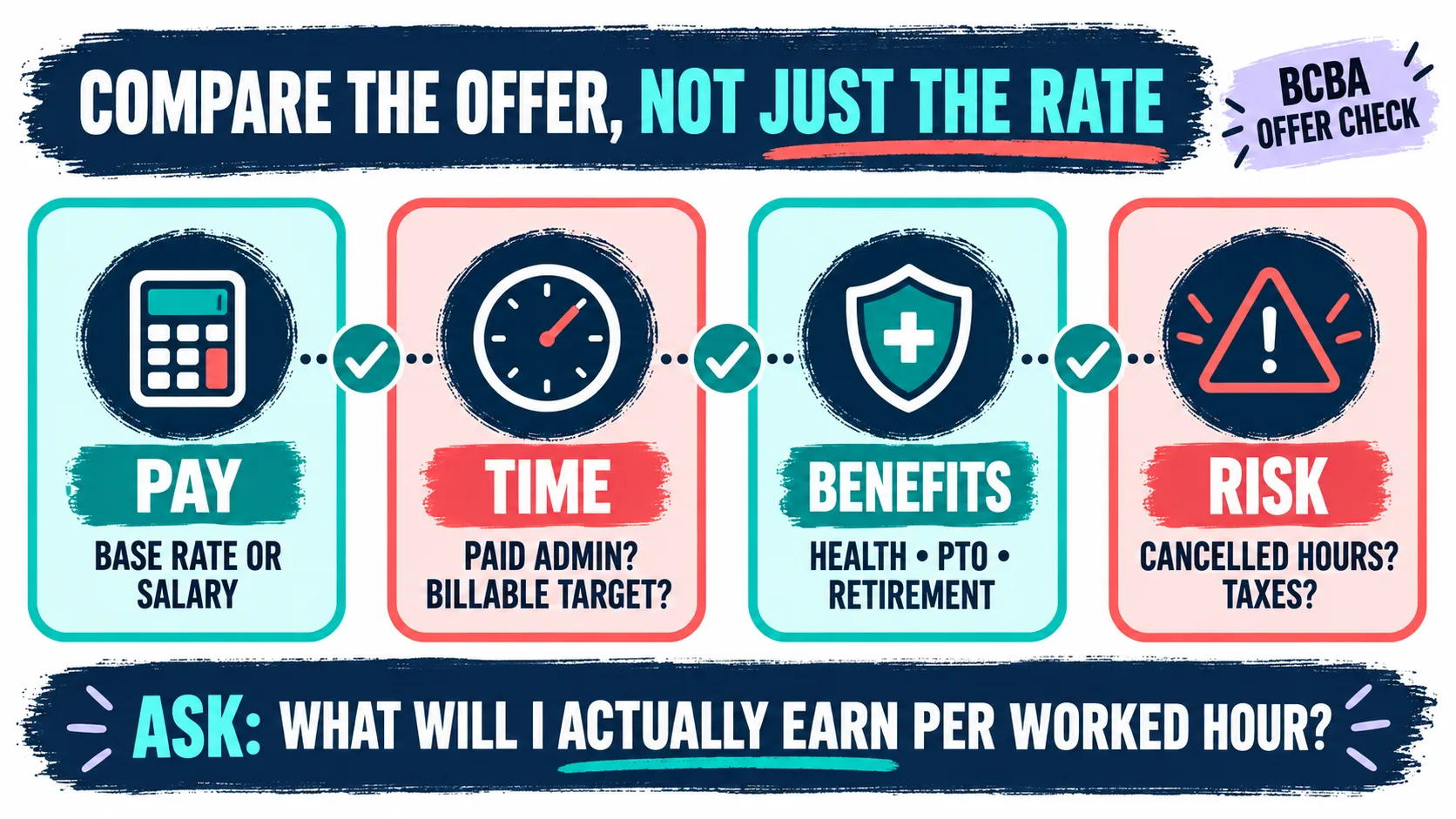
Use the same four buckets for every offer: pay, time, benefits, and risk. Put the answers in writing. An offer that pays less per direct hour may be stronger if it pays documentation and supervision time, guarantees a stable caseload, includes benefits, and protects against cancelled sessions.
- Pay: Is the amount salary, hourly wage, per-session pay, or contractor revenue?
- Time: Which activities count as paid time, and what is the expected billable or productive target?
- Benefits: What are the employer’s contributions for health insurance, paid time off, retirement, continuing education, and liability coverage?
- Risk: Who absorbs cancellations, no-shows, low census, travel, and unpaid gaps?
For a broader job-search workflow, the existing BCBA jobs guide can help you compare role types. This article adds the compensation math so that “hourly” does not end the analysis.
Employee versus contractor hourly pay
Employee and contractor offers can both be reasonable. The problem is comparing them with one gross-rate column. Use a side-by-side worksheet and include the costs that change the value of the offer.
| Comparison | Employee role | Contract role |
|---|---|---|
| Tax handling | Employer withholds payroll taxes under the arrangement | Worker plans for taxes and estimated payments |
| Benefits | May include health, PTO, retirement, or education benefits | Often self-funded or absent; price it explicitly |
| Time risk | May include guaranteed paid hours or paid indirect work | May pay only for completed or approved units |
| Business costs | Some costs are carried by the employer | Insurance, credentialing, travel, and admin may be yours |
Neither label decides whether an offer is good. Read the agreement, clarify classification questions with the employer, and obtain professional tax or legal advice when the arrangement is complex.
Six questions to ask before accepting the offer
- What is the guaranteed minimum number of paid hours per week?
- Are assessments, reports, parent meetings, supervision, documentation, and training paid?
- What happens financially when a client cancels or a session ends early?
- Is the stated rate a wage, a contractor rate, or a billed service rate?
- What is the expected billable target, and how is it calculated?
- Which benefits and business costs should be included in my comparison?
Save the answers next to the offer date. Rates and conditions can change by location, setting, specialty, experience, licensure requirements, payer mix, and local hiring conditions. A current written offer is more relevant to your decision than an undated headline on a salary page.
FAQ about BCBA hourly rates
What is a good hourly rate for a BCBA?: There is no single answer without the location, employment model, paid-hour definition, benefits, and workload. Use current posting snapshots as directional context, then compare the full written offer. A higher direct-service rate can be weaker if it excludes indirect work and leaves cancellations unpaid.
Does a BCBA salary have an hourly rate?: A salary can be converted into an hourly equivalent by dividing annual pay by paid hours, but that calculation is not necessarily the wage shown on a job advertisement. Calculate it with the actual paid-hour denominator and then run a second check using realistic worked hours.
Is a BCBA service rate the same as BCBA pay?: No. A service rate may be the amount billed to a payer or client. It may cover clinical labor plus administrative and operating costs. Ask how much is paid to the BCBA and which tasks or cancellations are included.
Where can I check official BCBA compensation data?: The BACB provides official certificant and profession data, and the BLS explains its occupational wage methodology. Neither should be presented as a universal BCBA hourly-rate schedule. For a specific decision, use the written offer, current local postings, and professional advice where needed.
If you are studying for the BCBA exam while comparing career options, try the Free BCBA Mock Exam. It is a practice and feedback resource, not a salary calculator, tax service, or substitute for current BACB requirements.
Sources for Further Study
- U.S. Bureau of Labor Statistics: Using Occupational Employment and Wage Statistics
- U.S. Bureau of Labor Statistics: OEWS tables
- BACB: Certificant data
- TrueRounds: Board Certified Behavioral Analyst posting snapshot
- CertifyndABA: BCBA hourly rate 2026 market review
This article is educational career-planning information. It is not a guaranteed wage quote, tax opinion, legal opinion, or official BACB compensation schedule. Confirm current terms with the employer and current rules with the appropriate official source.
Take the Free BCBA Mock Exam
When you are ready to apply the idea, use the free practice resource below for additional feedback. Take the Free BCBA Mock Exam



