
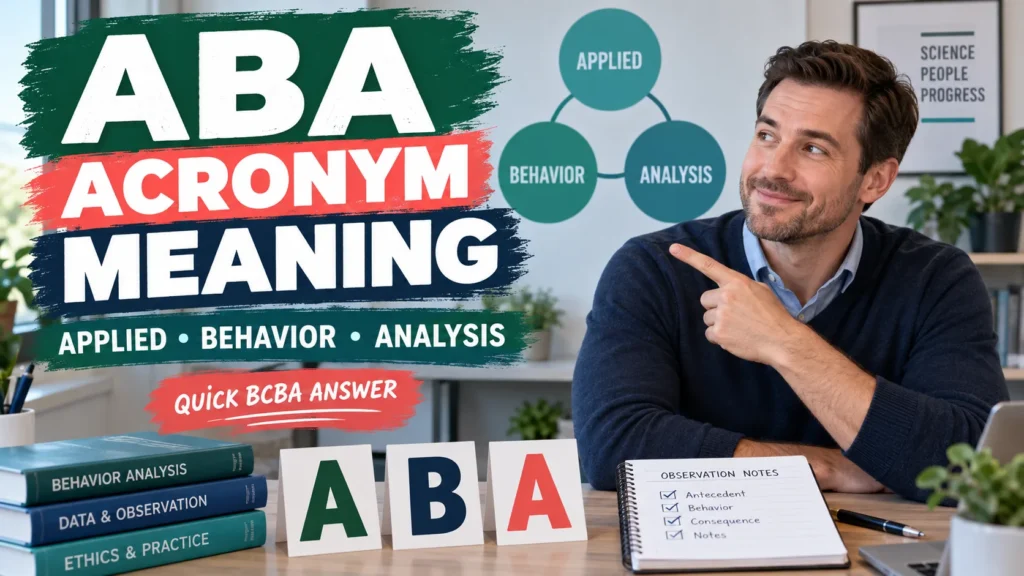
The phrase aba acronym meaning has a direct answer: ABA stands for Applied Behavior Analysis. It does not stand for autism. Autism is one context in which applied behavior analysis may be discussed, but the acronym names a field and approach focused on behavior, environmental relations, measurement, and socially meaningful change.
Table of Contents
- ABA acronym meaning: the short answer
- What Applied, Behavior, and Analysis each contribute
- Break ABA into three study questions
- What ABA means—and what it does not mean
- ABA versus related BCBA exam acronyms
- Use the acronym when reading a BCBA question stem
- Common mistakes about the ABA acronym
- FAQ about ABA acronym meaning
- Sources for Further Study
- Take the Free BCBA Mock Exam
For BCBA study, do not stop at expanding the letters. Use each word as a question: where is the science applied, what behavior can be observed and measured, and how does analysis connect change to environmental variables? That three-part reading strategy helps you answer definition questions without turning ABA into a vague synonym for therapy.
ABA acronym meaning: the short answer
ABA = Applied Behavior Analysis. The BACB’s overview describes behavior analysis as a science and explains that applied behavior analysis uses behavior-analytic principles and procedures to improve meaningful behavior in real-world contexts. For certification and examination purposes, the BACB also directs readers to the applicable task-list content. That answer has three important boundaries:
- Applied means the work addresses meaningful behavior in practical contexts.
- Behavior means the focus is behavior that can be defined, observed, and measured—not a guess about a person’s character.
- Analysis means data and systematic evaluation are used to understand whether environmental changes relate to behavior change.
These words do not describe three separate services. Together, they name the applied branch of behavior analysis and a way of thinking about behavior change. The exact practice, scope, and rules depend on training, supervision, ethics, and applicable law.
What Applied, Behavior, and Analysis each contribute
Use the table as a quick answer map. A strong exam response should connect the definition to the question being asked rather than repeating a memorized expansion.
| Letter | Study meaning | Question to ask | Common shortcut to avoid |
|---|---|---|---|
| A — Applied | Targets behavior that matters in a real person’s life or context | Why does this change matter to the learner or community? | Assuming “applied” means one diagnosis or one setting |
| B — Behavior | Focuses on a response that can be operationally defined | What would an observer see, hear, or count? | Treating a trait, label, or inferred feeling as the response |
| A — Analysis | Uses data and systematic evaluation to examine relations | What evidence supports the explanation or intervention? | Calling an intervention analysis simply because data were collected |
A useful memory cue is meaning → response → evidence. Applied asks whether the goal matters. Behavior asks what the response is. Analysis asks how the data support the conclusion.
Break ABA into three study questions
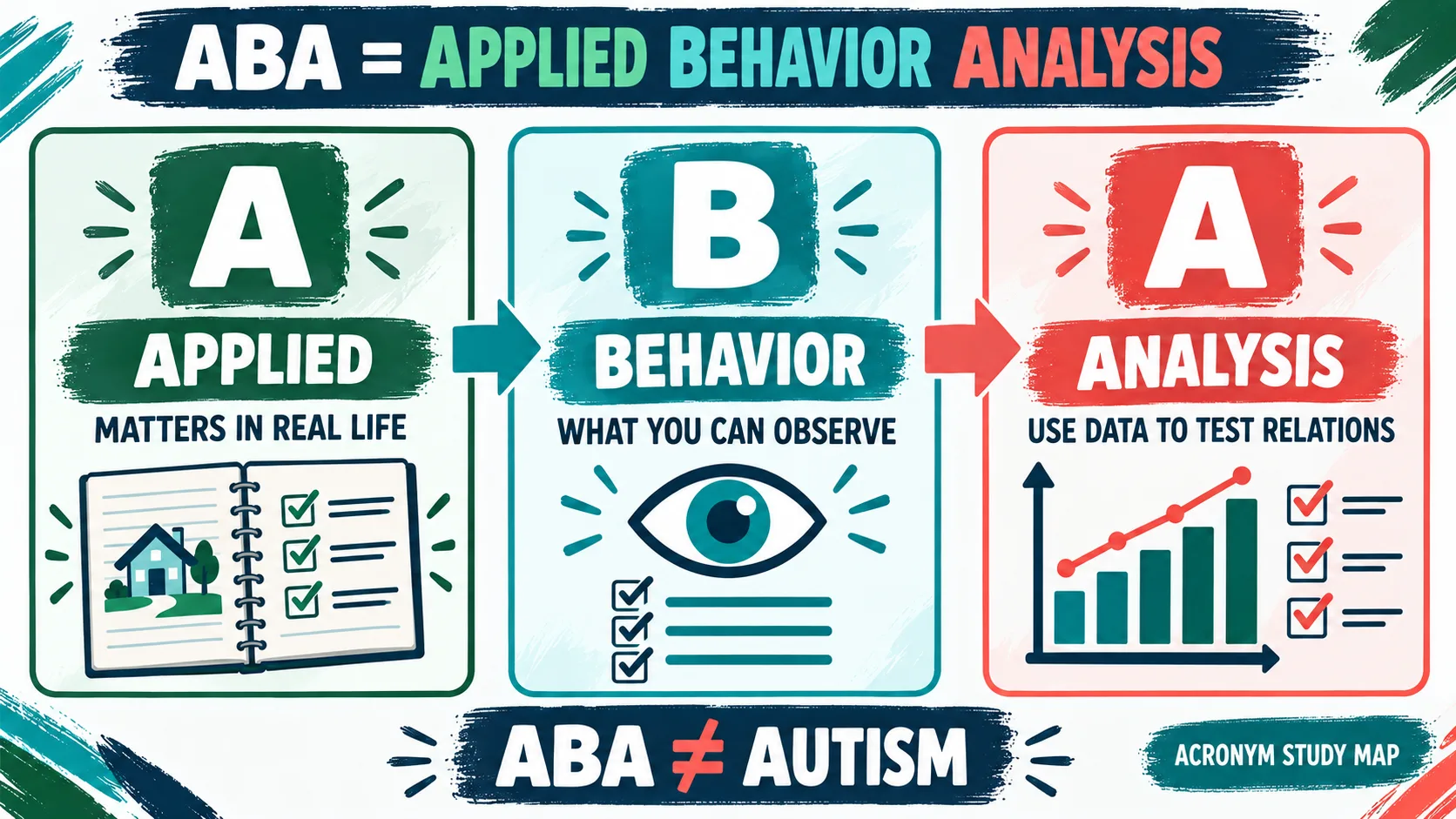
The visual map is deliberately simple. If a question asks for an applied example, look for a socially meaningful target in a real context. If it asks for a behavioral definition, look for observable and measurable wording. If it asks about analysis, look for data, comparison, experimental logic, or a defensible relation between environmental events and behavior.
This does not mean every ABA program must use the same design or that one graph proves every claim. It means the word analysis carries an evidence question. A description of improvement is not automatically an analysis of why the improvement occurred.
What ABA means—and what it does not mean
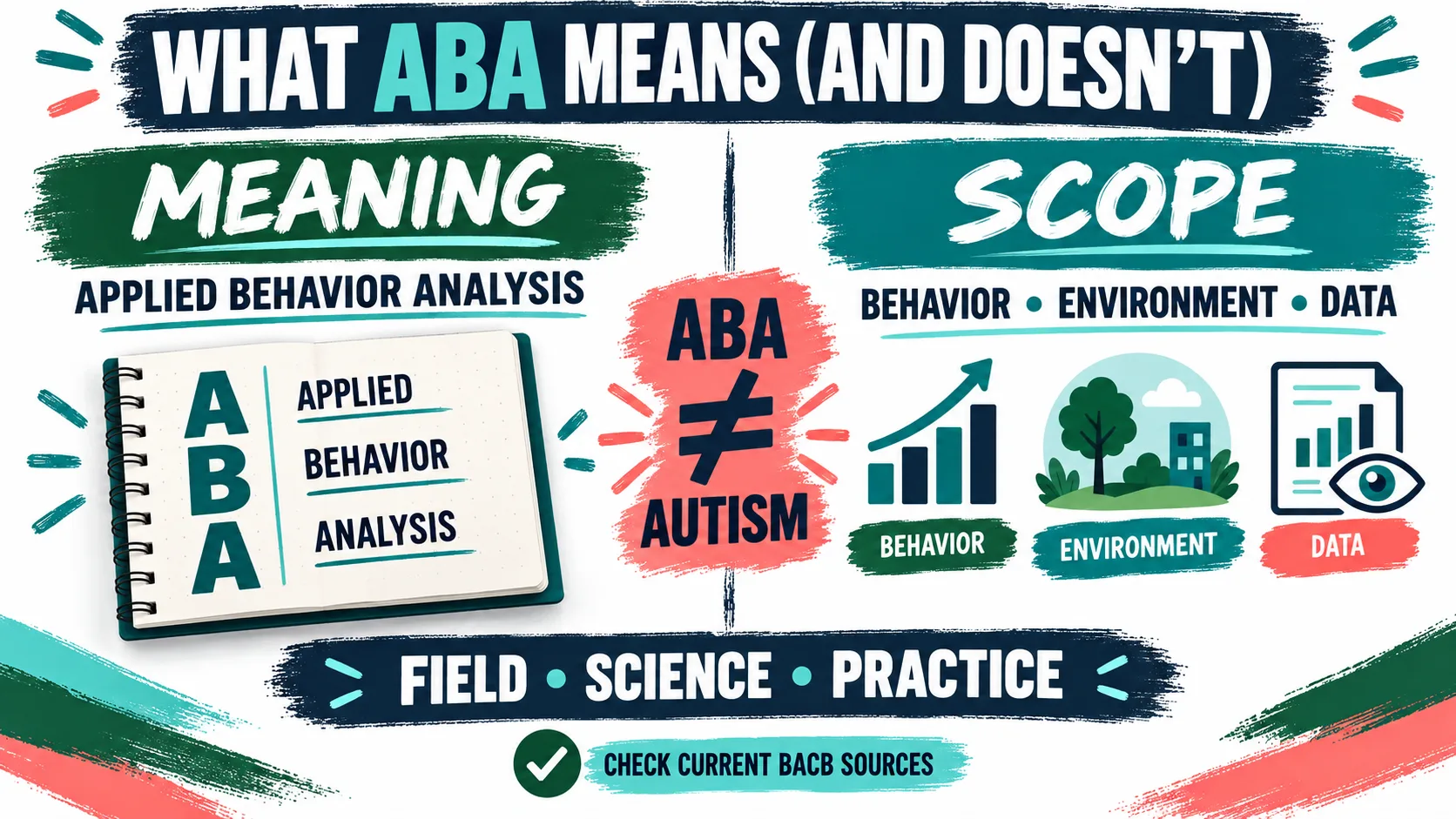
Applied behavior analysis is broader than a single diagnosis, age group, or service setting. Behavior-analytic principles may be applied in education, developmental services, health, organizational settings, safety, communication, daily living, and other contexts when the goal and methods are appropriate. A program should be individualized and grounded in direct observation, measurement, ethical practice, and relevant professional competence.
ABA is not an acronym for autism. It is also not a promise that every intervention labeled “ABA” has identical goals, procedures, quality, or outcomes. The BACB, APBA, and APA describe applied behavior analysis in terms of behavior-analytic science and application; readers should use current professional and legal sources when evaluating a particular service. For a current exam boundary, check the BACB overview of behavior analysis and the current BCBA Test Content Outline. This article expands the acronym; it is not a substitute for those sources.
ABA versus related BCBA exam acronyms
Many errors happen because a learner knows the letters but confuses the type of thing each acronym names. Use the category column before memorizing the expansion.
| Acronym | Expansion | What it names | Fast distinction |
|---|---|---|---|
| ABA | Applied Behavior Analysis | A field, science, and applied approach | Not a person’s credential |
| BCBA | Board Certified Behavior Analyst | A BACB certification | A credentialed practitioner, not the field itself |
| BCaBA | Board Certified Assistant Behavior Analyst | A BACB certification with defined supervision requirements | Do not substitute it for BCBA |
| RBT | Registered Behavior Technician | A paraprofessional certification | Role and supervision boundaries matter |
| ABC | Antecedent–Behavior–Consequence | A way to describe a behavior episode | A framework or record, not ABA’s expansion |
Certification names and requirements can change. Use the current BACB certification pages and outline when the exam question asks for an exact credential definition or scope.
Use the acronym when reading a BCBA question stem
For an acronym question, answer the direct expansion first. For an application question, let the rest of the stem determine which part of the expansion matters. Try this five-step reading routine:
- Expand the letters: Applied Behavior Analysis.
- Identify the target: What behavior or outcome is being discussed?
- Check the context: Is the target socially meaningful in the stated setting?
- Find the evidence: What observation, measurement, comparison, or relation supports the answer?
- Respect the role: Is the stem asking about ABA as a field or about a BCBA, BCaBA, RBT, or another role?
For example, if a question asks what ABA stands for, do not choose “autism behavior assessment” because it sounds familiar. If a question asks which option is behavioral, look for an observable response. If it asks which option demonstrates analysis, look for evidence that links environmental conditions and behavior rather than a before-and-after description alone.
Common mistakes about the ABA acronym
- “ABA means autism”: autism is a context, not the expansion of the acronym.
- “Behavior means personality”: behavior must be defined at a level that can be observed and measured.
- “Applied means easy”: applied means socially meaningful and practical, not automatically simple.
- “Analysis means any data”: analysis involves a defensible evaluation of relations, not merely recording numbers.
- “ABA and BCBA are interchangeable”: ABA names a field or approach; BCBA names a certification.
- “One source is permanent”: exam, ethics, and credential information should be checked against current official sources.
FAQ about ABA acronym meaning
What does ABA stand for?: ABA stands for Applied Behavior Analysis. It is the applied branch of behavior analysis and uses behavior-analytic principles, measurement, and systematic evaluation in practical contexts. Does ABA stand for autism?: No. ABA does not stand for autism. Applied behavior analysis may be used in services for autistic people, but the acronym expands to Applied Behavior Analysis.
What does the “applied” in ABA mean?: Applied points to behavior that matters in a real-world context. A study answer should connect the target to a meaningful outcome rather than treating applied as a synonym for a particular diagnosis or therapy setting.
What is the difference between ABA and BCBA?: ABA refers to Applied Behavior Analysis, a field and applied approach. BCBA refers to Board Certified Behavior Analyst, a professional certification. A BCBA may practice within ABA, but the terms do not name the same thing.
When you are ready to practice separating ABA concepts from credential and scenario wording, try the Free BCBA Mock Exam. It is a practice and feedback resource, not an official BACB glossary or substitute for current certification information.
Sources for Further Study
- BACB: About Behavior Analysis
- BACB: BCBA Test Content Outline (6th ed.)
- APBA: About Behavior Analysis
- American Psychological Association: Applied Behavior Analysis policy
This article is an educational study framework. Confirm current certification, ethics, and exam information in official BACB materials.
Take the Free BCBA Mock Exam
When you are ready to apply the idea, use the free practice resource below for additional feedback. Take the Free BCBA Mock Exam



