
If you search for skills based training ABA, you may be looking for one of two different ideas. Behavior Skills Training (BST) teaches an implementer how to perform a defined skill through instruction, modeling, rehearsal, and feedback. Skill-Based Treatment (SBT) is a function-based treatment process that teaches a learner communication, tolerance, and contextual skills related to problem behavior. They are not interchangeable acronyms.
Table of Contents
- What Does Skills Based Training ABA Mean?
- First Decide: BST or SBT?
- BST: Train the Implementer
- SBT: Teach Functional Communication and Tolerance
- Use the Exam Clue Matrix
- Do Not Mix the Acronyms
- Choose the Next Step Without Mixing Acronyms
- Apply the Distinction to BCBA Vignettes
- Skills-Based Training ABA FAQ
- Practice the Route
- Sources to Verify
- Take the Free BCBA Mock Exam
This guide gives you a fast route for separating BST from SBT in a BCBA vignette. It does not replace the site’s BST exam guide or its PFA/SBT guide. Those pages cover each topic in depth. This page owns the confusing search and exam task: identify which concept the question is actually describing, then choose the evidence or next step that fits. Scope note: the current BACB Test Content Outline is the source for examination expectations. Research examples below are educational explanations, not a BACB-mandated protocol, a treatment plan, or individualized clinical advice.
What Does Skills Based Training ABA Mean?
The phrase skills-based training ABA is a broad search label, not a single procedure name. In an exam question, begin by asking who is supposed to acquire the skill. If a technician, caregiver, teacher, or other implementer is learning to carry out a written teaching procedure, the question is usually pointing toward BST. If the learner is being taught a functional communication response, tolerance for delay or denial, or cooperation in a context related to challenging behavior, the question may be pointing toward SBT.
| Search or exam phrase | Likely target | First question to ask |
|---|---|---|
| Behavioral skills training | BST | Who is being trained to perform the procedure? |
| Skill-based treatment | SBT | What function-based learner skill replaces or reduces problem behavior? |
| Skills training in ABA | Ambiguous | Is the stem about implementer fidelity or learner treatment? |
The word training can appear in both contexts. That word alone does not decide the answer. The target, sequence, consequence, and measurement do.
- Identify the person: name the implementer or learner who is acquiring the skill.
- Identify the outcome: separate procedure fidelity from a function-based replacement repertoire.
- Identify the evidence: match the measure to performance accuracy, communication, tolerance, problem behavior, or generalization.
First Decide: BST or SBT?
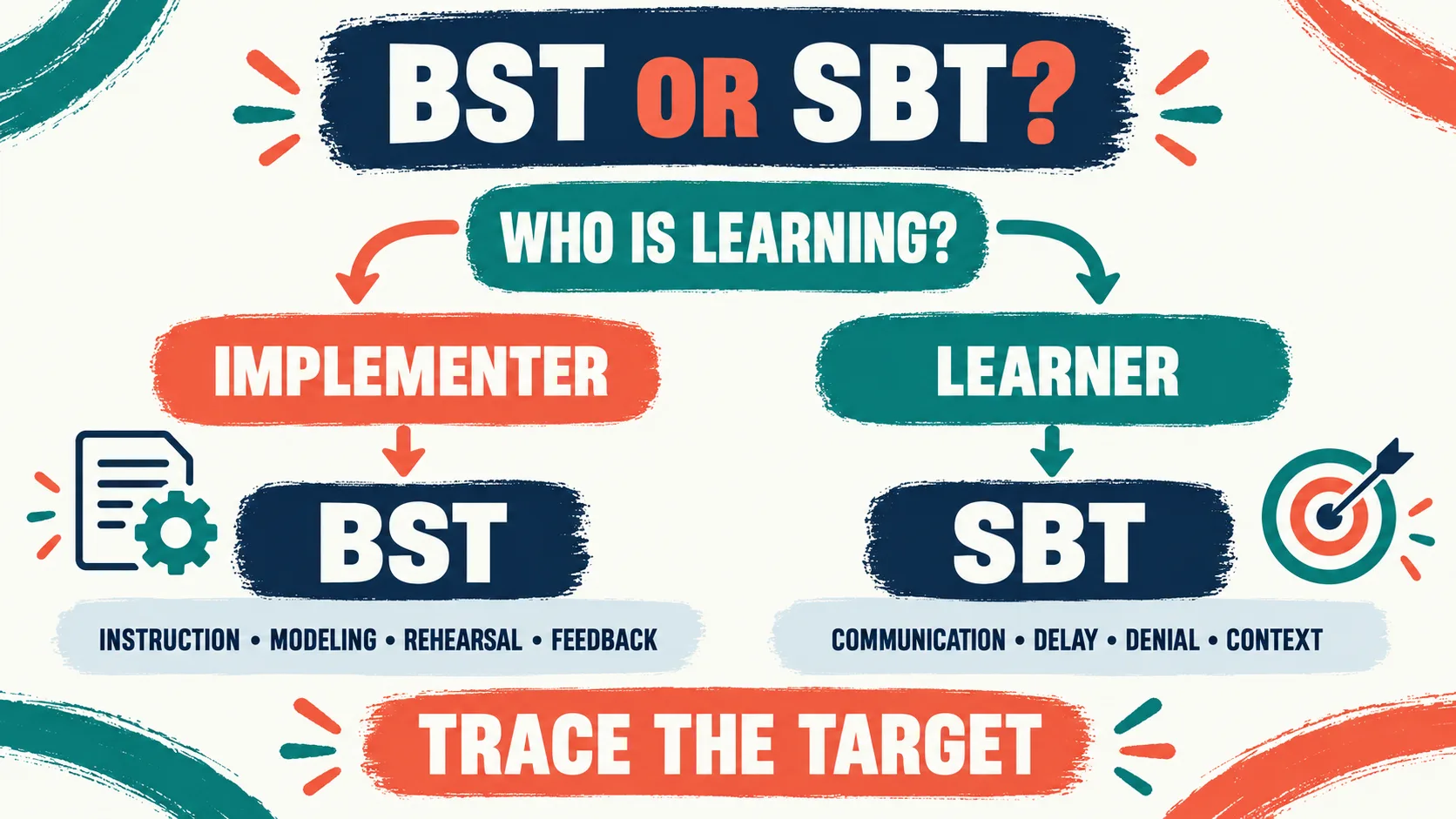
Use this four-question router before choosing an answer:
- Name the learner. Is the person acquiring a teaching or implementation skill, or is the client acquiring a communication, tolerance, or context skill?
- Name the target. Is the target accurate delivery of a procedure, or a change in the learner’s behavior under specific motivating and antecedent conditions?
- Find the organizing relation. BST is organized around competent performance of a task. SBT is organized around a function-informed replacement and the learner’s progressive tolerance or cooperation.
- Match the measure. BST often uses implementation fidelity or performance accuracy. SBT commonly tracks communication, tolerance, problem behavior, engagement, and generalization in the relevant context.
| If the stem emphasizes… | Start with… | Do not jump to… |
|---|---|---|
| A caregiver learns to run a prompting procedure | BST and implementation fidelity | SBT just because the client is present |
| A learner requests, waits, and tolerates denial | SBT or a related function-based skill sequence | BST just because instruction and feedback occur |
| A question only says “skills training” | The target and consequence details | Either acronym without more evidence |
BST: Train the Implementer
Behavior Skills Training is a training package for teaching another person to perform a defined behavior. The common sequence is instruction, modeling, rehearsal, and feedback. The trainer describes the task, shows what correct performance looks like, gives the trainee a chance to perform it, and provides specific feedback. Rehearsal and feedback may repeat until the learner reaches a stated mastery criterion.
The critical unit is implementation accuracy. A BCBA vignette may ask which training package is best for a caregiver who knows the steps on paper but does not perform them consistently. Look for a performance measure such as a task-analysis percentage, procedural-integrity score, or correct response count. BST is not defined by the topic being taught; it is defined by how the implementer is taught to perform the skill.
| BST component | What happens | What to measure |
|---|---|---|
| Instruction | The trainer explains the steps, cues, and expected standard. | Whether the trainee can describe the task is not enough by itself. |
| Modeling | The trainer demonstrates correct performance. | The model should match the written target and context. |
| Rehearsal | The trainee practices the skill under relevant conditions. | Record each critical step completed correctly. |
| Feedback | The trainer names accurate and inaccurate components and guides correction. | Check later performance and generalization, not praise alone. |
Research on BST includes training caregivers and staff to implement behavioral procedures. That evidence supports the package as a way to teach implementers; it does not mean that every learner intervention containing modeling is automatically BST.
SBT: Teach Functional Communication and Tolerance
Skill-Based Treatment is a different use of “skills-based.” In the PFA/SBT literature, the treatment process is function-based and may teach a functional communication response, tolerance for delays and denials, and contextual skills such as cooperation or engagement. The exact sequence, assessment, safety plan, and decision rules depend on the case and qualified supervision.
On an exam, SBT clues usually point to the learner’s replacement repertoire and the conditions under which it must work. The question may mention a functional communication response, gradually longer delays, tolerating “not now,” or moving from a preferred context into an instructional context. These details are about changing the learner’s response options and treatment outcomes, not simply teaching a staff member to follow a protocol.
| SBT skill area | Study clue | Boundary |
|---|---|---|
| Functional communication | The learner uses an appropriate response to access a relevant outcome. | The response must be selected from the function and assessment, not guessed from a generic script. |
| Delay or denial tolerance | The learner practices waiting or tolerating “not now” under planned conditions. | Do not treat a single delay as proof of a complete treatment process. |
| Contextual skills | Communication and tolerance support participation in a meaningful context. | Safety, assent, assessment, and generalization remain case-specific. |
Do not use SBT as a fashionable synonym for any skill lesson. The function-based rationale and the learner’s relevant repertoire are what separate this concept from a generic training session.
Use the Exam Clue Matrix
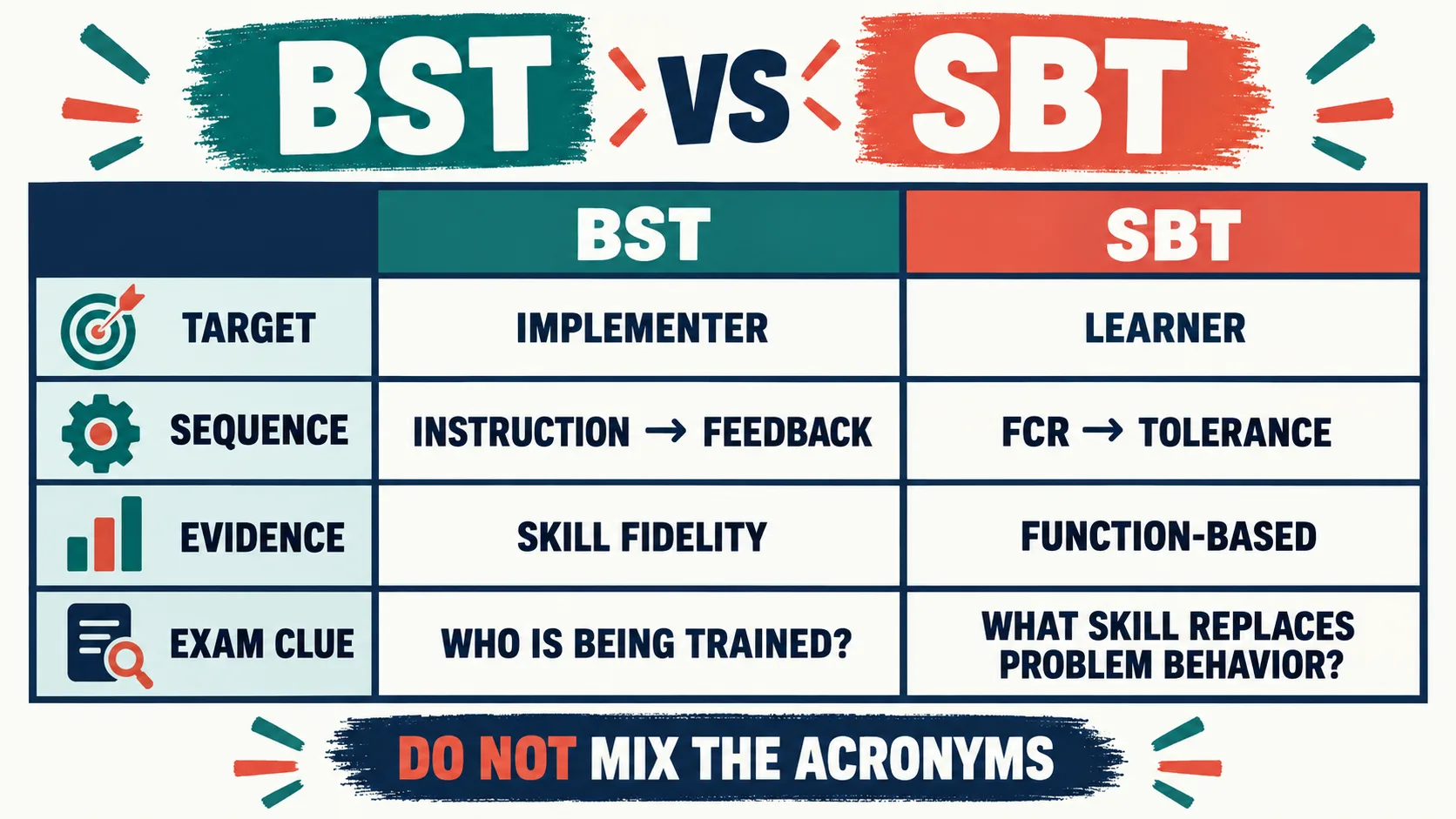
When two answer choices use similar language, compare the target rather than the acronym. The matrix below turns the distinction into an exam-time check.
| Question detail | BST reading | SBT reading |
|---|---|---|
| Who is the learner? | Technician, caregiver, teacher, or implementer. | Client acquiring communication, tolerance, or contextual skills. |
| What changes? | Accuracy and fidelity of the procedure. | Problem behavior and replacement-skill performance in relevant conditions. |
| What sequence stands out? | Instruction, model, practice, feedback. | Function-based communication followed by tolerance and contextual progression. |
| What is the common trap? | Calling any teaching interaction BST. | Calling every delay-tolerance lesson a full SBT protocol. |
Do Not Mix the Acronyms
Most wrong answers come from noticing one familiar word and ignoring the rest of the stem. A question can include modeling in an SBT context, or feedback in a learner’s skill program, without turning the entire intervention into BST. Conversely, a client can benefit from a procedure taught to a caregiver through BST without the client receiving SBT.
| Trap | Why it fails | Repair |
|---|---|---|
| “There is instruction, so it is BST.” | Instruction appears in many teaching packages. | Ask who is being taught and what performance is measured. |
| “There is a functional communication response, so it is BST.” | The response may be the learner’s function-based replacement skill. | Look for SBT or FCT clues and the relevant consequence. |
| “BST and SBT are two names for the same thing.” | Their targets and organizing relations differ. | Use the target-person and target-behavior tests. |
- Do not select an acronym from a single keyword.
- Do not claim a functional relation from a training label alone.
- Do not convert a study example into a universal treatment rule.
Choose the Next Step Without Mixing Acronyms
If the question does not give enough information, the best answer may be a measurement or assessment step. Use the current BACB outline and the facts in the stem to decide what is missing. A good answer is precise about the target and modest about what the available evidence proves.
| What is missing? | Next defensible check | Avoid claiming |
|---|---|---|
| Implementer cannot perform a written procedure | Define the task steps, establish a mastery criterion, and evaluate BST performance. | That a handout alone produced competency. |
| Learner behavior changes when access or demands change | Review assessment information and function-based replacement-skill data. | That a generic BST package identifies the function. |
| A study reports a promising SBT outcome | Read the design, participant, setting, measures, and limitations. | That the result guarantees an outcome for every learner. |
Apply the Distinction to BCBA Vignettes
Try the following reasoning pattern: identify the target, name the person learning, find the sequence, and match the measure.
- A caregiver practices prompting. The BCBA gives directions, models the prompt, asks the caregiver to rehearse, and gives corrective feedback. The target is caregiver implementation fidelity, so BST is the stronger match.
- A learner uses a card to request a break and gradually waits longer. The target is a function-related communication and tolerance repertoire. The stem points toward SBT or a related function-based treatment sequence, not merely BST.
- The stem says “skills training” but gives no target. Do not guess. Look for the next detail, or choose the assessment/clarification answer if the question asks what should happen next.
Notice that a supervisor could use BST to train staff to implement an SBT plan. The two concepts can appear in the same real-world program, but they still describe different levels of the system: training the implementer versus teaching the learner’s function-based repertoire.
Skills-Based Training ABA FAQ
Is skills-based training the same as BST? Not always. In many ABA study contexts, the phrase points to BST, but it can also refer to SBT. Identify the target and the person learning before choosing an acronym. What are the four BST steps? The common package is instruction, modeling, rehearsal, and feedback. The steps are used to teach an implementer accurate performance of a defined skill. What does SBT teach? SBT may teach functional communication, delay and denial tolerance, cooperation, engagement, and other contextual skills selected from a function-informed assessment and treatment process. The exact plan is case-specific. Can BST be used to teach SBT procedures to staff? Yes. BST can train an implementer to carry out a separate learner program. That overlap does not make BST and SBT synonyms.
What is the fastest BCBA exam clue? Ask “Who is being trained?” If the answer is the caregiver or technician performing a procedure, start with BST. If the answer is the client learning a function-based replacement and tolerance repertoire, examine SBT clues.
Practice the Route
Before you answer a question, write one sentence: “The person acquiring the skill is ___, and the outcome being measured is ___.” Then choose BST, SBT, or “more information needed.” This two-part sentence prevents a familiar acronym from replacing the actual analysis.
Use the free BCBA mock exam as a practice checkpoint for separating training packages, learner targets, and evidence. It is independent study material, not an official BACB exam, a treatment protocol, a certification decision, or a passing-score guarantee.
Bottom line: in ABA, “skills-based training” is not precise enough by itself. BST teaches an implementer to perform a defined procedure through instruction, modeling, rehearsal, and feedback. SBT teaches a learner a function-based communication, tolerance, and contextual repertoire. Trace the target before you name the acronym.
Sources to Verify
- BACB Test Content Outline
- Behavioral Skills Training and caregiver implementation
- BST training scoping review
- Synthesized analyses and treatments study
- Functional communication and tolerance replication
- Recent SBT systematic review and meta-analysis
Reviewed October 11, 2026. Confirm current BACB resources and use qualified supervision for real assessment or treatment decisions.
Take the Free BCBA Mock Exam
A useful next step is to apply this idea in a fresh set of BCBA-style practice questions and review the feedback. Take the Free BCBA Mock Exam



