

Short answer: Tact cards are visual teaching materials that can help evoke and practice tacts, such as labeling an apple, dog, color, action, or other nonverbal stimulus. The card is not the tact itself. The learner’s spoken word, sign, picture selection, or other verbal response is the behavior being taught and measured. Effective use of tact cards depends on stimulus control, prompt fading, varied examples, functional reinforcement, and data—not simply memorizing a stack of pictures.
Table of Contents
- What are tact cards in ABA?
- How do tact cards support teaching?
- How should prompts, fading, and generalization be planned?
- How are tacts different from mands and intraverbals?
- What data should be collected with tact cards?
- What tact-card mistakes appear on the BCBA exam?
- Tact cards FAQ
- Take the Free BCBA Mock Exam
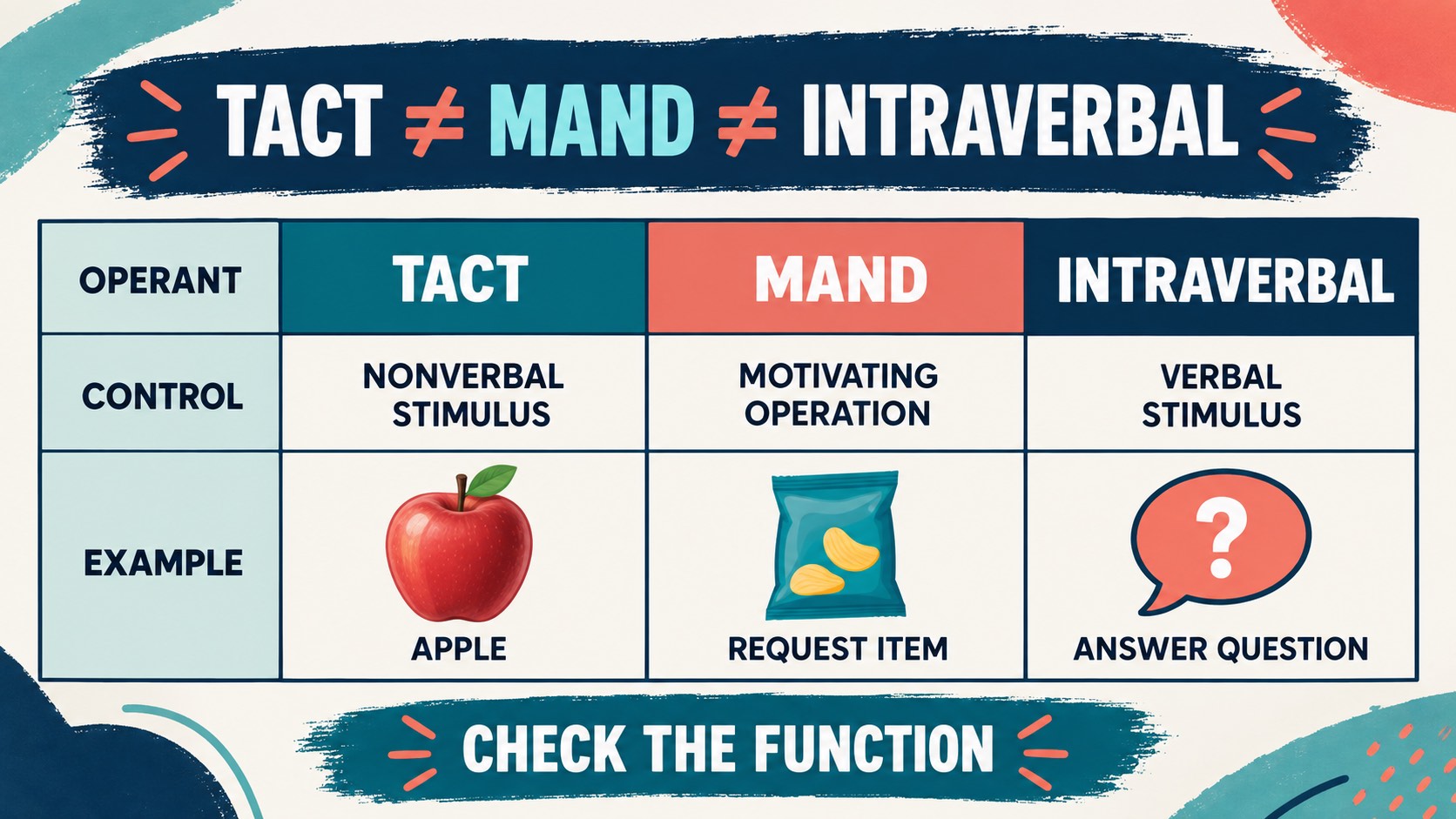
For BCBA exam questions, start by identifying what controls the response. If a picture or object evokes “apple,” the nonverbal stimulus is relevant to a tact. If a motivating operation evokes “juice, please,” think about a mand. If a verbal question evokes the answer, think about an intraverbal. That distinction is more important than the brand, artwork, or format of the cards.
This article treats tact cards as study and teaching materials, not as a universal treatment protocol. Follow the current BACB Test Content Outline, applicable ethics requirements, supervision, consent or assent processes, and the qualified professional’s assessment and documentation. The examples below are educational BCBA exam support, not individualized clinical advice. Table of Contents
What are tact cards in ABA?
A tact is a verbal operant evoked by a nonverbal stimulus and typically maintained by generalized conditioned reinforcement. In everyday language, it is often described as labeling or commenting on something that is present: saying “ball” when seeing a ball, “cold” when touching a cold item, or “dog” when looking at a dog. The relevant question is not merely what word was spoken; it is what stimulus and consequence controlled that response.
A tact card is a teaching material that presents a picture, symbol, object feature, action, category, or other visual cue. It may be used as an antecedent during instruction, an assessment probe, a stimulus for discrimination training, or a way to organize examples. The card itself does not automatically make a learner’s response a tact. If an adult says “What is this?” and the learner echoes the answer, the verbal prompt may be controlling the response. If the card is shown while the learner independently labels the pictured item, the nonverbal stimulus is more central to the tact relation. Use these questions to analyze a tact-card trial:
- What exactly is presented: a real object, photograph, drawing, symbol, action, sound, or spoken instruction?
- What response is expected, and is it defined in observable terms?
- Which prompt, if any, is controlling the response?
- What consequence follows an independent or prompted response?
- Will the response transfer to different examples, people, settings, and naturally occurring situations?
For a broader definition and exam comparison, see the existing tacting in ABA guide. This page focuses more narrowly on how cards should be selected, used, generalized, and measured.
How do tact cards support teaching?
A tact-card lesson should be organized as a teaching loop rather than a guessing game: present a meaningful stimulus, arrange an opportunity to respond, prompt only as needed, reinforce the target response, and collect enough information to make the next decision. The exact sequence depends on the learner, target, setting, and assessment evidence.
One simple study example is teaching a learner to tact common objects. The instructor presents a picture of an apple, allows an opportunity to respond, and uses a least-intrusive prompt or another justified prompting arrangement if the learner does not respond. An independent “apple” may contact the planned consequence. The instructor then records whether the response was independent, prompted, incorrect, or absent. The goal is not to make the learner repeat a word after an adult; it is to establish reliable stimulus control and useful communication.
| Card component | Instructional purpose | What to check |
|---|---|---|
| Clear stimulus | Makes the intended object, feature, action, or event available as a discriminable cue. | The image is recognizable, relevant to the target, and not consistently accompanied by an unintended prompt. |
| Response opportunity | Creates a defined moment in which the learner can label or comment. | The latency, response form, and acceptable alternatives are specified before scoring begins. |
| Prompt and fade plan | Supports acquisition without allowing the prompt to become the only controlling stimulus. | Prompt level, delay, fading criterion, and error-correction procedure are defined. |
| Meaningful consequence | Increases the value of responding and supports continued communication or participation. | The consequence is available for the target response and is not delivered in a way that reinforces errors. |
| Varied examples | Helps the learner respond to the relevant feature rather than one card’s background, position, or exact picture. | Examples vary in size, color, angle, materials, people, and context when those variations matter. |
Why is the card not the target behavior?: Suppose a card shows a red apple. If the learner says “apple” only after the adult asks, “What is it?” the verbal question may be part of the controlling relation. If the learner matches the picture to an identical picture, the trial may test matching rather than tacting. If the learner points to the apple when told, “Show me apple,” the response may be listener behavior. Each activity can be useful, but the BCBA exam expects you to name the relation accurately.
How should prompts, fading, and generalization be planned?
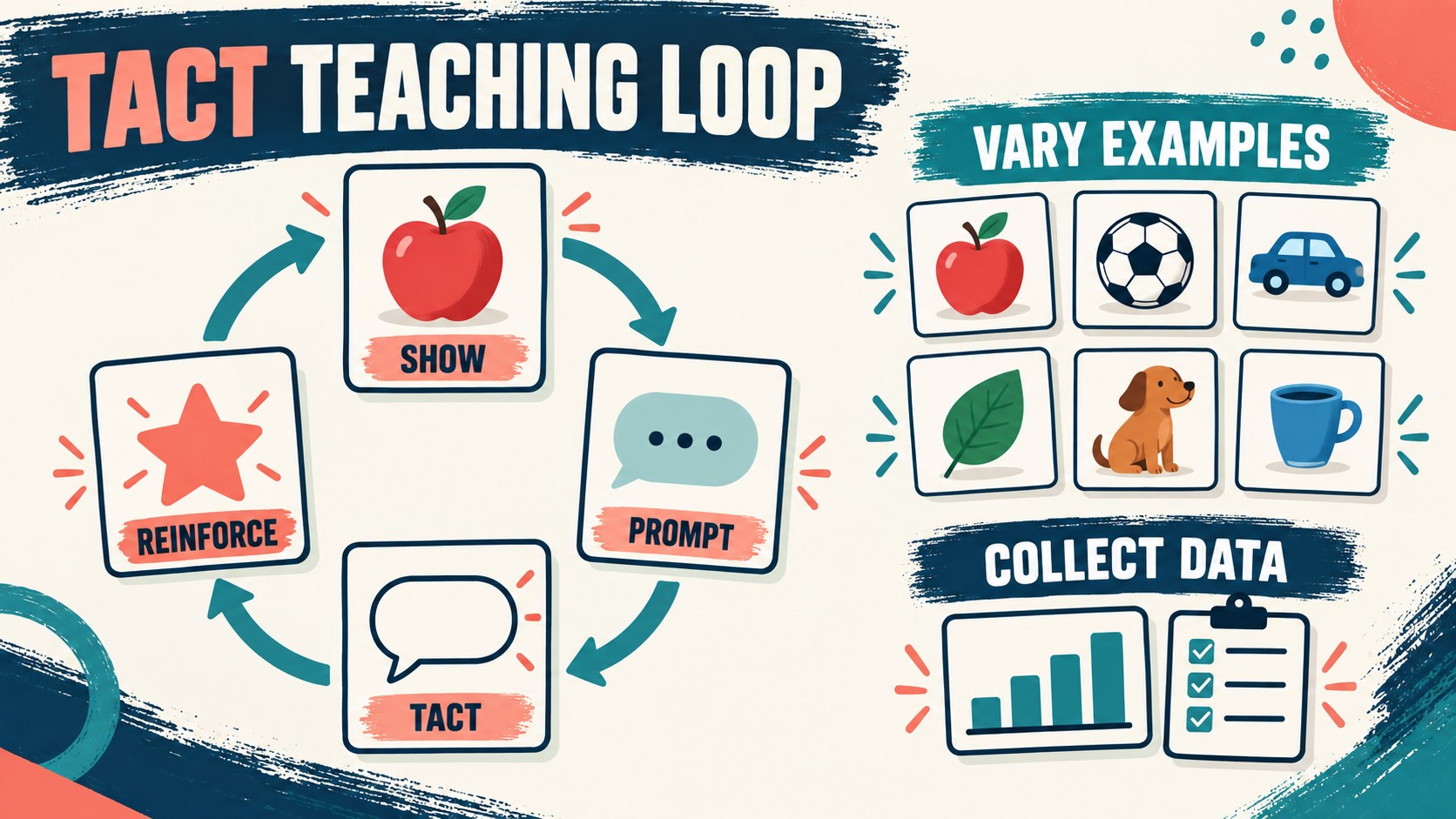
Prompting can help a learner contact the correct response, but prompts also create stimulus control. A prompt that is never faded can produce prompt dependence: the learner waits for the adult’s question, pointing, model, or partial word instead of responding to the relevant picture or object. A tact-card plan should therefore state how prompts will be delivered, how they will be reduced, and how independent responding will be reinforced.
For exam reasoning, compare the prompt with the target stimulus. If the goal is to tact a picture, an adult’s whispered word should not become the reliable cue for the answer. If a prompt is needed, the team can use a justified prompt hierarchy, a time delay, stimulus fading, model fading, or error-correction strategy consistent with the learner’s needs and the teaching plan. Record the prompt level rather than counting every prompted response as independent.
| Generalization dimension | Card-based example | Exam question to ask |
|---|---|---|
| Stimulus exemplars | Use different apples, dogs, cups, photographs, drawings, and real objects when the category is the target. | Is the learner responding to the relevant feature or memorizing one image? |
| People and settings | Practice with more than one instructor and in naturally relevant places. | Does the response occur outside the original table or lesson station? |
| Response forms | Accept the defined communication form and then assess whether it works across partners and routines. | Is the response understandable, efficient, and socially meaningful for the learner? |
| Time and consequence | Move from contrived trials toward naturally occurring comments and interactions. | Does the skill maintain when the teaching materials and dense reinforcement are thinned? |
Common fading and generalization errors include:
- Using the same card position every time and then mistaking position preference for learning.
- Prompting with the complete answer before allowing an independent opportunity.
- Scoring an echoed word as an independent tact without recording the verbal prompt.
- Teaching only one exemplar and assuming the category has generalized.
- Removing reinforcement before the response is reliable or meaningful.
- Testing generalization only after instruction ends instead of planning it during teaching.
How are tacts different from mands and intraverbals?
The fastest way to separate verbal operants is to identify the antecedent relation and the consequence. The same spoken word can function differently on different trials. “Cookie” may be a tact if the learner labels a cookie that is visible, a mand if the learner requests a cookie when motivated for one, or an echoic response if the learner repeats an adult model. The topography alone does not decide the operant.
| Verbal operant | Relevant control | Simple example | BCBA exam clue |
|---|---|---|---|
| Tact | A nonverbal stimulus | Seeing an apple and saying “apple” | Ask what object, feature, event, or action was present. |
| Mand | A motivating operation and a history of specific reinforcement | Wanting a snack and saying “chips” | Ask what outcome is requested and what motivation is operating. |
| Intraverbal | A verbal stimulus without point-to-point correspondence | Hearing “What do you eat?” and answering “food” | Ask what spoken question or statement evoked the response. |
How to solve a tact-card scenario: Imagine that a learner sees a picture of a bus and says “bus” after the instructor asks, “What is it?” If the question is always required, the item may be testing a prompted labeling routine rather than independent tacting. Now imagine that the learner sees the picture during a natural walk, labels it without a question, and receives a socially meaningful response. The second description provides stronger evidence that the nonverbal stimulus is controlling the tact.
Do not overcorrect the scenario by assuming that a question makes tacting impossible. A brief question can be part of an instructional arrangement, and the team may be teaching a mixed repertoire. The exam task is to identify the controlling variables described in the stem and the independence criterion being scored.
What data should be collected with tact cards?
Data should answer the decision question. If the question is whether the learner can tact common objects independently, record opportunities and independent responses separately from prompted, incorrect, and no-response trials. If the question is whether a new card set generalized the skill, sample varied exemplars and settings. A pile of completed cards is not enough evidence by itself.
| Measure | Useful when | Interpret carefully |
|---|---|---|
| Percentage of independent opportunities | The number of planned trials is reasonably stable and independence is the main outcome. | A high percentage from one repeated card set may not show generalization. |
| Prompt level | The learner is acquiring the response and the team is fading assistance. | Do not collapse prompted and independent responses into one mastery score. |
| Latency or response rate | Speed, fluency, or spontaneous commenting matters to the functional goal. | A faster response is not automatically better if accuracy or communication value falls. |
| Generalization sample | The team wants to know whether the skill transfers across materials, people, places, or times. | A single probe cannot establish broad maintenance or generalization. |
A practical review sequence is:
- Define the target label and acceptable response forms before the session.
- Record the stimulus set and prompt level for each opportunity.
- Separate independent, prompted, incorrect, and absent responses.
- Sample novel exemplars rather than only the cards used during teaching.
- Check whether the consequence was delivered as planned.
- Review procedural integrity before changing the intervention.
- Use the pattern over time to decide whether to continue, fade, modify, or reassess.
What tact-card mistakes appear on the BCBA exam?
Watch for answer choices that sound educational but skip the controlling relation or measurement plan:
- Calling the card the behavior: the card is a stimulus or teaching material; the learner’s response is what must be defined and measured.
- Confusing labeling with matching: selecting an identical picture is not automatically a tact.
- Confusing a tact with an intraverbal: a verbal question can become the controlling stimulus.
- Confusing a tact with a mand: a visible item does not eliminate the possibility that motivation and requesting are central.
- Counting prompts as mastery: prompted accuracy should not be reported as independent performance.
- Teaching one exemplar only: high performance on a single card does not prove category generalization.
- Ignoring communication access: the response modality should fit the learner and be defined functionally.
- Adding cards instead of analyzing data: more materials do not correct an unclear target, weak prompt plan, or missing consequence.
Quick review: identify the antecedent, define the response, record prompts, reinforce useful independent communication, vary examples, and check generalization. When a question asks whether a card activity teaches a tact, do not stop at the picture. Ask what actually evokes the response.
For additional independent practice, use the free BCBA mock exam to test verbal-operant distinctions and stimulus-control scenarios. It is a practice and feedback resource, not an official BACB product, does not reproduce official exam questions, and does not guarantee certification or exam performance.
Tact cards FAQ
Are tact cards the same as flashcards?: They can look similar, but the instructional function matters. A flashcard may be used for matching, receptive identification, spelling, memorization, or verbal responding. A tact-card trial is defined by the relation between the nonverbal stimulus, the learner’s response, and the consequence.
Can a tact be taught with pictures instead of real objects?: Pictures can be useful stimuli, but the team should assess whether the learner responds to the relevant feature and whether the skill transfers to real objects or natural events when that transfer is important. A picture-based success does not automatically prove generalization.
Should every tact card have one correct answer?: The target and scoring rule should be clear, but some stimuli can evoke more than one acceptable label depending on the instructional goal, language community, and context. Define the response before teaching and document acceptable alternatives rather than treating an arbitrary answer key as the behavior definition.
What is the most important tact-card data point?: There is no single measure for every case. For independence training, separate independent responses from prompted responses. For generalization, sample novel examples and contexts. For fluency, consider rate or latency. Choose the measure that answers the decision question and pair it with integrity and meaningful-outcome information.
Bottom line: Tact cards are visual tools, not magic materials. Strong BCBA reasoning connects the card to the nonverbal stimulus, the defined verbal response, prompt fading, reinforcement, varied exemplars, and data-based decisions. When the controlling variable changes, the verbal operant may change too.
Take the Free BCBA Mock Exam
When you are ready to apply the idea, use the free practice resource below for additional feedback. Take the Free BCBA Mock Exam



