
If you are studying reinstatement ABA, start with the event that happened after behavior had already decreased. Reinstatement is a form of treatment relapse: after a target response has been reduced, the reinforcer that supported it is presented again, and the target response returns. The key is not simply that behavior came back. The key is the trigger that came before the return.
Table of Contents
- What Is Reinstatement in ABA?
- How Does the Three-Phase Reinstatement Arrangement Work?
- How Is Reinstatement Different From Other ABA Relapse Effects?
- How Do You Identify Reinstatement on a BCBA Exam Question?
- What Does Reinstatement Look Like in Practical ABA Examples?
- What Data Should a BCBA Review?
- How Can a BCBA Mitigate Reinstatement Risk?
- A Fast Reinstatement ABA Study Workflow
- Reinstatement ABA FAQ
- Take the Free BCBA Mock Exam
This distinction matters on the BCBA exam and in clinical reasoning. A response can return because time passed, the context changed, alternative reinforcement weakened, or the original reinforcer became available again. Those patterns are not interchangeable. This guide defines reinstatement, maps its three-phase logic, compares it with resurgence, renewal, and spontaneous recovery, and shows how to read a scenario without confusing a behavior change with its function.
What Is Reinstatement in ABA?
Reinstatement in ABA is the return of a previously reduced or extinguished target behavior after the reinforcer associated with that behavior is presented again. The reinforcer may be delivered independently of the target response or contingently on the target response, depending on the arrangement being analyzed. In either case, the defining sequence is: the target response was reinforced, the response was reduced while that reinforcement was withheld, and the relevant reinforcer was later reintroduced.
For example, suppose a learner’s screaming historically produced attention. During treatment, attention is no longer delivered following screaming and an appropriate communication response is reinforced instead. Screaming decreases. If a caregiver later gives attention immediately after screaming, and screaming increases again, the pattern may be consistent with response-dependent reinstatement. The conclusion still depends on the data and the arranged contingencies; one loud episode is not enough to prove a relapse effect.
Do not confuse this technical meaning with reinstating a professional license or returning a credential to active status. In an ABA exam question, the surrounding terms are usually extinction, relapse, reinforcement, target response, alternative behavior, and treatment integrity.
How Does the Three-Phase Reinstatement Arrangement Work?
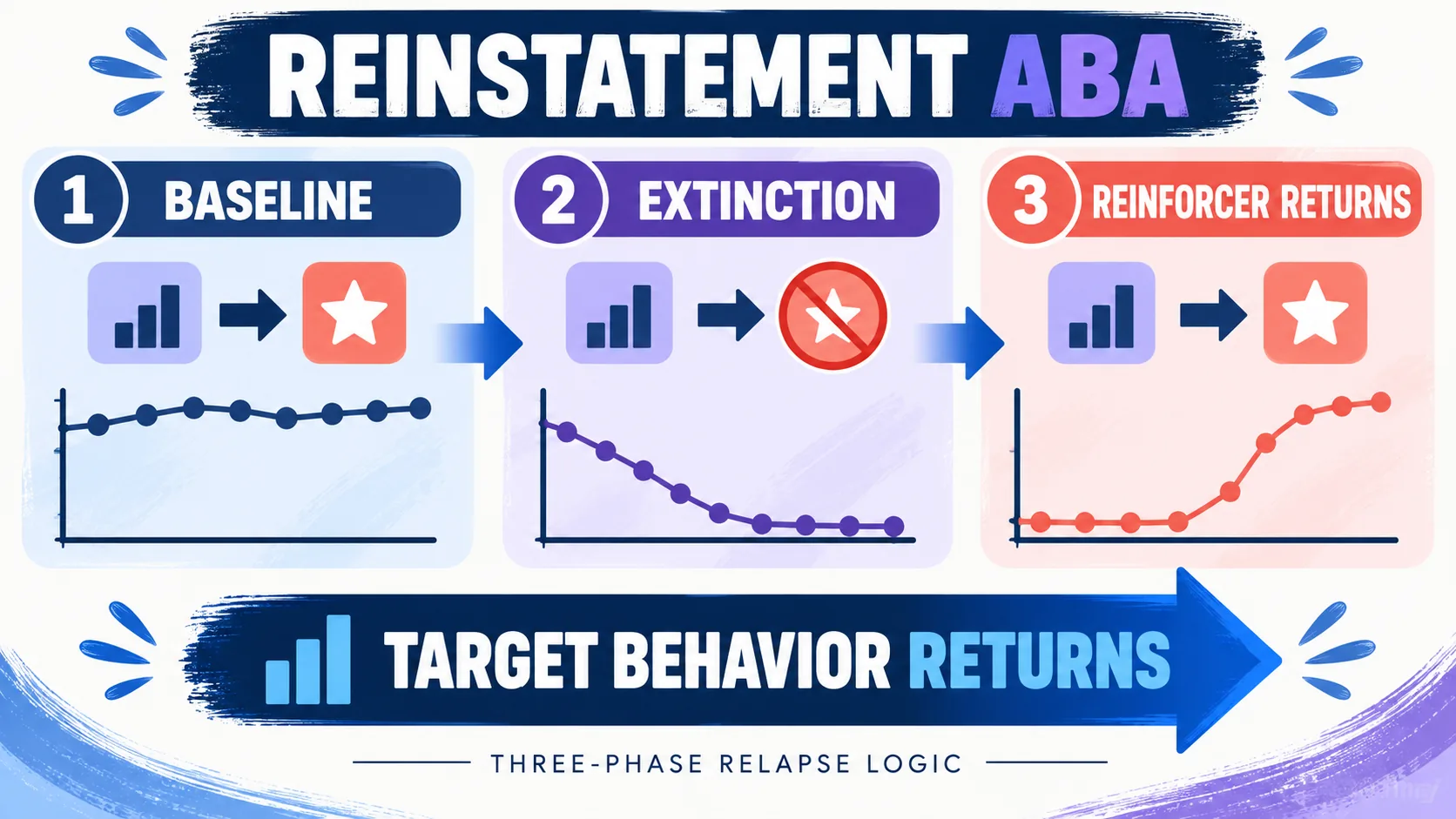
A simple way to recognize reinstatement is to divide the case into three phases. The exact schedules, durations, and response requirements can vary, but the logic stays the same.
- Baseline or acquisition: the target response produces a relevant reinforcer. The response is stable enough to establish a history with that consequence.
- Reduction or extinction: the target response no longer produces the former reinforcer, or the treatment arrangement otherwise reduces the response. The response declines relative to the earlier phase.
- Reinstatement test: the former reinforcer is delivered again. If the target response increases relative to the reduction phase, the pattern is consistent with reinstatement.
Researchers and clinicians should specify whether the reinforcer is delivered response-independently or response-dependently. Response-independent delivery can resemble a time-based or freely delivered event: the reinforcer appears even though the target response did not earn it. Response-dependent delivery means the target response again contacts the consequence. The second arrangement is especially important for treatment integrity because an accidental caregiver response can recreate the contingency that the intervention was designed to change.
The return does not have to reach the original baseline level to be meaningful. Compare the phase data, the measurement system, the number of opportunities, and the treatment decision rule. A modest but reliable increase can matter when the target behavior is dangerous or when a small amount of responding produces a large clinical risk.
How Is Reinstatement Different From Other ABA Relapse Effects?
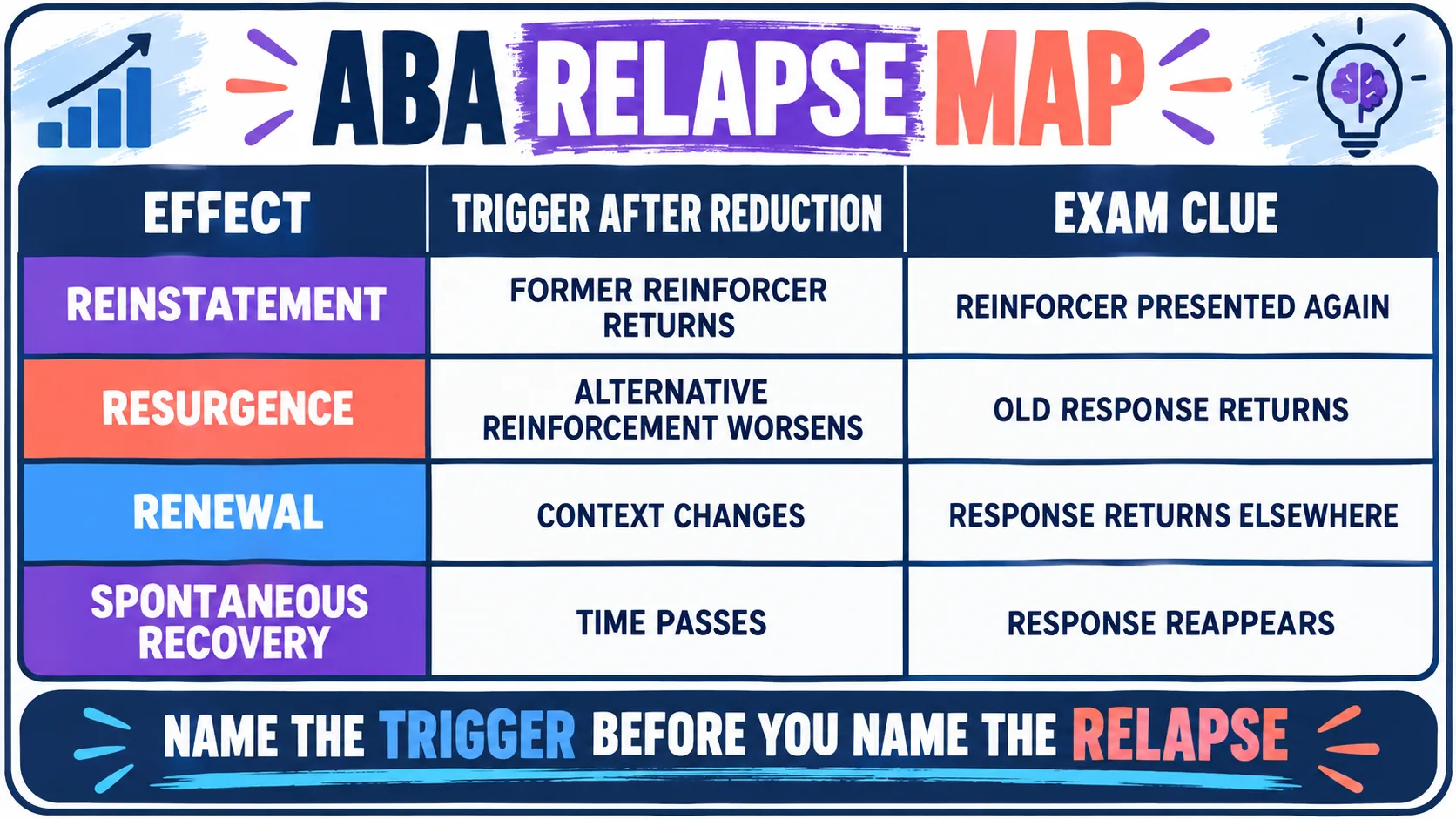
The best exam shortcut is to identify the event that occurred immediately before the behavior returned. Use the table below as a discrimination tool. It is a study aid, not a replacement for the current BACB Test Content Outline or the primary research literature.
| Effect | Trigger after reduction | What to look for |
|---|---|---|
| Reinstatement | The former reinforcer is presented again. | Target behavior returns after reinforcer reintroduction. |
| Resurgence | Reinforcement for an alternative response is reduced, delayed, or discontinued. | An older response returns while the replacement contingency worsens. |
| Renewal | The context or setting changes after reduction. | The response returns outside the treatment context or after a context shift. |
| Spontaneous recovery | Time passes after the response was reduced. | The response reappears without a stated reinforcer reintroduction or context change. |
The terms can occur in the same case, but they should not be collapsed into one label. A caregiver might accidentally deliver the old reinforcer, move the learner to a different setting, and reduce alternative reinforcement in the same week. A careful BCBA would separate those events, review the timeline, and avoid claiming that one relapse mechanism explains everything.
How Do You Identify Reinstatement on a BCBA Exam Question?
Read the scenario in a fixed order. First identify the target response and the consequence that historically followed it. Next locate the reduction phase. Then look for the event that occurred before the target response increased. The answer is usually hidden in that final transition.
- Name the target: write the observable response, not a vague label such as “noncompliance” or “meltdown.”
- Name the old consequence: identify what the target response previously produced, such as attention, escape, access to a tangible item, or another consequence.
- Confirm the reduction: look for extinction, differential reinforcement, treatment, or another arrangement that reduced the target response.
- Find the return trigger: ask whether the old reinforcer came back, alternative reinforcement weakened, the setting changed, or time simply passed.
- Check the measurement: compare the target response across phases using the measure given in the question.
Do not choose “reinstatement” merely because a problem behavior returned after treatment. If the question says the behavior returned when a replacement response stopped contacting reinforcement, resurgence is the stronger label. If the only new event is a different setting, consider renewal. If the scenario emphasizes a delay with no other manipulation, consider spontaneous recovery.
What Does Reinstatement Look Like in Practical ABA Examples?
Attention-maintained behavior: During baseline, a learner’s repeated calling-out produces adult attention. During treatment, calling-out is placed on extinction while an appropriate attention request is reinforced. Calling-out decreases. During a busy afternoon, an adult begins responding to calling-out again because the request is inconvenient. If calling-out rises after that old consequence is reintroduced, the pattern is consistent with possible reinstatement. The team should verify the data and treat the caregiver response as a treatment-integrity variable, not as proof that the learner “chose” to relapse.
Escape-maintained behavior: Suppose task refusal previously resulted in demands being removed. A plan teaches a break request and changes the task arrangement so the break request, rather than refusal, produces a brief break. Refusal decreases. If staff begin removing the demand after refusal again, the original escape consequence has returned. A subsequent increase in refusal is consistent with reinstatement logic, although the plan must also examine task difficulty, response effort, communication access, assent, and whether the break request remains efficient.
Tangible-maintained behavior: A learner previously engaged in grabbing to obtain a tablet. After treatment, an appropriate request produces timed access and grabbing no longer does. If a caregiver hands over the tablet after grabbing during a rushed transition, the former tangible consequence has been restored for that response. The most useful analysis is not “the intervention failed.” It is “which contingency was contacted, how often, and what should be repaired?”
What Data Should a BCBA Review?
Reinstatement is a phase-and-contingency question, so the data system should make both visible. Record the target response with a measure suited to the behavior: frequency or rate for discrete events, duration for episodes that vary in length, latency when the time to respond matters, or percentage when opportunities are controlled. Record the relevant reinforcer delivery separately. A graph showing only the target response cannot tell you whether the old consequence was actually reintroduced. At minimum, review:
- the phase labels and dates;
- the number of observation opportunities;
- the target response measure;
- the alternative response and its reinforcement;
- the former reinforcer’s timing and delivery rule;
- context, staff, task, and setting changes;
- treatment-integrity or procedural-fidelity checks;
- interobserver agreement when reliability is needed.
Use caution with a single spike. A short observation, a change in opportunity count, observer drift, or an unrelated motivating operation can create an apparent return. The more consequential the decision, the more important it is to replicate the pattern and inspect the actual contingency rather than infer a mechanism from a graph shape.
How Can a BCBA Mitigate Reinstatement Risk?
The current BACB Task Lists identify relapse mitigation as part of BCBA exam content. The practical response is not to punish a returning behavior or to remove a learner’s communication option. Start by identifying why the old reinforcer was delivered and whether the replacement response still works efficiently.
- Repair the contingency: train caregivers and staff on what follows the target response and what follows the replacement response.
- Protect the alternative: make the functional communication response observable, feasible, and low effort enough to compete with the old response.
- Plan for errors: decide what staff should do after an accidental delivery of the old reinforcer and how to document it.
- Use function-based prevention: adjust antecedents, task demands, choice, pacing, and access so the plan is workable in the real setting.
- Monitor safety and assent: review distress, refusal, communication, and dignity-related signals instead of treating every return as intentional noncompliance.
- Recheck outcomes: use data to decide whether the plan needs refinement, not merely whether the learner needs more exposure to extinction.
The research literature describes reinstatement as one form of relapse and emphasizes that relapse effects can be shaped by treatment-integrity failures. A useful review is Relapse and Its Mitigation: Toward Behavioral Inoculation. For a broader discussion of translating quantitative behavior theory to clinical treatment, see Translating Quantitative Theories of Behavior into Improved Clinical Treatments. Use research to understand the mechanism, then use the current BACB documents to determine the exam and professional-practice boundary.
A Fast Reinstatement ABA Study Workflow
Create one comparison card with four prompts: “What was reinforced?”, “What reduced the target?”, “What changed before it returned?”, and “What alternative response should be protected?” Then work through a short scenario without looking at the answer. Mark the trigger in one color and the target response in another. If you cannot name the trigger, you are not ready to choose among reinstatement, resurgence, renewal, and spontaneous recovery.
For exam review, connect the term to the current BACB BCBA and BCaBA Task Lists rather than memorizing an old flashcard definition in isolation. The BACB explains that the task list defines the content used for certification examinations. Requirements and ethical guidance can change, so a current source check matters when a question involves relapse mitigation, treatment integrity, client dignity, or the use of extinction.
Reinstatement ABA FAQ
Is reinstatement the same as relapse?: Reinstatement is one specific form of relapse. “Relapse” is the broader category for the return of a previously reduced behavior. Reinstatement identifies the return of a relevant former reinforcer as the trigger.
Does reinstatement require the old reinforcer to follow the target response?: No. The former reinforcer can be delivered response-independently or contingently, depending on the arrangement. In an exam question, use the event described rather than assuming a contingency that the scenario does not provide.
Can a behavior return after extinction without being reinstatement?: Yes. A context change may indicate renewal, time may support spontaneous recovery, and reduced alternative reinforcement may support resurgence. The return alone does not identify the mechanism. What is the most common exam mistake? The most common mistake is labeling every return after treatment as reinstatement. Identify the consequence or event that changed immediately before the response increased, then compare that event with the definitions and phase data.
After you can distinguish the four relapse patterns, test your reasoning with scenario-based practice rather than rereading definitions. Our free BCBA mock exam is a useful next step. When an item depends on a current requirement or ethical boundary, return to the current BACB source and document the version you used.
Take the Free BCBA Mock Exam
When you are ready to apply the idea, use the free practice resource below for additional feedback. Take the Free BCBA Mock Exam



