
These ABA facts are a bounded study guide: what applied behavior analysis is, what it is not, how behavior and consequences are analyzed, and why data, consent, dignity, and meaningful outcomes belong in the same conversation.
Table of Contents
- ABA Facts: Start With the Definition
- Fact 1: ABA Is a Science and an Application
- Fact 2: ABA Is Not One Script or One Procedure
- Fact 3: Behavior Is Defined and Measured
- Fact 4: Reinforcement Is About Future Behavior
- Fact 5: Function Matters More Than a Label
- Fact 6: Goals Should Be Socially Important
- Facts 7–9: Data, Consent, and Generalization Go Together
- Fact 10: The Best Exam Answer Matches the Evidence
- Common ABA Fact-Check Traps
- How to Study These Facts
- Frequently Asked Questions
- Sources and Scope
- Quick Review Checklist
- Take the Free BCBA Mock Exam
If you are looking for ABA facts, start with a distinction that prevents most confusion: ABA is both a science of behavior and an applied way of using behavioral principles to address socially important outcomes. It is not one script, one therapy room, one autism protocol, or a promise that one procedure produces the same result for every person.
The evidence and professional boundaries matter. The National Academies chapter on the evidence base for ABA describes behavioral practices and reviews the quality and limits of research. The BACB Test Content Outline (6th ed.) gives the exam context. This page translates those ideas into facts and exam cues; it is not individualized treatment advice or a substitute for clinical assessment.
ABA Facts: Start With the Definition
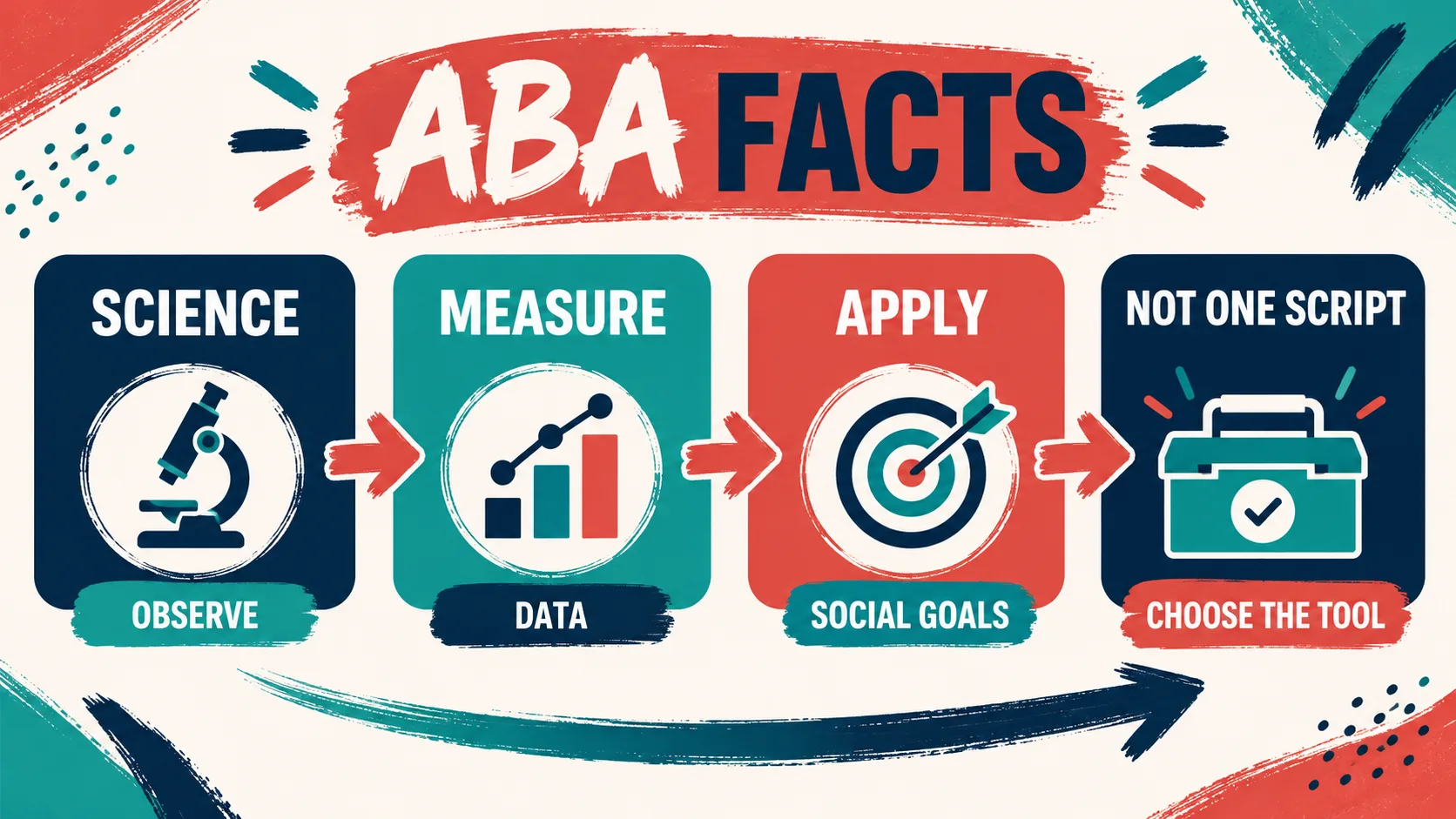
Applied behavior analysis uses principles of behavior to understand and influence behavior in ways that matter in the person’s life. “Applied” means the goals are socially significant; “behavior analysis” means the analyst looks for lawful relations between behavior and environmental variables rather than relying only on impressions or personality labels.
ABA can be used in education, communication, daily living, health, organizational settings, and support for autistic people and others. Autism services are one important application, not the definition of the entire field. The American Psychological Association policy statement also describes ABA as a science and professional practice within psychological science, subject to competence and applicable regulation.
Fact 1: ABA Is a Science and an Application
A core ABA fact is that the field is not only a collection of classroom tricks. Behavior analysts observe, define, measure, hypothesize, test, and revise. An applied program should connect the selected goal to socially important outcomes and use data to evaluate whether the plan is helping.
For a BCBA exam item, words such as functional relation, systematic observation, measurement, and data-based decision making usually signal the analytic side of behavior analysis. Words such as quality of life, communication, independence, or safety may signal the applied side. Read the stem for the dimension it is asking about.
Fact 2: ABA Is Not One Script or One Procedure
Reinforcement, prompting, shaping, task analysis, functional communication training, naturalistic teaching, discrete-trial instruction, stimulus control, and self-management are different procedures or arrangements. A program may combine several of them. Choosing a procedure requires a defined target, assessment information, learner preferences, cultural responsiveness, and a reason connected to the goal.
This fact corrects two common shortcuts. “ABA means discrete-trial training” is too narrow. “ABA means rewards for every behavior” is also too narrow. A procedure can be behavior analytic without being the right choice for every learner or routine. The relevant question is not whether a technique is popular; it is whether the plan is conceptually sound, ethical, feasible, and supported by the data.
Fact 3: Behavior Is Defined and Measured
Behavior is something an observer can detect, describe, and measure. “Noncompliant” may be a useful shorthand in conversation, but an operational definition might say, “After an instruction, the student says ‘no,’ pushes the material away, or does not begin within 30 seconds.” A clear definition allows two people to collect data about the same event.
Choose measurement that fits the response. Frequency can count events; rate accounts for observation time; duration measures how long behavior lasts; latency measures time from an event to a response; percentage can show correct or independent opportunities. A graph is only as meaningful as the definition and measurement rule behind it.
Fact 4: Reinforcement Is About Future Behavior
Reinforcement is defined by its effect on future behavior, not by what an adult intended or what looks enjoyable. If a learner completes a communication response and receives a brief break, the break is a reinforcer only if that response becomes more likely under relevant conditions. A preferred item can be offered without increasing the behavior, in which case it was not demonstrated to be reinforcing for that response in that context.
Positive and negative reinforcement both increase future behavior; the terms describe whether a stimulus is added or removed, not whether the event is good or bad. Punishment procedures decrease future behavior and carry additional ethical and procedural considerations. On an exam, identify the future-behavior evidence before labeling a consequence.
Fact 5: Function Matters More Than a Label
The same topography can occur for different reasons, and different topographies can serve a similar function. A student who leaves a table may be escaping a difficult task, accessing attention, obtaining a preferred activity, or responding to another variable. The label “elopement” describes what happened; it does not by itself tell you why it happened.
Functional assessment uses information about antecedents, behavior, and consequences to develop a testable hypothesis. A descriptive ABC note is valuable, but it is not automatically a functional analysis and does not prove causation. The safest exam answer usually respects the level of evidence provided by the stem.
Fact 6: Goals Should Be Socially Important
The applied dimension asks whether the selected behavior matters to the learner, family, classroom, workplace, or community. Communication, access, health, safety, independence, participation, and meaningful relationships are common examples. A behavior that is easy to count is not automatically an applied target if it has no clear connection to the person’s life.
| Fact | What it means | Exam clue | Do not assume |
|---|---|---|---|
| Science | Observe, measure, test, and revise. | Systematic data and functional relations. | Anecdote proves cause. |
| Procedure | Different tools answer different teaching questions. | The stem names a strategy or arrangement. | One technique is all of ABA. |
| Behavior | The response is observable and operationally defined. | A measurable target and clear rule. | A label reveals function. |
| Reinforcement | Future responding increases under relevant conditions. | The stem provides before-and-after evidence. | Preference equals reinforcement. |
| Applied goal | The behavior has real social importance. | Quality of life, safety, access, or independence. | Easy measurement makes it important. |
Facts 7–9: Data, Consent, and Generalization Go Together
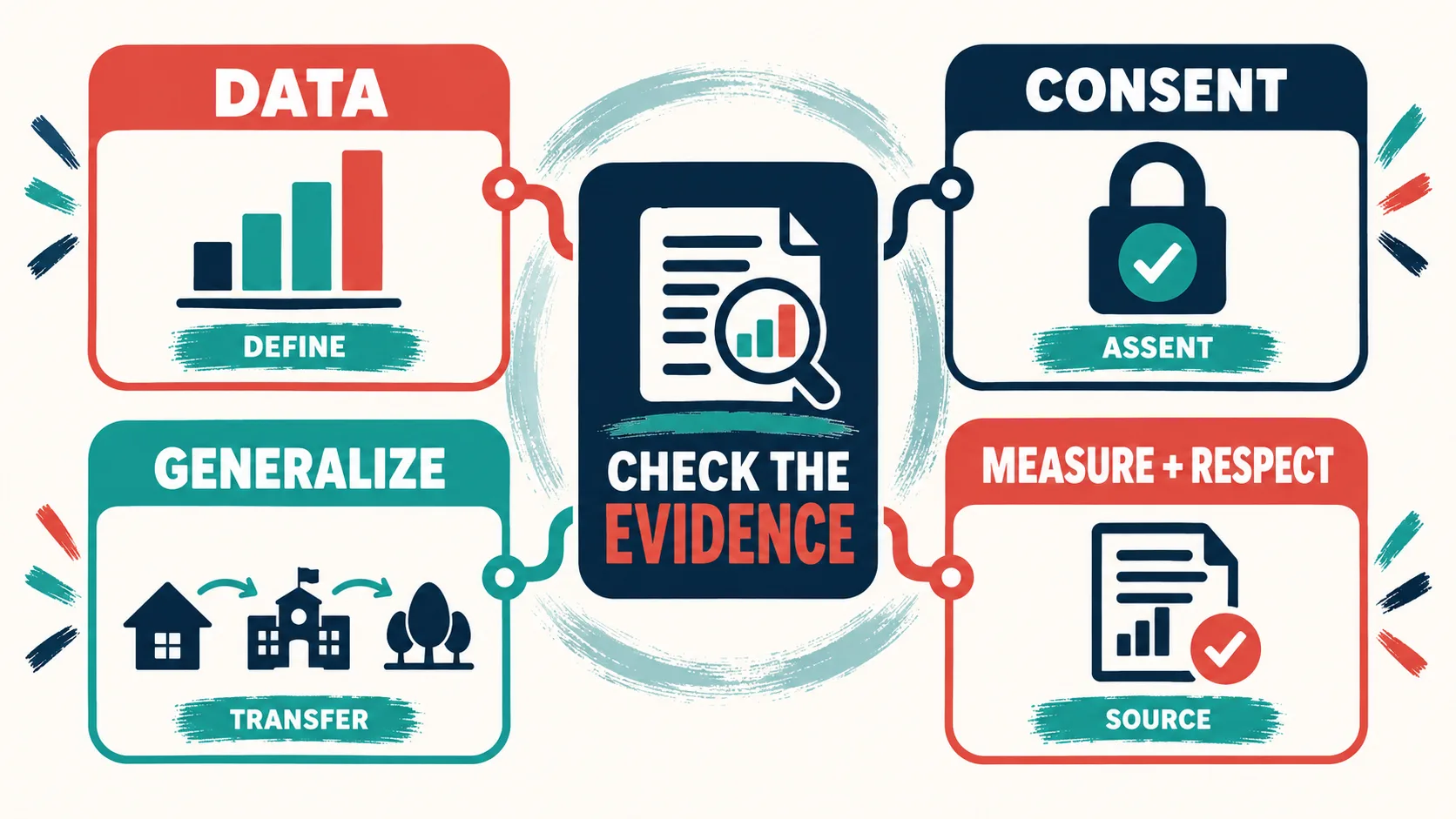
Fact 7: Data Do Not Replace Consent or Dignity: Accurate measurement is necessary, but a clean graph does not automatically make a goal ethical or valued. The BACB Ethics Code emphasizes benefit, compassion, dignity, respect, integrity, competence, privacy, and self-determination. In practice, ask whose priorities are represented, whether the person can communicate assent or dissent in a meaningful way, and whether the plan creates benefit without avoidable harm.
Fact 8: Evidence Depends on the Intervention and Outcome: “ABA is evidence based” is too vague to answer every question. Evidence must be tied to a specific intervention, population, outcome, comparison, and implementation context. Reviews have reported promising findings in some domains while also noting small samples, methodological limits, mixed outcomes, and gaps in quality-of-life measurement. A careful statement is stronger than a universal promise.
The scoping review and the individual-participant-data meta-analysis are useful reminders that evidence quality and outcome selection matter. The CDC overview notes that behavioral approaches are used for autism and that progress is tracked, but neither source guarantees the same outcome for every individual.
Fact 9: Generalization and Maintenance Need Direct Checks: A skill that appears with one therapist, one material, or one prompt has not automatically generalized. Test the behavior across relevant people, settings, materials, time periods, or related responses when appropriate. Maintenance asks whether it lasts; generalization asks whether it spreads. Both require planned probes and definitions, not optimistic assumptions.
Fact 10: The Best Exam Answer Matches the Evidence
BCBA questions often place familiar terms next to one another. Use a three-step reading method:
- Name the target: What behavior is observed, and how is it measured?
- Locate the relation: Is the question about an antecedent, a consequence, a function, a measurement procedure, an intervention, or an ethical boundary?
- Match the claim to the evidence: Is the stem showing a hypothesis, a functional relation, a meaningful outcome, maintenance, generalization, or only one observation?
For example, “the learner’s requests increased after a break was delivered” may support a reinforcement interpretation only if the future pattern and relevant conditions are clear. “The target is independent dressing because it matters to the learner’s daily life” points toward the Applied dimension. “The skill occurs at home with a caregiver after teaching at school” points toward Generality. Choose the term demonstrated, not the one that sounds most positive.
Common ABA Fact-Check Traps
- Myth: ABA is only for autism. Fact: behavior-analytic principles are applied across many socially important contexts; autism services are one major application.
- Myth: ABA is one fixed treatment. Fact: ABA includes many procedures, and selection should follow assessment, goals, preferences, competence, and data.
- Myth: reinforcement means bribery. Fact: reinforcement is a technical relation defined by an increase in future behavior; ethical practice still requires respect and meaningful choice.
- Myth: an ABC chart proves function. Fact: descriptive observation informs a hypothesis; it is not automatically an experimental functional analysis.
- Myth: a larger percentage always means success. Fact: practical value depends on the behavior, independence, context, stakeholder priorities, and meaningful outcomes.
How to Study These Facts
Turn each fact into a contrast card. On the front, write a term such as reinforcement, function, Applied, Effective, Generality, or assent. On the back, write the evidence that would demonstrate it and one tempting but unsupported conclusion. Then practice with a short stem and explain why the other options do not fit.
Keep a source hierarchy: current BACB documents for exam and professional requirements, peer-reviewed reviews for evidence claims, public-health or university resources for plain-language orientation, and the learner’s actual data for individual decisions. When sources disagree or the evidence is limited, record the limitation instead of smoothing it away.
For focused practice, use the Free BCBA Mock Exam. After each missed question, label the error as definition, measurement, function, procedure, evidence, ethics, or generalization. That turns broad ABA facts into decisions you can actually recognize on the exam.
Frequently Asked Questions
What is the most important ABA fact?: ABA is a science and an application of behavioral principles to socially important outcomes. It is not one protocol or a guaranteed result. Is ABA only used for autism?: No. Behavior analysis is applied in education, communication, daily living, health, organizations, and other settings. Autism services are one important application. Does ABA always use rewards?: Reinforcement is one core behavioral principle, but ABA is broader than rewards. Effective reinforcement is defined by its effect on future behavior and should fit the person and goal. Are ABA facts the same as BCBA exam rules?: No. Research facts describe behavior, intervention, and evidence. The exam also tests measurement, assessment, ethics, professional judgment, and the current BACB outline. Where can I verify an ABA claim?: Start with current BACB documents for certification and ethics, peer-reviewed reviews for evidence, and reputable public-health or university resources for orientation. Avoid relying on an unsupported slogan.
Sources and Scope
This guide draws on the NCBI evidence review, the CDC autism treatment overview, the APA ABA policy, peer-reviewed evidence reviews, the BACB Test Content Outline, and the BACB Ethics Code hub. Use these facts for education and BCBA exam reasoning; individualized care requires qualified assessment, consent, competence, and ongoing data review.
Quick Review Checklist
Use this final checklist to turn aba facts into exam-ready reasoning. The goal is not to memorize a label in isolation; it is to identify the relevant evidence and explain why the best answer fits the scenario. Key ideas to review:
- State the central definition or decision point for aba facts in your own words.
- Identify the detail that makes aba facts different from its closest related ABA term.
- Separate the observable facts in a scenario from assumptions that are not supported by the facts.
- Write one example and one nonexample so you can recognize the concept in a new setting.
Exam application checks:
- Ask what the question is actually requesting before comparing the answer choices.
- Mark the antecedent, response, consequence, or other evidence that supports the selected answer.
- Look for a distractor that describes a related process but does not answer the specific question.
Final self-check:
- Explain how you would verify the interpretation with clear observations or data.
- Change one detail in the scenario and decide whether your answer should change.
- Give a one-sentence rationale that a supervisor or study partner could evaluate.
Take the Free BCBA Mock Exam
When you are ready to apply the idea, use the free practice resource below for additional feedback. Take the Free BCBA Mock Exam



