
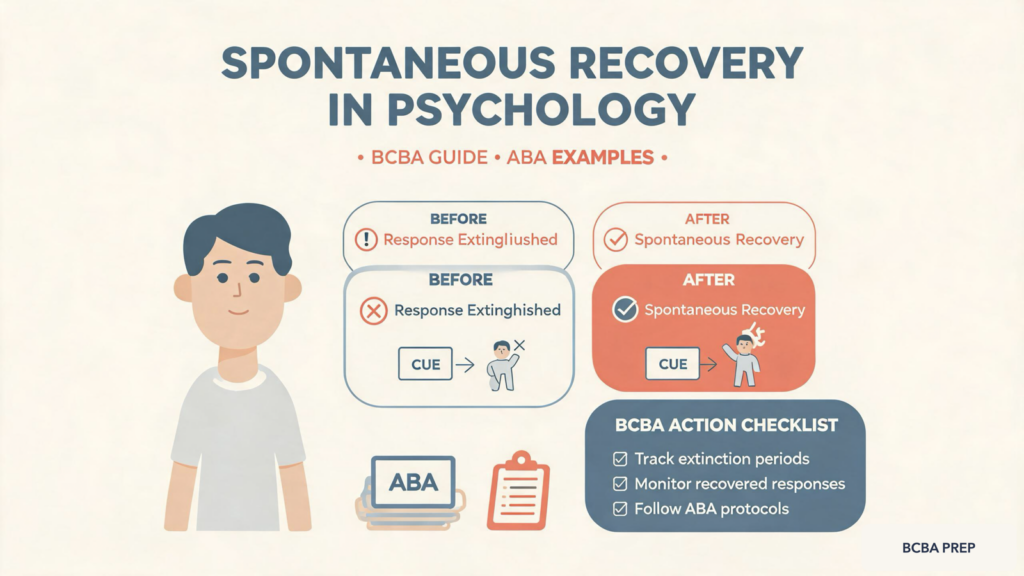
What is Spontaneous Recovery? A Behavioral Definition
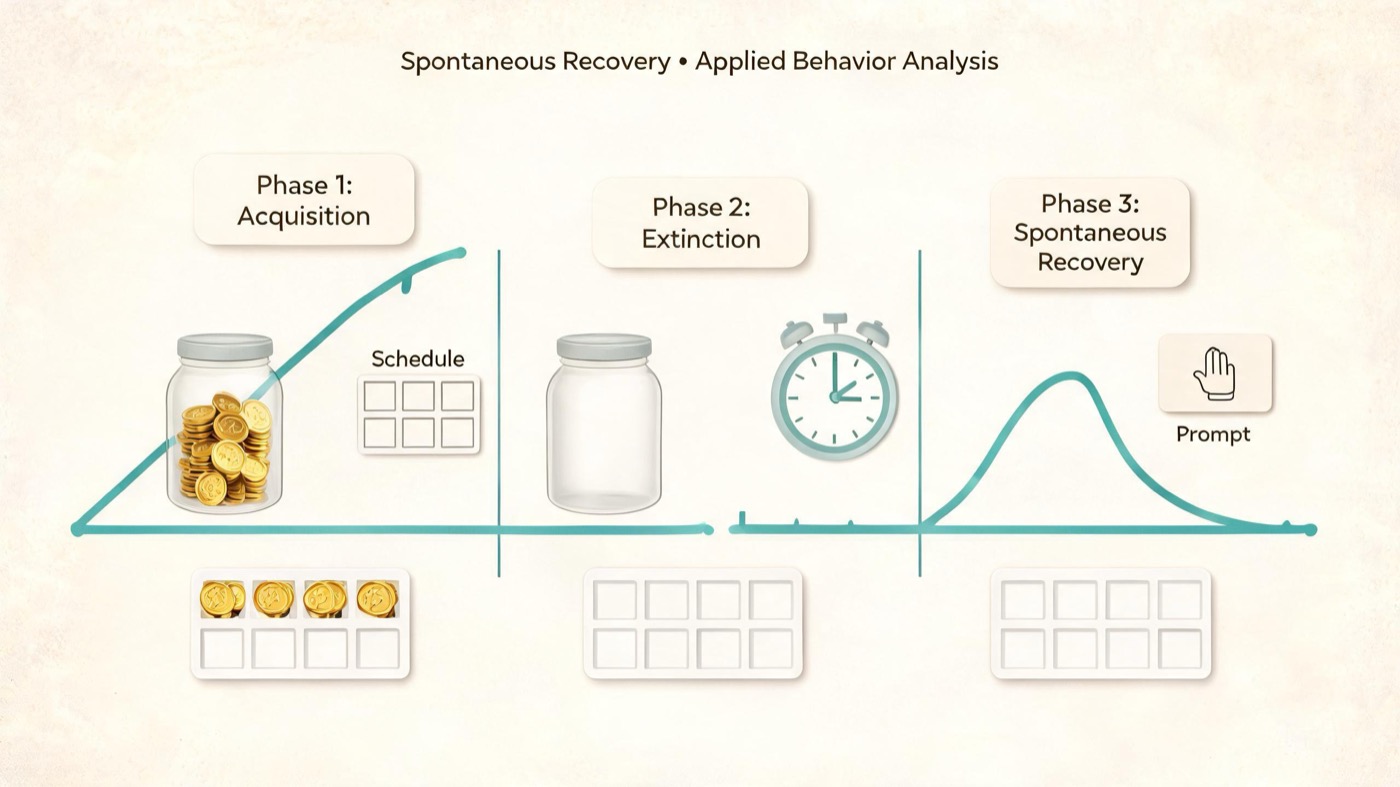
In applied behavior analysis, spontaneous recovery refers to the reappearance of a previously extinguished behavior after a period of time without any reinforcement for that behavior. It is a temporary phenomenon, often observed when the individual returns to the original context after a break (e.g., overnight, weekend, holiday). The behavior typically occurs at a lower rate or intensity than before extinction and fades quickly if extinction continues.
Table of Contents
- What is Spontaneous Recovery? A Behavioral Definition
- Real-World ABA Examples of Spontaneous Recovery
- Why Spontaneous Recovery Matters for the BCBA Exam
- Quick Study Checklist for Spontaneous Recovery
- Summary: Mastering Spontaneous Recovery
- How to Study what is spontaneous recovery for BCBA-Style Questions
- How to Study what is spontaneous recovery for BCBA-Style Questions
- Take the Free BCBA Mock Exam
Spontaneous recovery is not a failure of extinction; rather, it is a natural part of the extinction process. It demonstrates that extinction does not erase the learned behavior but suppresses it temporarily. The environment, passage of time, and contextual cues all play a role in triggering the brief return.
Spontaneous Recovery vs. Extinction Burst: A common confusion is between spontaneous recovery and an extinction burst. An extinction burst is an immediate, temporary increase in the frequency, intensity, or duration of the behavior when extinction is first implemented. In contrast, spontaneous recovery occurs after a delay, typically when the person returns to the setting where the behavior was previously reinforced. The key difference is timing: extinction burst happens right at the start of extinction; spontaneous recovery occurs later, after a pause.
The Role of Context and Time: Contextual stimuli (e.g., the same room, time of day, presence of specific people) can become discriminative stimuli for the behavior. When extinction is implemented, the behavior decreases. However, after a time lapse, the contextual cues may again evoke the behavior because the individual has not learned that those cues signal extinction. The longer the time away, the more likely the behavior may reappear, though usually at a reduced level. For a deeper understanding of extinction procedures and how they relate to spontaneous recovery, see our guide on extinction in ABA.
Real-World ABA Examples of Spontaneous Recovery
Understanding through examples is crucial for the BCBA exam. Below are three common scenarios where spontaneous recovery is likely to occur, complete with ABC data and hypothesized functions. Example 1: Attention-Maintained Behavior: A preschool child engages in tantrum behavior (crying, dropping to floor) to gain teacher attention. The teacher implements extinction by ignoring the tantrum. After several days, the tantrum decreases. However, after a weekend break, the child returns to school and immediately has a tantrum when the teacher is busy with another student. This is spontaneous recovery of an attention-maintained behavior. The antecedent is the teacher not attending, the behavior is crying, and the consequence is (now) no attention. The function is attention.
Example 2: Escape-Maintained Task Avoidance: A middle school student frequently leaves the classroom (elopement) when given math worksheets. The team implements extinction by blocking elopement and prompting the student to complete the work. After a week, elopement stops. Following a holiday break, the student again attempts to leave when given a math assignment. This is spontaneous recovery of an escape-maintained behavior. Antecedent: math worksheet presented. Behavior: walking toward door. Consequence: prevented from leaving (extinction). Function: escape from task.
Example 3: Automatic Reinforcement (Sensory): An adult with autism engages in hand-flapping stereotypy that produces sensory stimulation. An intervention uses response interruption and redirection (RIRD) as extinction. After consistent implementation, the hand-flapping decreases. After a quiet weekend with little stimulation, the individual returns to the therapy room and immediately begins hand-flapping. This is spontaneous recovery of a behavior maintained by automatic reinforcement. Antecedent: quiet environment. Behavior: hand flapping. Consequence: sensory input (previously blocked). Function: automatic/sensory.
Why Spontaneous Recovery Matters for the BCBA Exam
The BCBA exam often tests your ability to distinguish spontaneous recovery from other phenomena like extinction bursts, resurgence, and failure of extinction. Understanding the nuances can help you avoid exam traps and choose the correct answer. Common Exam Traps: Use the points below as a quick study guide.
- Confusing with Resurgence: Resurgence occurs when a previously reinforced behavior reappears after a new behavior is placed on extinction. Spontaneous recovery involves only the original behavior and no new reinforcement history.
- Thinking it means extinction failed: Spontaneous recovery is a temporary spike; it does not indicate that extinction was ineffective. If extinction continues, the behavior will decrease again.
- Ignoring the time delay: The key feature is that the behavior returns after a period of no contact with reinforcement (e.g., after a break). Without that pause, it is not spontaneous recovery.
Practice Prompts for Self-Testing: Try these questions to solidify your understanding:
- After extinction of a behavior, the behavior reappears after a 2-day break. Is this spontaneous recovery? Why? Answer: Yes, because the behavior was previously extinguished and the pause caused temporary reappearance.
- A child’s screaming increases immediately when you start ignoring it. Is this spontaneous recovery? Answer: No, this is an extinction burst because it occurs right at the onset of extinction.
- A client stops requesting items after extinction, but after a week of no requests, suddenly asks again. Is this spontaneous recovery? Answer: Yes, as long as the request was previously extinguished and a pause occurred.
For more exam-focused practice, check out our BCBA mock exam for the 6th edition.
Quick Study Checklist for Spontaneous Recovery
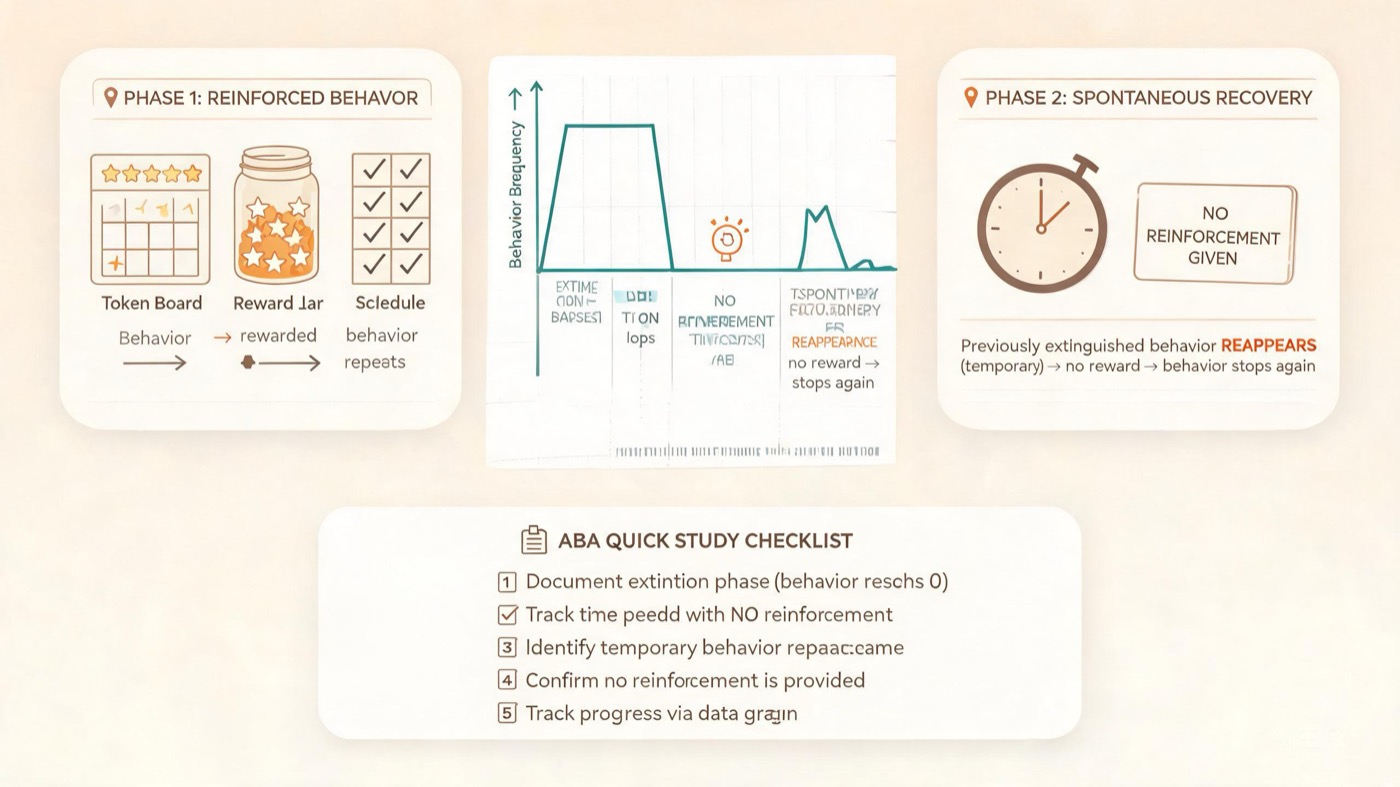
Use this checklist for last-minute review before the exam: Key Points: Use the points below as a quick study guide.
- Occurs after extinction is in place
- Behavior returns after a time without reinforcement
- Appearance is temporary and usually weaker
- Distinguish from extinction burst (immediate increase)
- Distinguish from resurgence (new behavior extinguished)
- Does NOT mean extinction failed
- Continue extinction; the behavior will fade again
Action Steps for Exam Prep: Use the points below as a quick study guide.
- Review ABC data to identify the function
- Note the time delay in scenarios
- Practice with real-life examples from your supervision
- Use flashcards for key terms: spontaneous recovery, extinction burst, resurgence
Summary: Mastering Spontaneous Recovery
Spontaneous recovery is a predictable, temporary return of a behavior after extinction has been implemented and a time gap occurs. It is not a sign of failure; it is part of the extinction process. By recognizing the role of context, time, and reinforcement history, behavior analysts can plan for spontaneous recovery and maintain consistent extinction procedures. On the BCBA exam, focus on the timing and the absence of new reinforcement to differentiate it from similar concepts.
For further study, explore the extinction page on our site. Additionally, the Behavior Analyst Certification Board provides the official task list and resources. For a deeper dive into the science, this journal article on extinction and spontaneous recovery offers empirical background.
How to Study what is spontaneous recovery for BCBA-Style Questions
When you review what is spontaneous recovery, do not stop at the definition. The exam usually tests whether you can apply the concept inside a short scenario, separate it from similar terms, and choose the most behaviorally precise answer. A strong study routine should connect the term to observable behavior, environmental context, measurement, and likely consequences.
- Define the response: identify exactly what the learner or client does, not just the broad skill area.
- Find the context: note the antecedent, setting, materials, people, or condition that makes the concept relevant.
- Check the consequence: ask what changes after the response and whether that change supports the answer choice.
- Compare close terms: write one sentence explaining why the best answer is not a related but different ABA concept.
For practice, turn each example into a quick discrimination exercise. Ask, “What would make this answer wrong?” and then change one detail in the scenario. This builds flexible exam reasoning instead of memorizing a single phrase.
How to Study what is spontaneous recovery for BCBA-Style Questions
When you review what is spontaneous recovery, do not stop at the definition. The exam usually tests whether you can apply the concept inside a short scenario, separate it from similar terms, and choose the most behaviorally precise answer. A strong study routine should connect the term to observable behavior, environmental context, measurement, and likely consequences.
- Define the response: identify exactly what the learner or client does, not just the broad skill area.
- Find the context: note the antecedent, setting, materials, people, or condition that makes the concept relevant.
- Check the consequence: ask what changes after the response and whether that change supports the answer choice.
- Compare close terms: write one sentence explaining why the best answer is not a related but different ABA concept.
For practice, turn each example into a quick discrimination exercise. Ask, “What would make this answer wrong?” and then change one detail in the scenario. This builds flexible exam reasoning instead of memorizing a single phrase.
Take the Free BCBA Mock Exam
Ready for more practice? Use the free mock exam to keep testing your accuracy with realistic BCBA-style items. Take the Free BCBA Mock Exam



