
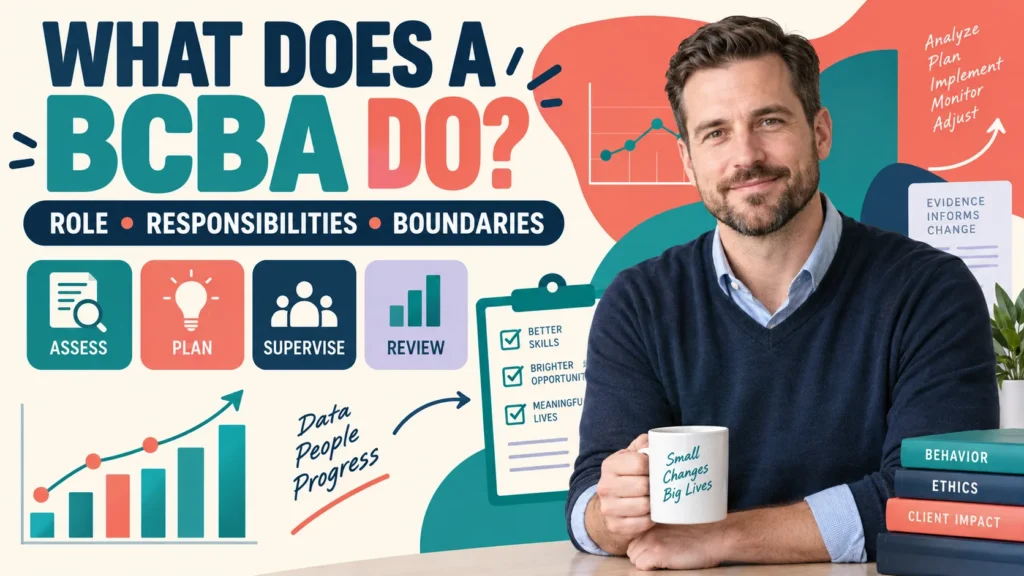
If you searched for board certified behavior analyst what do they do, the short answer is that a BCBA applies behavior analysis to meaningful goals: assess behavior, define measurable outcomes, design and evaluate interventions, supervise implementation, and use data to decide what should change next.
Table of Contents
- What Does a Board Certified Behavior Analyst Do?
- The BCBA Work Cycle: Assess, Plan, Supervise, Review
- Board Certified Behavior Analyst What Do They Do in Practice?
- BCBA vs. BCaBA vs. RBT
- Where BCBAs Work and How the Role Changes
- What This Role Looks Like on the BCBA Exam
- Frequently Asked Questions
- Sources and Verification Notes
- Take the Free BCBA Mock Exam
If you are asking what does a board certified behavior analyst do, the shortest accurate answer is: a BCBA turns a behavioral question into an ethical, measurable, individualized plan and then checks whether that plan is working. The exact job varies by setting, client needs, competence, employer, payer, and state law. A BCBA in a school may consult with teachers, while a clinic-based BCBA may lead a treatment team; both still rely on assessment, data, professional judgment, and supervision.
The search wording board certified behavior analyst what do they do usually signals a practical question: who makes the clinical decisions, who implements the daily procedures, and how does the team know whether the plan is helping? The answer is a responsibility chain, not a single task.
This guide focuses on the role itself. It is not a promise that every BCBA performs every task, and it is not a substitute for the current BACB handbook, the Ethics Code for Behavior Analysts, state licensure rules, or a qualified professional’s advice. The BACB’s current BCBA materials also include 2027 transition guidance, so candidates should verify date-sensitive requirements directly with the BACB.
What Does a Board Certified Behavior Analyst Do?
A BCBA is a graduate-level behavior-analytic practitioner credentialed by the Behavior Analyst Certification Board. The BACB describes BCBAs as independent practitioners who can provide behavior-analytic services and supervise the work of RBTs, BCaBAs, and other professionals who implement behavior-analytic interventions. “Independent” describes the certification level; it does not cancel state licensure, employer policies, payer rules, informed consent, or the BCBA’s duty to practice within competence. Most BCBA work can be grouped into five connected jobs:
- Understand the situation: review records, interview stakeholders, observe behavior, and select assessments that fit the question.
- Define a meaningful outcome: prioritize client-informed goals and write observable, measurable targets.
- Design and evaluate support: select behavior-change procedures, plan measurement, and interpret the resulting data.
- Build implementation quality: train, supervise, observe, and give feedback to the people carrying out the plan.
- Protect progress and rights: document decisions, monitor effectiveness and safety, coordinate appropriately, and plan maintenance or generalization.
The BCBA Work Cycle: Assess, Plan, Supervise, Review
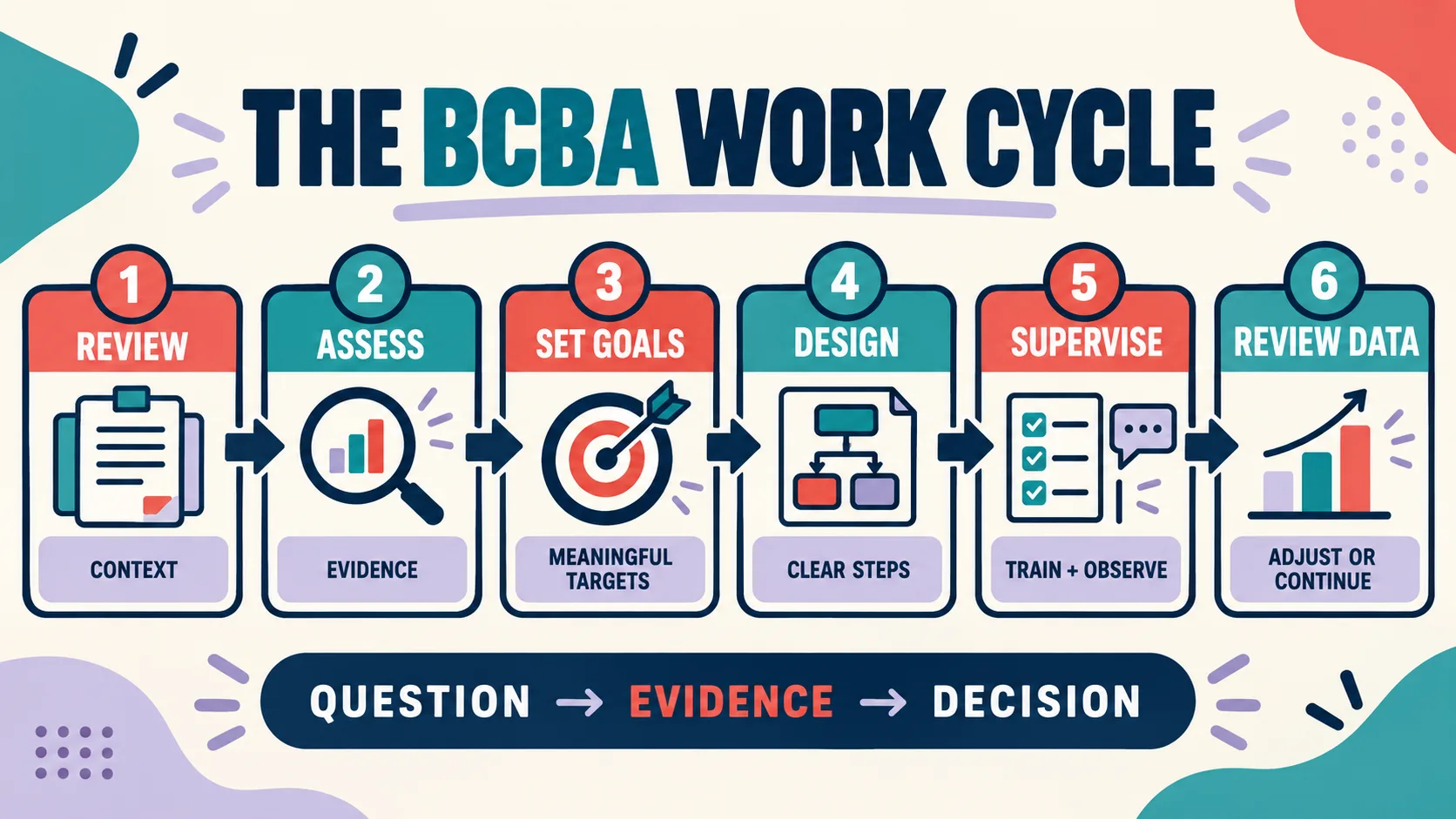
The most useful way to understand the role is as a recurring work cycle rather than a fixed daily checklist. The cycle starts with a question and ends with a documented decision. A new concern, a plateau, a safety issue, or a change in context can send the team back to assessment.
- Review the context: gather relevant history, records, existing data, stakeholder priorities, and information about health, communication, environment, and safety.
- Assess behavior and skills: choose direct, indirect, descriptive, skill, preference, reinforcer, or functional assessment methods that match the decision being made.
- Set measurable goals: identify socially significant outcomes, operationally define targets, select a measurement system, and establish criteria for progress.
- Design the plan: select procedures based on assessment information, behavioral principles, evidence, client preferences, contextual fit, and ethical considerations.
- Train and supervise: teach implementers the steps, observe performance, provide feedback, and check treatment integrity instead of assuming that a written plan is enough.
- Review data and adjust: examine level, trend, variability, fidelity, generalization, and stakeholder feedback before deciding whether to continue or revise.
These stages do not mean the BCBA works alone. Good practice is collaborative. Families, clients, teachers, technicians, other professionals, and organizational leaders may contribute information and implementation support. The BCBA’s job is to make the behavior-analytic reasoning clear, preserve appropriate boundaries, and coordinate rather than claim expertise outside the role.
Board Certified Behavior Analyst What Do They Do in Practice?
The following table summarizes the responsibility chain. “Typical” matters: the scope of a specific BCBA job depends on setting, competence, law, and the service agreement.
| Work area | What a BCBA typically does | What the work should produce |
|---|---|---|
| Assessment | Review records, interview, observe, measure, and select assessments that answer the referral question. | A defensible description of strengths, needs, context, and the variables that should be evaluated next. |
| Goal selection | Prioritize client-informed and socially significant outcomes with the people affected by the plan. | Observable targets, meaningful criteria, and a reason the goal matters in daily life. |
| Intervention design | Choose and individualize behavior-change procedures, prompts, reinforcement, skill teaching, or behavior-reduction supports. | A written plan with observable steps, decision rules, measurement, and safeguards. |
| Data review | Graph and interpret progress, inspect data quality, compare results with criteria, and look for unintended effects. | A documented decision to maintain, modify, intensify, fade, generalize, or discontinue a procedure. |
| Supervision and training | Teach implementers, observe performance, provide feedback, and monitor treatment integrity and competency. | A team that can implement the plan accurately, safely, and consistently within its role. |
| Communication and records | Explain the rationale, protect confidentiality, record services and decisions, and coordinate with consent. | A clear clinical record and shared understanding of responsibilities, limits, risks, and next steps. |
Assessment comes before confident recommendations: A BCBA does not begin with a favorite intervention and then search for data to justify it. The professional first clarifies the referral question and reviews relevant information. Depending on the case, that may include interviews, direct observation, record review, skill assessment, preference assessment, reinforcer assessment, descriptive analysis, or a functional assessment. The method should fit the question and the practitioner’s competence.
Intervention is individualized, measurable, and reviewable: A BCBA may design skill-acquisition programs, communication supports, caregiver-training plans, or behavior-reduction procedures. The important feature is not the label of the program. It is whether the plan has a measurable target, a clear procedure, a reasoned relation to the assessment, and a review plan. If the data show that the intervention is not producing meaningful progress, the BCBA should investigate and adjust rather than simply continue unchanged.
Supervision is active oversight, not only a signature: The BACB’s supervision resources distinguish among supervising ongoing services, supervising future certificants, assessing or training RBTs, and supervising BCaBAs. A BCBA who oversees implementation should communicate expectations, observe or otherwise evaluate performance as required, provide feedback, and ensure that the work stays within the implementer’s training and role. Signing a form without knowing what happened is not a substitute for responsible supervision.
Documentation turns professional judgment into an accountable record: Documentation may include assessment results, operational definitions, graphs, treatment plans, supervision notes, training records, progress summaries, consent information, and coordination notes. The exact form depends on the setting and rules. The consistent principle is that the record should make the decision process understandable without exposing confidential information unnecessarily.
BCBA vs. BCaBA vs. RBT
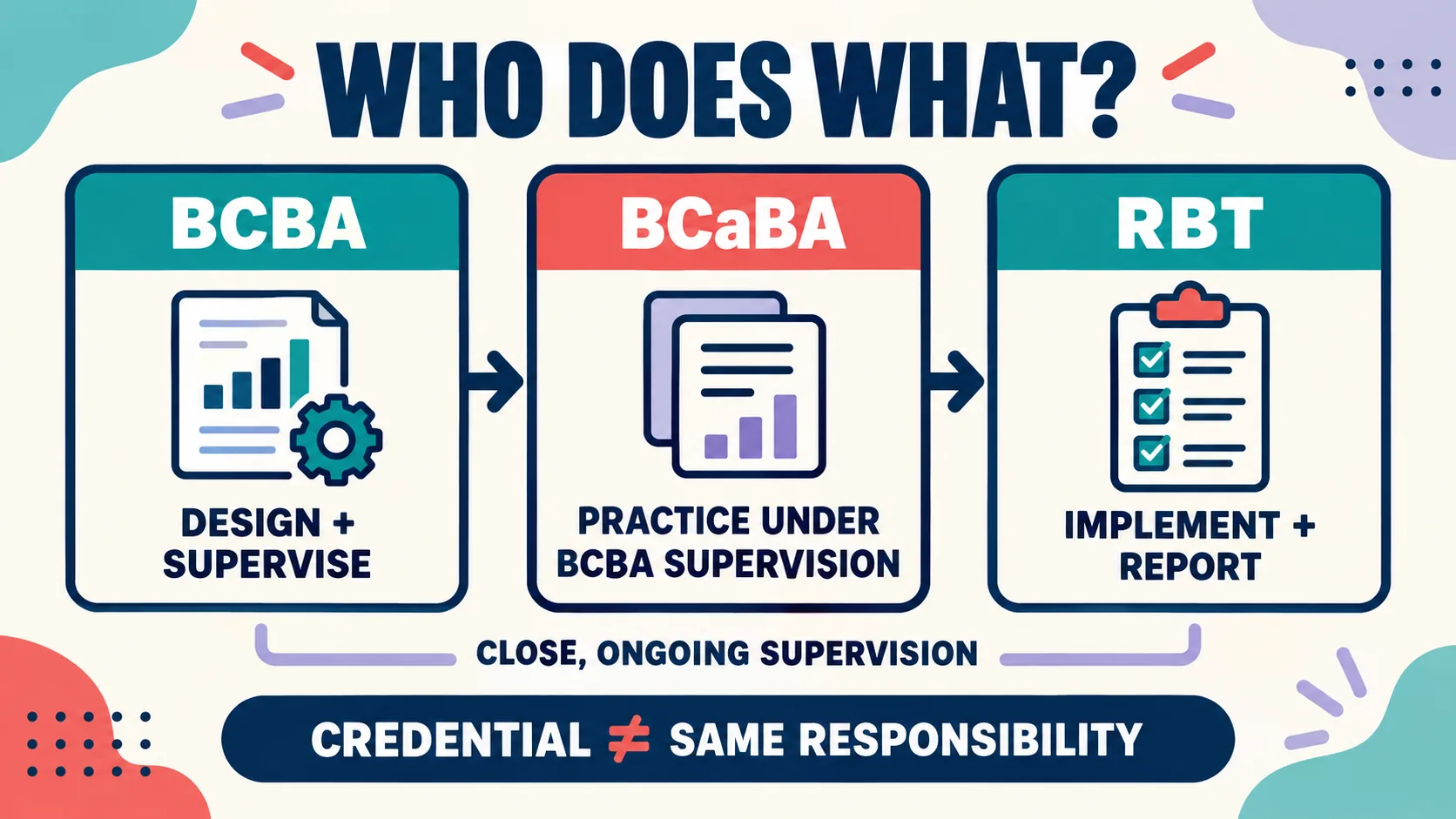
Many readers asking what a board certified behavior analyst does are also trying to understand who they will meet on an ABA team. Credentials describe training and certification levels, but an organization may assign work differently. Always check the service agreement, local law, and the supervising professional’s plan.
| Role | Typical contribution | Supervision and boundary reminder |
|---|---|---|
| BCBA | Provides behavior-analytic services, interprets assessment and progress data, designs or directs individualized interventions, and may supervise RBTs, BCaBAs, and other implementers. | Must practice within competence and applicable law; certification does not replace state licensure or authorize every specialty. |
| BCaBA | Provides behavior-analytic services at the undergraduate certification level and may supervise RBT work when qualified and assigned. | The BACB describes BCaBAs as practicing under BCBA supervision; the BCBA remains the higher-level supervising credential in that relationship. |
| RBT | Implements assigned behavior-analytic procedures, collects and reports data, and works directly with clients in the routines where programs are practiced. | The BACB describes an RBT as a paraprofessional who practices under close, ongoing supervision; an RBT is not an independent clinical decision-maker. |
A role distinction is not a judgment about importance. Direct implementation gives the team essential information about how the plan works in real routines. The BCBA’s responsibility is to use that information, support the team, and make decisions that are appropriate to the credential, assignment, and case.
Where BCBAs Work and How the Role Changes
BCBAs may work in clinics, homes, schools, hospitals, residential programs, community settings, private practice, universities, organizations, or telehealth-supported services. The setting changes the daily tasks, but not the need for clear measurement and ethical boundaries.
- Clinic or home services: the BCBA may conduct assessment, coach caregivers, observe treatment, supervise technicians, and revise skill or behavior programs.
- Schools: the BCBA may consult with teachers, support classroom routines, analyze school-based data, and coordinate with an educational team. The role does not automatically replace the responsibilities of educators or other licensed professionals.
- Community or residential services: the BCBA may design supports for daily living, safety, communication, and participation while training multiple staff across shifts.
- Organizational or performance work: the same behavior-analytic reasoning may be applied to staff performance, workflow, or systems. The BCBA still needs competence, consent, appropriate measurement, and a clear client or stakeholder relationship.
A job title alone cannot tell you the full scope of a specific position. Ask who holds clinical responsibility, who can change the plan, how supervision occurs, what data are reviewed, how concerns are escalated, and which rules govern the service.
What This Role Looks Like on the BCBA Exam
The current BCBA Test Content Outline organizes the examination into nine domains, including measurement, experimental design, ethics, behavior assessment, behavior-change procedures, intervention selection, and personnel supervision and management. That is why a question about “what a BCBA does” may appear as a scenario rather than a definition. Look for the decision hidden in the vignette:
- If the referral question is unclear, the best next step may be to review records, interview stakeholders, or clarify the target before choosing an intervention.
- If two observers use different definitions, improve the operational definition and measurement system before interpreting a graph.
- If an intervention is not producing progress, inspect the data, treatment integrity, contextual fit, and the original hypothesis instead of blaming the learner.
- If a technician is implementing steps incorrectly, the BCBA should provide competency-based training, modeling, feedback, and follow-up rather than simply send another written reminder.
- If a question involves a medical, legal, educational, or other specialized issue outside the BCBA’s competence, seek consultation or make an appropriate referral.
When you are ready to practice these role decisions under time pressure, use the free BCBA Mock Exam. After each question, name the responsibility involved—assessment, measurement, intervention, supervision, ethics, or documentation—and write the evidence that supports your answer. That makes the role easier to recognize across different settings.
Frequently Asked Questions
How should you answer “board certified behavior analyst what do they do”?: Start with the responsibility chain: a BCBA assesses needs, defines meaningful and measurable goals, designs or directs behavior-analytic interventions, supervises implementation, reviews data, documents decisions, and plans for maintenance or generalization. Then add the scope caveat: the exact duties depend on competence, setting, law, employer, and service arrangement.
Does a BCBA work directly with clients?: Sometimes. The amount of direct work varies by setting, employer, case, service model, and competence. A BCBA may observe, assess, coach, model procedures, or run parts of a session while also supervising others and reviewing data.
Does a BCBA diagnose autism or prescribe medication?: Do not assume so. Diagnosis, medication, and other clinical decisions belong to professionals and jurisdictions authorized to provide them. A BCBA should coordinate or refer when a question is outside behavior-analytic competence and should not present certification as a substitute for another license.
Who does a BCBA supervise?: Depending on qualifications and assignment, a BCBA may supervise RBTs, BCaBAs, trainees pursuing certification, and other personnel who implement behavior-analytic interventions. The BACB’s supervision resources explain different oversight roles and training requirements.
What is the difference between a BCBA and an RBT?: A BCBA is a graduate-level independent practitioner credential who may provide services and supervise others. An RBT is a paraprofessional who implements assigned procedures under close, ongoing supervision. The organization may structure daily tasks differently, but the credentials do not carry the same level of independent clinical responsibility.
Is every BCBA job the same?: No. A BCBA’s daily work depends on the setting, population, employer, caseload, payer, state law, and area of competence. Use the credential as a starting point, then ask how responsibility, supervision, documentation, and decision-making are actually organized.
Sources and Verification Notes
This article was checked against current BACB role, supervision, handbook, RBT, BCaBA, and BCBA Test Content Outline resources. Certification requirements and 2027 transition details can change, so candidates should verify the current handbook and official BACB announcements before making an eligibility or career decision.
- BACB Board Certified Behavior Analyst resource page.
- BACB Supervision, Assessment, Training, and Oversight.
- BACB BCBA Handbook.
- BACB BCBA Test Content Outline, 6th edition.
- BACB RBT role description and BACB BCaBA role description.
Take the Free BCBA Mock Exam
A useful next step is to apply this idea in a fresh set of BCBA-style practice questions and review the feedback. Take the Free BCBA Mock Exam



