

Direct assessment in ABA means gathering information by observing and measuring the behavior, response, or performance itself rather than relying only on someone’s report. A useful direct-assessment plan defines the behavior, selects the critical dimension, observes the relevant context, records data consistently, and uses the results to guide the next professional decision.
Table of Contents
- What Does Direct Assessment ABA Mean?
- How Is Direct Assessment Different From Indirect Information?
- What Should You Define Before Observing?
- How Do You Plan a Direct Observation?
- Which Measurement Fits the Direct-Assessment Question?
- What Can Direct Assessment Show?
- How Do Direct and Indirect Data Work Together?
- Does Direct Assessment Prove Function?
- How Do You Check Direct-Assessment Quality?
- What Ethical Boundaries Apply?
- What Common Direct-Assessment Mistakes Appear?
- How Is Direct Assessment Tested on the BCBA Exam?
- What Is the Bottom Line?
- Quick Review Checklist
- Take the Free BCBA Mock Exam
When a learner, caregiver, teacher, or examiner asks what direct assessment ABA means, the shortest answer is: the analyst obtains information from behavior as it occurs or from a direct response to an assessment task. The observer may record frequency, rate, duration, latency, intensity, percentage, accuracy, or another dimension that fits the question.
Direct does not mean perfect, and it does not mean interviews, records, or rating scales have no value. Direct data are one part of an assessment plan. The quality of the conclusion still depends on the operational definition, observation context, measurement system, observer training, and the limits of what was actually observed.
The official BCBA task list includes creating operational definitions, measuring behavior, evaluating measurement quality, and selecting procedures that account for environmental constraints. This article is study guidance, not a substitute for supervision or an individualized assessment.
What Does Direct Assessment ABA Mean?
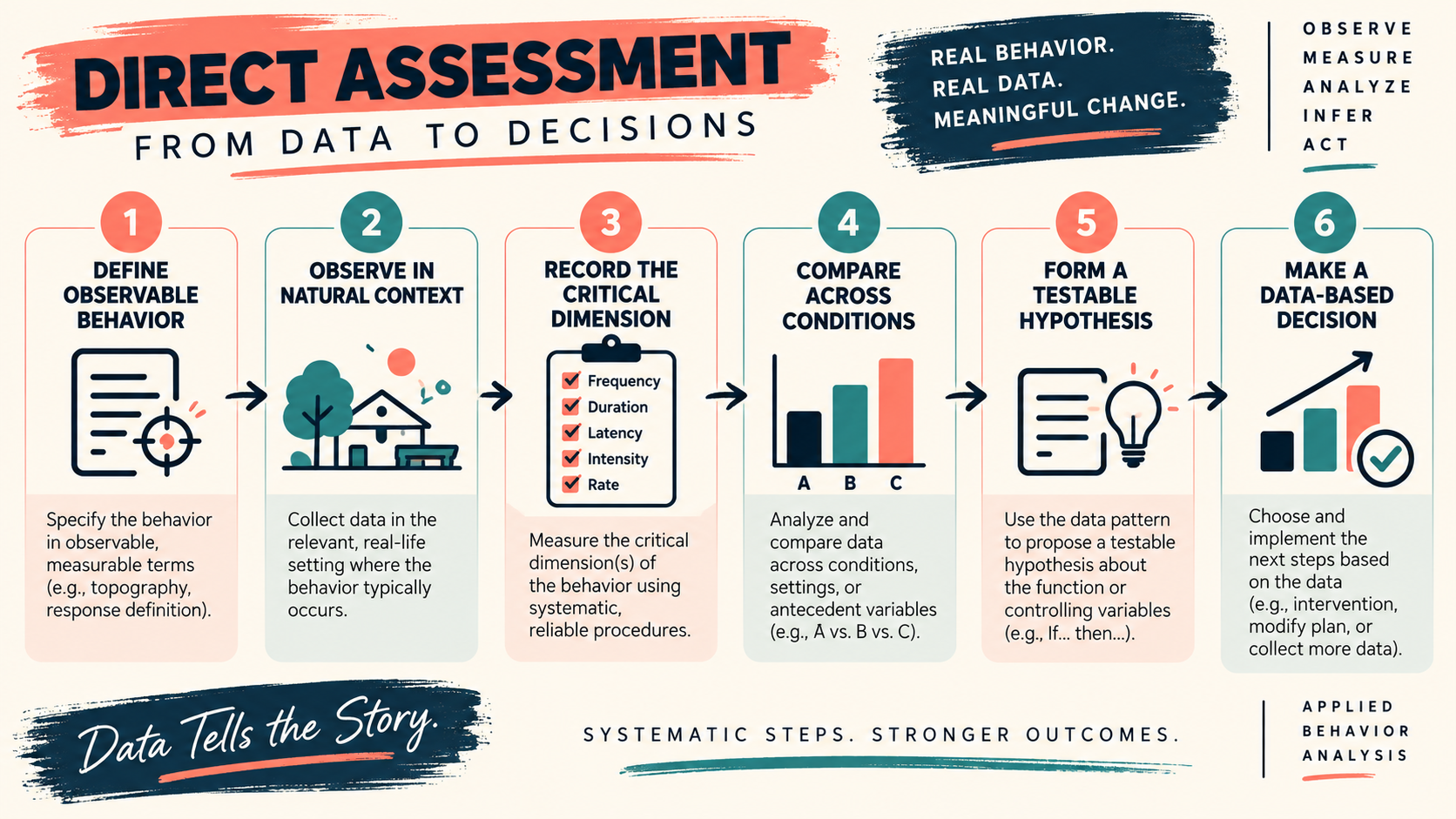
Direct assessment is a process in which the assessor observes or directly engages the learner in a defined assessment activity and records the target response. In naturalistic observation, the analyst may watch a routine and record what happens before, during, and after the behavior. In a structured assessment, the analyst may arrange a task or opportunity and measure the response under stated conditions.
Direct assessment can include descriptive observation, direct skill assessment, direct preference assessment, direct demand assessment, or a functional analysis when a qualified professional determines that an experimental test is indicated. The shared feature is that the data come from the behavior or response under observation, not only from a third party’s memory or interpretation.
How Is Direct Assessment Different From Indirect Information?
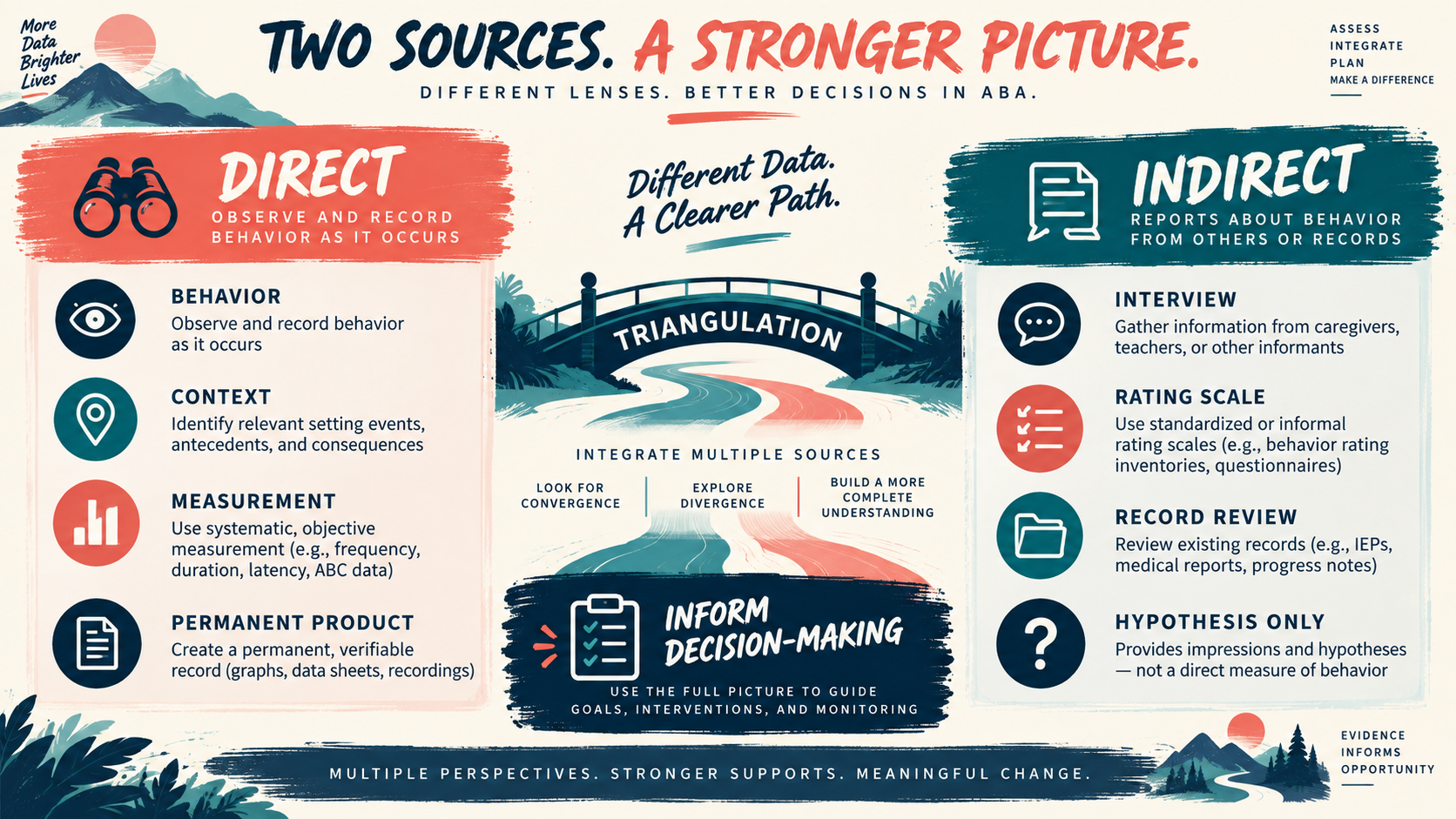
Indirect information comes from an interview, questionnaire, rating scale, record review, or another report about behavior. It can reveal history, routines, settings the assessor cannot observe, and stakeholder priorities. It can also be affected by memory, wording, expectations, and opportunities for observation.
Direct information records what occurred under a defined observation. It can confirm, refine, or challenge an indirect hypothesis. Neither source should be treated as automatically sufficient. A caregiver may know patterns invisible during a short visit, while a live observation may reveal that a reported pattern occurs only under particular task or communication conditions.
What Should You Define Before Observing?
Start with the target and the assessment question. An operational definition should state what an observer can see or hear, when the response begins and ends, what counts as one occurrence, and what similar behavior is excluded. “Off-task” or “meltdown” is not enough to choose a measurement system. Define the response in terms that support reliable observation.
Also define the context: who is present, what activity is occurring, what materials are available, how long the observation lasts, and what opportunities are counted. If the question concerns instruction, specify the task and prompt. If it concerns communication, specify the opportunity and response form. Direct data become more useful when the observation unit matches the decision the team needs to make.
How Do You Plan a Direct Observation?
Choose observation periods likely to include the relevant behavior while avoiding a plan that samples only unusual moments. Review available records and reports to identify settings, routines, and variables worth observing. Obtain the permissions and privacy protections required for the setting, and train the observer to record without changing the situation more than necessary.
- Write the question: decide whether you are describing occurrence, testing a hypothesis, assessing a skill, or evaluating change.
- Select the context: observe the natural routine or arrange a structured opportunity that matches the question and ethical limits.
- Set the observation unit: define session length, opportunities, response windows, and start or stop rules.
- Prepare the data system: use a form or device that captures the critical dimension without making accurate recording impractical.
Plan for reactivity. The observer’s presence, a camera, a new material, or an unfamiliar assessor can change behavior. That does not make direct observation useless, but it should be considered when interpreting the data. Repeat observations or compare sources when the result will affect an important decision.
Which Measurement Fits the Direct-Assessment Question?
Choose the measure from the behavior dimension that matters. Frequency counts responses; rate adjusts a count for time; duration captures how long a response lasts; latency captures time between a cue and response; percentage describes performance across defined opportunities. Intensity may require an anchored scale, while permanent-product measurement examines a reliable outcome left in the environment.
Do not select a measure simply because it is easy to tally. A single long episode and several brief episodes can have the same frequency but different implications. A raw count can also mislead when observation periods are unequal. Professional assessment guidance supports choosing methods that fit the individual and the question; the same principle applies to direct measurement.
What Can Direct Assessment Show?
Direct data can show the observable pattern of behavior under the conditions that were sampled. They can establish a baseline, identify antecedent and consequence correlations, document a skill under specified opportunities, compare performance across contexts, or evaluate change after an intervention is introduced. They can also show that an indirect report does not appear under the observed conditions.
Direct observation is especially helpful when the target has a clear definition and can be measured in the available setting. It can reveal that behavior varies by activity, communication partner, time, task difficulty, or access to materials. Those patterns can guide a more focused assessment, but they should not be turned into a causal claim without an appropriate design.
How Do Direct and Indirect Data Work Together?
Use the two sources as complementary lenses. Indirect information may identify a history, concern, or setting to observe. Direct data may confirm the response, show its temporal pattern, and identify variables that deserve further testing. If the sources disagree, investigate the disagreement instead of averaging them into a vague conclusion.
| Evidence source | What it can contribute | Important limit |
|---|---|---|
| Direct observation | Observable response, context, timing, and selected measurement data. | Represents sampled conditions and may be affected by reactivity or observer limits. |
| Interview or rating scale | History, stakeholder priorities, settings not observed, and hypotheses to investigate. | Depends on report accuracy and does not directly verify a maintaining relation. |
| Permanent product | A lasting result such as completed work, a record, or a data product. | May not show when, how, or with what prompts the product was produced. |
| Experimental assessment | A structured test of how arranged variables affect responding when appropriate. | Requires qualified design, risk review, fidelity, and interpretation beyond one observation. |
Does Direct Assessment Prove Function?
Not automatically. A descriptive observation can show that a response often follows a demand and is followed by a break, but that sequence is a correlation. It may support a hypothesis about escape, yet it does not establish that escape maintains the behavior. The observer must distinguish what was seen from what is inferred.
A functional analysis or another experimental assessment may be needed when a causal question must be answered and the procedure is within the professional’s competence and ethical authority. A direct test should answer a defined question; it should not be treated as a universal requirement or a generic protocol.
How Do You Check Direct-Assessment Quality?
Review whether observers agree on the definition and record the behavior consistently. When appropriate, collect interobserver agreement data and document the observation conditions. Check whether the measurement captures the critical response dimension, whether the observation periods are representative, and whether the observer’s role changed the context.
Also examine implementation fidelity when the observation includes a structured assessment or intervention. If a task was delivered inconsistently, the data may reflect different exposure rather than a meaningful difference in responding. A clean form cannot fix an unstable definition or an invalid observation plan.
What Ethical Boundaries Apply?
Direct observation should serve the learner’s welfare and the assessment question. Protect privacy, minimize unnecessary intrusion, obtain appropriate permission, and avoid collecting information that is not needed. Do not arrange risky conditions merely to create a clearer graph. When behavior involves immediate danger, health concerns, or severe distress, safety and qualified clinical oversight come before a study-friendly data pattern.
Respectful assessment also includes asking whether the target is meaningful and whether the learner has a practical way to communicate discomfort, help, or refusal. Direct measurement should make the plan more responsive, not turn the learner into a set of numbers. Current BACB ethics resources should guide professional decisions about competence, welfare, and confidentiality.
What Common Direct-Assessment Mistakes Appear?
- Observing an undefined label: data are hard to interpret when observers cannot identify the response the same way.
- Measuring convenience instead of the critical dimension: a quick count may miss duration, latency, intensity, or opportunity-based performance.
- Generalizing too far: one short observation cannot represent every setting, person, routine, or time of day.
- Confusing correlation with function: an antecedent-behavior-consequence sequence is not automatically a causal demonstration.
- Ignoring reactivity and fidelity: observer presence or inconsistent task delivery can change what the data mean.
How Is Direct Assessment Tested on the BCBA Exam?
Exam questions may ask you to distinguish direct, indirect, and product measures. Direct assessment involves observing the behavior or response itself. An interview or questionnaire is indirect. A completed worksheet may be a permanent product if the product reliably reflects the behavior of interest. Read the stem carefully instead of choosing “direct” because a professional is present.
Another common question asks what to do when an indirect report suggests one function but direct observation does not show the pattern. The defensible answer is usually to examine the discrepancy, collect additional representative data, refine the definition, or conduct an appropriate next assessment—not to erase one source or declare a function from a brief observation.
What Is the Bottom Line?
Direct assessment in ABA means obtaining data from behavior, performance, or a response as it occurs under defined conditions. A strong plan connects an operational definition to the right observation context, measurement dimension, sampling strategy, reliability check, and decision. Direct evidence is powerful because it is close to the behavior, but it remains bounded by what was observed and how it was measured.
For a structured practice session on assessment, measurement, and data interpretation, try the free BCBA mock exam. Use practice questions to review distinctions; they do not replace supervision, current professional standards, or an individualized assessment.
For targeted review, use our direct assessment ABA practice questions to apply the concept in exam-style scenarios.
Quick Review Checklist
Use this final checklist to turn direct assessment ABA into exam-ready reasoning. The goal is not to memorize a label in isolation; it is to identify the relevant evidence and explain why the best answer fits the scenario. Key ideas to review:
- State the central definition or decision point for direct assessment ABA in your own words.
- Identify the detail that makes direct assessment ABA different from its closest related ABA term.
- Separate the observable facts in a scenario from assumptions that are not supported by the facts.
- Write one example and one nonexample so you can recognize the concept in a new setting.
Exam application checks:
- Ask what the question is actually requesting before comparing the answer choices.
- Mark the antecedent, response, consequence, or other evidence that supports the selected answer.
- Look for a distractor that describes a related process but does not answer the specific question.
Final self-check:
- Explain how you would verify the interpretation with clear observations or data.
- Change one detail in the scenario and decide whether your answer should change.
- Give a one-sentence rationale that a supervisor or study partner could evaluate.
Take the Free BCBA Mock Exam
When you are ready to apply the idea, use the free practice resource below for additional feedback. Take the Free BCBA Mock Exam



