
Short answer: A strong answer to “which of the following is a social intervention for ASD?” is peer-mediated instruction and intervention (PMII) when the peers are systematically taught to initiate, respond to, and support meaningful interaction with an autistic learner. Social skills groups, social narratives, video modeling of interaction, and adult-mediated social-communication teaching can also be social interventions when their target is reciprocal social behavior. The exam clue is the social target and context—not simply the fact that an intervention is used with an autistic person.
Table of Contents
- Which of the following is a social intervention for ASD?
- What makes an intervention social?
- How do you recognize the best answer?
- What social-intervention options may appear?
- How should you solve a BCBA scenario?
- What are common exam traps?
- Social intervention for ASD FAQ
- Take the Free BCBA Mock Exam
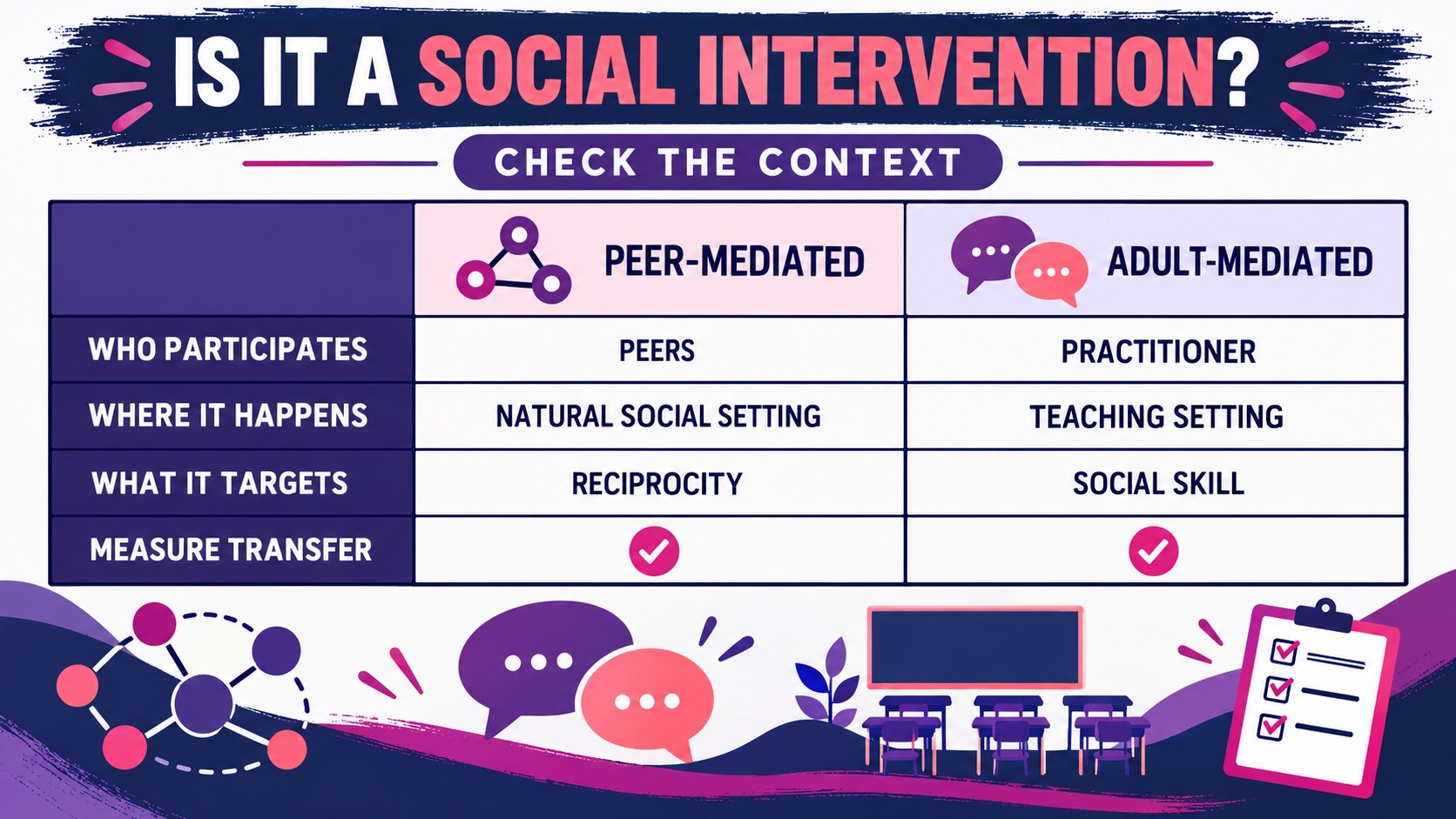
For BCBA questions, do not choose an option because it sounds friendly or because it contains the word “social.” Identify who participates, what behavior is being taught, where practice occurs, what consequence or natural opportunity supports the response, and how transfer will be measured. A visual schedule may support participation, but it is not automatically a social intervention. A medication or diet is not a behavioral social intervention merely because it may affect behavior.
This article uses respectful, person-centered language and treats ASD intervention claims cautiously. The current BACB Test Content Outline is the exam-scope reference; evidence-based practice resources and clinical guidance should be interpreted by qualified professionals in the relevant context. This is educational BCBA study support, not individualized treatment or diagnostic advice. Table of Contents
Which of the following is a social intervention for ASD?
If a question presents peer-mediated instruction and intervention as an option, it is often the clearest answer because the intervention deliberately trains peers to create and respond to social opportunities. The peer is not just nearby. The peer receives systematic instruction, prompting, feedback, or reinforcement so that interaction with the focal learner becomes more likely and more meaningful. Targets can include initiation, responding, turn taking, play, conversation, joint engagement, or participation in a group activity.
However, do not turn that exam shortcut into an absolute rule. Social narratives, video modeling, social skills groups, adult-mediated play, and parent- or teacher-mediated communication may also address social behavior. The correct option depends on the wording of the stem. If the question asks which intervention directly involves typically developing peers, PMII is the strongest match. If it asks which intervention describes a short individualized story about a social situation, social narratives may be the intended answer. If it describes watching a demonstration and then practicing the behavior, video modeling may fit.
| Option in a question | Why it may be social | Exam caution |
|---|---|---|
| Peer-mediated intervention | Peers are taught to initiate or respond in natural interactions with the learner. | Look for systematic peer training, a defined social target, and a plan to fade adult support. |
| Social narrative | A personalized narrative can describe cues, perspectives, expectations, and possible responses in a social situation. | A story is a tool; the goal and observable response still need to be defined and measured. |
| Video modeling | A model can demonstrate a conversation, play routine, greeting, or other social skill. | The stem must connect the model to a social behavior; watching any video is not automatically an intervention. |
| Visual schedule | It may support access to a social routine or group activity. | By itself it is an antecedent support, not proof that the target is reciprocal social interaction. |
What makes an intervention social?
A social intervention changes or teaches behavior that involves another person, a social context, or participation in a meaningful relationship or group activity. The target might be a learner’s initiation, response, conversation, play, cooperation, joint attention, perspective-taking, or use of a communication system with a partner. The target should be observable and socially meaningful rather than a vague demand to “act normal.”
The word “social” does not mean that a person must make eye contact, speak, imitate a particular facial expression, or perform a culturally preferred style of interaction. A respectful BCBA analysis asks what participation or communication the person wants or needs, how the environment can become more accessible, and whether the goal improves genuine access to people and activities. Social validity includes the importance of the goal, the acceptability of the procedures, and the meaningfulness of the outcome. Use this boundary test:
- Social partner: Does another person participate as a communication partner, peer, caregiver, teacher, or group member?
- Social target: Is the target an interaction, communication, reciprocity, play, conversation, or participation response?
- Social context: Does practice occur in a setting where the skill naturally matters, such as a classroom, playground, home, community, or group?
- Functional outcome: Does the response provide access to communication, relationships, activities, choice, or shared participation?
- Transfer plan: Will the team check whether the skill occurs with different partners, materials, settings, and routines?
An intervention can be delivered one-to-one and still target a social skill. Conversely, an intervention can occur in a group and still primarily target an academic, motor, or self-care response. Setting alone is not enough. Analyze the contingency and the stated goal.
How do you recognize the best answer?
Read the question stem for the smallest clue that identifies the intervention’s active ingredient. A phrase such as “typically developing classmates are trained to initiate play” points to peer-mediated intervention. “A short individualized description explains what will happen and what the learner can do” points toward a social narrative. “The learner watches a recording of a peer greeting someone and then practices” points toward video modeling. “The practitioner arranges a structured group to rehearse conversation” may indicate a social skills group.
| Question clue | Likely concept | What the answer must still specify |
|---|---|---|
| Peers receive training to initiate and respond to a learner. | Peer-mediated instruction and intervention | The peer behavior, focal-learner goal, setting, prompting, feedback, and transfer measure. |
| A brief personalized account explains a social situation and possible responses. | Social narrative | The situation, individualized cues, target response, and data beyond merely reading the story. |
| A recording demonstrates a target interaction for later practice. | Video modeling | The modeled behavior, viewing arrangement, practice opportunity, and generalization probe. |
| Learners rehearse conversation or play in a guided group. | Social skills group or structured social-communication teaching | The specific social skill, opportunities to respond, feedback, and transfer to ordinary interactions. |
Why peer-mediated intervention is a common answer: PMII makes the social partner part of the intervention. The peer may be taught how to approach, offer a choice, wait, respond to a communication attempt, invite play, or maintain a reciprocal exchange. The adult arranges training, prompts, feedback, and reinforcement, but the desired outcome is interaction in a natural social environment. This is why peer-mediated intervention is often a strong answer when the question asks for a direct social intervention rather than a general classroom accommodation.
Why a visual support can be a distractor: A visual cue, schedule, or checklist can support almost any routine. It becomes relevant to a social intervention only when the question connects it to a defined social-communication goal and an observable opportunity to interact. “Use a visual schedule” is too broad to beat “train peers to initiate and reinforce reciprocal play” when the stem asks specifically for a social intervention.
What social-intervention options may appear?
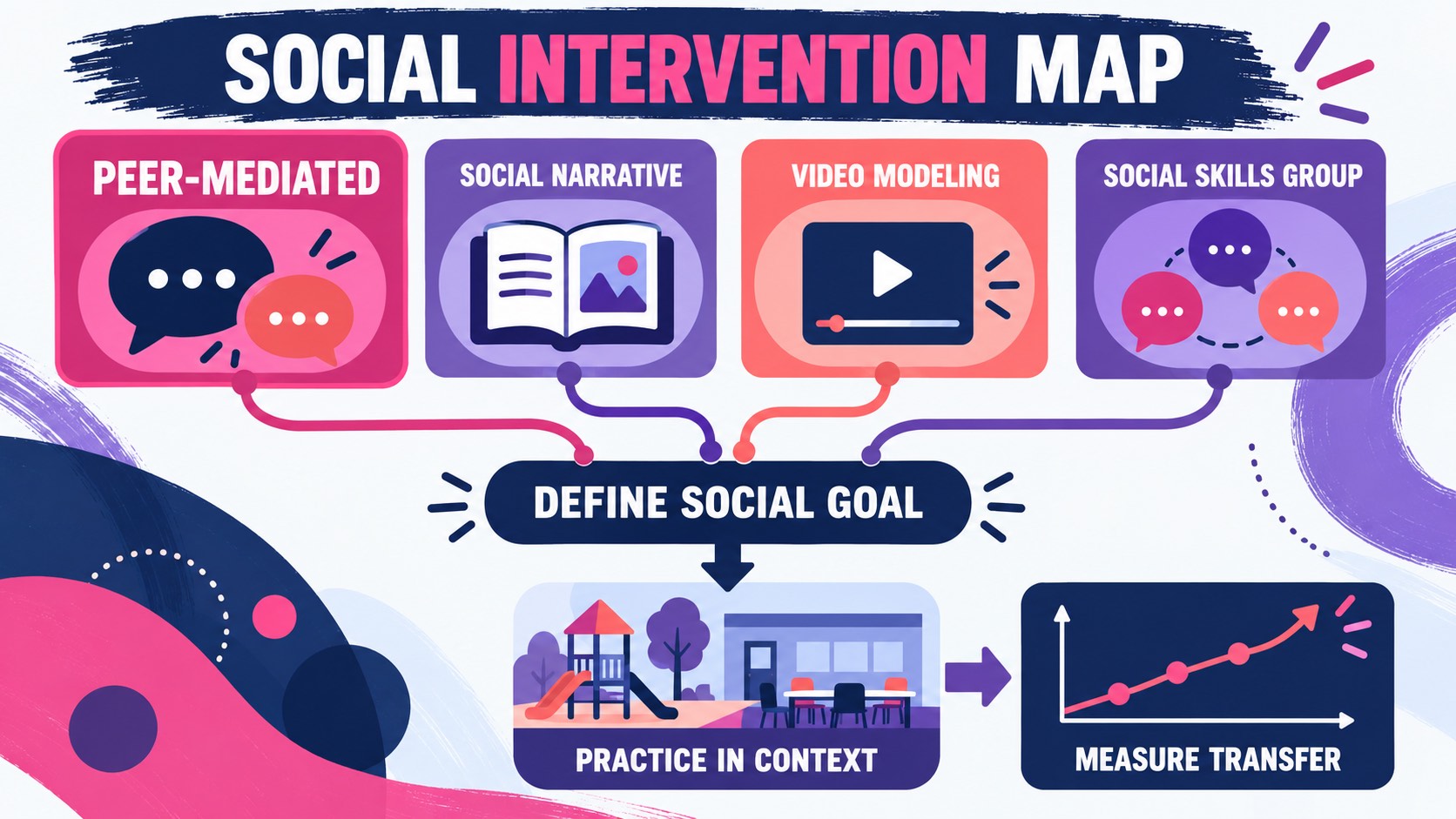
Evidence-based practice resources describe several approaches that can support social communication for autistic learners, but the label alone does not establish effectiveness for every person or outcome. A recent systematic review of social-skills interventions found that results vary by intervention type, participant, outcome, and study design. That is useful exam context: choose the intervention that matches the stem, then look for measurement and generalization rather than assuming a universal effect.
Resources from the National Professional Development Center on Autism Spectrum Disorders describe peer-mediated instruction and intervention as a way to teach peers how to engage learners with ASD in social interactions. The CDC also describes social skills groups, social narratives, peer mentors, and other approaches within broader autism treatment information. Professional guidance may use different terminology, so read the definition supplied by the question or source.
| Approach | Typical social goal | Quality check |
|---|---|---|
| Peer-mediated instruction and intervention | Peer initiation, responding, play, conversation, or group participation | Train peers, define interaction opportunities, support consent and accessibility, and measure transfer. |
| Social narrative | Understanding and responding to cues in a specific anticipated situation | Individualize the narrative and observe behavior in the actual social context. |
| Video modeling | Acquiring a demonstrated interaction or communication routine | Check whether the modeled response transfers beyond the screen and whether the target is meaningful. |
| Social skills group | Practice defined social knowledge, conversation, play, or problem-solving skills | Measure real-world use; performance in a rehearsal group is not the same as natural generalization. |
Use a person-centered lens when interpreting social goals. A good intervention supports communication, access, choice, safety, belonging, and participation. It should not assume that suppressing harmless autistic differences or forcing eye contact is the definition of social success. On a BCBA exam, social validity and contextual fit can be the clue that separates a defensible intervention from a merely compliant-looking one.
How should you solve a BCBA scenario?
Consider this example: A school team wants to increase a student’s participation during recess. One option says to train three classmates to invite the student into a ball game, wait for a response, acknowledge a communication attempt, and receive feedback from the teacher. Another option says to provide a worksheet about friendship. The first option is the clearest peer-mediated social intervention because it arranges peer behavior and real interaction in the setting where the goal matters.
Now change the stem: the team creates a short, individualized description of entering a game, identifies what the student can say or do, reads it before recess, and measures independent entry attempts. Social narrative may be the best label. If the stem instead shows a recording of a model entering a game followed by practice, video modeling may be the answer. The target context—not the topic of autism—determines the label. Work through the scenario in this order:
- Underline the target behavior: initiation, response, conversation, play, joint engagement, or another observable action.
- Identify the social partner: peer, adult, caregiver, teacher, or group.
- Find the active teaching component: peer training, narrative, model, rehearsal, prompting, or reinforcement.
- Ask whether the procedure occurs in a natural or simulated social context.
- Check how independence, fidelity, generalization, and social validity will be measured.
What are common exam traps?
- Choosing the most familiar tool: a token board, visual schedule, or worksheet may be useful but is not automatically a social intervention.
- Confusing a setting with a target: a group room does not prove that the goal is social.
- Ignoring the active ingredient: peer-mediated intervention requires systematic peer involvement, not merely placing a peer nearby.
- Calling every communication goal social: requesting an item may be functional communication without being the social-interaction target described in the question.
- Overgeneralizing evidence: support for one social-skills program does not prove every program with the same label works the same way.
- Counting rehearsal as transfer: success in a clinic or group does not establish use in the playground, classroom, home, or community.
- Using vague outcomes: “be more social” should be replaced with an observable, meaningful behavior.
- Ignoring the learner’s preferences: a socially valid goal should matter to the person and respect communication access and autonomy.
Quick review: The strongest answer identifies a meaningful social behavior, a relevant partner or context, a specific active teaching component, and a plan to measure transfer. When the option says peers are trained to engage the learner in interaction, peer-mediated instruction and intervention is usually the clearest match.
For additional independent practice, use the free BCBA mock exam to work through intervention-selection and social-validity scenarios. It is a practice and feedback resource, not an official BACB product, does not reproduce official exam questions, and does not guarantee certification or exam performance.
Social intervention for ASD FAQ
Is peer-mediated intervention the only social intervention for ASD?: No. It is a common and clear example because peers are deliberately involved in creating social opportunities. Social narratives, video modeling, social skills groups, adult-mediated teaching, and parent or teacher mediation can also be social interventions when they target meaningful social communication or participation.
Is a social skills group automatically effective?: No. The group format does not guarantee a meaningful outcome. Define the skill, teach and practice it with appropriate supports, measure independent use, and assess transfer to the settings and relationships that matter to the learner.
Can a visual schedule be part of a social intervention?: Yes, if it supports a defined social routine or communication goal, but the schedule alone does not establish the intervention’s function. Identify the target response, the social context, and the way the visual support changes the opportunity to participate.
What is the fastest exam clue?: Look for the active ingredient. Trained peers point to peer-mediated intervention; an individualized written scenario points to a social narrative; a recorded demonstration points to video modeling; structured rehearsal points to a social skills group. Then verify the target and generalization plan.
Bottom line: When asked “which of the following is a social intervention for ASD?”, peer-mediated instruction and intervention is often the best answer when trained peers support real interaction. Still, the defensible choice comes from the target, partner, context, active teaching component, and data—not from a label alone.
Take the Free BCBA Mock Exam
When you are ready to apply the idea, use the free practice resource below for additional feedback. Take the Free BCBA Mock Exam



