

A practical verification guide for separating program accreditation, BCBA certification, coursework, and fieldwork before choosing an online route. If you search for accredited BCBA certification online, start with one important correction: accreditation and certification are not the same thing. A school or educational program can have an accreditation or recognition status, while BCBA is a professional certification earned by an individual who meets the current requirements and passes the examination. Online delivery does not erase that distinction.
Table of Contents
- Accreditation is not the same as BCBA certification
- What does “accredited” mean on an online program page?
- Run the three-layer accreditation check
- What the BACB actually certifies
- Separate ABAI accreditation from ABAI recognition
- Match the program to your current BCBA pathway
- Build the evidence packet before you enroll
- Online delivery does not change the eligibility gates
- Recheck the program around the 2027 transition
- Verify fieldwork separately from accreditation
- Ask these five questions before paying
- Compare programs by evidence, not by the word accredited
- Use exam practice after the pathway is clear
- Accredited BCBA certification online FAQ
- The bottom line
- Sources to recheck
- Quick Review Checklist
- Take the Free BCBA Mock Exam
The useful question is not simply “Is this online BCBA program accredited?” It is: What exactly is accredited or recognized, which organization lists it, what evidence will I receive, and how does that evidence fit my BCBA pathway and application date? Use the checklist below before paying a deposit or assuming a program guarantees eligibility. Recheck the current BACB BCBA Handbook whenever you make a major decision.
Accreditation is not the same as BCBA certification
“Accredited” normally describes an institution or an educational program. “BCBA certified” describes a person who has completed the applicable eligibility process, application, and examination requirements. A program can be valuable without being the exact pathway you need, and an accredited or recognized program still does not remove the need to check coursework, fieldwork, application, and examination gates.
| Layer | What it describes | What it does not prove by itself |
|---|---|---|
| Institution | The school’s institutional standing or authority to offer education. | That every course or program at the school fits a BCBA pathway. |
| Program | A behavior-analysis program’s accreditation or recognition status, level, modality, and dates. | That an individual applicant has completed all current BACB requirements. |
| BCBA pathway | Your degree, coursework, fieldwork, application, and exam evidence under current rules. | That a sales page’s “BCBA-ready” phrase is an official determination. |
| Certification | The individual credential awarded through the BACB process. | That a short online certificate is the same as BCBA certification. |
What does “accredited” mean on an online program page?
Look for the subject, organization, scope, level, modality, status, and dates. A careful page should identify whether it is discussing institutional accreditation, a program-level accreditation, an ABAI recognition tier, or a general statement about quality. It should not use “accredited BCBA certification” as though the BACB accredits individual students.
Also watch for time limits. A directory may list a program as accredited through a particular date, under review, eligible to apply, or recognized for a defined period. Those statuses are not interchangeable. Save the exact directory entry and check it again if your enrollment, graduation, or application will occur after the listed date.
Run the three-layer accreditation check
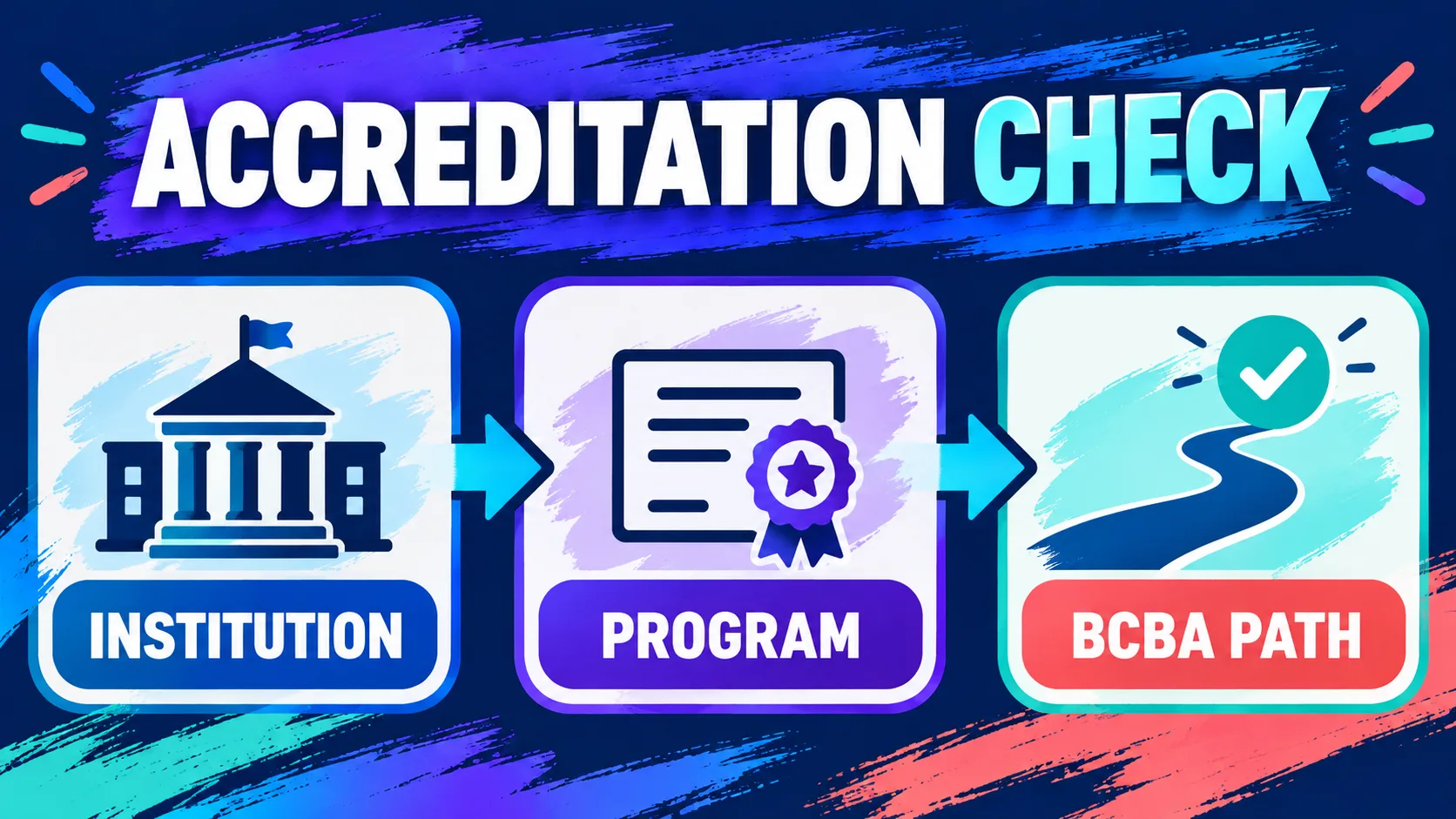
Use the three-layer check before comparing tuition. First verify the institution. Next verify the exact program, including degree level and online or hybrid modality. Finally map the program’s record to your current BACB pathway. If any layer is missing, mark the program “needs confirmation” rather than “approved.”
| Check | Where to look | Pass condition |
|---|---|---|
| Institution | School accreditation page and official institutional directory. | The legal school name and campus or online unit match the offer. |
| Program | ABAI accreditation or recognition directory and the university catalog. | The exact degree, modality, status, and active dates match the program you will enter. |
| BCBA path | Current BACB handbook, pathway guidance, and written program response. | You can identify what the program supplies and what degree, fieldwork, or documentation remains separate. |
What the BACB actually certifies
The BACB describes BCBA as a graduate-level professional certification in behavior analysis. The certification process is not a school accreditation badge. The current handbook sets the pathway rules, and the candidate must satisfy the applicable requirements, submit the right evidence, and pass the examination.
That is why a provider’s wording matters. “Our program is accredited” is a program statement. “Graduates may pursue BCBA certification under pathway X if they also complete Y and Z” is a more useful boundary statement. Even then, do not treat marketing copy as a formal BACB pre-approval. The BACB’s application-processing guidance explains that it cannot determine whether a specific degree, coursework set, or training experience meets requirements outside formal review of an application.
Separate ABAI accreditation from ABAI recognition
ABAI’s accreditation and recognition directories are useful places to check program status, but the labels and tiers must be read exactly as listed. A program may be accredited, recognized under a tiered model, applying, eligible to apply, under review, or listed with an end date. “Online” is a modality; it is not a status.
Use the official directory entry as evidence, not as a shortcut. Confirm the program name, degree level, modality, status, and date. Then read the university’s current catalog to check admissions, curriculum, credits, transcript language, and whether the online program is the same program named in the directory.
Match the program to your current BCBA pathway
An online program can support a pathway without being the entire pathway. Depending on the route and application date, you may still need a qualifying degree, behavior-analytic coursework, supervised fieldwork, documentation, application approval, and the examination. A certificate, a degree, and a coursework sequence produce different records, so ask which gate each record is intended to support.
| Program claim | Evidence to request | Boundary to write down |
|---|---|---|
| BCBA pathway | Named pathway, current catalog, and responsible program contact. | Which requirements are included and which remain the candidate’s responsibility. |
| Coursework | Syllabus, credits, transcript format, and attestation or verification process. | Whether the record is academic coursework, CEU training, or exam preparation. |
| Fieldwork | Supervisor, site, written arrangement, activity rules, and monthly records. | Whether fieldwork is actually provided, merely referred, or entirely separate. |
| Application | Transcript, forms, signatures, dates, and current version requirements. | Who completes each document and who makes the final eligibility decision. |
Build the evidence packet before you enroll
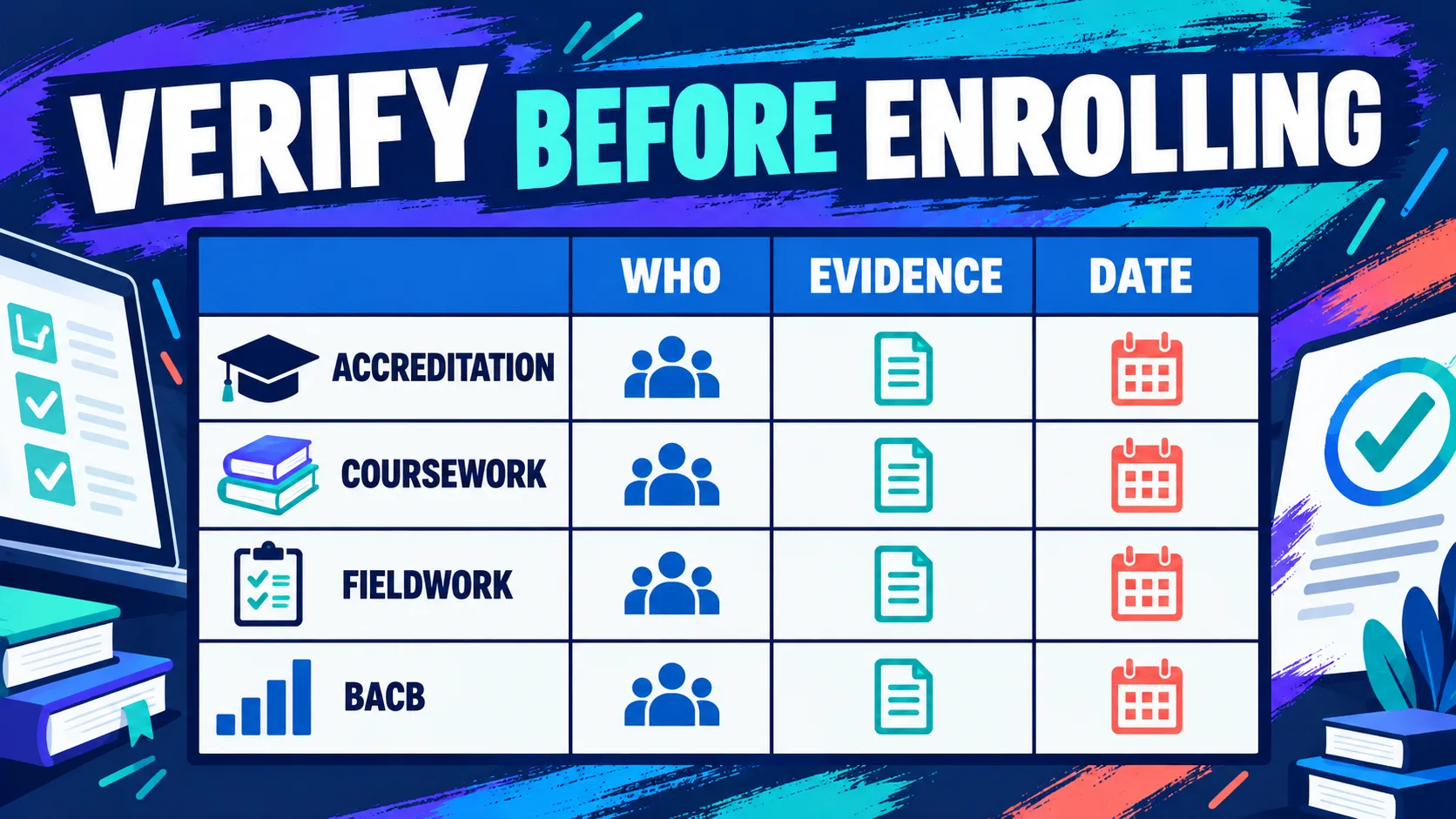
Save five items in one folder: the official accreditation or recognition listing, the university catalog, the syllabus or course sequence, the program’s written pathway explanation, and the date-stamped questions you sent. This packet helps you compare options and prevents a later disagreement about what a sales page appeared to promise. Do not call the packet an approval. It is your decision record. The final answer about your application depends on the current BACB rules and the formal review process.
| Packet item | Record the date? | Why it matters |
|---|---|---|
| Directory listing | Yes | Status and dates can change. |
| Catalog and syllabus | Yes | The course record must match the program being advertised. |
| Written program answer | Yes | It shows what the provider says it covers and excludes. |
| BACB source version | Yes | Application-date and transition rules are time-sensitive. |
Online delivery does not change the eligibility gates
A fully online or hybrid format may be convenient, but the format does not by itself answer whether the degree, coursework, fieldwork, or documents fit your route. Confirm how assessments are recorded, where credits appear, whether any in-person or supervised components are required, and how the program handles students who apply during a rule transition. Use the existing online BCBA pathway guide for broad route context, then return to this verification checklist before enrolling. The two pages serve different decisions.
Recheck the program around the 2027 transition
The BACB’s current upcoming-changes materials list January 1, 2027 revisions affecting core BCBA requirements, including degree, coursework, supervised fieldwork, continuing education, and ongoing supervision. They also list the discontinuation of Pathways 3 and 4. If your enrollment or application crosses that date, ask the program which rule version its advice assumes and what will happen to your documentation.
Do not rely on a page that says “2027 compliant” without a current handbook reference, a named pathway, and a description of the evidence you will receive. Save the official source and the program response, then recheck both before applying.
Verify fieldwork separately from accreditation
Accreditation is not fieldwork. Ask whether the program provides an actual supervisor and site, or only a referral list. Confirm the written supervision arrangement, countable activities, monthly verification process, and what happens if the supervisor or site changes. A program can be accredited and still leave fieldwork entirely to you.
Ask these five questions before paying
- What organization lists the exact program, and what is its current status and end date?
- Is the listing for the same degree, modality, campus, and program name that I will enter?
- Which current BCBA pathway does the program support, and which requirements remain separate?
- What transcript, coursework verification, fieldwork record, and application documents will I receive?
- Which BACB handbook version and application date does this answer assume?
Ask in writing and keep the response with your saved directory record. If the answer uses “guaranteed,” “automatically eligible,” or “BACB approved” without naming the evidence and responsible authority, ask for clarification before paying.
Compare programs by evidence, not by the word accredited
Build one row per program and compare total cost, modality, degree level, accreditation or recognition status, status date, credits, transcript, fieldwork arrangement, pathway statement, refund policy, and verification contact. A program with a narrower but documented claim is easier to evaluate than one with a broad promise and no current directory link. For a broader discussion of online ABA and graduate options, see the existing online ABA certification comparison and master’s in applied behavior analysis guide. This page adds the status-and-evidence audit before enrollment.
Use exam practice after the pathway is clear
Once your program, coursework, fieldwork, and application route are documented, use practice questions to diagnose exam readiness. Practice is valuable for correcting scenario-reasoning errors, but it does not establish accreditation, eligibility, fieldwork compliance, or authorization to test. If your route is confirmed and you are ready to practice, try the Free BCBA Mock Exam. Use the result as a study signal, not as an official eligibility decision.
Accredited BCBA certification online FAQ
Does an accredited online program guarantee BCBA certification?: No. Program accreditation or recognition is one piece of evidence. You still need to meet the current individual eligibility, application, fieldwork, and examination requirements that apply to your route and date.
Is the BACB the organization that accredits online universities?: Do not assume so. BACB certification and educational-program accreditation are different functions. Check the exact organization named by the program and verify the listing in the responsible official directory.
Can a certificate be used the same way as a master’s degree?: Not automatically. A certificate, degree, coursework record, and CEU record are different products. Ask what evidence the route requires and where the provider’s record fits before enrolling.
What should I do if the program claims BACB approval?: Ask the program to name the current pathway, source, status, dates, and documents behind the claim. Then compare the answer with the current BACB handbook and official program directories. A sales statement is not a formal BACB review.
The bottom line
The safest way to choose accredited BCBA certification online is to verify three separate layers: the institution, the exact program, and your individual BCBA pathway. Save the status and dates, confirm coursework and fieldwork evidence, recheck the 2027 transition, and never treat the word “accredited” as a promise of automatic certification.
Sources to recheck
Official references: the BACB BCBA page, BCBA Handbook, application-processing guidance, and Recent & Upcoming Changes. Also check the ABAI Accredited Programs directory, ABAI Recognized Programs directory, and ABAI accreditation FAQ. Existing BCBA Mock Exam pages provide context but do not replace current official rules. For targeted review, use our accredited bcba certification online practice questions to apply the concept in exam-style scenarios.
Quick Review Checklist
Use this final checklist to turn accredited bcba certification online into exam-ready reasoning. The goal is not to memorize a label in isolation; it is to identify the relevant evidence and explain why the best answer fits the scenario. Key ideas to review:
- State the central definition or decision point for accredited bcba certification online in your own words.
- Identify the detail that makes accredited bcba certification online different from its closest related ABA term.
- Separate the observable facts in a scenario from assumptions that are not supported by the facts.
- Write one example and one nonexample so you can recognize the concept in a new setting.
Exam application checks:
- Ask what the question is actually requesting before comparing the answer choices.
- Mark the antecedent, response, consequence, or other evidence that supports the selected answer.
- Look for a distractor that describes a related process but does not answer the specific question.
Final self-check:
- Explain how you would verify the interpretation with clear observations or data.
- Change one detail in the scenario and decide whether your answer should change.
- Give a one-sentence rationale that a supervisor or study partner could evaluate.
Take the Free BCBA Mock Exam
A useful next step is to apply this idea in a fresh set of BCBA-style practice questions and review the feedback. Take the Free BCBA Mock Exam



