
Simple one step instructions ABA are brief directions that signal one observable response at a time. Examples include “touch the cup,” “give me the block,” or “stand up.” The phrase is useful for BCBA study because it sits at the intersection of stimulus control, instruction design, prompting, reinforcement, measurement, and generalization.
Table of Contents
- What Are Simple One Step Instructions ABA?
- One-Step Instructions Versus Task Analysis and Multi-Step Directions
- How to Write a Clear One-Step Instruction
- How to Deliver a Simple One-Step Instruction in ABA
- Prompting and Fading for One-Step Directions
- How to Record One-Step Instruction Data
- How to Generalize Following Instructions
- Respect, Choice, and Ethical Boundaries
- Common BCBA Exam and Fieldwork Mistakes
- FAQ
- Sources to Verify the Topic
- Quick Review Checklist
- Take the Free BCBA Mock Exam
A one-step instruction is not automatically a good teaching trial. The direction should be understandable in context, the expected response should be observable, the learner should have a meaningful reason to respond, and the team should know how it will score independent versus prompted performance. A clear cue supports learning; a vague command can create an assessment of language, attention, motivation, or motor skills without anyone realizing it.
This guide explains how to write and deliver one-step instructions, separate one direction from task analysis, choose and fade prompts, and record data without turning “following directions” into blind compliance. It is educational study material, not individualized treatment advice. Table of Contents
What Are Simple One Step Instructions ABA?
A simple one-step instruction is an antecedent or discriminative stimulus that communicates one response requirement. “Place the spoon in the cup” can be one step if the learner performs one defined placement response. “Get ready for school” is not a useful one-step instruction because it could include dressing, packing, walking, and waiting. The number of words is not the deciding factor; the number and clarity of the expected responses are.
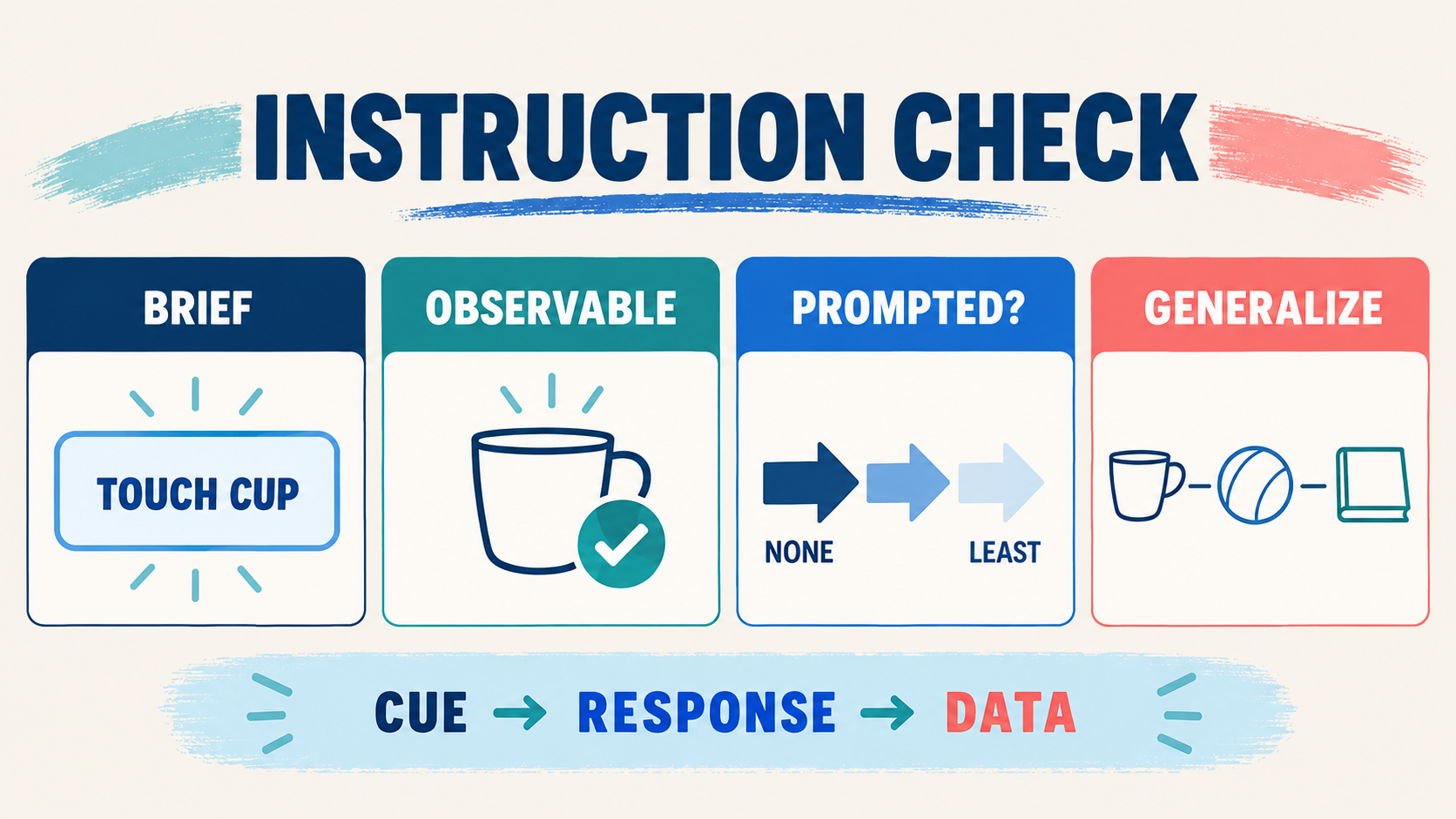
For BCBA purposes, define the response before presenting the cue. For “touch the cup,” specify the cup, what contact counts, and the response window. For “give me the block,” define whether any block and release into the instructor’s hand count when multiple blocks are present.
The current BCBA Test Content Outline includes designing and evaluating instructions and rules, selecting and fading prompts, developing measurable goals, and making data-based decisions. One-step directions are therefore not a memorization topic alone. They are a compact way to practice several BCBA decisions at once.
One-Step Instructions Versus Task Analysis and Multi-Step Directions
A single instruction can be one component of a larger behavior chain. Task analysis breaks a complex skill into a sequence of teachable steps; chaining describes how those steps are taught. A one-step instruction, by contrast, specifies the immediate response for the current opportunity. Do not call a direction “one step” simply because it is short.
| Direction or procedure | What the learner must do | BCBA question |
|---|---|---|
| “Touch the cup.” | One defined contact response. | Is the cup identified and the contact response observable? |
| “Pick up the cup and put it on the tray.” | At least two linked actions. | Should this be split into steps or assessed as a chain? |
| “Clean up.” | An undefined collection of possible actions. | What exact response, materials, and completion criterion are intended? |
| Task analysis | A sequence of defined component responses. | Which steps are independent, prompted, missing, or ready for chaining? |
One-step instructions can teach listener responding, routines, safety, vocational skills, communication, or daily-living components. The goal is a meaningful, measurable opportunity—not adult direction in every situation.
How to Write a Clear One-Step Instruction
Start with the response, not a preferred phrase:
- Use an observable verb. Choose touch, point, hand, place, open, select, or stand when it matches the goal.
- Name the stimulus. Say “touch the red cup” or arrange a defined array instead of relying on “that one.”
- Keep one response requirement. Split linked actions or use a task analysis.
- Set the window and data. Define correct, prompted, incorrect, and no-response outcomes, plus the consequence.
A direction should be brief without becoming cryptic. Extra words, repeated commands, questions, gestures, and positioning can change the antecedent. Use wording that fits the learner and deliver it consistently enough to interpret the data.
How to Deliver a Simple One-Step Instruction in ABA
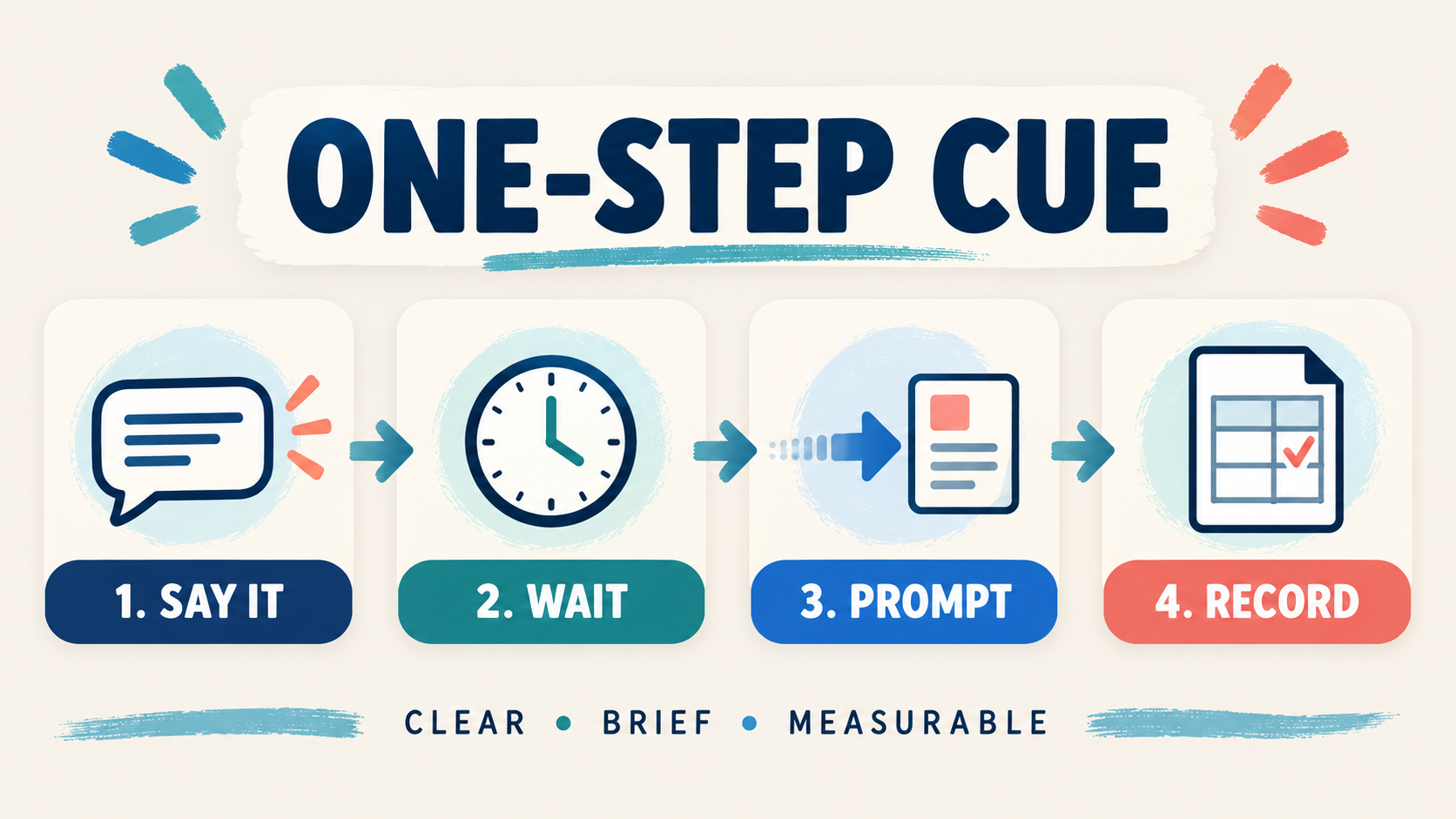
A clean teaching trial often follows this sequence:
- Arrange the opportunity. Place the materials within reach, confirm that the response is possible, and use a preferred or meaningful context when appropriate.
- Present the cue once. Use the planned instruction and avoid requiring eye contact as a hidden prerequisite unless eye contact is itself the individualized target.
- Wait for the defined interval. Allow processing time and record the response within the planned window. Repeating the cue immediately can turn one opportunity into several unrecorded prompts.
- Prompt according to the plan. If the learner does not respond or responds incorrectly, use the selected prompt and document the level needed.
- Reinforce meaningful responding. Deliver the planned consequence for the correct response, including access to the activity, communication, social interaction, or another individualized reinforcer.
- Reset and vary thoughtfully. Change materials or position only when the goal calls for generalization; do not change several variables before you know why performance changed.
“Say it once, wait, prompt, reinforce, record” is a study shorthand, not a universal script. Select the delay, prompt hierarchy, reinforcement, and error correction from assessment information, the skill, environment, and learner needs.
Prompting and Fading for One-Step Directions
A prompt is added stimulus or response assistance intended to increase correct responding. A repetition, model, gesture, positional arrangement, visual cue, or physical guidance can function differently by procedure. Record what was delivered; calling every extra word “the instruction” hides the prompt.
Most-to-least prompting may reduce errors by starting with a more intrusive prompt and systematically fading. Least-to-most prompting may allow an independent response or a less intrusive prompt before additional help. Time delay, stimulus fading, and errorless arrangements are other options. The best choice depends on the target, learner, environment, safety, response effort, and risk of prompt dependency.
Do not choose a hierarchy by slogan alone. A behavior-analyst decision tool emphasizes client characteristics, target-skill features, teaching conditions, and prompt-fading variables. Once a prompt helps, plan how control will transfer to the natural cue. Responding only after a repeated adult instruction is not independent following. Do not use a prompt instead of checking motivation, stimulus clarity, prerequisite skills, access, language, motor demands, or consequence value. A failed response may reflect a poor arrangement rather than unwillingness.
How to Record One-Step Instruction Data
Match the measurement to the question. If the question is whether the learner independently follows a direction, record independent versus prompted or incorrect responses across defined opportunities. If the question is how quickly the learner responds, latency may be useful. If the direction is part of a larger chain, record the relevant task-analysis step rather than treating completion of the entire routine as one score.
| Decision question | Possible measure | Record with it |
|---|---|---|
| Does the learner follow independently? | Percentage of independent opportunities | Cue, stimulus arrangement, response window, prompt level, and opportunity outcome. |
| How quickly does the response occur? | Latency | The exact start point, response definition, and whether prompts were delayed. |
| Which part of a routine needs teaching? | Task-analysis step scoring | Step number, correct or incorrect response, prompt, and chain arrangement. |
| Is the skill reliable across people or places? | Probes across exemplars and settings | Person, location, materials, wording, and whether the natural cue was present. |
Define the denominator. “80% correct” could mean four independent responses out of five opportunities, or eight correct steps out of ten in a task analysis. Those are not interchangeable. If two observers collect data, calculate IOA using a planned method and review disagreements instead of using agreement as proof that the instructional procedure worked.
How to Generalize Following Instructions
Generalization means the response occurs under relevant changes, not every variable at once. Vary one dimension at a time: speaker, setting, materials, position, wording, response form, or natural consequence. For example, practice “touch the cup” with different cups and speakers after the original arrangement is reliable. Check stimulus and response generalization separately. Stimulus generalization concerns classes of cues or materials; response generalization concerns acceptable response variations. Decide in advance whether touching a cup’s rim, side, or handle counts.
Check maintenance after prompts and dense reinforcement are faded. The video-modeling and daily-living study illustrates why prompt data and maintenance probes matter: teaching performance can differ from performance without support. It does not establish one universal procedure, so measure rather than assume transfer.
Respect, Choice, and Ethical Boundaries
Following a one-step instruction should not become unquestioning compliance. The BACB Ethics Codes provide context for dignity, client involvement, competence, confidentiality, and protection from harm. Ask whether the direction is meaningful and whether the response increases access, safety, communication, independence, or participation.
Offer choices, use a culturally and linguistically appropriate cue, and do not score refusal as an automatic deficit. A learner may need a break, clearer arrangement, another communication mode, or a safer alternative. For an immediate-safety direction, specify the context, teach the safety response, and review data and learner experience.
Do not use “simple” to mean easy for every person. A short direction may require language, access, motor planning, stimulus discrimination, or reinforcement history. If prerequisites are missing, assess and adjust instead of increasing pressure.
Common BCBA Exam and Fieldwork Mistakes
- Counting a repeated direction as independence: separate the original cue from verbal prompts or repetitions.
- Calling a vague command one step: “clean up” may contain many responses and needs an operational definition.
- Confusing a prompt with a consequence: a gesture before the response and praise after the response serve different functions in the teaching arrangement.
- Choosing a prompt hierarchy by habit: consider the learner, response effort, skill, context, safety, and fading plan.
- Using the wrong denominator: percentage of trials and percentage of task-analysis steps answer different questions.
- Ignoring generalization: success with one person, object, and room is not automatically flexible instruction following.
- Equating compliance with quality: include communication, choice, dignity, assent, and socially meaningful outcomes.
For optional BCBA exam practice, the free BCBA mock exam can help you distinguish an antecedent, prompt, response, consequence, measurement system, and generalization probe. It is a study aid, not a BACB protocol or individualized clinical guidance.
FAQ
What are examples of simple one-step instructions in ABA?: Examples include “touch the cup,” “give me the block,” “point to the dog,” “put the spoon in the bowl,” or “stand up,” when each response is defined for the context. The correct example depends on the learner, materials, communication mode, and goal.
Is a one-step instruction the same as a task analysis?: No. A one-step instruction signals one immediate response. A task analysis breaks a complex routine into a sequence of component steps. One-step directions may be used to teach or assess individual steps in that sequence.
How long should you wait after a one-step instruction?: Use the response interval specified by the teaching plan and measurement system. The interval should allow reasonable processing time without turning the opportunity into an undefined delay. Record whether a response was independent, prompted, incorrect, or absent.
How do you measure following one-step directions?: For independent following, use defined opportunities and record independent, prompted, incorrect, and no-response outcomes. Add latency when speed matters, prompt level when independence is the target, and generalization probes when the skill must transfer across people, materials, or settings.
Sources to Verify the Topic
- BACB Test Content Outline, 6th edition — official context for instructions, prompting, measurement, procedural integrity, and generalization.
- BACB Ethics Codes — professional context for dignity, client involvement, competence, and confidentiality.
- Optimizing task-analysis instruction — research on descriptions, pictures, antecedent stimuli, outcomes, and instructional performance.
- Video modeling and activities of daily living — applied example measuring task-analysis accuracy, prompts, and maintenance.
- A decision-making tool for selecting prompting strategies — framework for matching prompt and fading decisions to the learner, skill, and environment.
- Stimulus characteristics within directives — research context for how directive features can affect task completion.
Bottom line: simple one-step instructions ABA should be brief, observable, meaningful, and measurable. Present one clear cue, allow the planned response time, prompt and fade deliberately, reinforce useful responding, record the actual level of support, and test whether the skill generalizes without sacrificing communication or dignity. For targeted review, use our simple one step instructions ABA practice questions to apply the concept in exam-style scenarios.
Quick Review Checklist
Use this final checklist to turn simple one step instructions ABA into exam-ready reasoning. The goal is not to memorize a label in isolation; it is to identify the relevant evidence and explain why the best answer fits the scenario. Key ideas to review:
- State the central definition or decision point for simple one step instructions ABA in your own words.
- Identify the detail that makes simple one step instructions ABA different from its closest related ABA term.
- Separate the observable facts in a scenario from assumptions that are not supported by the facts.
- Write one example and one nonexample so you can recognize the concept in a new setting.
Exam application checks:
- Ask what the question is actually requesting before comparing the answer choices.
- Mark the antecedent, response, consequence, or other evidence that supports the selected answer.
- Look for a distractor that describes a related process but does not answer the specific question.
Final self-check:
- Explain how you would verify the interpretation with clear observations or data.
- Change one detail in the scenario and decide whether your answer should change.
- Give a one-sentence rationale that a supervisor or study partner could evaluate.
Take the Free BCBA Mock Exam
If you want a low-pressure way to check your recall, use the free practice resource below. Take the Free BCBA Mock Exam



