
An independent activity schedule in ABA uses pictures, words, or another accessible cue system to guide a learner through a sequence with less adult direction. Learn the parts of the schedule, how it differs from a general visual schedule, and how to measure true independence.
Table of Contents
- What Is an Independent Activity Schedule ABA Program?
- What Are the Core Parts of an Activity Schedule?
- How Is an Independent Activity Schedule Different From a Visual Schedule?
- What Readiness Questions Should a BCBA Ask?
- How Are Prompting and Fading Used?
- How Do You Measure Independence?
- How Can the Schedule Be Generalized?
- What Problems Can Make a Schedule Less Independent?
- How Should Ethical and Person-Centered Checks Shape the Plan?
- How Is Independent Activity Schedule Tested on the BCBA Exam?
- What Is the Bottom Line?
- Quick Review Checklist
- Take the Free BCBA Mock Exam
An independent activity schedule ABA program is not simply a list of chores or a colorful board. It is a support that helps a learner contact a cue, identify the next activity, complete the activity, mark it finished, and move to what comes next with decreasing adult assistance. The goal is not just that the activities get done. The goal is that the learner can use the schedule as a practical source of information and control.
Activity schedules can use photographs, line drawings, written words, objects, icons, or a digital format. The format should match the learner’s communication, discrimination, motor, and attention skills. A schedule that looks sophisticated but cannot be accessed independently is not a strong schedule for that learner.
This guide is an educational explanation for BCBA candidates and families who want to understand the terminology. The BACB task-list materials provide exam-scope context, but the exact design, prompting, reinforcement, and data system must be individualized. A schedule is a teaching support, not a universal treatment prescription.
What Is an Independent Activity Schedule ABA Program?
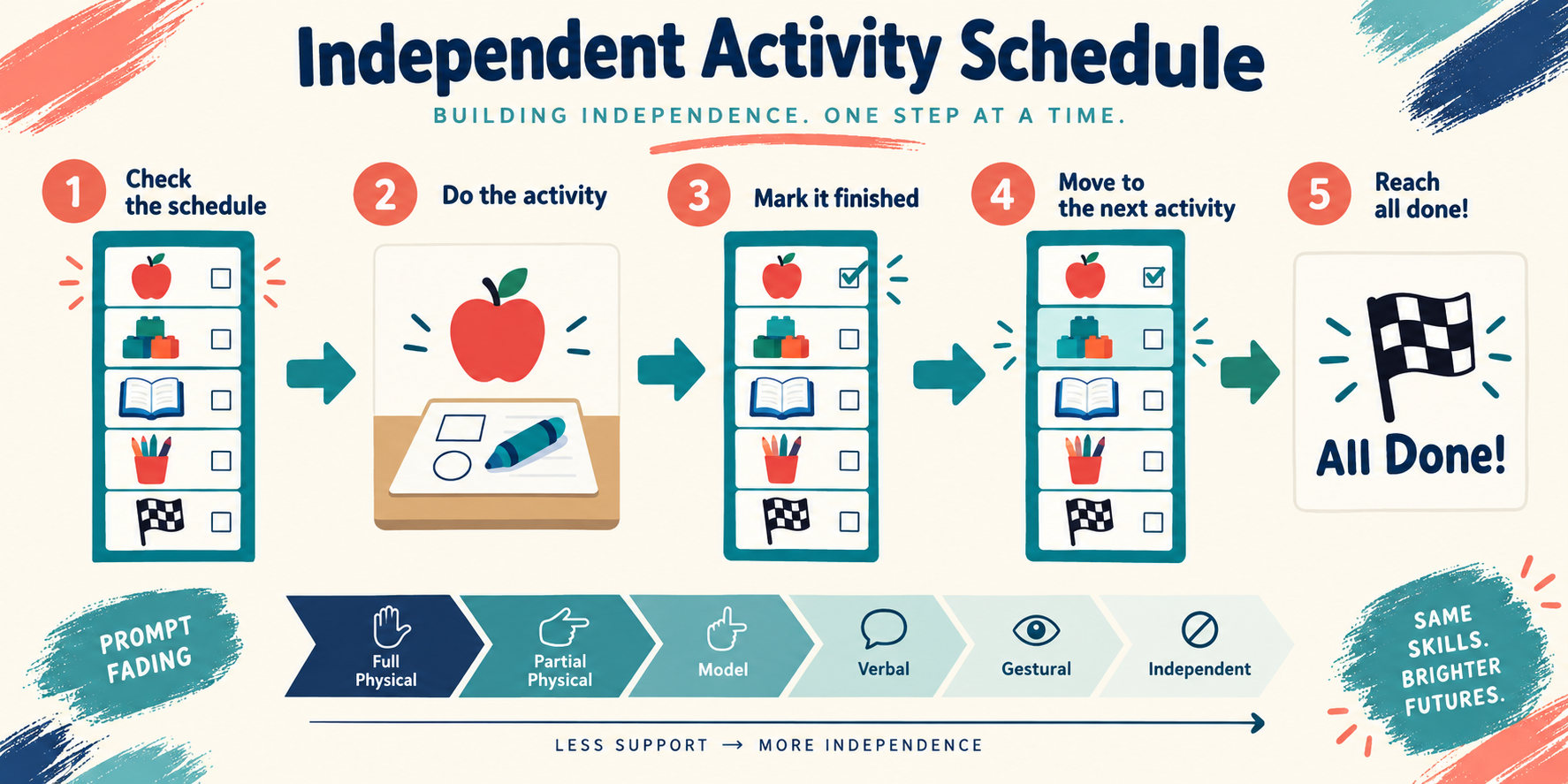
An independent activity schedule is a sequence of visual or written cues that signals what activities are available, the order in which they occur, and often how the learner will know an activity is finished. The schedule is taught as a chain of actions: approach the schedule, check the cue, obtain or begin the indicated activity, complete the relevant steps, mark the activity finished, and return for the next cue.
The word independent describes the learner’s use of the schedule, not the absence of every support during teaching. A learner may initially need a prompt to orient to the schedule, turn a page, match a photograph, start an activity, or transition to the next item. The teaching plan should make those prompts visible in the data and should include a reasonable path toward less assistance.
The schedule may organize a short play sequence, a classroom work period, a self-care routine, a vocational task sequence, or another meaningful set of activities. It should be connected to a real purpose and should include a way to ask for help, pause, or change when those options are relevant.
What Are the Core Parts of an Activity Schedule?
A usable schedule usually contains more than the cue cards themselves. Before selecting a format, clarify the parts that make the cue functional:
- Access point: where the learner finds the schedule and how it is kept available.
- Activity cue: a photograph, symbol, object, word, or combination that the learner can discriminate.
- Sequence rule: how the learner knows which item is next and whether there is a choice within the sequence.
- Activity definition: what counts as starting and completing the activity.
- Finished signal: a check box, finished pocket, turn of a page, container, or other observable response.
- Help or pause option: an accessible way to communicate when the cue is unclear, the activity is unavailable, or a break is needed.
- Reinforcement and natural outcome: a meaningful reason to use the schedule, which may include preferred activity access, completion, social connection, or increased control.
These components should not be treated as a rigid checklist. Some learners may need a single first-then cue before using a longer sequence. Others may prefer a written checklist or a digital schedule. The correct level of complexity is the one that communicates the next action without creating unnecessary dependence on an adult.
How Is an Independent Activity Schedule Different From a Visual Schedule?
A visual schedule is a broad category of visual support. It may show a day’s routine, preview transitions, display available activities, or make time and expectations more predictable. An independent activity schedule is a narrower use: the learner is taught to interact with the schedule and use it to move through activities with reduced adult direction.
| Question | General visual schedule | Independent activity schedule |
|---|---|---|
| Primary purpose | Make routines, transitions, or choices more predictable | Teach the learner to use a cue sequence to initiate, complete, and transition |
| Who operates it? | An adult may point to or describe the next item | The learner is explicitly taught to check and act on the cue |
| Completion signal | May be implicit or managed by the adult | Is observable and supports movement to the next activity |
| Success measure | Predictability, transition support, or access to information | Independent initiation, completion, transition, choice, and prompt fading |
What Readiness Questions Should a BCBA Ask?
Readiness is not a pass-or-fail label. It is a way to identify what the schedule must teach or accommodate. Ask whether the learner can orient to the cue, discriminate a photograph or word from other stimuli, travel to the activity, manipulate the materials, complete enough of the routine to contact an outcome, and communicate help or refusal.
If a learner cannot yet match the cue to the activity, use a format and teaching arrangement that makes that relation learnable. If a motor or sensory barrier prevents access, modify the materials or location. If the activity is too difficult or too long, break it into meaningful steps. A schedule should not be used to hide missing skills or to interpret noncompletion as a motivation problem.
How Are Prompting and Fading Used?
Prompting can help establish the schedule routine, but the prompt should not become the learner’s only signal to act. A teaching plan may begin with a more supportive prompt, then systematically reduce prompt intensity, delay the prompt, change its position, or transfer control to the schedule cue. The exact sequence depends on the learner and the response being taught.
Record the prompt level rather than scoring a prompted response as independent. If an adult says “check your schedule” every time, the learner may be following the adult’s voice instead of the schedule. A fading plan can target the first point at which assistance is needed: approaching the schedule, selecting the next card, starting the activity, finishing, or transitioning.
Prompt fading should preserve dignity and access. Do not withhold necessary communication support simply to create a lower prompt score. If a learner needs an AAC device, visual timer, adapted materials, or a way to request a pause, those supports are part of accessible independence rather than evidence of failure.
How Do You Measure Independence?
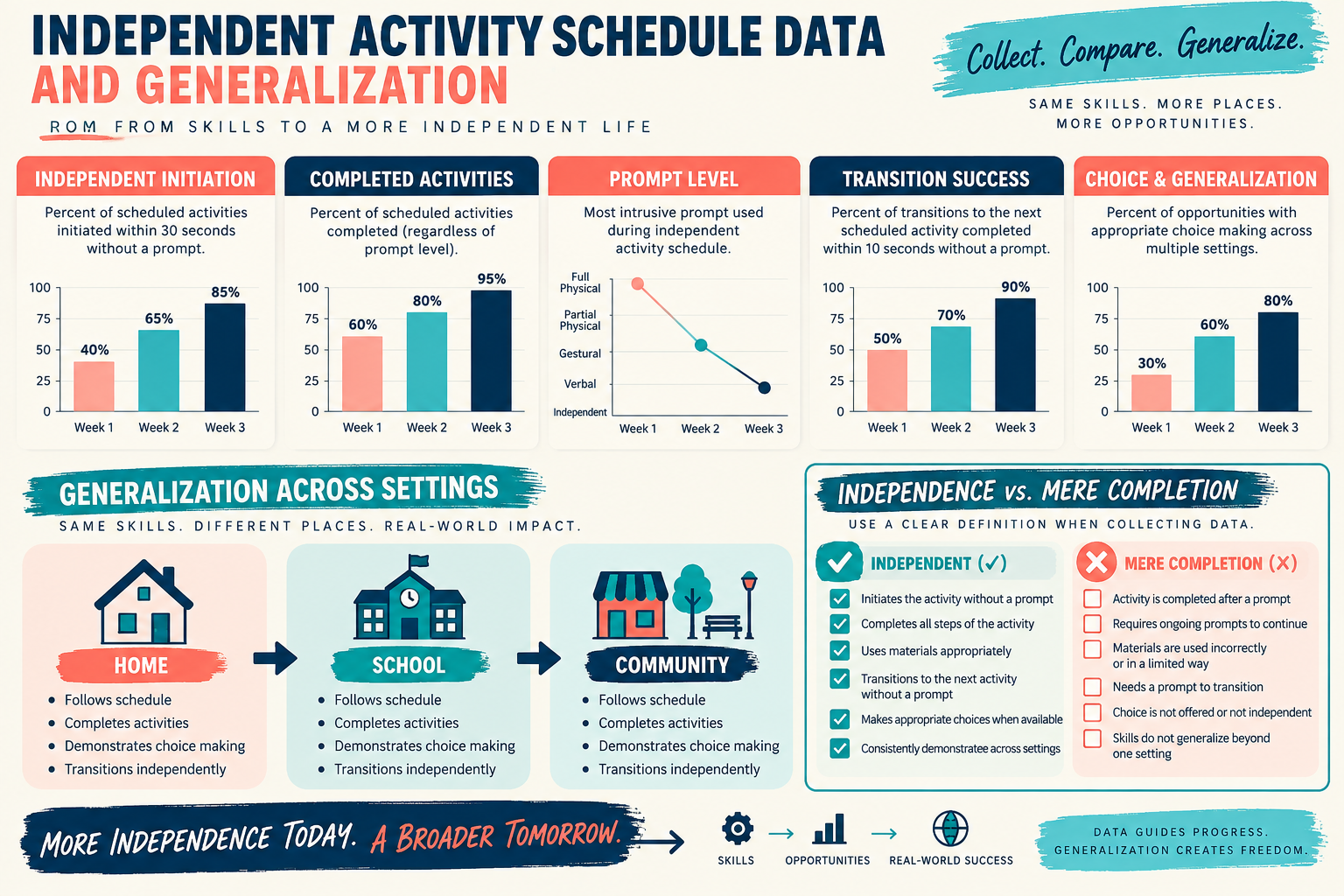
Measure the behavior the schedule is intended to change, not just whether the final task was completed. A learner can complete every activity after continuous adult prompting and still have low independent schedule use. Conversely, a learner may independently check a cue and request help appropriately even when an activity is unavailable.
- Independent initiation: whether the learner checks or acts on the cue within a defined opportunity without a prompt.
- Activity completion: whether the defined steps are completed, with prompt level recorded separately.
- Schedule interaction: whether the learner marks an item finished and returns to the schedule.
- Transition: whether the learner moves to the next activity within a defined time or after an appropriate communication response.
- Choice and flexibility: whether the learner selects among available options, accepts a change, or uses a help/pause signal.
- Generalization: whether the schedule skill occurs with different people, materials, settings, and activity types.
Choose denominators that match the question. “Four activities completed” does not reveal whether the learner initiated any activity. “80% independent” is not interpretable unless the team states what counted as an opportunity and whether prompts were available. The data sheet should distinguish no opportunity, unavailable materials, refusal, prompt dependence, and independent use when those distinctions affect a decision.
How Can the Schedule Be Generalized?
Generalization means more than using the same board in a second room. Plan variation in people, settings, materials, activity order, cue format, and the amount of naturally available help. A learner might first use a photo sequence for familiar leisure activities, then use written cues for classroom routines or a work task if that matches the learner’s goals.
Offer meaningful choice when choice is part of the learner’s priorities. An activity schedule should not become a device for enforcing an adult-selected sequence when the learner could reasonably choose between options. A change card, help card, or pause signal may support flexibility while protecting communication and assent.
Maintenance checks can be brief and planned. Look at whether the learner still approaches the schedule, uses the completion signal, and transitions with less assistance after the direct teaching period changes. If performance drops, examine the cue, materials, activity value, and prompt history before assuming the learner has “lost” the skill.
What Problems Can Make a Schedule Less Independent?
- The cue is not meaningful: a generic icon may not tell the learner what action is available.
- The sequence is too long: too many items can overload working memory or make the next action unclear.
- Completion is ambiguous: without a finished response, the learner may wait for adult confirmation.
- Activities are not actually available: an inaccessible or missing item weakens trust in the schedule.
- Prompts are hidden: calling a prompted completion “independent” makes the data look better than the skill is.
- The schedule is used as compliance pressure: removing choice, breaks, or communication can create avoidable refusal or distress.
- Adults vary in implementation: inconsistent cue placement or completion rules makes the schedule harder to discriminate.
How Should Ethical and Person-Centered Checks Shape the Plan?
The BACB ethics resources provide context for considering dignity, competence, collaboration, informed participation, and meaningful outcomes. An activity schedule should expand access to participation and independence, not make a learner easier to manage for someone else’s convenience.
Ask whether the activities matter to the learner, whether a refusal or pause can be communicated, and whether the schedule includes reasonable flexibility. Review whether the learner’s sensory, cultural, communication, and motor needs are represented in the design. If an activity creates a safety or health concern, involve qualified professional oversight rather than treating a generic schedule article as a protocol.
How Is Independent Activity Schedule Tested on the BCBA Exam?
Exam questions may ask you to distinguish a visual support from an independent activity schedule, select a useful measure, or identify why a learner remains prompt dependent. Look for the answer that defines the learner’s observable schedule interaction and records prompt level separately from task completion.
A common distractor is to choose an adult-directed checklist because all activities were completed. Another is to remove the schedule when the learner needs help, rather than teaching a help response or improving the cue. The best answer usually connects stimulus control, prompting and fading, skill acquisition, data-based decisions, generalization, and social validity.
What Is the Bottom Line?
An independent activity schedule in ABA is a teachable cue sequence that helps a learner identify, complete, and transition between meaningful activities with decreasing adult direction. The most important outcome is not a full checklist. It is reliable access to information, communication, choice, and participation. For a focused review of prompting, measurement, and skill-acquisition concepts, try the free BCBA mock exam. Practice questions can sharpen your reasoning, but they do not replace supervision, assessment, or an individualized plan.
For targeted review, use our independent activity schedule ABA practice questions to apply the concept in exam-style scenarios.
Quick Review Checklist
Use this final checklist to turn independent activity schedule ABA into exam-ready reasoning. The goal is not to memorize a label in isolation; it is to identify the relevant evidence and explain why the best answer fits the scenario. Key ideas to review:
- State the central definition or decision point for independent activity schedule ABA in your own words.
- Identify the detail that makes independent activity schedule ABA different from its closest related ABA term.
- Separate the observable facts in a scenario from assumptions that are not supported by the facts.
- Write one example and one nonexample so you can recognize the concept in a new setting.
Exam application checks:
- Ask what the question is actually requesting before comparing the answer choices.
- Mark the antecedent, response, consequence, or other evidence that supports the selected answer.
- Look for a distractor that describes a related process but does not answer the specific question.
Final self-check:
- Explain how you would verify the interpretation with clear observations or data.
- Change one detail in the scenario and decide whether your answer should change.
- Give a one-sentence rationale that a supervisor or study partner could evaluate.
Take the Free BCBA Mock Exam
When you are ready to apply the idea, use the free practice resource below for additional feedback. Take the Free BCBA Mock Exam



