
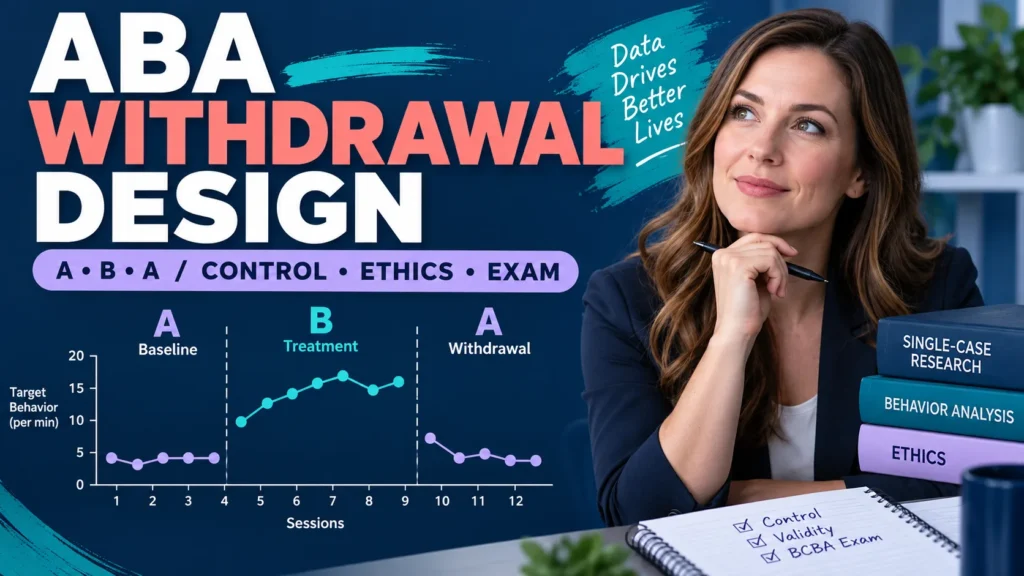
A source-first BCBA guide to A-B-A phases, worked examples, functional control, withdrawal-versus-reversal terminology, and ethical decision making. If you are studying aba withdrawal design, start with the phase sequence rather than the name. A withdrawal design introduces an intervention after baseline, then removes or withdraws that intervention to see whether behavior changes back toward its earlier pattern. The classic sequence is A-B-A: baseline, intervention, and withdrawal. An extended version may reintroduce treatment as A-B-A-B.
Table of Contents
- aba withdrawal design: The Short Answer
- How the A-B-A Sequence Works
- Withdrawal Versus Reversal Design
- Worked ABA Withdrawal Design Example
- Ethics, Feasibility, and Limitations
- The Exam-Ready Rule
- Practice the Design Decision
- Frequently Asked Questions
- Quick Review Checklist
- Take the Free BCBA Mock Exam
The design can strengthen an argument that the intervention caused a behavior change because the same case is observed across changing conditions. But it is not automatically appropriate just because it produces a clear graph. Withdrawing an effective treatment can be unsafe, unethical, impractical, or impossible to reverse. A BCBA must evaluate client welfare, assent, consent, risk, feasibility, and the purpose of the analysis before considering the A2 phase.
Study note: A withdrawal design is a research and evaluation arrangement, not a recommendation to remove a client’s support. The current BACB Ethics Code, the service agreement, state rules, and the client’s welfare remain more important than a tidy experimental sequence.
aba withdrawal design: The Short Answer
An ABA withdrawal design is a single-case design that compares behavior during a baseline condition, an intervention condition, and a return to the baseline or comparison condition. “A” represents the baseline or comparison condition, and “B” represents the intervention. The word withdrawal emphasizes that the intervention is removed during the later A phase.
For example, a team might measure the number of classroom disruptions during baseline, introduce a reinforcement-based intervention, and then remove the intervention only if doing so is safe and justified. If disruptions increase again during withdrawal, the pattern is consistent with the intervention having affected behavior. That pattern is evidence, not proof detached from the quality of the baseline, measurement, phase timing, and alternative explanations. The main questions are:
- Was the baseline stable enough to interpret a later change?
- Did behavior change when the intervention began?
- Did behavior move toward the earlier pattern when the intervention was withdrawn?
- Was withdrawal safe, ethical, feasible, and consistent with consent and the service plan?
- Would an ABAB extension or another single-case design provide evidence without creating unacceptable risk?
How the A-B-A Sequence Works
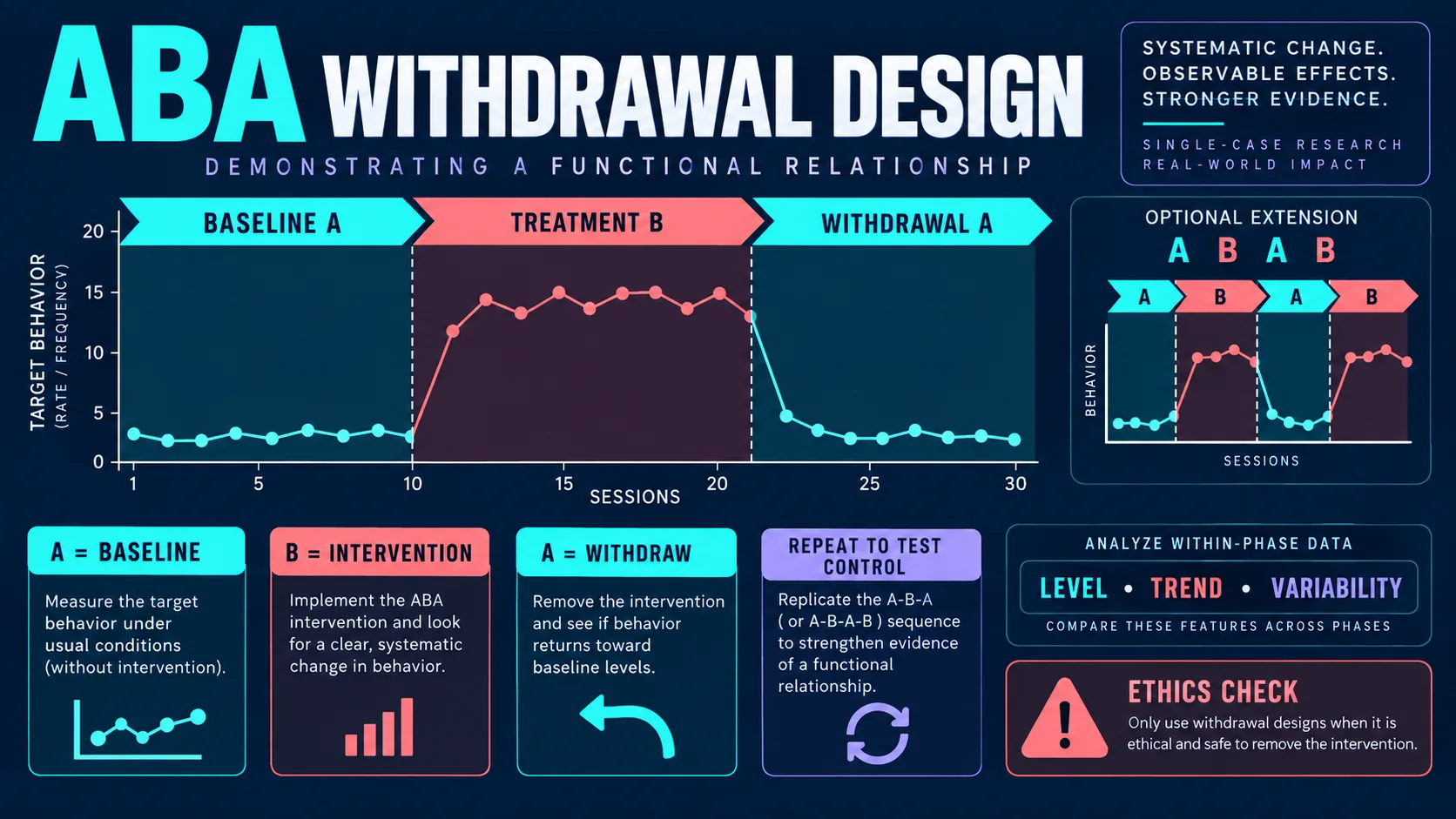
The letters are conditions, not simply calendar labels. Each phase should have a clear operational definition, a defined measurement system, and a reason for the phase change. The analyst evaluates level, trend, variability, immediacy of effect, overlap, and replication rather than relying on one dramatic data point.
| Phase | What happens | What to examine |
|---|---|---|
| A1: Baseline | Measure the target behavior under the comparison condition before the intervention. | Stability, trend, variability, measurement quality, and whether the baseline is safe to continue. |
| B: Intervention | Implement the defined treatment and collect data systematically. | Immediacy, level change, trend, variability, treatment fidelity, and competing events. |
| A2: Withdrawal | Remove or return from the intervention to the comparison condition when it is justified. | Whether behavior moves toward A1, whether risk increases, and whether the withdrawal should stop. |
| Optional ABAB | Reintroduce the intervention to replicate the effect and, when possible, finish with treatment. | Replication, practical benefit, maintenance, and the learner’s safety during each phase. |
A stable baseline is helpful because it makes a phase change easier to interpret, but “stable” does not mean perfectly flat. A baseline can have a trend or variability that must be considered when judging whether the B phase produced a meaningful change. If the measurement system changes between phases, the graph may show a measurement artifact rather than a treatment effect.
Withdrawal Versus Reversal Design
Research and teaching materials sometimes use withdrawal and reversal as if they were identical. They are closely related, but the emphasis can differ. A withdrawal design removes the intervention and returns toward a comparison condition. A reversal design emphasizes changing the experimental condition and demonstrating that behavior changes in the corresponding direction. In a practical BCBA exam question, read the phase descriptions instead of choosing based only on the label.
| Term | Core emphasis | Exam clue |
|---|---|---|
| Withdrawal | The intervention is removed or reduced in a later phase. | Look for a return toward the pre-intervention comparison pattern. |
| Reversal | The experimental condition is changed and then changed back or reversed to replicate an effect. | Focus on the repeated correspondence between condition changes and behavior changes. |
| ABAB extension | Treatment is reintroduced after the second A phase. | A final B phase can replicate the effect and may be preferable because the case ends with treatment. |
Terminology can vary by textbook and research tradition. The defensible answer is to identify what the analyst actually did: baseline, intervention, removal, reintroduction, or a change to another condition.
Worked ABA Withdrawal Design Example
Imagine a student whose target behavior is calling out during independent work. The team defines a call-out as speaking aloud without being called on while the teacher is giving independent-work instructions. The team records the number of call-outs during each ten-minute observation.
- A1: During baseline, the student averages 8–10 call-outs across several sessions. The data are reasonably stable, and the team documents the classroom context.
- B: The team introduces a reinforcement procedure for raising a hand and waiting. Call-outs decrease to 2–3 per session while treatment fidelity remains high.
- A2: If the team has a defensible reason and the risk is low, the reinforcement procedure is withdrawn. Call-outs rise toward the earlier level.
- B2: If an ABAB extension is justified, the intervention is reintroduced. Call-outs decrease again, providing a stronger replication pattern.
The graph supports a functional relation when changes in behavior repeatedly correspond with changes in the condition, while alternative explanations are less plausible. The analyst should still examine whether the teacher changed, the assignment difficulty shifted, the student was absent, measurement drift occurred, or another support was introduced at the same time.
Ethics, Feasibility, and Limitations
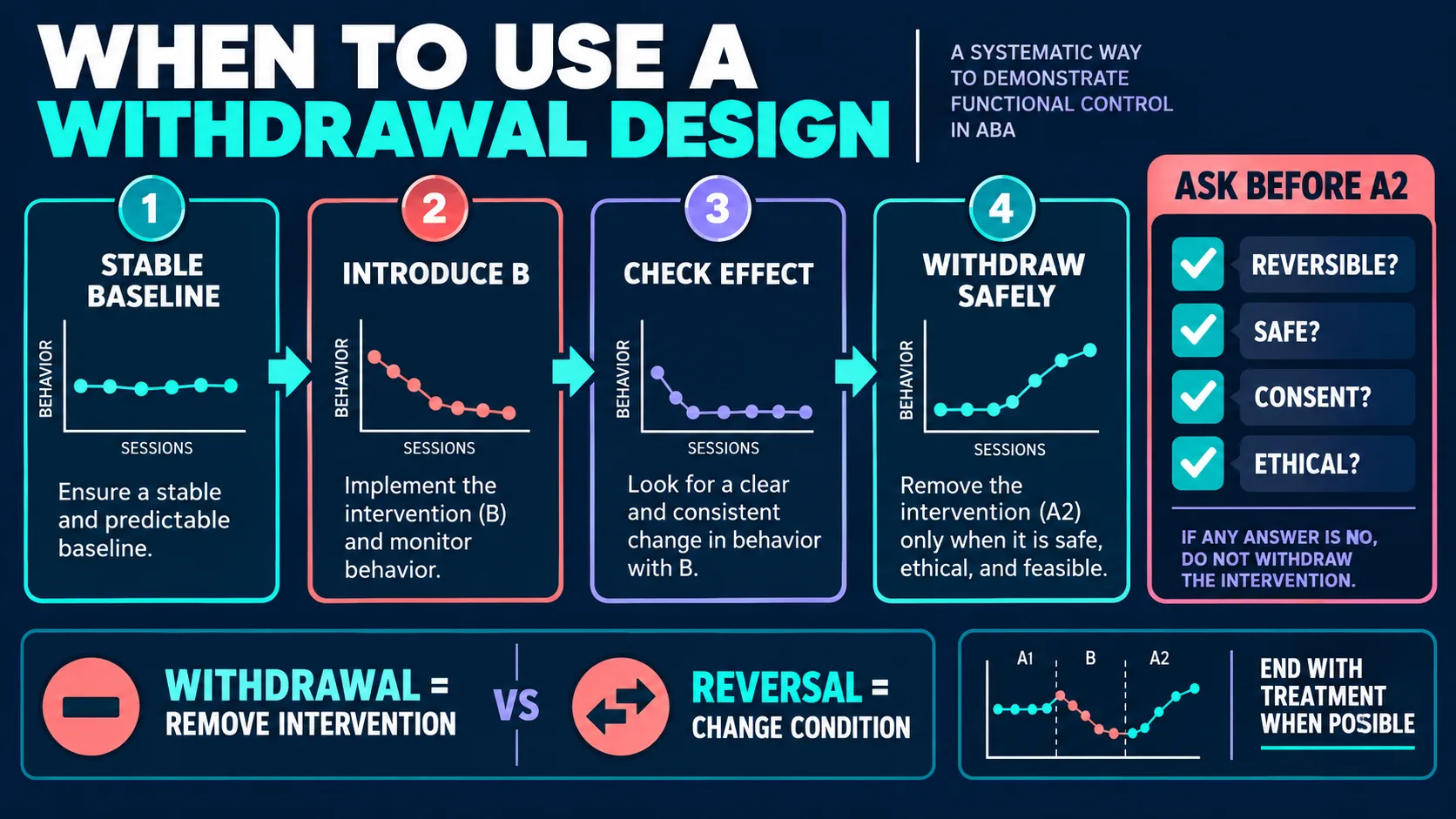
The A2 phase is not a default step. Before withdrawal, ask:
- Is the behavior reversible? Withdrawing an effective safety or communication intervention may produce a serious or lasting cost.
- Is the risk acceptable? A design that may increase self-injury, aggression, elopement, medical risk, or severe distress needs a different plan or should not proceed.
- Is there informed consent and assent? The people affected by the service should understand the plan as appropriate to their role, and the learner’s assent-related signals must be respected.
- Is there a less risky design? Multiple-baseline, changing-criterion, alternating-treatment, or other designs may demonstrate effects without withdrawing a beneficial intervention.
- Will treatment resume promptly? When an ABAB design is justified, ending with treatment may better protect the learner than leaving the case in A2.
Withdrawal designs also have methodological limits. A return toward baseline can support a functional interpretation, but it may not occur if the learner has learned a durable skill, the treatment has a maintenance effect, the behavior is irreversible, or the A2 condition is not actually equivalent to A1. The absence of reversal does not automatically mean the intervention did not work.
For a deeper methods explanation, compare the open-access single-case design discussion from the National Library of Medicine with the primary Journal of Applied Behavior Analysis withdrawal-design paper. These sources are useful because they show why design choice and ethical feasibility have to be evaluated together.
The Exam-Ready Rule
When a BCBA question presents an A-B-A graph, identify the condition first and the label second:
- Find the stable comparison or baseline phase.
- Find the phase in which the intervention was introduced.
- Check whether the behavior changed in the predicted direction and whether measurement remained consistent.
- Identify whether the later A phase removed the intervention or changed to a different condition.
- Evaluate safety, consent, assent, treatment fidelity, and alternative explanations before calling the pattern evidence of control.
Common traps include calling every ABAB graph “withdrawal” without reading the phases, assuming a return toward baseline proves causation by itself, and choosing to withdraw treatment despite clear risk. The strongest answer respects both experimental logic and client welfare.
Practice the Design Decision
Once the A-B-A pattern is clear, scenario practice can help you distinguish design terminology from ethical action. The goal is not to memorize that “A means baseline” and stop there. Ask what the phase change was, what the data support, and whether the next action protects the learner.
The Free BCBA Mock Exam can help you practice single-case design scenarios. After each question, explain the phase sequence in your own words and identify the ethics or feasibility issue before checking the answer rationale.
Frequently Asked Questions
What is an ABA withdrawal design?: It is a single-case design that measures behavior during a baseline A phase, an intervention B phase, and a later A phase in which the intervention is withdrawn or the comparison condition returns. The aim is to examine whether behavior changes correspond with the condition changes.
Is ABA withdrawal design the same as ABAB reversal design?: They are closely related and are sometimes labeled interchangeably. Withdrawal emphasizes removing the intervention; reversal emphasizes changing the experimental condition and demonstrating a corresponding behavior change. Read the actual phase descriptions in the scenario.
Why add a B2 phase?: Reintroducing the intervention can replicate the effect and strengthen the functional interpretation. It can also allow the case to end with treatment, although the decision still depends on safety, consent, feasibility, and the service plan.
When should a withdrawal design not be used?: Do not withdraw a beneficial intervention when doing so would create unacceptable risk, serious distress, loss of essential communication or safety skills, or a foreseeable lasting harm. Consider a design that does not require treatment removal.
What should I look for on the BCBA exam?: Identify A and B conditions, examine the direction and replication of behavior change, check measurement and alternative explanations, and apply the ethics and client-welfare gate before recommending withdrawal.
Bottom line: An ABA withdrawal design is more than an A-B-A label. It is a structured comparison of conditions that can support functional control when the data and design are sound, but it must never outrank safety, consent, assent, competence, and the learner’s long-term benefit.
Quick Review Checklist
Use this final checklist to turn aba withdrawal design into exam-ready reasoning. The goal is not to memorize a label in isolation; it is to identify the relevant evidence and explain why the best answer fits the scenario. Key ideas to review:
- State the central definition or decision point for aba withdrawal design in your own words.
- Identify the detail that makes aba withdrawal design different from its closest related ABA term.
- Separate the observable facts in a scenario from assumptions that are not supported by the facts.
- Write one example and one nonexample so you can recognize the concept in a new setting.
Exam application checks:
- Ask what the question is actually requesting before comparing the answer choices.
- Mark the antecedent, response, consequence, or other evidence that supports the selected answer.
- Look for a distractor that describes a related process but does not answer the specific question.
Final self-check:
- Explain how you would verify the interpretation with clear observations or data.
- Change one detail in the scenario and decide whether your answer should change.
- Give a one-sentence rationale that a supervisor or study partner could evaluate.
Take the Free BCBA Mock Exam
When you are ready to apply the idea, use the free practice resource below for additional feedback. Take the Free BCBA Mock Exam



