
What Is Shaping in ABA? A Definition for BCBA Candidates
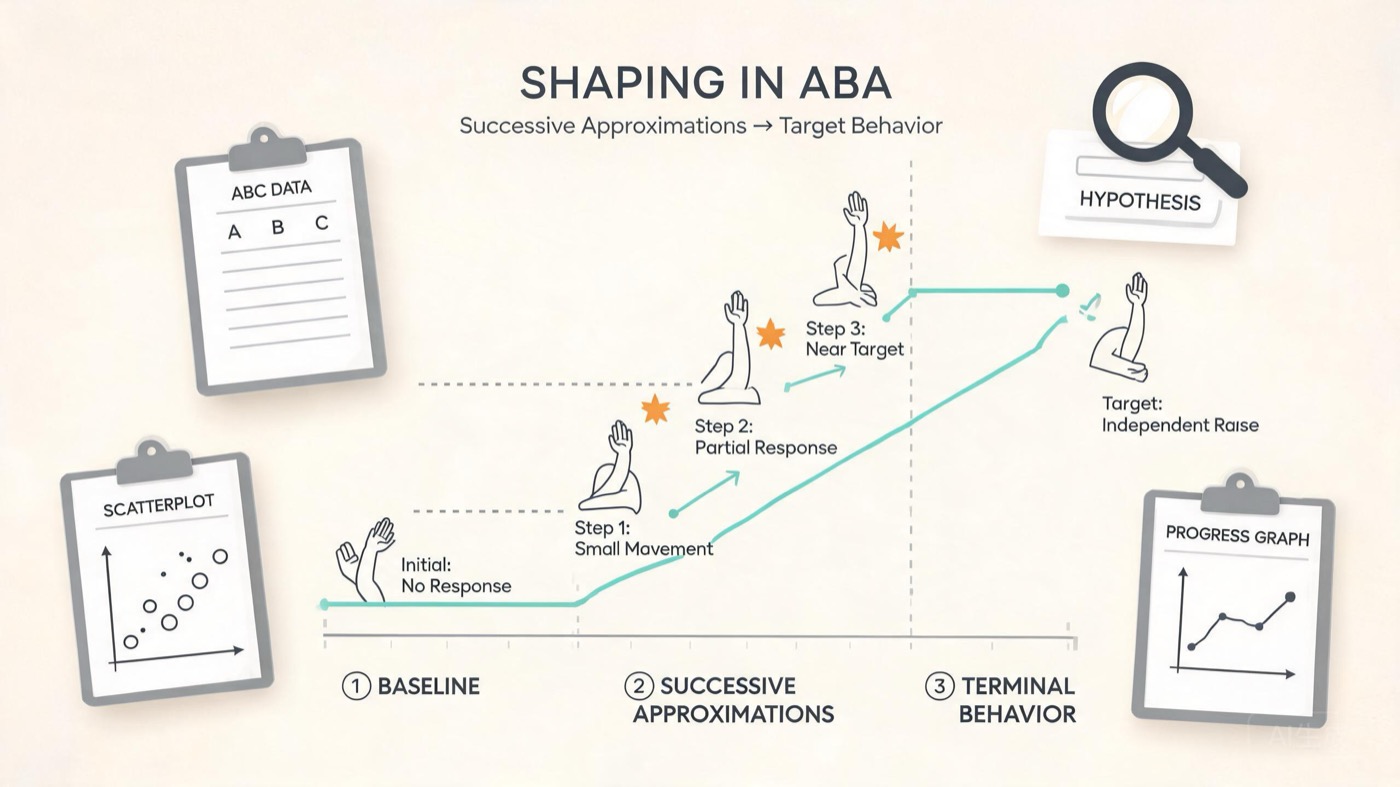
Shaping is a procedure used in Applied Behavior Analysis (ABA) to develop a new behavior by systematically reinforcing successive approximations toward a terminal behavior. The process begins with a baseline behavior that the learner already exhibits, then each step is reinforced only if it is closer to the final target. This method is especially useful when the target behavior is not currently in the learner’s repertoire.
Table of Contents
- What Is Shaping in ABA? A Definition for BCBA Candidates
- Three Real-World Shaping Behavior Examples with ABC Analysis
- Common Exam Traps: How to Avoid Misidentifying Shaping
- Quick Checklist for Applying Shaping on the Exam
- Summary: Shaping Behavior Examples for Your BCBA Exam Prep
The key components include:
- Baseline behavior – the starting point, something the learner already does.
- Terminal behavior – the final desired behavior.
- Successive approximations – a sequence of steps, each closer to the terminal behavior.
- Differential reinforcement – only the current approximation is reinforced; previous approximations are placed on extinction.
Shaping is a cornerstone of ABA and frequently appears on the BCBA exam. Understanding how to identify and apply shaping in real-world scenarios is crucial for passing.
Three Real-World Shaping Behavior Examples with ABC Analysis
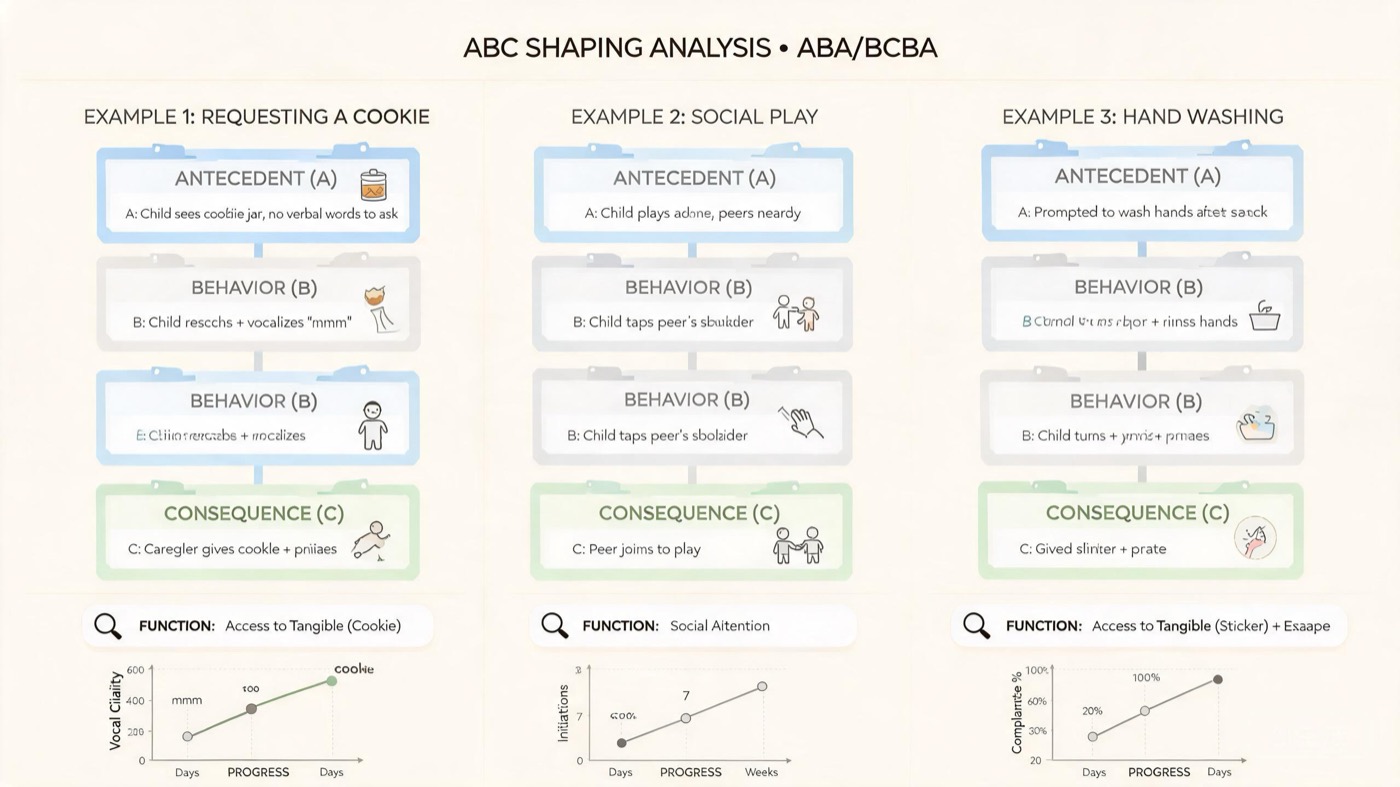
Each example includes an ABC analysis (Antecedent-Behavior-Consequence) and the hypothesized function of the behavior. These shaping behavior examples are designed to mirror what you might encounter on the exam.
Example 1: Teaching a Child to Request a Snack Using Vocal Approximations
A young child with limited vocal skills wants a cookie. The BCBA designs a shaping program:
- Baseline: Child points to the cookie jar.
- Step 1: Reinforce a vocal grunt (e.g., “uh”) immediately after pointing.
- Step 2: Reinforce the sound “buh” (approximation for “cookie”).
- Step 3: Reinforce “cuh” or “coo”.
- Terminal: Reinforce a clear “cookie” or “cookie please”.
ABC Analysis:
- Antecedent: Cookie jar is visible (motivating operation: hunger).
- Behavior: Successive vocal approximations (e.g., “buh”, “cuh”).
- Consequence: Therapist delivers a piece of cookie.
- Function: Access to tangibles.
This example demonstrates how shaping can build complex verbal behavior from simple responses.
Example 2: Shaping a Teenager’s Tooth-Brushing Duration
A teenager with autism brushes teeth for only 5 seconds. The goal is 2 minutes.
- Baseline: 5 seconds of brushing.
- Step 1: Reinforce 10 seconds of continuous brushing.
- Step 2: Reinforce 20 seconds.
- Step 3: Reinforce 40 seconds, then 1 minute, then 1.5 minutes, finally 2 minutes.
ABC Analysis:
- Antecedent: Timer set for 10 seconds; toothpaste ready.
- Behavior: Brushing for 10 seconds.
- Consequence: Praise and a sticker on a chart.
- Function: Negative reinforcement (escape from bad breath later) and positive reinforcement (access to preferred activity after brushing).
This example highlights how shaping can increase the duration of a behavior.
Example 3: Increasing Eye Contact Duration in a Preschooler
A preschooler with social delays maintains eye contact for only 0.5 seconds. The BCBA shapes longer durations.
- Baseline: 0.5 seconds of eye contact.
- Step 1: Reinforce 1 second.
- Step 2: Reinforce 2 seconds.
- Step 3: Reinforce 4 seconds, then 8 seconds, up to 10 seconds.
ABC Analysis:
- Antecedent: Therapist says “Look at me” and holds a small toy near eyes.
- Behavior: Eye contact for 1 second.
- Consequence: Smile, praise, and brief access to toy.
- Function: Social positive reinforcement.
Common Exam Traps: How to Avoid Misidentifying Shaping
Many BCBA candidates confuse shaping with other ABA procedures. Here are the most common traps and how to avoid them.
Shaping vs. Chaining vs. Fading
- Shaping changes the topography or quality of a single behavior (e.g., from grunt to word). It is used when the behavior does not yet exist.
- Chaining links a sequence of discrete behaviors (e.g., washing hands: turn tap, soap, rinse). The individual steps are already in the repertoire.
- Fading removes prompts over time; the behavior itself remains the same, but the stimulus control shifts.
Trap example: A question describes reinforcing “step 1” then “step 2” of a hand-washing routine. That is chaining, not shaping.
Overlooking Successive Approximations
Each step must be closer to the terminal behavior, not just any behavior. For instance, reinforcing any vocalization when the target is a specific word is not shaping unless the vocalization is an improvement over the baseline. Reinforcing unrelated sounds would be ineffective.
Another trap: Reinforcing the same behavior repeatedly without requiring a closer approximation. That is just reinforcement of a single response class, not shaping.
Quick Checklist for Applying Shaping on the Exam
When you see a scenario that might involve shaping, use this checklist to confirm:
- Identify the terminal behavior – what is the final target?
- Identify the baseline behavior – what does the learner currently do?
- Are there successive approximations – a sequence of steps leading to the target?
- Is differential reinforcement used – only the best approximation is reinforced?
- Is the behavior new or is it a link in a chain? If it’s a new form, it’s shaping.
Use this checklist to quickly rule out chaining or fading when the question is about shaping.
Summary: Shaping Behavior Examples for Your BCBA Exam Prep
Shaping is a powerful tool for building new behaviors, and the BCBA exam expects you to understand its components and applications. The shaping behavior examples in this guide show how to apply successive approximations and differential reinforcement in realistic settings. Remember to watch out for common traps, especially confusing shaping with chaining or fading. For more exam-ready resources, check out our guide on shaping in ABA and BCBA exam prep guide. Additionally, you can refer to the BACB website for the official task list and more example scenarios. Good luck with your studies!
Complete BCBA Exam Prep
Turn this topic into exam-day practice
Practice concepts in context with five full-length 6th Edition mock exams, two bonus practice exams, a 6th Edition study guide, and key-term flashcards—all in one $120 USD package.
Get the $120 All-in-One Prep Pack
Review everything included on the product page before ordering. No pass guarantee is implied.



