
SELF-INJURY · FUNCTION-BASED ABA The best replacement behaviors for self-injurious behavior ABA does not come from a generic list of calming activities. A replacement response should be safer, teachable, meaningful, and functionally related to what the self-injury has produced. New or severe self-injury also requires qualified clinical and medical attention.
Table of Contents
- What Should Happen Before Choosing a Replacement Behavior?
- What Are Replacement Behaviors for Self-Injury in ABA?
- Why Does Function Matter?
- How Do You Choose a Replacement Behavior?
- How Do You Teach and Monitor the New Response Safely?
- What Does a Function-to-Response Example Look Like?
- What Are the BCBA Exam Takeaways?
- Frequently Asked Questions
- Sources for Further Study
- Take the Free BCBA Mock Exam
What Should Happen Before Choosing a Replacement Behavior?
Self-injurious behavior (SIB) can include responses directed toward a person’s own body that cause or could cause tissue damage. The first step is not selecting a token, sensory item, or communication card. The team must determine whether there is an immediate injury, medical concern, medication or sleep issue, pain, seizure concern, environmental danger, or another factor requiring appropriate professional evaluation.
If a person is injured, at immediate risk, or showing a sudden change, follow the organization’s emergency and medical procedures and contact qualified professionals. Do not wait for a behavior plan to solve a medical emergency. A BCBA learner should work within training, supervision, authorization, and local requirements; an online article cannot assess a person or replace a crisis plan.
After immediate safety is addressed, define the behavior in observable terms. “Self-harm” or “meltdown” is not enough to select an intervention. A useful definition specifies the response form, when it starts and stops, intensity or injury level when relevant, and the context in which it occurs. Accurate description makes functional assessment and progress measurement possible.
What Are Replacement Behaviors for Self-Injury in ABA?
A replacement behavior is a response taught to meet an important need more safely than the target behavior. In function-based ABA, the replacement should often be functionally equivalent: it produces the same class of outcome that has reinforced the self-injury, while requiring a reasonable amount of effort and remaining socially valid for the person.
For example, if self-injury reliably produces escape from an overwhelming demand, a replacement might communicate “break,” “help,” or “different task” in a form the person can use. If the behavior produces attention, the alternative may be an attention request. If it produces access to a tangible item, a request or waiting response may be relevant. Those examples are not interchangeable prescriptions. The function, communication system, safety context, and learner’s existing repertoire determine what is appropriate.
A replacement does not have to look like the self-injury. It has to compete with the outcome that maintains it and be efficient enough to use when the establishing conditions are present. Teaching a difficult, slow response while adults continue to deliver the reinforcer after SIB is unlikely to produce a stable change.
Why Does Function Matter?
Topography tells you what the self-injury looks like. Function concerns the environmental relation that makes the response more likely to occur or continue. The same topography can have different functions for different people, and one person can show multiply maintained behavior across contexts.
Functional assessment may include records review, interviews, direct observation, descriptive assessment, and, when appropriate and safely designed by qualified professionals, functional analysis. The purpose is to test or refine hypotheses rather than guess from appearance. “It happens when work is presented” is a useful observation; “the person wants attention” is a hypothesis that still needs evidence.
Functional communication training (FCT) is one well-studied example of function-based replacement teaching. FCT teaches a recognizable communication response and arranges the relevant reinforcer for that response. The response might be vocal, signed, gestural, aided, or another accessible form of communication. The review literature also emphasizes that assessment, response effort, caregiver training, schedule changes, and generalization affect outcomes.
How Do You Choose a Replacement Behavior?
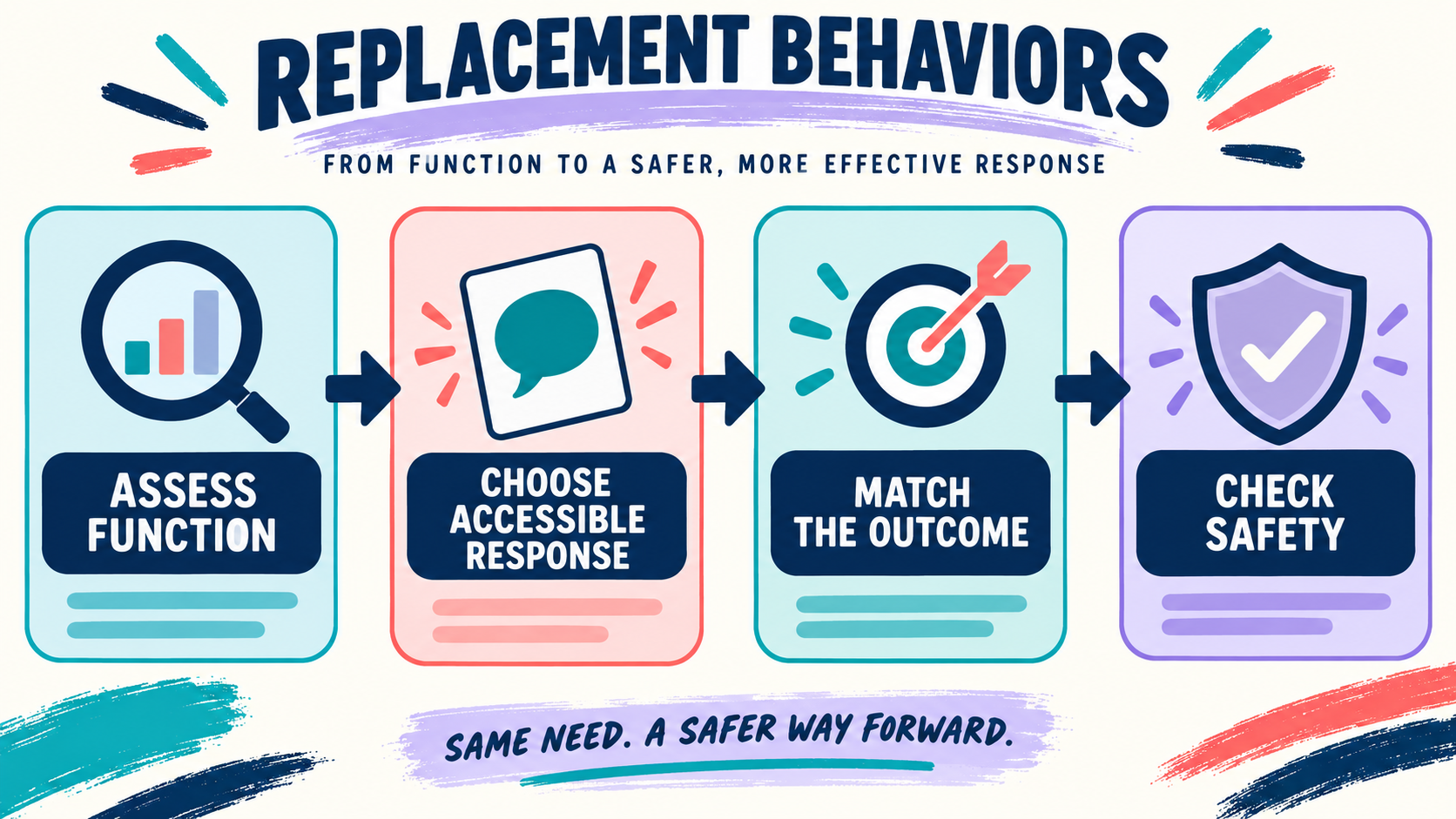
Use a decision screen rather than a memorized list:
- Match the function. Identify whether the relevant outcome involves attention, escape, access, automatic reinforcement, or multiple variables.
- Choose an accessible response. The person must be able to perform or learn it under the conditions in which SIB occurs.
- Keep response effort reasonable. A replacement that takes ten steps may not compete with a rapid response that has a long reinforcement history.
- Preserve communication. Include help, break, protest, all-done, pain, and choice responses when they are relevant—not only requests to continue an adult-selected task.
- Check safety and dignity. The response should not create a new risk, require unnecessary physical contact, or turn a valid preference into a compliance target.
- Plan the consequence. The team needs a clear, ethical plan for how the replacement contacts reinforcement and how safety is maintained when SIB occurs.
| Possible function hypothesis | Replacement response category | What the team must still verify |
|---|---|---|
| Escape or reduction of a demand | A functional break, help, pause, or task-modification request. | Whether the response is honored safely, the task is adjusted appropriately, and teaching does not require ignoring distress. |
| Social attention | An accessible attention request, greeting, tap, sign, or communication device response. | Who responds, how quickly, and whether attention is available for safe communication across settings. |
| Tangible or activity access | A request, choice, waiting, or transition response matched to the access routine. | Whether delay, denial, and changes in availability are taught safely and predictably. |
| Automatic or sensory variables | A safer competing or incompatible response, environmental change, or sensory support selected by the clinical team. | Whether the proposed response actually competes with the sensory consequence and remains safe across intensity and context. |
The table describes reasoning categories, not a do-it-yourself protocol. Automatic reinforcement can be especially difficult to match, and protective or competing responses may require specialized assessment. Do not assume that a fidget, squeeze item, or exercise will replace a behavior simply because it looks sensory.
How Do You Teach and Monitor the New Response Safely?
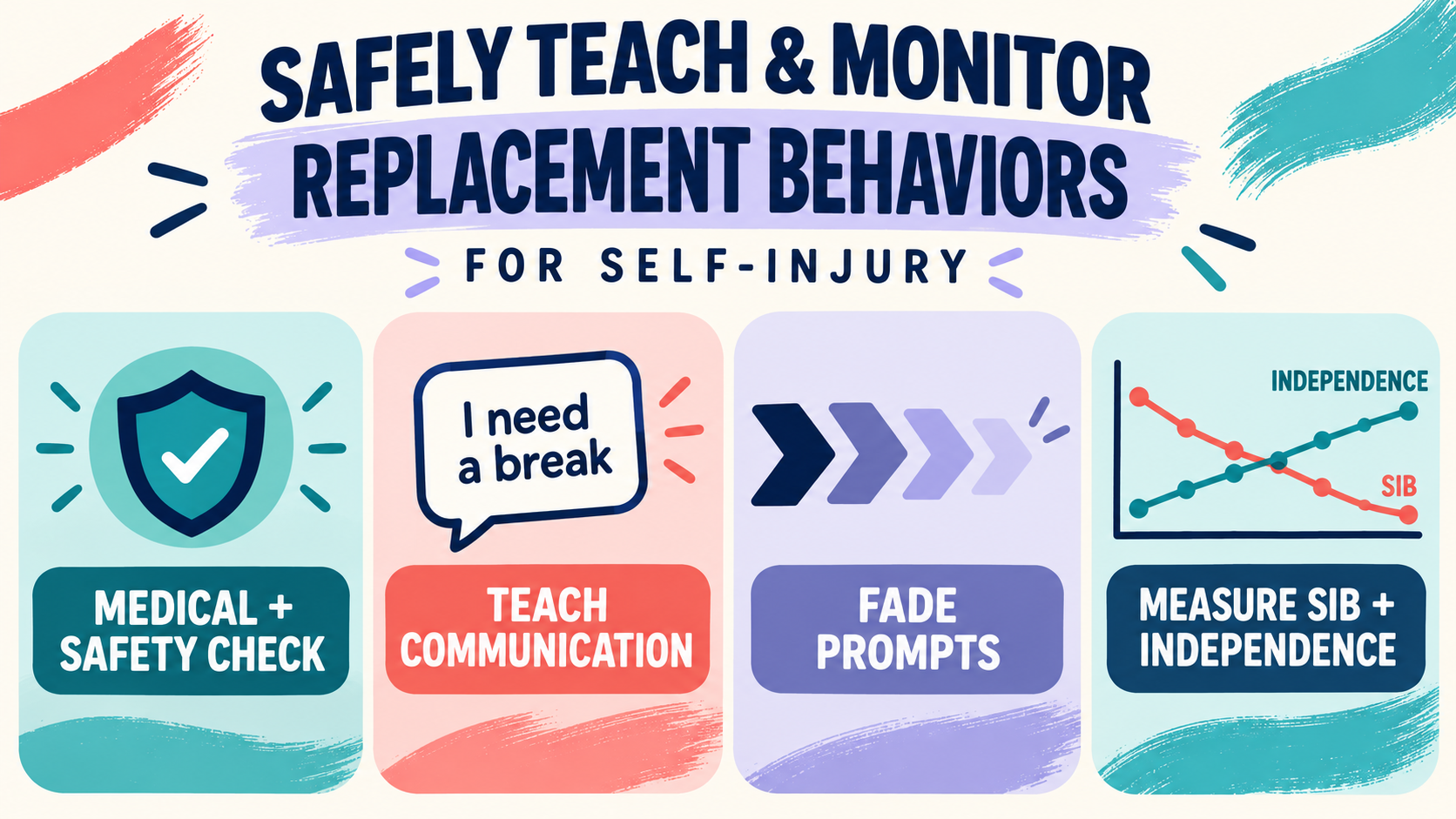
Teaching often begins when the relevant motivation or context is present but before the person reaches a dangerous level of distress. The practitioner makes the replacement response easy to emit, prompts it according to the approved plan, and delivers the functionally relevant consequence quickly when the response occurs. The goal is to establish independent communication or skill, not to create a new prompt-dependent ritual. Measure more than whether SIB decreased. Track at least some of the following:
- frequency, rate, duration, intensity, or injury severity of SIB using the defined measure;
- independent replacement responses and prompted replacement responses separately;
- latency from the relevant antecedent to the replacement response;
- which prompt level was required and whether prompts are fading;
- access to the relevant reinforcer, delay tolerance, generalization, and maintenance;
- side effects such as distress, escalation, new problem behavior, or loss of communication.
Safety procedures can include environmental protections, trained staff, medical coordination, protective equipment when clinically justified, and emergency escalation. A recent scoping review of functional analyses involving SIB underscores why protective procedures and their rationale should be documented. Safety modifications should be designed and trained by qualified professionals; they are not shortcuts around assessment.
Schedule thinning and delayed reinforcement may be necessary later, but they should not be rushed. If the replacement stops working when the reinforcer is delayed, the team may need to review response effort, competing reinforcement, communication access, and the accuracy of the function hypothesis.
What Does a Function-to-Response Example Look Like?
Consider a hypothetical learner who hits their head when a difficult activity begins. A single observation is not enough to conclude that escape maintains the response. Suppose repeated assessment shows that demands reliably precede SIB and that task removal follows. The team might teach a low-effort “break” or “help” response, arrange a safe and predictable consequence, adjust task difficulty, and measure independent requests, SIB, and prompt levels.
Now change the context: the same topography occurs when the learner is alone, appears during quiet periods, and does not reliably produce attention or escape. An attention request may be irrelevant. The team may need additional assessment of automatic variables, pain, sleep, medication, sensory context, or other medical and environmental factors. The visible form is the same; the replacement decision is not.
In both cases, the ethical question is broader than “did the person stop?” Did the learner gain a safer way to communicate or regulate? Was the goal meaningful? Were choices and protest honored? Did the intervention reduce risk without creating new harm? Did the data support the decision?
What Are the BCBA Exam Takeaways?
For a BCBA question about replacement behaviors for self-injurious behavior ABA, the strongest answer usually begins with assessment and safety, then selects a functionally equivalent, accessible response and reinforces it according to the identified contingency. Do not choose a generic calming activity simply because the question says “replacement.”
- Define SIB observably and check medical and immediate-safety variables.
- Use functional assessment to identify the relevant maintaining consequence.
- Choose a low-effort, accessible communication or competing response when appropriate.
- Measure independent and prompted replacement responding separately.
- Monitor SIB, side effects, generalization, maintenance, and safety—not just compliance.
For additional study scenarios in assessment, behavior change, and ethics, the site’s free BCBA mock exam is an independent practice resource. It is not official BACB content and does not guarantee certification.
Frequently Asked Questions
Can a replacement behavior be any behavior that is safer?: Safety matters, but a replacement also needs to be functionally relevant, accessible, socially valid, and teachable. A response that is safe but does not contact the relevant outcome may not compete with SIB.
Should self-injury be ignored while teaching the replacement?: Do not apply an extinction or crisis procedure based on an article. Severe behavior can make withholding a reinforcer unsafe, and the response plan must be designed, trained, and supervised by qualified professionals with appropriate safeguards.
What if the self-injury appears to be automatic?: Automatic variables require careful assessment; the team may consider competing or incompatible responses, environmental changes, and medical or sensory evaluation. There is no universal sensory replacement that can be selected from a list.
Sources for Further Study
- BACB Ethics Code for Behavior Analysts — current assessment, intervention, client-welfare, and competence standards.
- BACB BCBA Test Content Outline, 6th edition — current assessment and behavior-change domains.
- Functional Communication Training: A Review and Practical Guide — function-based communication and implementation considerations.
- Protective Procedures in Functional Analysis of Self-Injurious Behavior — safety-procedure reporting and review.
Take the Free BCBA Mock Exam
If you want a low-pressure way to check your recall, use the free practice resource below. Take the Free BCBA Mock Exam



