

Scored interval IOA is calculated by dividing the number of intervals in which both observers agree that the behavior occurred by the number of intervals in which at least one observer scored the behavior as occurring, then multiplying by 100. The method is designed to focus on agreement about occurrence rather than giving equal weight to intervals in which both observers recorded no behavior.
Table of Contents
- Scored Interval IOA Formula
- Worked Scored Interval IOA Example
- Why the Denominator Matters
- Scored Interval IOA Compared With Other Methods
- Common Scored Interval IOA Mistakes
- Quick Review Checklist
- Practice Scored Interval IOA
- References
For a quick example, suppose five intervals contain an occurrence score from at least one observer. If both observers agree on occurrence in three of those intervals, scored interval IOA is 3 ÷ 5 × 100 = 60%. This article shows the formula, a complete table, the difference between scored and unscored interval IOA, and the wording clues that help you choose the right method on a BCBA-style question. Scored interval IOA is not the same as interval-by-interval IOA. Both methods use interval data, but they use different denominators. Identify the denominator before doing the arithmetic. Table of Contents
Scored Interval IOA Formula
Use the following formula when the question asks for scored interval agreement: Scored interval IOA (%) = intervals with agreement on occurrence ÷ intervals with an occurrence score from at least one observer × 100 In the denominator, count every interval where Observer A marked occurrence, Observer B marked occurrence, or both observers marked occurrence. Do not include an interval where both observers recorded nonoccurrence. In the numerator, count only the intervals where both observers marked occurrence. Because the numerator is a subset of the denominator, the result should be between 0% and 100%.
Before calculating, confirm that both observers used the same target-behavior definition, the same observation period, and the same interval boundaries. The formula cannot repair a mismatch in what counts as an occurrence. It only summarizes agreement in the scores that were recorded.
| Part of formula | What to count | What to exclude |
|---|---|---|
| Numerator | Both observers scored occurrence in the same interval. | Any interval where one or both observers scored nonoccurrence. |
| Denominator | At least one observer scored occurrence. | Intervals where both observers scored nonoccurrence. |
| Final step | Divide numerator by denominator and multiply by 100. | Do not use total intervals unless the question asks for interval-by-interval IOA. |
Worked Scored Interval IOA Example
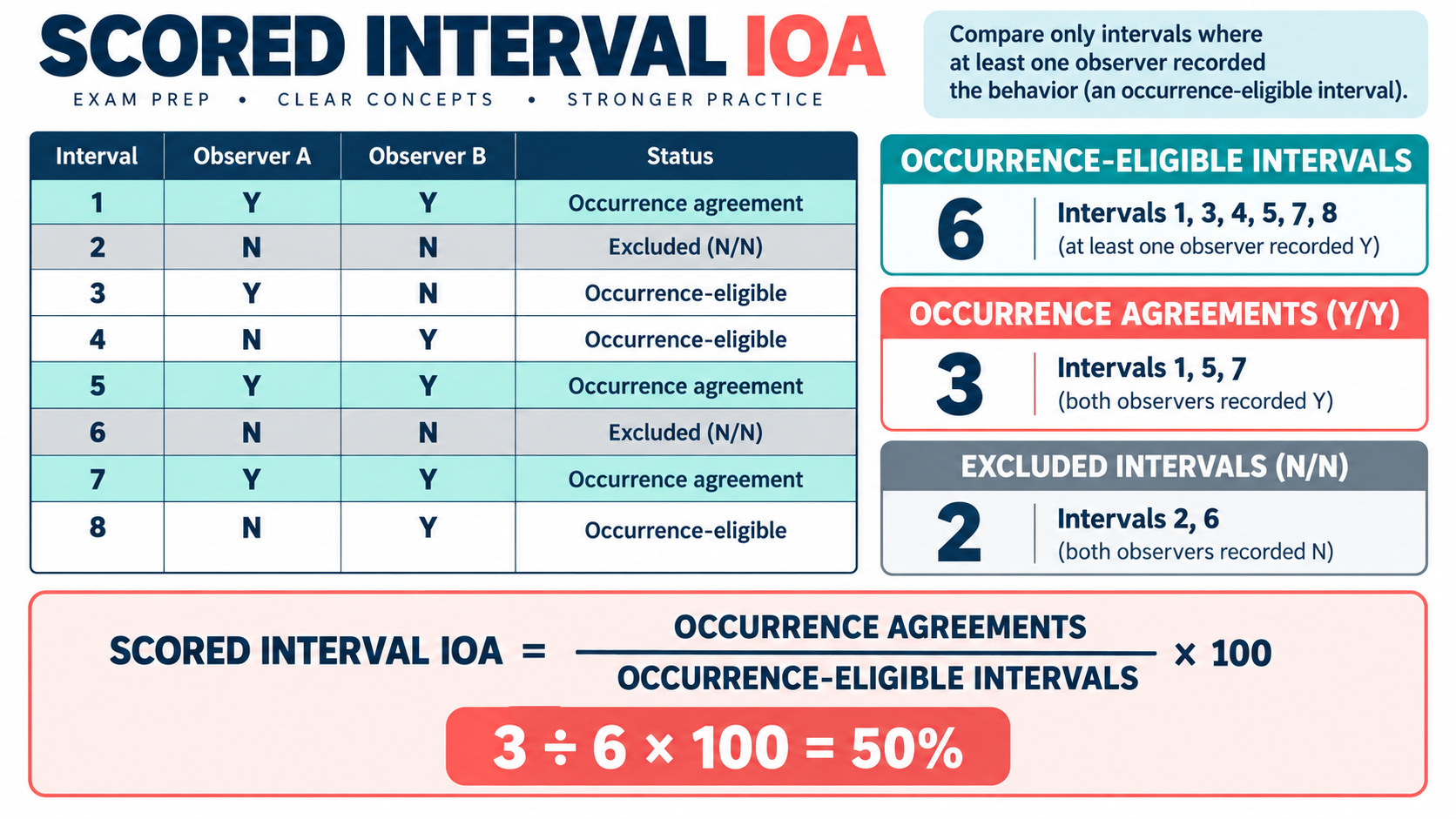
Imagine that two observers record whether a target behavior occurred during eight equal intervals. Use “Y” for occurrence and “N” for nonoccurrence. The target question is scored interval IOA, so the denominator will include only intervals where at least one observer marked “Y.”
| Interval | Observer A | Observer B | Counts toward scored IOA denominator? | Agreement on occurrence? |
|---|---|---|---|---|
| 1 | Y | Y | Yes | Yes |
| 2 | N | N | No | Not used |
| 3 | Y | N | Yes | No |
| 4 | N | Y | Yes | No |
| 5 | Y | Y | Yes | Yes |
| 6 | N | N | No | Not used |
| 7 | Y | Y | Yes | Yes |
| 8 | N | Y | Yes | No |
The interval-by-interval result is easy to read from the table:
- Intervals with an occurrence score from at least one observer: 1, 3, 4, 5, 7, and 8.
- Denominator: 6 intervals.
- Intervals with agreement on occurrence: 1, 5, and 7.
- Numerator: 3 intervals.
- Scored interval IOA: 3 ÷ 6 × 100 = 50%.
Intervals 2 and 6 were not counted in this scored-interval calculation because both observers marked nonoccurrence. They would count as agreements in an ordinary interval-by-interval calculation, but scored interval IOA deliberately asks a narrower question: when occurrence was scored by at least one observer, how often did both observers score occurrence?
Why the Denominator Matters
The denominator changes the meaning of the percentage. If you divide the three occurrence agreements by all eight intervals, you get 37.5%, which is an interval-by-interval agreement value for the complete table. If you divide by the six intervals in which at least one observer scored occurrence, you get 50%, which is the scored interval IOA requested here.
That distinction is especially important when nonoccurrence intervals are common. Excluding intervals in which both observers recorded no behavior prevents those shared zeros from dominating this occurrence-focused index. At the same time, scored interval IOA does not tell you how well observers agreed on nonoccurrence. A complete interpretation may require a method that matches the decision and the behavior’s distribution.
A useful exam annotation is to write the denominator in words before writing numbers: “intervals where at least one observer scored occurrence.” Then scan each row once and place a small mark beside every eligible interval. On a second pass, mark only the rows with Y/Y. This two-pass approach reduces the chance that a Y/N disagreement is accidentally counted as an agreement or that an N/N row is added to the denominator. It also gives you an audit trail if the answer choices use similar percentages.
If the stem gives percentages rather than a full table, look for the counts behind the percentage whenever they are provided. A result such as 60% could come from three agreements out of five occurrence-eligible intervals, six out of ten, or another ratio. The percentage alone does not identify the method; the numerator and denominator wording does.
- Read “at least one observer” as a denominator clue.
- Read “both observers scored occurrence” as a numerator clue.
- Keep shared nonoccurrence intervals out of the scored-interval denominator.
- Report the raw interval records when the pattern of disagreement matters.
Scored Interval IOA Compared With Other Methods
Several interval-based agreement methods can look similar in a multiple-choice stem. The fastest way to separate them is to ask what counts as an agreement and which intervals form the denominator.
| Method | Numerator | Denominator | Main clue |
|---|---|---|---|
| Scored interval IOA | Both scored occurrence | At least one scored occurrence | Focuses on occurrence agreement |
| Interval-by-interval IOA | Same score in an interval | All intervals | Counts occurrence and nonoccurrence agreements |
| Unscored interval IOA | Both scored nonoccurrence | At least one scored nonoccurrence | Focuses on nonoccurrence agreement |
| Exact count-per-interval IOA | Exact matching counts in an interval | All intervals | Uses counts, not only Y/N occurrence scores |
These labels describe calculation methods, not automatic quality judgments. The appropriate method depends on the measurement system and the question being asked. The current BCBA exam outline places measurement, data display, and interpretation within the exam content, so practice identifying the measurement dimension before reaching for a formula.
Common Scored Interval IOA Mistakes
- Using all intervals in the denominator without checking whether the item asks for scored interval IOA.
- Counting a shared nonoccurrence as a scored-occurrence agreement.
- Putting intervals with only one observer’s occurrence score in the numerator.
- Confusing scored interval IOA with unscored interval IOA.
- Adding interval counts instead of classifying each observer’s score pair.
- Rounding before the final division when the stem asks for a precise percentage.
- Ignoring unequal interval lengths when the data-collection plan requires equal intervals.
- Assuming a high occurrence agreement proves that nonoccurrence agreement is also high.
Quick Review Checklist
Before selecting an answer for a scored interval IOA question, ask:
- Did the question specify scored interval IOA?
- Which intervals have an occurrence score from at least one observer?
- Which of those intervals have occurrence scored by both observers?
- Did I exclude shared nonoccurrence intervals from the denominator?
- Did I divide the occurrence-agreement count by the occurrence-eligible interval count?
- Did I multiply by 100 only after completing the division?
- Would interval-by-interval or unscored IOA answer a different question?
Practice Scored Interval IOA
After you can identify the denominator, practice with new interval tables instead of memorizing one number. Our scored interval IOA practice questions can help you distinguish scored interval, unscored interval, interval-by-interval, and exact count-per-interval calculations in BCBA-style scenarios. Practice is a study aid and does not replace the official BACB content outline or a supervision team’s measurement plan. Take the Free BCBA Mock Exam
References
- BACB BCBA Test Content Outline (6th ed.)
- BACB Test Content Outlines and Task Lists
- Worked IOA calculation reference
- IOA formulas and data-integrity reference



