
Is the BCBA exam all multiple choice? Yes. The current BACB examination information says BCBA examination questions are multiple choice, with four possible answers and one correct answer. That does not make the exam a simple memory quiz: the questions can place you inside an assessment, intervention, supervision, data, or ethics scenario and ask for the best professional decision.
Table of Contents
- Is the BCBA Exam All Multiple Choice?
- BCBA Exam Format at a Glance
- What Does “Multiple Choice” Mean on the BCBA Exam?
- Are BCBA Questions Just Recall?
- How to Study for Scenario-Based Multiple-Choice Questions
- How to Compare Four Answer Choices
- What the 2027 Changes Do—and Do Not—Change
- BCBA Multiple-Choice Exam FAQ
- Take the Free BCBA Mock Exam
This guide explains the published format, what “multiple choice” does and does not tell you, how to prepare for scenario-based items, and which 2027 requirement changes are separate from the exam’s question format. Always check the current BACB handbook before scheduling because exam policies and requirements can be updated. Table of Contents
Is the BCBA Exam All Multiple Choice?
Yes. The BACB’s official examination information states that BACB examinations are composed of multiple-choice questions. Each question has four possible answers, and only one answer is correct. The BCBA examination is delivered by computer at an authorized Pearson VUE testing site, so “multiple choice” describes the response format—not a paper worksheet or an informal classroom quiz.
The current BCBA Handbook describes an examination with 185 questions, including 175 scored questions and 10 unscored pilot questions, to be completed in four hours. You do not receive a separate label telling you which items are pilot questions. Treat every question as real and manage your time across the complete appointment.
The practical answer is therefore: yes, all questions use a multiple-choice format; no, the test is not necessarily easy because the answer options can represent competing applications of the same ABA principle. A candidate may know the definition of a term and still miss the item by overlooking the function of behavior, the measurement dimension, an ethical constraint, or the order of events in the stem.
BCBA Exam Format at a Glance
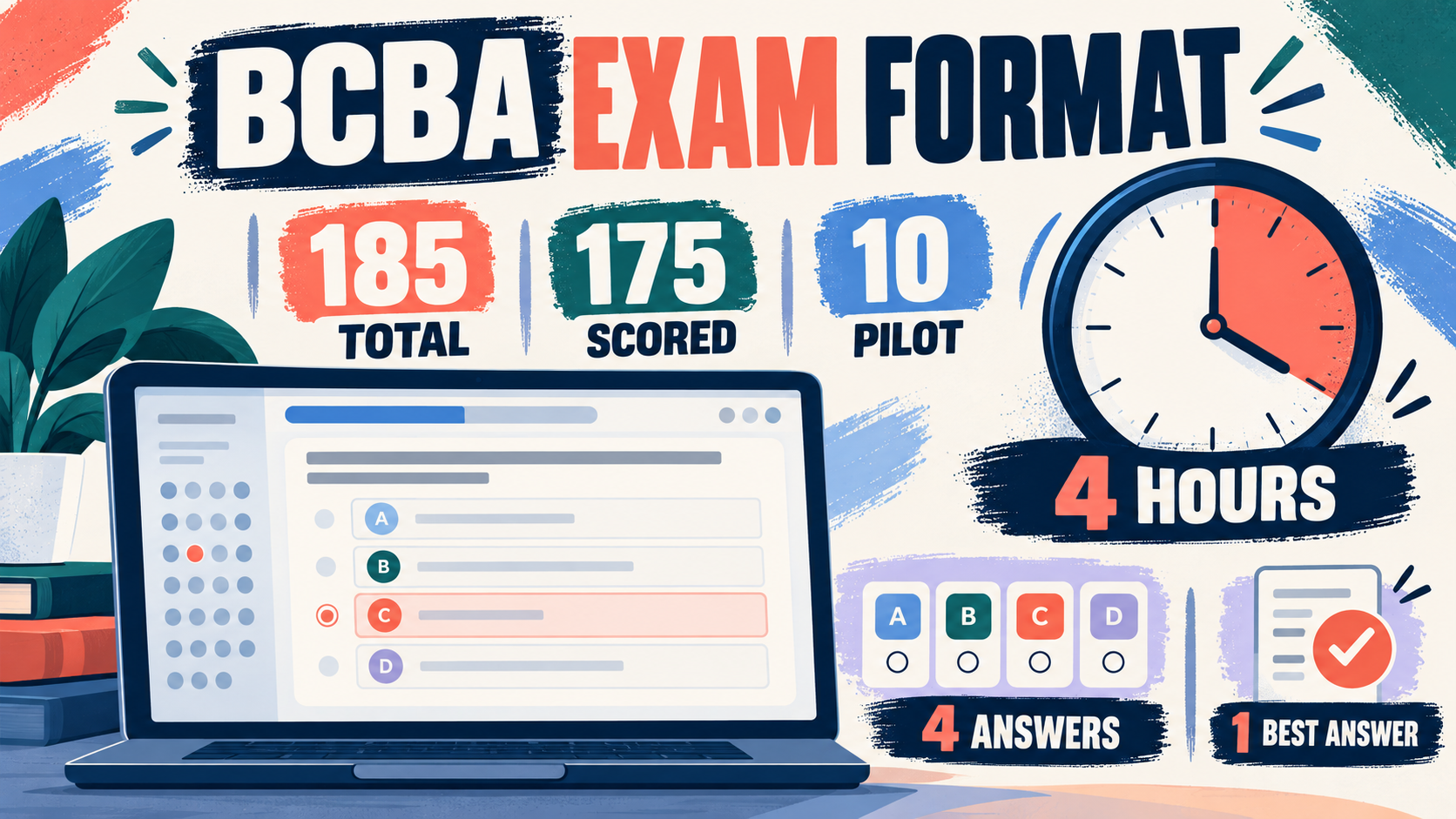
Use the table as a current study snapshot, not as a substitute for the official handbook. The BACB can revise examination information, and a candidate’s authorization and testing appointment are governed by the current official documents.
| Element | Published current detail | What it means for preparation |
|---|---|---|
| Question format | Multiple choice | Practice selecting the best answer, not writing an essay. |
| Answer options | Four options; one correct answer | Eliminate answers that violate the facts, function, measurement, or ethics in the stem. |
| Total questions | 185 | Plan for sustained concentration across the entire test. |
| Scored versus unscored | 175 scored and 10 unscored pilot items | You cannot identify the pilot items; answer every item carefully. |
| Time | Four hours | Use a pacing checkpoint and reserve time to review flagged items. |
| Delivery | Computer-based, in person at authorized sites | Learn the testing-center and computer workflow before exam day. |
The question count and scored-item details above come from the current BACB examination information and BCBA Handbook. The official source also explains that the BACB uses multiple forms and scaled scoring. That is why a raw “number correct” target is not a reliable universal pass rule.
What Does “Multiple Choice” Mean on the BCBA Exam?
Multiple choice means you select one response from the options shown on the screen. It does not mean that every item asks, “What is the definition of reinforcement?” The item writer can test the same content through a short clinical vignette, a data display, a description of an experimental design, a supervision problem, or an ethics decision.
For example, a stem might describe attention-maintained behavior, list several possible interventions, and ask what the BCBA should do next. All four options may sound behavior analytic. The best answer is the one that fits the stated function, the sequence of assessment and intervention, the available data, and the professional scope described in the question.
Likewise, a measurement item may give a behavior definition and ask whether frequency, duration, latency, or interval recording is most appropriate. The response is still one of four choices, but the work happens before clicking: identify what must be measured, what the denominator is, and which dimension matches the behavior and decision.
- Format: select one answer from four choices.
- Reasoning: interpret the facts and select the best application.
- Scoring: the BACB uses scaled, form-equated scoring rather than a single public raw-score cutoff for every form.
- Preparation: practice retrieval, discrimination, application, and pacing together.
Are BCBA Questions Just Recall?
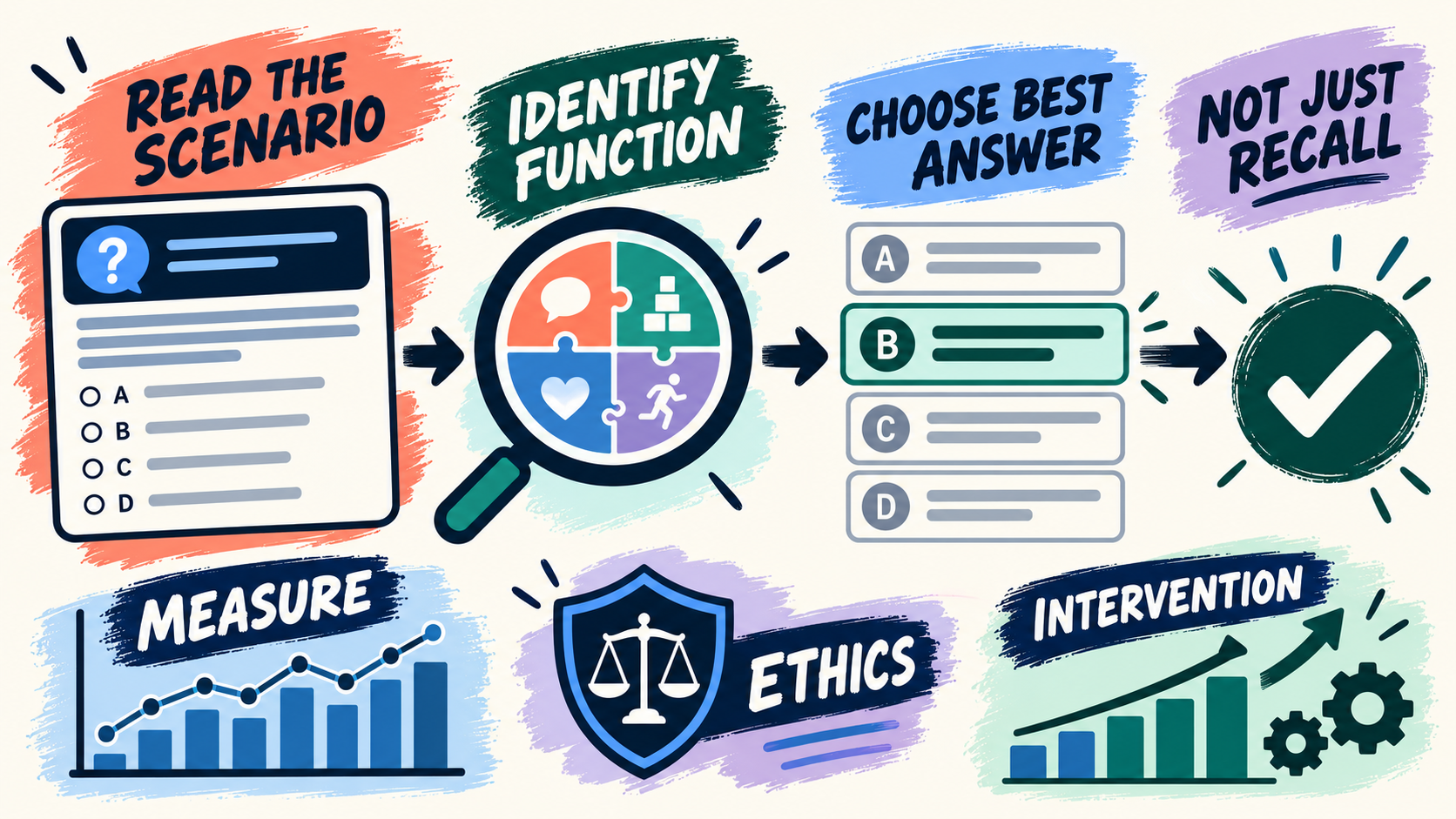
No. Recall is necessary, but it is only one layer of exam performance. A useful practice item asks you to move from a cue in the stem to a defensible professional action. The test may require you to identify a function, interpret a graph, select an assessment, protect treatment integrity, apply the Ethics Code, or choose the next step in supervision.
Read the stem before looking for a familiar keyword. Ask: What is the target behavior? What happened immediately before and after it? What data are actually available? What decision is the question asking for? Which answer changes the relevant variable rather than merely describing the problem?
Be careful with options that are technically true but do not answer the question. An item may ask for the next step, while one answer describes a later intervention. Another may ask for the most ethical response, while a tempting option is efficient but ignores assent, dignity, scope, or client risk. “True in general” is not the same as “best for this scenario.”
The current BCBA Handbook directs candidates to prepare from the current Test Content Outline, Ethics Code, and training materials. The 6th-edition BCBA Test Content Outline organizes content across foundations, concepts, measurement, design, ethics, assessment, behavior change, intervention selection, and personnel supervision. Those domains naturally produce scenario questions, even when the response on screen is only one click.
How to Study for Scenario-Based Multiple-Choice Questions
Build practice around decisions, not only vocabulary. A productive study block can use one short concept review, several closed-book questions, an error log, and a second attempt after you explain why each distractor is weaker. The explanation is important: it converts a lucky answer into a repeatable discrimination.
- Map the stem: underline the learner, target behavior, antecedent, consequence, data, and requested decision.
- Name the task-list area: decide whether the item is mainly measurement, assessment, intervention, ethics, design, or supervision.
- Predict before viewing the options: state what a strong answer should accomplish and what it must avoid.
- Eliminate by contradiction: remove options that change the function, use a mismatched measurement, skip required assessment, or violate the scenario’s ethics.
- Review the miss: label the error as knowledge, discrimination, reading, calculation, or pacing—not simply “wrong.”
Rotate domains instead of studying one topic until it feels familiar. Interleaving forces you to identify which principle applies, which is closer to the actual challenge of choosing among plausible answers. Include graphs, short cases, ethical vignettes, and questions that ask for the best next step.
- Practice timed sets, but first build accuracy without rushing.
- Keep an error log with the fact you missed and the cue you overlooked.
- Review why every distractor is weaker, not only why the key is correct.
- Use full-length practice to test stamina and pacing after targeted practice improves.
How to Compare Four Answer Choices
When two or more answers look plausible, compare them against the exact question rather than against your general preference. A compact decision check is:
- Evidence: Does the option fit the data and facts given, or does it invent information?
- Function: Does it address the likely maintaining variable or merely react to topography?
- Sequence: Is it the appropriate next step, or is it premature?
- Measurement: Can the proposed decision be evaluated with a defined and relevant measure?
- Ethics: Does it protect client welfare, dignity, assent, confidentiality, and professional scope?
Avoid adding facts that are not in the stem. If the question does not establish a functional relation, do not treat an assumed function as proven. If the answer requires a treatment change but baseline or assessment information is missing, consider whether the better option is to gather the needed information first. BCBA multiple-choice questions often reward disciplined reading more than the most elaborate-sounding intervention.
For pacing, use a flexible checkpoint rather than staring at the clock after every item. Flag a question when you have narrowed the choices but need a fresh read. Do not let one difficult item consume the time needed for several questions you can answer confidently. Because you cannot identify pilot items, use the same careful process throughout the exam.
What the 2027 Changes Do—and Do Not—Change
The BACB has announced significant BCBA and BCaBA requirement changes taking effect January 1, 2027. The official 2027 requirements announcement and the 2027 BCBA Requirements PDF address eligibility, coursework, supervised fieldwork, and transition rules. The published 2027 document still says candidates must pass the BCBA examination based on the 6th-edition Test Content Outline.
That distinction matters for SEO and for candidates. Do not turn a 2027 fieldwork article into an exam-format article, and do not assume that a change in eligibility automatically means the question format changed. The official examination page is the source to verify the current number of questions, timing, delivery, and scoring information. A candidate applying near the transition date should read the applicable handbook and transition guidance for their own pathway.
For a study plan, keep two checklists: one for exam readiness—content, scenario practice, ethics, pacing, and computer familiarity—and one for certification eligibility—degree, coursework, supervised fieldwork, application documents, and the deadline that applies. Separating them prevents a common planning error: preparing hard for the test while overlooking a requirement that determines whether you can schedule it.
BCBA Multiple-Choice Exam FAQ
Does the BCBA exam include essay or short-answer questions?: The published BACB format is multiple choice. Each question has four possible answers with one correct answer. The exam can still test complex reasoning through scenarios, data, and professional decisions.
How many questions are on the BCBA exam?: The current BCBA Handbook describes 185 questions: 175 scored and 10 unscored pilot items. Check the official BACB materials close to your appointment because the organization controls the current examination information.
Are all BCBA questions worth the same amount?: Do not assume a public raw-score rule. The BACB uses multiple examination forms, equating, and scaled scores. Candidates should answer every question and avoid basing preparation on an unofficial claim that one fixed number correct guarantees a pass.
What is the best way to practice?: Use scenario-based sets that make you explain the function, measurement, sequence, data, and ethical boundary behind your answer. You can use the free BCBA mock exam practice for additional timed questions. It is independent study support, not official BACB material.
Will the 2027 BCBA changes make the exam no longer multiple choice?: The published 2027 requirements focus on certification requirements and still reference passing the BCBA examination based on the 6th-edition Test Content Outline. Verify the current exam page and handbook before relying on any future detail.
The short answer to “is the BCBA exam all multiple choice?” is yes. The better preparation question is: can you read a behavior-analytic scenario, identify the decision being tested, and choose the one option that best fits the data, function, sequence, ethics, and scope? That is the skill your practice sets should develop.
Take the Free BCBA Mock Exam
If you want a low-pressure way to check your recall, use the free practice resource below. Take the Free BCBA Mock Exam



