
Remote ABA data collection can support services across settings, but the observer role, measurement rule, camera view, privacy plan, and technology limits must be explicit. Remote ABA data collection means recording behavior, opportunities, prompts, or outcomes when the analyst and learner are not in the same physical location, or when a caregiver or technician collects data under remote supervision. The data may come from a digital form, a shared platform, a live video observation, or a paper record reviewed later. The method is only useful when the record still represents the behavior and context the team intends to measure.
Table of Contents
- What Does Remote ABA Data Collection Include?
- How Do You Set Up Remote ABA Data Collection?
- What Should the Remote Observer Watch?
- How Should Caregivers or Technicians Be Trained?
- What If the Connection or Camera Fails?
- How Do You Check the Quality of Remote Data?
- What Are the Boundaries of Remote ABA Data Collection?
- What Privacy Safeguards Matter?
- What Does the BCBA Exam Test?
- What Is the Bottom Line?
- Take the Free BCBA Mock Exam
The BCBA Test Content Outline supports measurement and data-based decisions. Remote delivery adds another layer: the team must also decide who can see the behavior, who is responsible for scoring, and what happens when the connection or camera fails.
What Does Remote ABA Data Collection Include?
Remote collection can include live observation through an approved video platform, caregiver-recorded trial data, technician entries reviewed by a supervisor, or data entered during a home session and synced later. “Remote” describes the service or supervision arrangement, not a single measurement dimension. You can still record frequency, rate, duration, latency, percentage, interval data, or trial outcomes.
Separate direct observation from reported information. A caregiver’s summary of what happened yesterday may be valuable, but it is not the same as a live observer recording the behavior. Label the source so the reader knows how the point was obtained.
How Do You Set Up Remote ABA Data Collection?
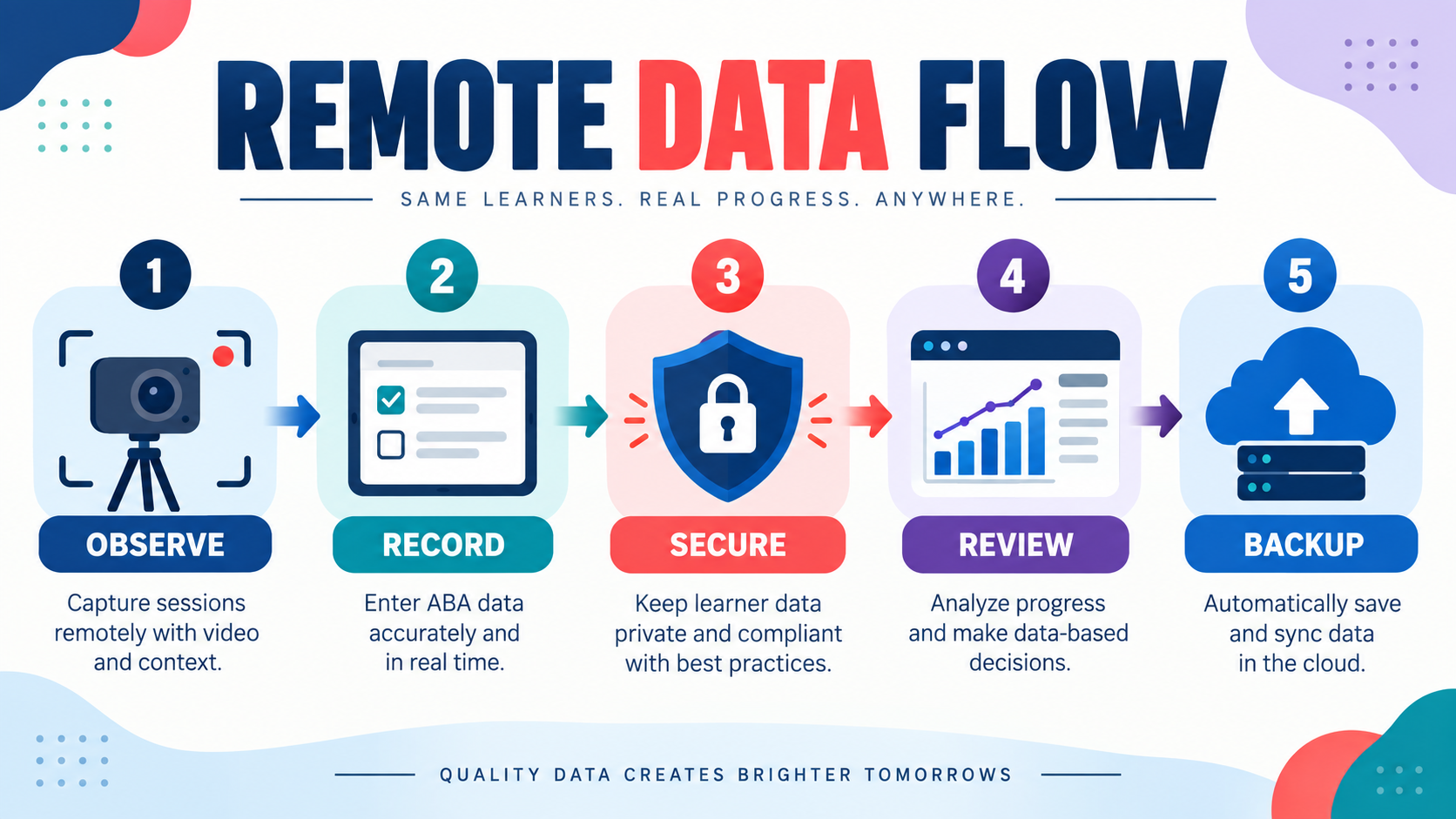
Begin with roles. Identify who delivers the instruction, who observes, who records, who handles technical problems, and who reviews the data. If a caregiver is entering data, provide a short operational definition and practice examples. If a technician is collecting the data, specify when the supervisor will review it and how feedback will be documented.
| Remote element | Decision | Quality check |
|---|---|---|
| Observer | Who can see and score? | Definition practice |
| Camera or setting | What behavior and context are visible? | View and sound check |
| Data tool | Where are entries stored? | Access and backup review |
| Failure rule | What happens if the session disconnects? | Document missing observation |
What Should the Remote Observer Watch?
Use the same response definition and observation window used for in-person measurement whenever possible. Confirm that the camera captures the relevant movement, materials, and interaction. If the behavior occurs outside the frame, mark it as not observed rather than assuming it did not occur.
Also watch the context. A camera may show a demand but not the preceding instruction, or show a response but not the item that was offered. Notes should identify what was visible and what was inferred. This is especially important for ABC data and any decision about function.
How Should Caregivers or Technicians Be Trained?
Train the person collecting data with a short definition, examples, nonexamples, and practice trials. Demonstrate how to start and stop a timer, mark a prompt, and handle an interruption. Ask the collector to explain the rule in their own words before relying on the data.
- Practice the target: score sample videos or role-play trials together.
- Practice exceptions: decide how to record no opportunity, interruption, and missing visibility.
- Use a simple form: reduce fields that are not needed for the decision.
- Review early: check the first sessions before the routine becomes difficult to correct.
What If the Connection or Camera Fails?
Set the failure rule before the session. Record the time of disconnection, what portion was observed, and whether the session resumed under comparable conditions. Do not fill the missing segment from memory and do not score unobserved behavior as zero unless the protocol explicitly calls for that interpretation.
How Do You Check the Quality of Remote Data?
Review remote data with the same questions used for any measurement system: was the response operationally defined, was the observation window known, and was the scoring rule stable? Add a source field such as live observation, caregiver entry, technician entry, or retrospective report. That small label prevents a later reader from treating every point as though it came from the same level of direct contact.
Check the first few sessions early. Compare selected entries with permitted video or with a second observer’s record, and discuss disagreements while the event is still easy to reconstruct. A disagreement can reflect a definition problem, a camera limitation, a prompt that was not visible, or simple data-entry error. Correct the system and document the correction; do not quietly change historical scores just to improve agreement.
| Question | Why it matters | Document |
|---|---|---|
| Could the camera see the target? | Visibility affects what can be scored. | View limitation or repositioning. |
| Who entered the point? | Source affects interpretation and training. | Observer role and source label. |
| Was the connection stable? | A gap is not the same as no behavior. | Start, stop, and missing interval. |
What Are the Boundaries of Remote ABA Data Collection?
Remote collection is not automatically equivalent to in-person collection. The team should state which observations are direct, which are reported, and which were unavailable. Some targets may require a different camera angle, an in-person assessment, or a revised measurement plan. A responsible report makes those limits visible so a graph is not interpreted with more certainty than the observation supports.
Plan a simple handoff at the end of each session. The collector should submit the data, source label, interruption note, and any visibility concern in the same place. The supervisor can then decide whether the point is ready for graphing, needs an annotation, or should be excluded under the written rule. This keeps a remote workflow from becoming a collection of unexplained numbers.
- Ready for graphing: the target was visible, the definition was followed, and the source is documented.
- Graph with annotation: a technology or context change occurred, but the point remains interpretable.
- Hold for review: the behavior was not observable, the source is unclear, or the planned failure rule does not cover the event.
When the service team changes platforms, cameras, or observers, treat the change as part of the data story. Note the date, check that the measurement rule stayed the same, and look for a level or trend shift that may reflect the system rather than learner behavior. This simple annotation helps the next decision-maker read remote data with appropriate confidence.
What Privacy Safeguards Matter?
Use an approved platform and limit recording, screen sharing, and storage to what is necessary. Confirm who is present in the room, explain the purpose of observation, and follow the service setting’s consent and privacy policy. The HHS HIPAA Privacy Rule resources provide general context, but organization and jurisdiction-specific rules also apply.
What Does the BCBA Exam Test?
- Remote does not mean indirect: live video observation can still be direct observation.
- Source labels matter: caregiver report and direct scoring are different evidence.
- Camera limits matter: out-of-view behavior is not automatically absence.
- Technology failure needs a rule: preserve missing-data meaning.
- Roles must be clear: identify who records and who reviews.
- Privacy is part of service quality: use approved tools and necessary access only.
What Is the Bottom Line?
Remote ABA data collection can be useful when roles, definitions, visibility, privacy, and failure rules are designed before the session. Label the data source, train the person recording, and describe what the camera or connection could not show. For more practice with measurement and data-based decisions, try the free BCBA mock exam. It is study support, not individualized supervision.
For targeted review, use our remote ABA data collection practice questions to apply the concept in exam-style scenarios.
Take the Free BCBA Mock Exam
When you are ready to apply the idea, use the free practice resource below for additional feedback. Take the Free BCBA Mock Exam



