

Real-time ABA data collection means recording a defined response, prompt, opportunity, or context while the session is happening, so the record stays close to the event it describes. Real-time ABA data collection is useful because delayed recall can remove the detail needed for a good decision. During a session, the observer can mark each response, note the prompt level, record a duration, or start and stop a timer. The goal is not to write everything down. The goal is to capture the measurement dimension that answers the program question without disrupting teaching or care. The BCBA Test Content Outline connects measurement with data-based decisions. Before the session begins, define what will be recorded, when it will be recorded, and how the entry will be reviewed.
Table of Contents
- What Does Real-Time ABA Data Collection Mean?
- How Do You Set Up Real-Time ABA Data Collection?
- What Should the Observer Record During the Session?
- How Do You Handle Interruptions and Missing Entries?
- How Do You Review Real-Time Data?
- How Do You Keep Real-Time Recording Practical?
- What Should You Do When Live Data Look Unusual?
- What Privacy Safeguards Matter?
- What Does the BCBA Exam Test?
- What Is the Bottom Line?
- Take the Free BCBA Mock Exam
What Does Real-Time ABA Data Collection Mean?
Real-time recording occurs close to the event. An observer may tap a frequency counter when a response occurs, mark a trial as correct or incorrect, start a timer when behavior begins, or record an opportunity and its outcome. The entry can be paper-based or digital; “real time” describes timing, not a particular device.
Real-time does not mean perfect. If the observer is teaching and recording at the same time, the system must be simple enough to use consistently. A complicated form can create missing data, delayed entries, or accidental changes in the teaching procedure. Select the smallest set of fields that supports the decision.
How Do You Set Up Real-Time ABA Data Collection?
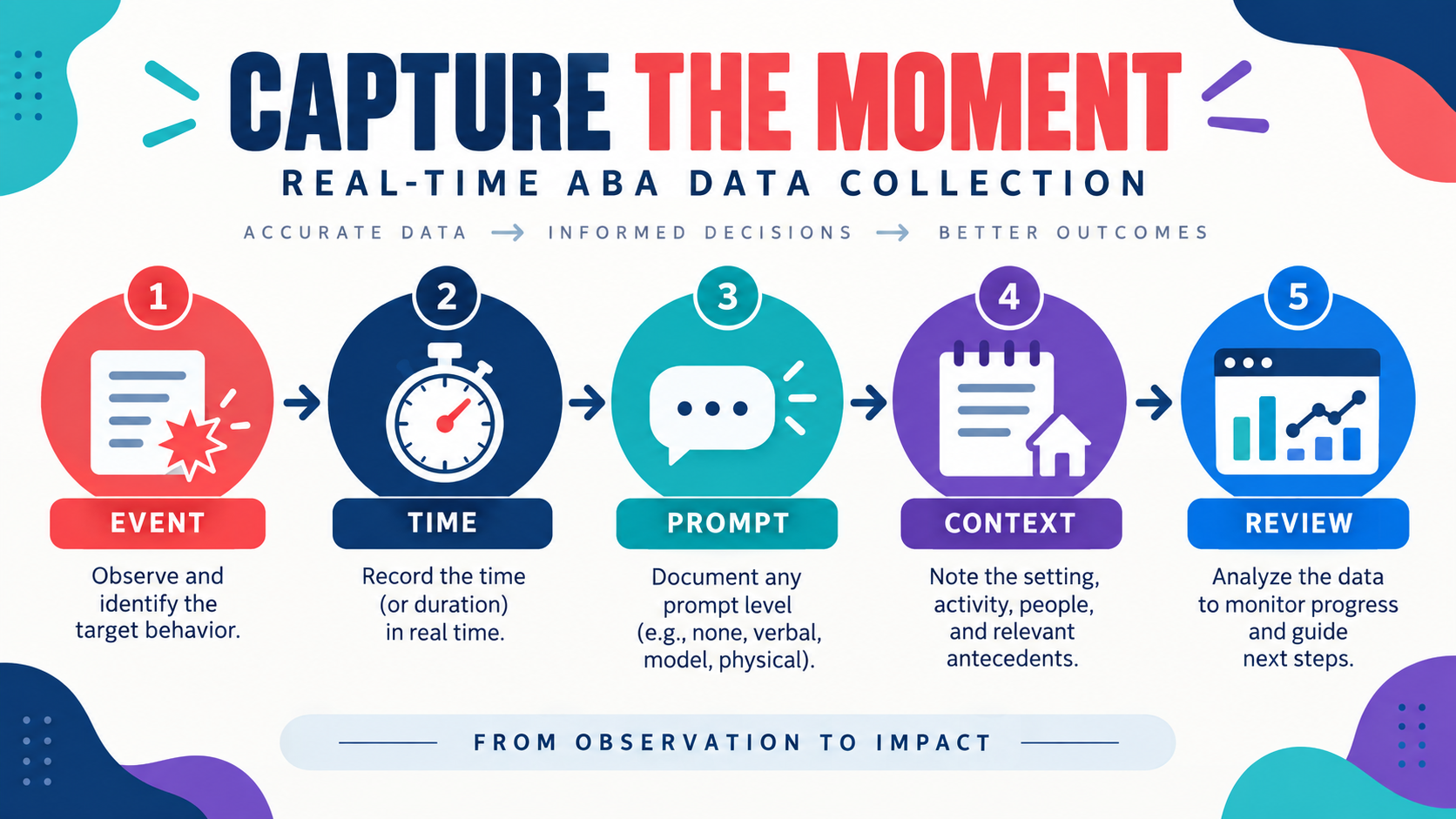
Start with an operational definition and a measurement plan. Write the target response, examples, nonexamples, observation window, unit, and scoring rule. Decide whether you need frequency, rate, duration, latency, percentage, interval data, prompt level, or a trial-by-trial outcome. Then arrange the form so the observer can reach the field quickly.
| Field | Example | Why record it live? |
|---|---|---|
| Event | Response occurred | Reduces recall errors |
| Time | Start, stop, or timestamp | Protects duration and rate |
| Prompt | Independent, model, or physical | Separates accuracy from independence |
| Context | Activity or condition | Makes the point interpretable |
What Should the Observer Record During the Session?
Record the response that was defined, not a broad impression. If the target is a completed request, mark the request using the stated topography. If the target is independent task completion, record the prompt level as well as whether the task was completed. If a trial is interrupted, use the preplanned code rather than improvising a new category.
- Response: what happened according to the operational definition?
- Opportunity: was the learner given a defined chance to respond?
- Prompt: what level of help was delivered before the response?
- Context: did a transition, break, material change, or safety event affect the trial?
How Do You Handle Interruptions and Missing Entries?
Plan interruption rules before the session. A learner may leave the area, a caregiver may enter, a device may lose connection, or the observer may need to respond to a safety concern. Mark the interruption and its duration. Do not convert an unobserved interval into a zero unless the protocol explicitly defines that rule.
Missing data should be visible. A blank entry may mean no response, no opportunity, not observed, or device failure. Those meanings are different. Use codes or notes that preserve the distinction, then decide whether the point can be analyzed or must be excluded from a particular calculation.
How Do You Review Real-Time Data?
Review the record soon after the session while the context is still available. Check whether every opportunity has a valid outcome, whether the time unit is consistent, and whether any scoring rule changed. Compare selected live entries with the session note or video when permitted and appropriate. The purpose is quality control, not rewriting data to make the graph look smoother.
How Do You Keep Real-Time Recording Practical?
A measurement plan can be technically correct and still fail if the observer cannot use it during instruction. Start with the smallest form that answers the immediate decision. If the team needs to know whether a learner responds independently, the form may need only the opportunity, response, prompt level, and a brief context code. Extra narrative fields can be completed after the session if they do not change the scoring rule.
Use consistent placement and timing. Put the most frequent entry where the observer’s hand or cursor naturally rests, keep response options in the same order, and use a visible timer when duration or latency matters. For digital systems, check the device before the session and keep a paper or offline backup when a lost connection would otherwise erase the observation. A backup is not a second scoring system: it should use the same operational definition and codes.
Practice the workflow with a short mock observation. Ask a second trained observer to describe the same event stream, then compare whether both people selected the same response, prompt, and interruption code. If disagreement appears, clarify the definition or the form before collecting a large series of points. This is more useful than simply asking observers to “pay closer attention.”
Keep the review loop proportionate to the risk of the decision. A quick skill-acquisition probe may need a brief same-day check, while safety-related measurement or a high-stakes treatment change may require a more formal reliability review and supervisor discussion. The observer should know in advance who receives the data, how quickly concerns are escalated, and which fields are required before a session can be closed.
- Before recording: test the form, timer, device, and backup; confirm the definition and observation window.
- During recording: enter the smallest valid observation, use the planned code, and mark interruptions immediately.
- After recording: check missingness, units, prompt notation, and context before the point enters a graph.
What Should You Do When Live Data Look Unusual?
An unusual point is a prompt to check the conditions, not an automatic reason to delete it. First ask whether the observer followed the measurement rule. Next ask whether the opportunity, activity, staffing, prompt, or device changed. Then document the explanation and decide whether the point remains interpretable under the prespecified rule. If the rule changed after data collection began, preserve the original values and note the change rather than silently recoding the series.
| Signal | First check | Safe next step |
|---|---|---|
| Sudden zero | Was the opportunity observed? | Use the missing-data code if not observed. |
| Unexpected spike | Did context or definition change? | Annotate the graph and verify the rule. |
| Many blanks | Was the form too difficult to use? | Simplify fields and retrain with examples. |
What Privacy Safeguards Matter?
Use only approved systems, limit access, and avoid recording unnecessary identifying details. If a digital tool stores data in the cloud, confirm the organization’s privacy requirements and retention rules. The HHS HIPAA Privacy Rule resources provide general privacy context, but local policy and the specific service setting also matter.
What Does the BCBA Exam Test?
- Live is not the same as complete: define what is recorded and check missing entries.
- Rate needs time: timestamps and observation duration protect the denominator.
- Prompt level matters: correct after a prompt may not be independent.
- Interruption is not zero: use the planned missing-data rule.
- Technology is optional: a simple paper form can still be real time.
- Privacy is part of quality: collect only what the decision requires.
What Is the Bottom Line?
Real-time ABA data collection works when the observer can record the right event at the right time with a stable rule. Keep the form simple, define interruptions, preserve missing-data meaning, and review the record before making a decision. For more practice with measurement and data-based decisions, try the free BCBA mock exam. It is study support, not a substitute for supervision.
For targeted review, use our real-time ABA data collection practice questions to apply the concept in exam-style scenarios.
Take the Free BCBA Mock Exam
When you are ready to apply the idea, use the free practice resource below for additional feedback. Take the Free BCBA Mock Exam



