
What Is Relational Frame Theory? A BCBA Candidate’s Overview
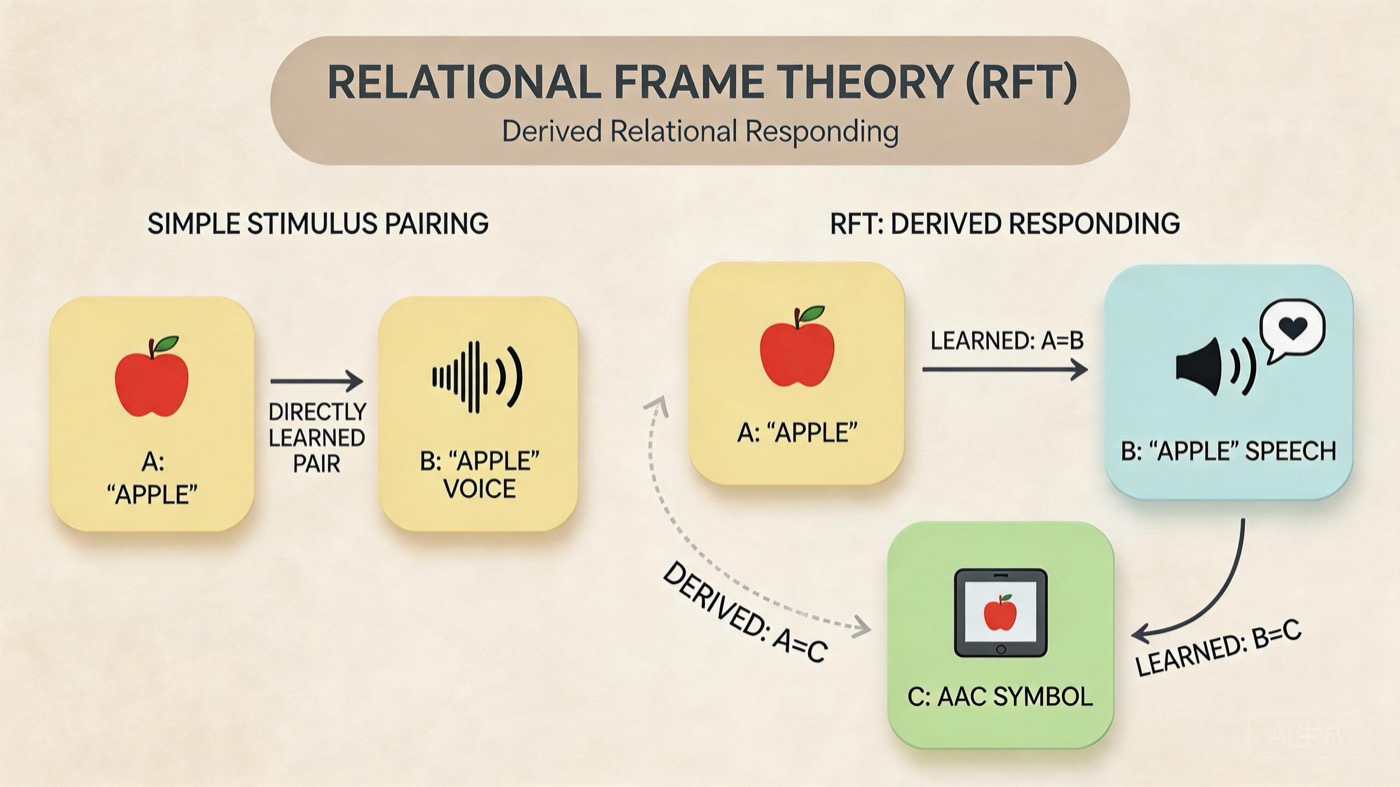
Relational frame theory (RFT) is a behavioral account of language and cognition that explains how humans learn to relate stimuli in arbitrary ways. Unlike simple stimulus-stimulus pairings, RFT focuses on derived relational responding—the ability to relate stimuli without direct training. For BCBA candidates, understanding RFT is essential for designing effective language interventions and interpreting complex verbal behavior.
Think of RFT as a framework that explains how we learn that “big” is the opposite of “small” without being taught every possible pair. This derived responding is what makes human language so flexible and powerful. In ABA, RFT underpins advanced language training programs like the PEAK Relational Training System and is central to acceptance and commitment therapy (ACT).
Table of Contents
- What Is Relational Frame Theory? A BCBA Candidate’s Overview
- ABA Worked Examples: Applying Relational Frame Theory
- Why RFT Matters for the BCBA Exam: Common Traps and Study Tips
- Quick RFT Review Checklist for Exam Day
- Summary: Relational Frame Theory in Behavioral Practice
Core Principles of RFT
RFT identifies three key properties of relational frames:
- Mutual entailment: If A is related to B in a particular way, then B is related to A in a complementary way. For example, if ‘big’ is the opposite of ‘small,’ then ‘small’ is the opposite of ‘big.’
- Combinatorial entailment: When two or more relations combine, new relations emerge. If A > B and B > C, then A > C (comparative frame).
- Transformation of stimulus function: The function of one stimulus changes based on its relation to another. For instance, if a neutral word is placed in a frame of opposition with a feared object, that word may evoke fear.
These principles work together to create networks of meaning. For example, if a child learns that a nickel is larger than a dime and a dime is larger than a penny, combinatorial entailment allows the child to infer that a nickel is larger than a penny without explicit training. This is the engine of derived relational responding.
RFT vs. Stimulus Equivalence
Stimulus equivalence is a subset of derived relations limited to coordination frames (sameness). RFT expands this to include comparison, opposition, hierarchy, deictic (perspective-taking), and other frames. While equivalence uses reflexivity, symmetry, and transitivity, RFT explains a broader range of derived relations that appear in natural language. For more on equivalence, see our guide on stimulus equivalence reflexivity symmetry transitivity.
It’s important to remember that RFT is not just about sameness; it accounts for how we learn opposites, comparisons, time sequences, and even social roles. Deictic frames, for instance, are crucial for perspective-taking skills—understanding “I” vs. “you” or “here” vs. “there.” These frames are often tested on the BCBA exam in the context of social skills training and verbal behavior interventions.
ABA Worked Examples: Applying Relational Frame Theory
These examples show how relational frame theory applies in real ABA scenarios using the ABC format and hypothesized functions.
Example 1: Teaching a Child to Match Big and Small
Antecedent: Therapist holds up a large block and says “big.” Behavior: Child touches the big block. Consequence: Praise and a small edible. After several trials, the therapist says “show me the opposite of big” while presenting a big and small block. Behavior: Child touches the small block. Hypothesized function: Derived relational responding via mutual entailment in an opposition frame. The child derived that “small” is the opposite of “big” without direct training.
This example illustrates how RFT can explain the emergence of novel behavior that cannot be accounted for by simple stimulus control. The child’s response is not based on a history of direct reinforcement for choosing small in that context; instead, it is derived from the relational frame of opposition.
Example 2: Using Opposites in Language Training
A child learns that A is bigger than B and B is bigger than C. When asked which is biggest, the child correctly selects A without training. This is combinatorial entailment in a comparative frame. The child derived that A > C by combining two trained relations.
Clinical takeaway: When designing language programs, teach multiple relational pairs within the same frame to promote derived relations. For instance, teach both big/small and tall/short to help the child generalize the opposition frame.
Example 3: Transformation of Stimulus Function in Social Skills
A child experiences teasing from a peer named Tom. The word ‘Tom’ becomes aversive. Later, the child hears a teacher say ‘Tom is a friend.’ Through a coordination frame, the word ‘friend’ may also acquire aversive properties, or ‘Tom’ may become more neutral depending on context. This transformation of function is critical for understanding how emotional responses spread through language.
Function analysis: The teasing (UCS) elicits a fear response (UCR). The name “Tom” becomes a CS for fear via classical conditioning. When “Tom” is placed in a coordination frame with “friend,” “friend” may also evoke fear (transformation of stimulus function). In practice, therapists can use RFT to design interventions that break problematic frames, such as teaching a hierarchy frame to reframe the relationship (e.g., “Tom is a person”).
For more practice with function analysis, review our 4 functions of behavior BCBA exam guide.
Why RFT Matters for the BCBA Exam: Common Traps and Study Tips
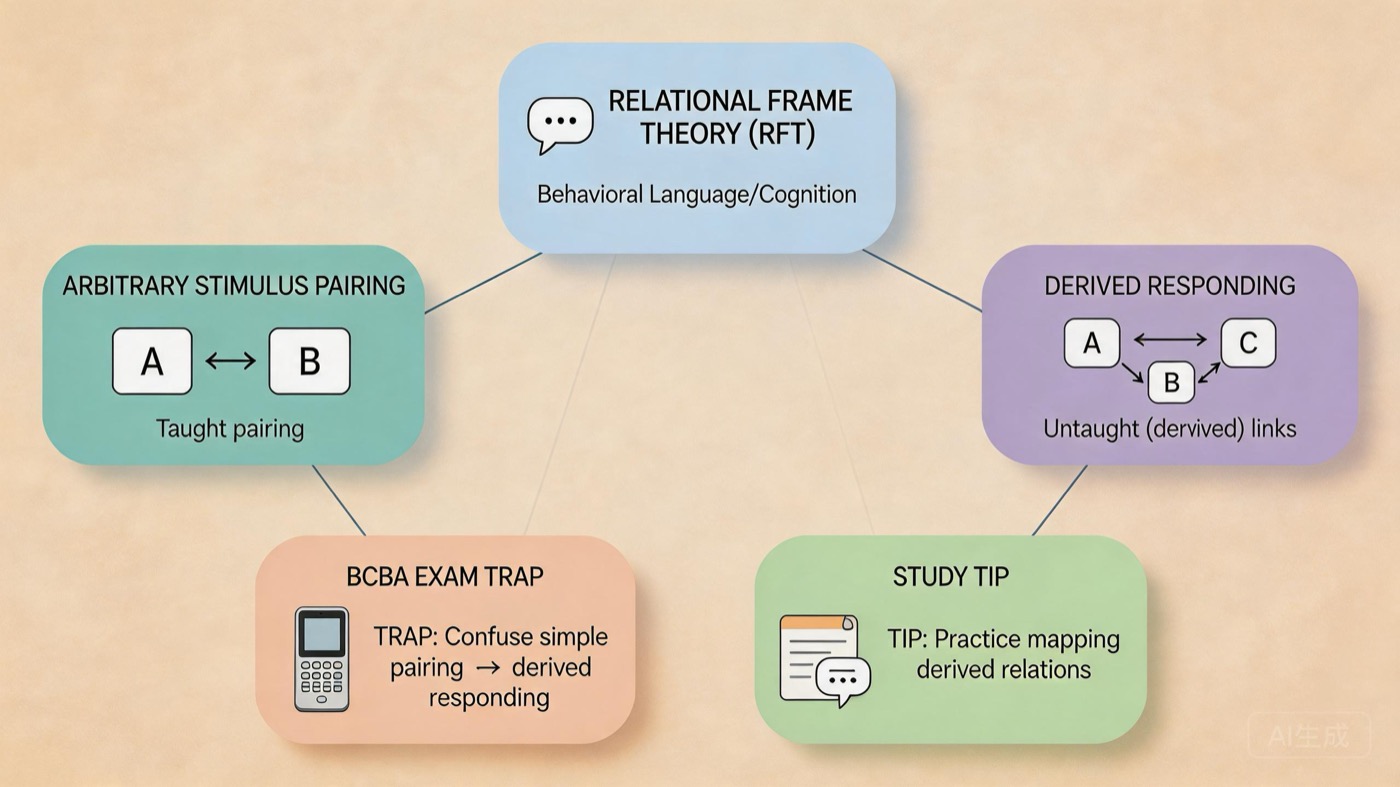
The BCBA exam often tests derived relations and their clinical applications. Many students confuse RFT with classical conditioning or stimulus equivalence. Below are key concepts and mistakes to avoid.
Key Concepts to Know for the Exam
- Frames: coordination, opposition, comparison, hierarchy, deictic (I/you, here/there, now/then).
- Transformation of function: How relational frames change the effect of stimuli on behavior.
- Clinical applications: PEAK Relational Training System, acceptance and commitment therapy (ACT), and language interventions.
Common Mistakes Test Takers Make
- Confusing derived relations with classical conditioning (which involves direct stimulus pairings). Remember: derived relations do not require direct pairing; they emerge from a history of relational framing.
- Forgetting that RFT is a mid-level term in behavior analysis, not a fundamental principle like reinforcement. It is a theory that organizes observations, not a basic behavioral process.
- Overlooking deictic frames when questions involve perspective-taking or social skills. Many exam scenarios ask about “I/you” distinctions; these are deictic frames.
- Thinking that stimulus equivalence and RFT are the same. Equivalence is a specific type of derived relation (coordination), while RFT encompasses many more frame types.
To avoid these traps, practice identifying the frame type in clinical vignettes. For example, if a client learns that “taller” means more height and then correctly infers that one person is shorter than another, that’s a comparative frame. If a client uses “I” and “you” correctly in conversation, that’s a deictic frame.
Quick RFT Review Checklist for Exam Day
Use this checklist to reinforce key RFT concepts before the exam:
- Define mutual entailment and give an example (e.g., if hot is opposite of cold, then cold is opposite of hot).
- Define combinatorial entailment and give an example (e.g., if A > B and B > C, then A > C).
- Explain transformation of stimulus function with a clinical scenario (e.g., aversive word spreads to related stimuli).
- List at least five relational frames (coordination, opposition, comparison, hierarchy, deictic).
- Differentiate RFT from stimulus equivalence (equivalence is a type of derived relation limited to coordination; RFT includes many frames).
- Identify how RFT applies to language training (e.g., PEAK, ACT, teaching derived mands and tacts).
Additionally, be ready to explain how RFT informs behavioral interventions. For example, if a child avoids all doctors because one doctor gave a shot, that’s transformation of stimulus function via a coordination frame (all doctors = same). Interventions might involve breaking that frame by teaching that different doctors have different functions.
Summary: Relational Frame Theory in Behavioral Practice
Relational frame theory provides a comprehensive framework for understanding how humans derive complex relations without direct training. For BCBA candidates, mastering RFT improves your ability to design language interventions, interpret functional analyses, and answer exam questions on derived relations. Integrate RFT concepts with your study of verbal operants and generalization maintenance for a complete picture of verbal behavior. Use the checklist above for a quick review on exam day.
Remember, RFT is not just a theory—it’s a practical tool. When you understand relational frames, you can predict and influence derived behavior in your clients. Whether you’re teaching a child to use opposites or helping an adult reframe negative thoughts, RFT offers a behavioral roadmap. Good luck on your BCBA exam!
\n
References
Complete BCBA Exam Prep
Turn this topic into exam-day practice
Practice concepts in context with five full-length 6th Edition mock exams, two bonus practice exams, a 6th Edition study guide, and key-term flashcards—all in one $120 USD package.
Get the $120 All-in-One Prep Pack
Review everything included on the product page before ordering. No pass guarantee is implied.



